Activated Alumina as a Molecular Sieve Guard Bed: Application Case Analysis
Overview
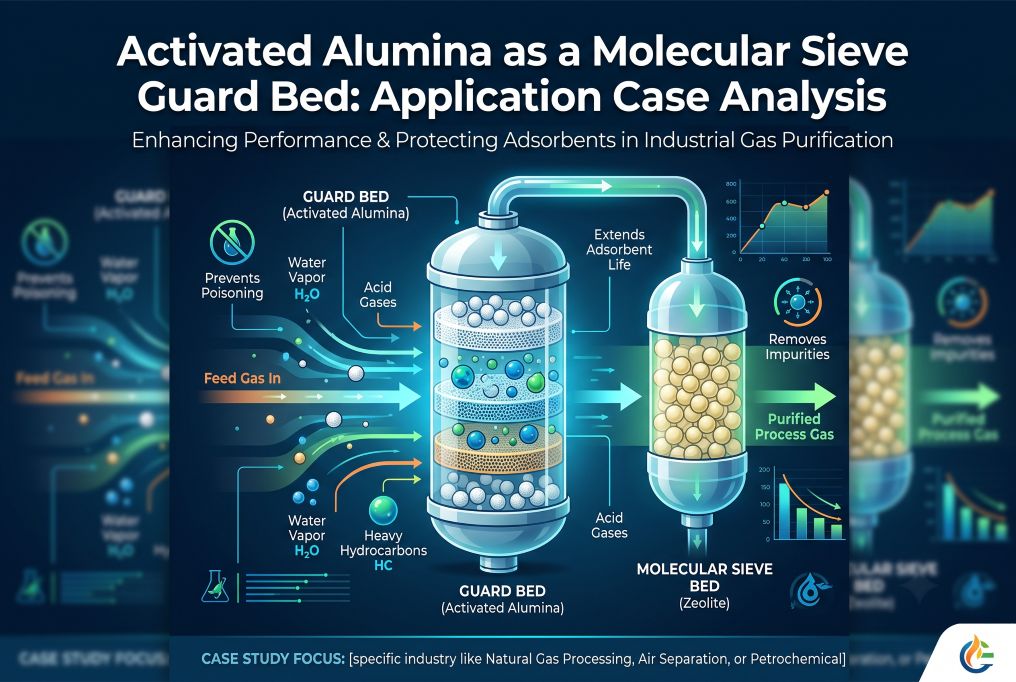
Across PSA (pressure swing adsorption) gas purification systems, the molecular sieve bed doing the final, precise separation work is also the most expensive and the most easily damaged by upstream neglect. Bulk liquid slugs, coarse moisture loading, and oil carryover from upstream compression all shorten molecular sieve life if they reach the bed directly. Activated alumina's role in these systems isn't to compete with the molecular sieve — it's to take the rough load off it before it ever gets there.
This case looks at how activated alumina functions as a front-end guard bed across three different molecular sieve gas purification systems, each producing a different end product but relying on the same underlying two-stage logic.
Key Takeaways
- Bulk Contaminant Shield: Activated alumina removes heavy liquid slugs, bulk moisture, and compressor oil carryover before they can permanently damage precision downstream beds.
- Universal Protection: Operates as an essential front-end stage across PSA nitrogen (protecting CMS), PSA oxygen (protecting 13X/Li-LSX), and general gas drying systems.
- Cost Efficiency: Absorbs the "rough load," drastically extending the service life of expensive kinetic and equilibrium separation molecular sieves.
Application 1: PSA Nitrogen Generation (Activated Alumina + CMS)
Process Context
Compressed air feeding a PSA nitrogen plant typically carries bulk moisture, and depending on the compression system, trace oil carryover as well. Left untreated, this bulk contamination load hits the molecular sieve bed directly — and molecular sieve beds are engineered for precision separation, not for absorbing large liquid loads.
How This Application Works
Our Activated Alumina handles the coarse drying duty — knocking down bulk water content before the feed reaches the molecular sieve bed — while also providing a degree of mechanical filtration against particulates and oil mist that would otherwise foul the downstream bed. Once bulk contamination is knocked down, the feed reaches the carbon molecular sieve (CMS) bed, where CMS performs a kinetic separation — selectively adsorbing oxygen at a faster rate than nitrogen — to produce high-purity nitrogen through the pressure swing cycle. This kinetic separation is more delicate than bulk drying and more sensitive to upstream contamination that can foul or degrade the carbon surface over time.
Application 2: PSA Oxygen Generation (Activated Alumina + Oxygen Generator Molecular Sieve)
Process Context
PSA oxygen generation follows a similar architecture to nitrogen generation, but the separation mechanism runs the other direction — the molecular sieve selectively adsorbs nitrogen, allowing oxygen to pass through as the product gas. The feed air purity requirements ahead of this bed are just as important as in nitrogen service.
How This Application Works
The same front-end role applies: activated alumina removes bulk moisture and particulate/oil contamination from the compressed air feed before it reaches the Oxygen Generator Molecular Sieve bed. Because oxygen PSA beds rely on precise equilibrium adsorption behavior to hit target purity and recovery, consistent, clean feed conditions matter as much here as they do in kinetic nitrogen separation — a fouled or moisture-loaded bed loses adsorption capacity and cycle efficiency over time.
Application 3: General Air & Gas Drying (Activated Alumina + 4A Molecular Sieve)
Process Context
Not every application needs PSA-grade gas separation — many systems simply need reliable bulk-to-fine drying, such as instrument air systems, general process gas drying, or feed conditioning ahead of other unit operations.
How This Application Works
In these systems, activated alumina again takes the bulk moisture load off the front end, while 4A Molecular Sieve handles the fine drying stage, pulling residual moisture down to the low dew points these applications typically require. This is the same two-stage pattern as the PSA systems above, just without the added complexity of a pressure-swing gas separation cycle.
Why the Same Pattern Repeats Across These Systems
The common thread across all three applications isn't the specific end product — it's the division of labor between bulk contaminant removal and precision separation:
- Activated alumina handles bulk, non-selective contaminant removal — moisture, particulates, oil mist — as a cost-effective front-end guard bed, regardless of what the downstream molecular sieve is ultimately separating.
- The downstream molecular sieve (CMS, Oxygen Generator Molecular Sieve, or 4A) performs the precision separation or drying that actually produces the end result, and depends on a clean, protected feed to do that job reliably over its service life.
Sharing your feed gas conditions and target purity specification is the fastest way to confirm bed sizing for both stages in your specific system.
Recommended Products from Sorbsieve
- Activated Alumina — high-surface-area guard bed for bulk moisture and contaminant removal ahead of precision separation stages
- Carbon Molecular Sieve for Nitrogen Generation (CMS) — kinetic separation media for PSA nitrogen production
- Oxygen Generator Molecular Sieve (13X & Li-LSX) — equilibrium separation media for PSA oxygen production
- 4A Molecular Sieve — general-purpose fine drying, often paired with activated alumina in the same front-end guard bed configuration
Contact our team for bulk pricing and grade recommendation based on your feed conditions and system design.
Supply Information
Sorbsieve supplies Activated Alumina and the full molecular sieve range to industrial buyers across the Middle East and internationally.
Standard packaging options:
- 25 kg drums (suitable for trial orders and small-batch systems)
- 150 kg steel drums
- 500 kg super sacks (most popular for industrial bulk orders)
- 1,000 kg jumbo bags (standard for plant-scale orders)
Minimum order quantity: 1 ton (trial orders accepted)
Container loading: 20'GP: 18-20 tons | 40'GP: 22-24 tons | 40'HQ: 24-26 tons
Loading ports: Shanghai, Qingdao, Tianjin, Ningbo, Shenzhen
Documents provided: COA (per batch) / TDS (pre-sale) / SDS (pre-shipment) / COO / Packing List
Looking for Bulk Supply of Activated Alumina and Molecular Sieves?
Sorbsieve is a trusted bulk supplier of Activated Alumina, Carbon Molecular Sieve, Oxygen Generator Molecular Sieve, and complete industrial adsorbents, serving industrial buyers across the Middle East.
We provide:
- ✅ Container-level supply (20'GP / 40'GP / 40'HQ)
- ✅ Full documentation (COA / TDS / SDS / COO)
- ✅ Multiple packaging options
- ✅ Technical support for guard bed and separation system design
- ✅ Fast quote response for industrial inquiries
Contact our team for bulk pricing, grade confirmation, and technical consultation.
Related Products
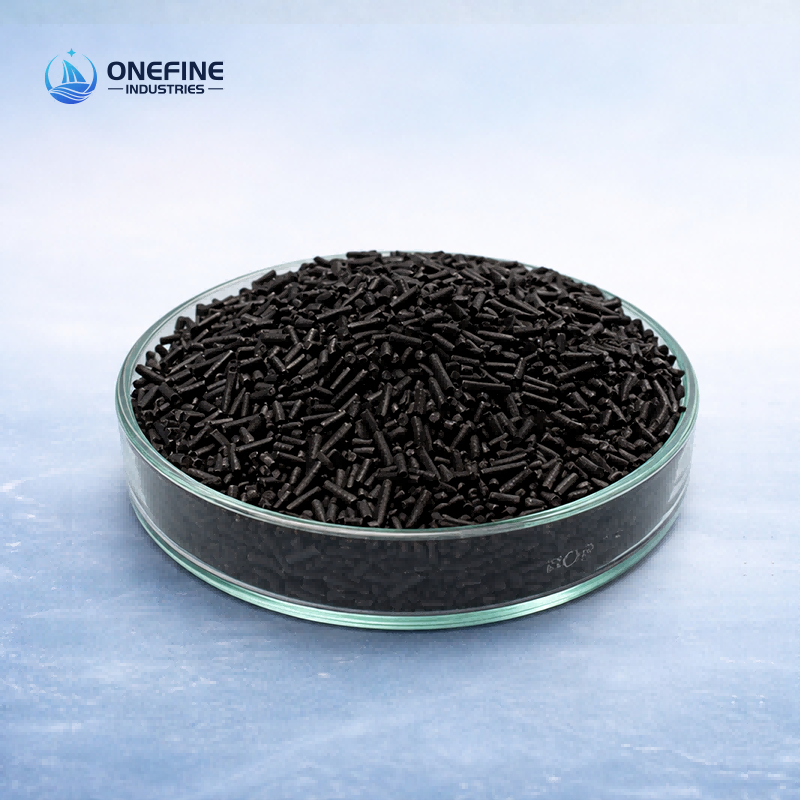
Carbon Molecular Sieve for Nitrogen Generation (CMS)
High-performance carbon molecular sieve (CMS) for PSA nitrogen generators. Uniform micropore distribution (0.3-0.5nm) ensures efficient oxygen-nitrogen separation. Delivers 95-99.999% nitrogen purity with 3-5 year service life. Bulk supply for industrial buyers worldwide.
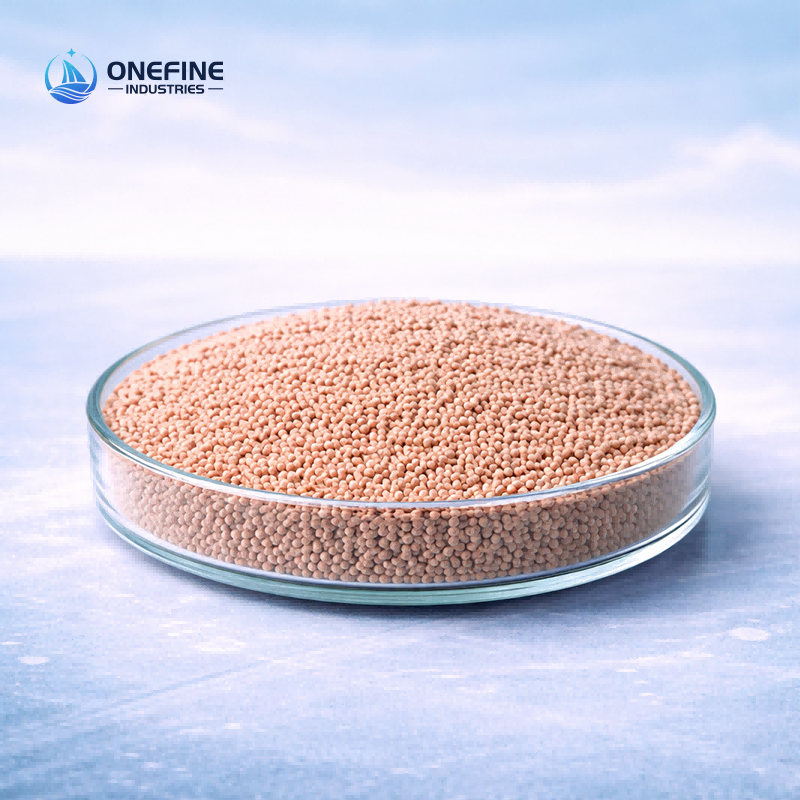
4A Molecular Sieve
General-purpose 4A molecular sieve desiccant for industrial air drying, solvent dehydration, CO2 removal, and static packaging applications. High capacity, long service life.
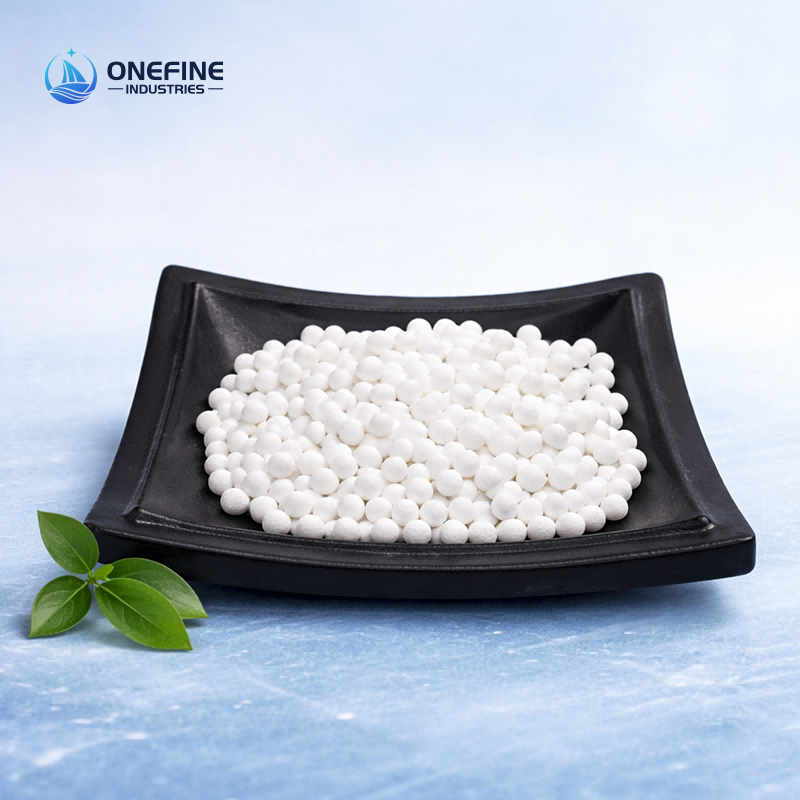
Activated Alumina for Purification
High-performance activated alumina (γ-Al₂O₃) adsorbent and desiccant for industrial gas/liquid drying, water defluoridation, and purification. White spherical beads with high surface area (≥300 m²/g), excellent crush strength, and full thermal regenerability. Available in multiple particle sizes for compressed air dryers, water treatment, and catalyst carrier applications.
Related Reading
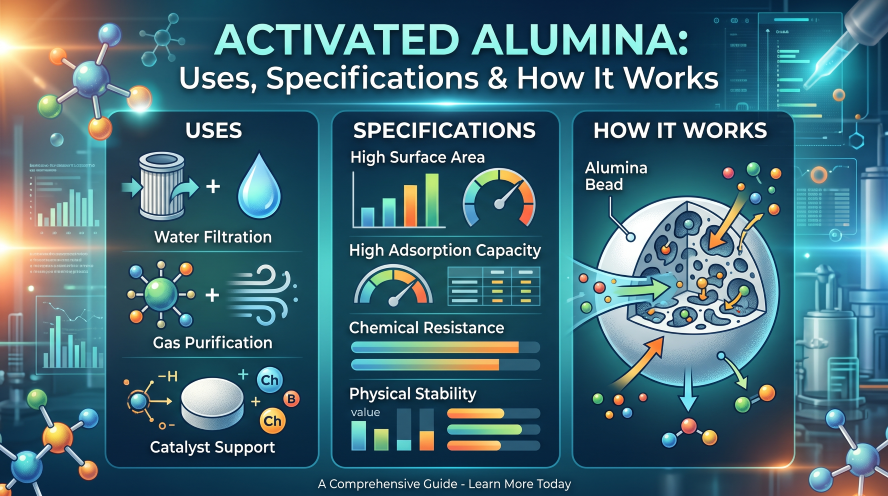
What is Activated Alumina? Uses, Specifications & How It Works
A practical guide to activated alumina (γ-Al₂O₃)—how it adsorbs moisture and fluoride, how it compares to silica gel and molecular sieve, and how to choose the right grade for your application.
Carbon Molecular Sieve: The Ultimate Guide to PSA Nitrogen Generation
A complete guide to carbon molecular sieve technology for on-site PSA nitrogen generation. Learn how CMS works based on kinetic diffusion separation, its key benefits including 50-90% cost savings vs cylinder/liquid nitrogen, industrial applications across food & beverage, chemical, electronics, pharmaceutical and mining industries, how to select the right CMS grade, maintenance tips, and comparisons with membrane and cryogenic nitrogen generation methods.