ZSM-5 Catalyst for Industrial VOC Emission Control: Application Case Analysis
Overview
Key Takeaways:
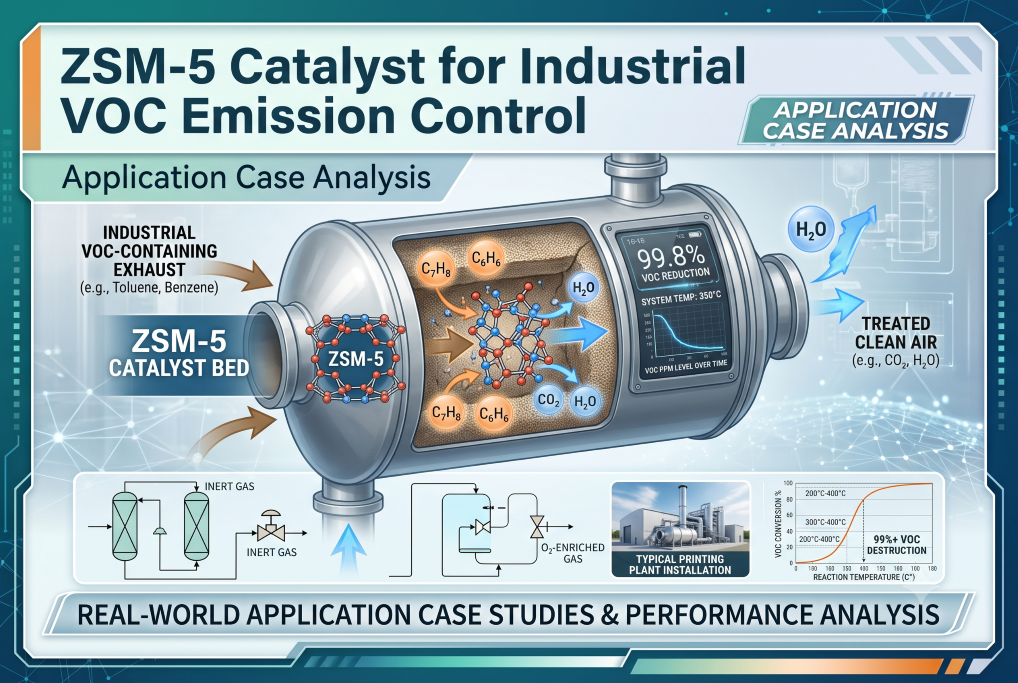
- RCO System Efficiency: Concentrates dilute VOCs and lowers catalytic oxidation temperatures to 200-400°C, significantly reducing fuel consumption.
- Plasma-catalytic oxidation: High-ratio ZSM-5 acts as a buffer to store pollutants during discharge phases for complete low-concentration VOC removal.
- Continuous reliability: Structural integrity withstands 1100°C, ensuring a stable 3-5 year service life in demanding petrochemical vapor recovery.
Volatile organic compound (VOC) emissions are among the most heavily regulated industrial air pollutants, generated by everything from paint and coating lines to chemical processing vents. Regenerative thermal oxidizers (RTO) and regenerative catalytic oxidizers (RCO) are the standard treatment technology, but their efficiency and operating cost depend heavily on the catalyst material used to enable oxidation at lower temperatures. ZSM-5 zeolite catalyst has become the material of choice for this role across a wide range of industries.
This case analysis covers how ZSM-5 is deployed in industrial VOC emission control systems, why its shape-selective structure matters for catalytic efficiency, and what to consider when specifying ZSM-5 for a VOC abatement project.
Application 1: Regenerative Catalytic Oxidation (RCO) for Paint & Coating Exhaust
Process Context
Paint, coating, and printing operations generate complex, large-volume exhaust streams containing toluene, xylene, ethyl acetate, and other solvents at relatively low concentrations — exactly the profile that makes catalytic oxidation more economical than thermal-only oxidation, which requires much higher temperatures to achieve complete combustion.
How ZSM-5 Works in This Application
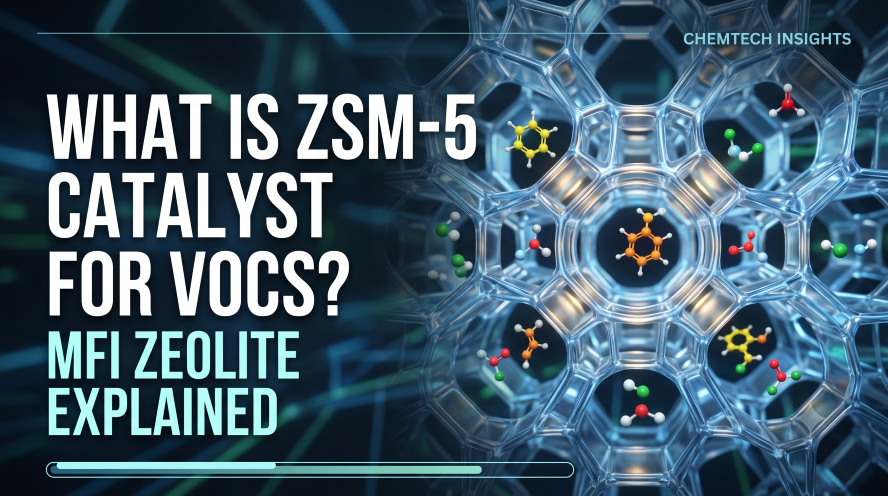
ZSM-5's intersecting micropore channels (5.1-5.8 Å) selectively adsorb aromatic and aliphatic VOC molecules while excluding bulkier compounds, concentrating dilute streams onto the catalyst surface. When loaded with a noble or transition metal (commonly Pt, Pd, or Cu), the concentrated VOCs are oxidized to CO₂ and water at 200-400°C — substantially lower than the 800-1000°C required for thermal-only oxidation, meaningfully reducing fuel consumption and operating cost. For a deeper look at this dual adsorption-plus-catalysis mechanism, see our What is ZSM-5 Catalyst for VOCs guide.
Catalyst Specification for This Application
- Type: Medium-to-high SiO₂/Al₂O₃ ratio ZSM-5 (50-200), balancing acidity for catalytic activity with hydrophobicity to maintain performance in humid exhaust streams
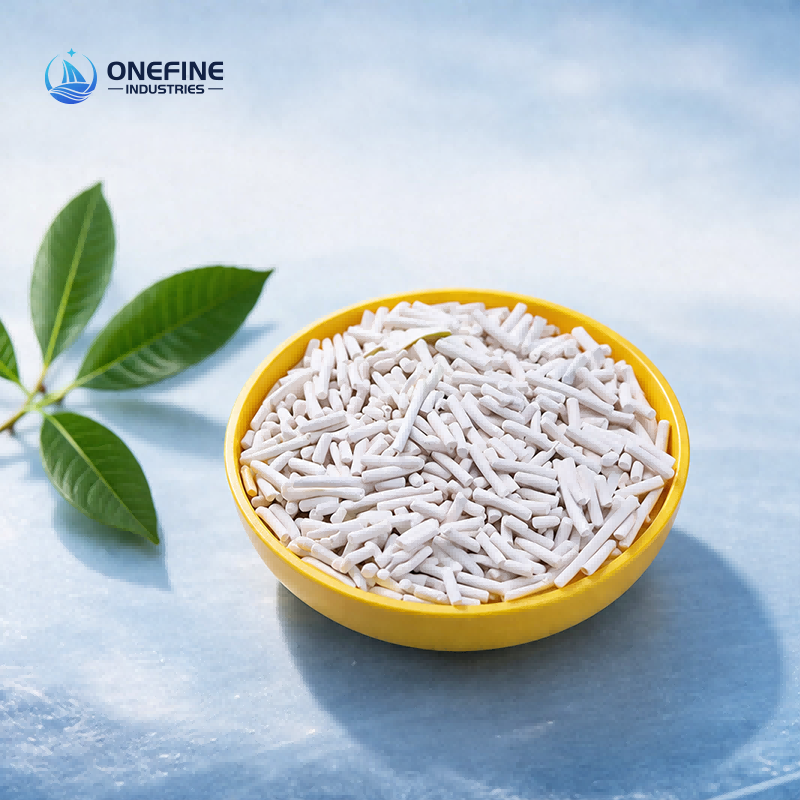
- Form: Extruded cylinders (Φ3mm) for fixed-bed RCO reactor configurations, providing low pressure drop and good mechanical durability
- Key requirement: Consistent metal dispersion across the high-surface-area ZSM-5 support (≥340-380 m²/g) for uniform catalytic activity
Application 2: Plasma-Catalytic Oxidation for Low-Concentration VOC Streams
Process Context
Some industrial exhaust streams carry VOCs at concentrations too low for cost-effective thermal or standard catalytic oxidation alone. Plasma-catalytic systems combine non-thermal plasma with a catalyst bed to achieve efficient conversion at these lower loadings.
How ZSM-5 Works in This Application
In plasma-catalytic configurations, ZSM-5's large VOC storage capacity allows it to buffer and concentrate pollutants generated during the plasma discharge phase, while a supported noble metal (commonly Au or Pt) drives more complete oxidation than plasma treatment alone could achieve. This combination is particularly effective for aromatic VOCs like toluene in low-concentration industrial exhaust.
Catalyst Specification for This Application
- Type: High SiO₂/Al₂O₃ ratio ZSM-5 (100-300) for strong hydrophobicity and stable VOC storage capacity
- Form: Cylinder form for reactor integration with plasma discharge chambers
Application 3: Petrochemical & Chemical Manufacturing Emission Control
Process Context
Petrochemical refineries and chemical plants generate VOC emissions from storage tank vapors, loading operations, process vents, and wastewater treatment off-gas — sources that are typically continuous and require reliable, long-service-life treatment systems.
How ZSM-5 Works in This Application
ZSM-5-based catalytic systems in this setting handle storage tank vapor recovery, process vent emission control, and fugitive emission abatement, typically running continuously with the same adsorption-plus-oxidation mechanism used in RTO/RCO systems. The catalyst's thermal stability (structural integrity maintained up to 1100°C) supports the repeated high-temperature regeneration cycles common in continuous-duty petrochemical service.
Catalyst Specification for This Application
- Type: Selection depends on the specific VOC profile — medium ratios for balanced acidity where catalytic cracking side-reactions aren't a concern, higher ratios where hydrophobicity and stability take priority
- Key requirement: Long service life under continuous operation; typical service life is 3-5 years with proper regeneration
Why ZSM-5 for Industrial VOC Emission Control?
Selecting ZSM-5 for VOC treatment comes down to matching its tunable SiO₂/Al₂O₃ ratio to the application:
- Lower ratios (25-50) — more acid sites, useful where stronger catalytic activity is needed
- Medium ratios (50-100) — balanced acidity and hydrophobicity for general-purpose VOC oxidation
- Higher ratios (100-300) — strong hydrophobicity, maintaining VOC adsorption capacity even in humid gas streams where hydrophilic adsorbents lose effectiveness
Choosing the wrong ratio for a given contaminant and humidity profile means either insufficient catalytic activity or premature loss of adsorption capacity in service — matching the sieve to your actual exhaust composition and operating conditions is the starting point for any system design.
Recommended Products from Sorbsieve
ZSM-5 Catalyst for VOCs Treatment — High-silica MFI zeolite catalyst, available in powder (325+ mesh) and 3mm cylinder forms, SiO₂/Al₂O₃ ratio 25-300.
Contact our team for bulk pricing and grade recommendation based on your target VOC compounds and reactor design.
Supply Information
Sorbsieve supplies ZSM-5 catalyst for industrial VOC emission control applications to buyers across the Middle East and internationally.
Standard packaging options:
- 25 kg drums (suitable for trial orders and small-batch systems)
- 150 kg steel drums
- 500 kg super sacks (most popular for industrial bulk orders)
- 1,000 kg jumbo bags (standard for plant-scale orders)
Minimum order quantity: 1 ton (trial orders accepted)
Container loading: 20'GP: 18-20 tons | 40'GP: 22-24 tons | 40'HQ: 24-26 tons
Loading ports: Shanghai, Qingdao, Tianjin, Ningbo, Shenzhen
Documents provided: COA (per batch) / TDS (pre-sale) / SDS (pre-shipment) / COO / Packing List
Looking for Bulk Supply of ZSM-5 Catalyst?
Sorbsieve is a trusted bulk supplier of ZSM-5 catalyst for industrial VOC emission control, serving industrial buyers across the Middle East.
We provide:
- ✅ Container-level supply (20'GP / 40'GP / 40'HQ)
- ✅ Full documentation (COA / TDS / SDS / COO)
- ✅ Multiple packaging options
- ✅ Technical support for catalyst grade selection and reactor design
- ✅ Fast quote response for industrial inquiries
Contact our team for bulk pricing, grade confirmation, and technical consultation.