Molecular Sieve for Insulating Glass (IG) Units: Spacer Bar Desiccant Applications
Overview
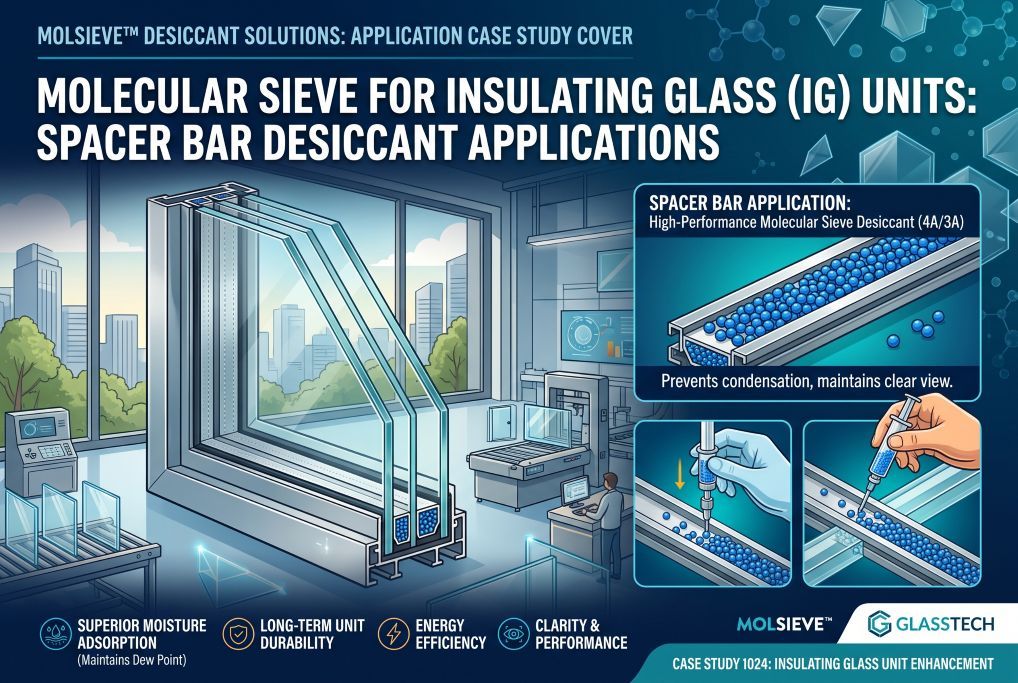
Every sealed insulating glass unit (IGU) — the double- or triple-pane windows standard in modern commercial and residential construction — depends on a small but critical component: a row of molecular sieve beads packed inside the aluminum or composite spacer bar that separates the glass panes. These beads absorb residual moisture trapped during manufacturing and any moisture that slowly diffuses through the edge seal over the unit's service life. Get the desiccant selection wrong, and the result isn't a minor performance issue — it's a fogged, defective window years before the unit should have failed.
This case covers why 3A molecular sieve is the standard material for this application, the specific engineering reason other pore sizes create problems, and what glass fabricators in the Middle East need to consider when sourcing desiccant at scale.
Key Takeaways
- Zero Gas Co-adsorption: 3A molecular sieve exclusively adsorbs moisture (~2.8 Å) without trapping air or argon fill gases, preventing pressure fluctuations and window "pillowing."
- Seal Protection: Prevents thermal cycling stress on perimeter seals, ensuring decades of clear, fog-free performance in insulating glass units.
- Equipment Compatibility: Fine bead sizes (0.5–1 mm) ensure dense, low-dust pneumatic filling inside automated spacer bar machinery.
Application 1: Why Pore-Size Selectivity Is Non-Negotiable in This Application
The Core Engineering Problem
An IGU is a sealed cavity. Whatever gas is trapped inside at the time of sealing — air, or an insulating fill gas such as argon — needs to stay at a stable volume and pressure for the window to perform correctly and look right. If the desiccant inside the spacer bar adsorbs anything besides water vapor, it disrupts that balance.
3A molecular sieve has a pore opening of approximately 3 Ångströms — large enough to capture water molecules (kinetic diameter ~2.8 Å) but too small to admit nitrogen, oxygen, or argon molecules. This selectivity is what makes it suitable for a sealed system: it dries the cavity without touching the fill gas.
4A molecular sieve, by contrast, has a larger 4 Å pore that can co-adsorb nitrogen and oxygen alongside water. In a sealed IGU, this creates a "breathing" problem — the desiccant adsorbs atmospheric gas as temperature drops, then releases it as temperature rises, causing the internal pressure to fluctuate. Over repeated thermal cycles, this pressure fluctuation manifests as visible glass deflection (commonly called "pillowing" or "oil-canning" in the glazing industry) and places ongoing mechanical stress on the perimeter seal, which can shorten the unit's service life.
This is why 3A — not 4A, despite 4A's higher general-purpose water capacity — is the standard specification across the glazing industry for standard IGU desiccant packing.
Practical Implication for Buyers
If you're sourcing molecular sieve for IGU manufacturing and a supplier proposes 4A because "it holds more water," that's solving for the wrong variable. The relevant spec isn't raw water capacity — it's gas selectivity inside a sealed cavity. This is a case where the technically higher-capacity product is the wrong choice for the application.
Application 2: Air-Filled vs. Gas-Filled IGU Systems
Standard Air-Filled Units
The majority of IGUs are simply air-filled — no special fill gas, just the atmosphere trapped at the time of sealing. 3A molecular sieve manages residual moisture in these units without complication, since air itself (nitrogen and oxygen) passes through the sieve's pores unaffected.
Gas-Filled Units (Argon, Krypton)
Higher-performance IGUs are filled with argon or, less commonly, krypton to improve thermal insulation values. These fill gases have larger kinetic diameters than nitrogen and oxygen, and are similarly excluded by 3A's pore structure — meaning the same 3A specification works across both air-filled and gas-filled unit types without requiring a different desiccant grade for each.
Application 3: Bead Size and Spacer Bar Fill Systems
Spacer Bar Geometry Drives Bead Size Selection
Molecular sieve for IGU applications is typically supplied in smaller bead diameters than many bulk industrial gas-drying applications, because the material has to flow through the narrow channel of the spacer bar during automated filling and pack densely enough to deliver adequate capacity within the limited internal volume of the bar. Industry sources commonly cite bead ranges in the roughly 0.5–2 mm class for this application, finer than the 3–5 mm or 1.5–2.5 mm beads typically used in bulk gas or liquid drying service.
Sorbsieve offers a 0.5–1 mm fine bead grade for spacer bar filling systems, in addition to the standard 1.5–2.5 mm and 3–5 mm grades used in bulk gas and liquid drying service. This fine grade falls within the industry-typical range for automated spacer bar filling equipment.
Fill Method Compatibility
Spacer bar desiccant is loaded using automated pneumatic filling equipment on the glass fabrication line. Low-dust, high-crush-strength beads are important here — excessive fines generated during handling and filling can affect both the filling equipment and the clarity of the finished unit if dust settles on the interior glass surface before sealing.
Application 4: Middle East Glass Fabrication Market Context
Climate-Driven Demand Factors
The Middle East's combination of high ambient humidity in coastal regions (UAE, Qatar, coastal Saudi Arabia) and extreme daily temperature swings in desert climates places IGU seals and desiccant systems under more thermal cycling stress than temperate-climate installations. This makes desiccant selection and adequate fill quantity particularly relevant for glass fabricators supplying the regional construction market, where large curtain-wall and residential glazing projects are a significant end-use segment.
Supply Considerations for Regional Fabricators
Glass fabrication plants typically consume molecular sieve on an ongoing basis tied to production volume rather than in one-off batches, making it a recurring bulk procurement category rather than a specialty low-volume purchase — a profile that fits container-level and multi-ton supply arrangements.
Why 3A Molecular Sieve for Insulating Glass?
- Water molecule diameter: approximately 2.8 Å — adsorbed by 3A molecular sieve
- Nitrogen, oxygen, argon: all larger than the 3 Å pore opening — excluded by 3A molecular sieve
This selectivity is the entire basis for using 3A in a sealed-cavity application: it removes moisture without disturbing the gas balance the unit depends on for stable, deflection-free performance.
For buyers evaluating molecular sieve types more broadly, our complete 3A molecular sieve guide covers water adsorption capacity, crush strength, and regeneration conditions in full. For a side-by-side comparison against 4A, see our 3A vs 4A comparison guide.
Recommended Product from Sorbsieve
The standard adsorbent for insulating glass desiccant applications, selected for its selective water-only adsorption that avoids gas co-adsorption in sealed cavities. Supplied with full documentation including COA per batch and TDS.
Contact our team for bulk pricing, grade confirmation, and availability based on your spacer bar filling system requirements.
Supply Information
Sorbsieve supplies 3A molecular sieve for insulating glass and other industrial applications to buyers across the Middle East and internationally.
Standard packaging options:
- 25 kg drums (suitable for trial orders and small batch systems)
- 150 kg steel drums
- 500 kg super sacks
- 1,000 kg jumbo bags (standard for plant-scale orders)
Minimum order quantity: 1 ton (trial orders accepted)
Container loading:
- 20'GP: 18-20 tons
- 40'GP: 22-24 tons
- 40'HQ: 24-26 tons
Loading ports: Shanghai, Qingdao, Tianjin, Ningbo, Shenzhen
Documents provided: COA (per batch) / TDS (pre-sale) / SDS (pre-shipment) / COO / Packing List
Looking for Bulk Supply of 3A Molecular Sieve for Insulating Glass?
Sorbsieve is a trusted bulk supplier of 3A molecular sieve and industrial adsorbents, serving industrial buyers across the Middle East.
We provide:
- ✅ Container-level supply (20'GP / 40'GP / 40'HQ)
- ✅ Full documentation (COA / TDS / SDS / COO)
- ✅ Multiple packaging options
- ✅ Technical support for molecular sieve grade and bead size selection
- ✅ Fast quote response for industrial inquiries
Contact our team for bulk pricing, grade confirmation, and technical consultation.
Related Reading
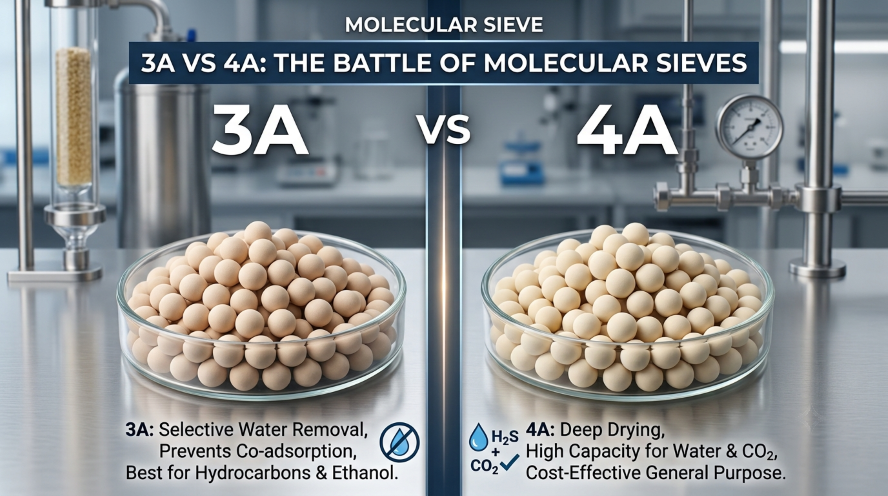
3A vs 4A Molecular Sieve: Key Differences & How to Choose
In-depth guide comparing 3A and 4A molecular sieves. Covers pore size differences, adsorption selectivity, capacity comparison, application scenarios for each type, and practical guidance on selecting the right molecular sieve for your industrial drying or gas separation needs.
What is 3A Molecular Sieve? Uses, Specifications & How It Works
Everything you need to know about 3A molecular sieves: how they work, key properties, common applications in ethanol dehydration, natural gas processing & refrigeration, plus regeneration and selection tips.