Palladium Catalyst for Hydrogen Peroxide Production via the Anthraquinone (AO) Process: Application Case Analysis
Overview
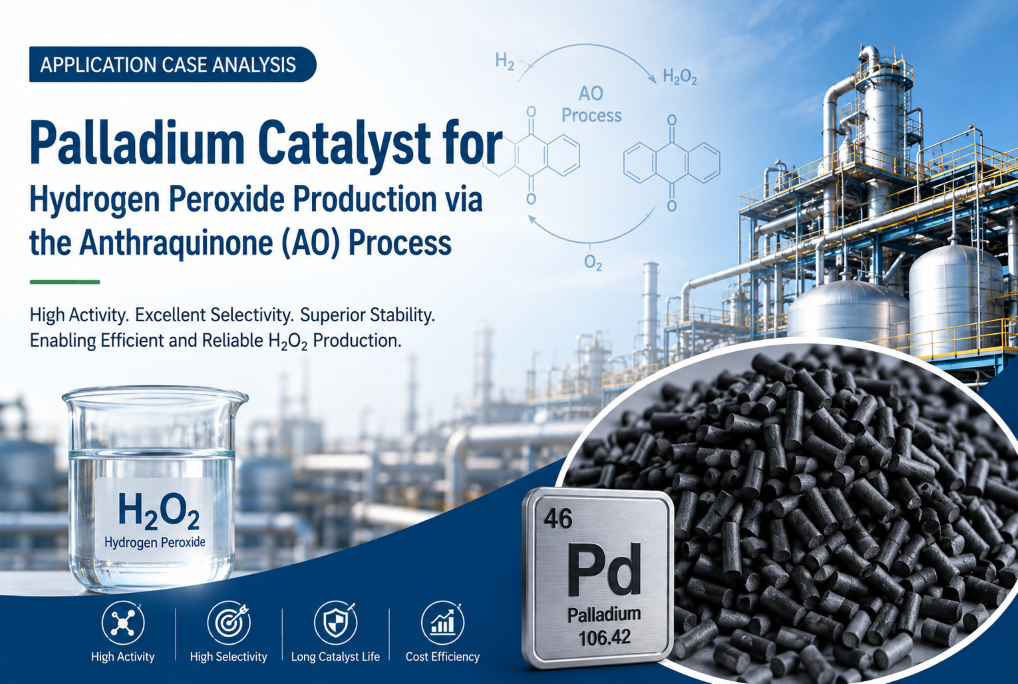
Hydrogen peroxide (H₂O₂) is one of the most widely used industrial oxidants, and more than 95% of global production still relies on the anthraquinone (AO) process. At the core of this process sits a single reaction step — the catalytic hydrogenation of the working anthraquinone compound — and a palladium catalyst is the standard choice for running it. This case looks at how a palladium hydrogenation catalyst functions inside an AO plant, why palladium is preferred over alternative metals for this duty, and the operational factors that determine catalyst service life in continuous production.
How the Anthraquinone Process Works
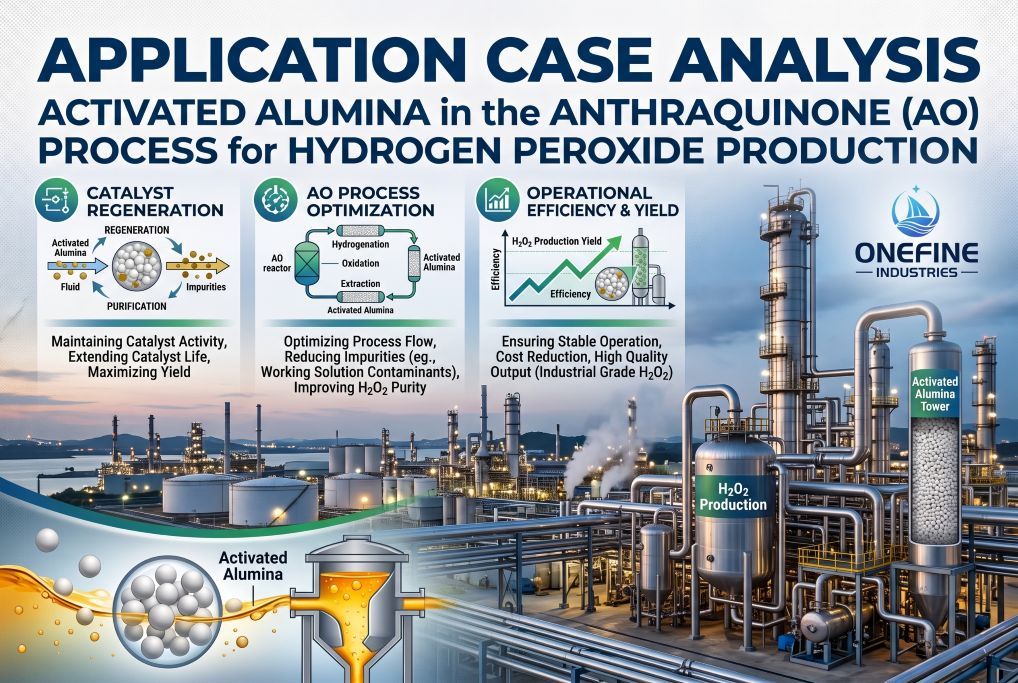
The AO process is a closed-loop cycle built around an alkylanthraquinone (commonly 2-ethylanthraquinone) dissolved in an organic solvent system — referred to as the "working solution." The cycle runs in three stages:
- Hydrogenation — the working solution is contacted with hydrogen gas in the presence of a Palladium Catalyst for Hydrogenation supported on a carrier such as alumina, converting the anthraquinone to its corresponding anthrahydroquinone form.
- Oxidation — the hydrogenated solution is then contacted with an oxygen-containing gas (typically air), which reforms the original anthraquinone and simultaneously releases hydrogen peroxide.
- Extraction — the hydrogen peroxide is extracted from the working solution with water, purified, and concentrated, while the regenerated anthraquinone solution is recycled back to the hydrogenation stage to repeat the cycle.
Key Takeaways
- High Selectivity: Palladium is favored over nickel because it avoids over-hydrogenating the anthraquinone ring structure, extending working solution life.
- Mass Transfer Focus: Reaction rates are driven by physical parameters (particle size and pore structure) to ensure hydrogen reaches the dispersed active sites efficiently.
- Regeneration Economy: Precious metal value is preserved through multi-cycle thermal/solvent regeneration, with spent catalyst routinely refined for palladium recovery.
Because the hydrogenation reaction is very fast on a palladium surface, plant performance is often limited by how quickly hydrogen can reach the catalyst (mass transfer) rather than by the intrinsic reaction rate itself — which is one reason catalyst particle size, pore structure, and dispersion on the support are treated as production-critical specifications rather than cosmetic ones.
Why Palladium Is the Catalyst of Choice for This Duty
Several hydrogenation metals have been tested for the AO process over the decades, including Raney nickel, but palladium has become the standard for one central reason: selectivity. Nickel-based catalysts are more prone to over-hydrogenating the aromatic ring system of the anthraquinone molecule itself, a side reaction that permanently damages the working compound and reduces the overall efficiency of the H₂O₂ cycle. Palladium hydrogenates the intended carbonyl groups with much less of this unwanted ring attack, which is what allows the same working solution to be recycled through thousands of cycles rather than being consumed.
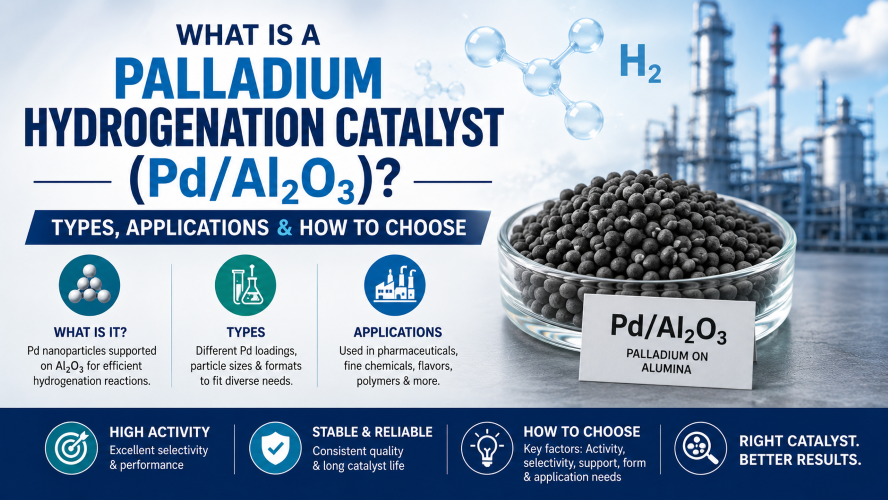
Supported palladium catalysts for this application are typically produced on alumina or silica carriers, with palladium loading commonly falling in a low single-digit weight percentage range depending on the specific plant design and desired activity. Alumina-supported grades are widely used because the carrier offers a good balance of mechanical strength, surface area, and resistance to the organic solvent environment of the working solution.
Operational Challenges in Continuous AO Production
Running a palladium hydrogenation catalyst in a continuous AO loop presents a few recurring operational challenges that buyers plan around:
- Working solution degradation byproducts. Over many cycles, a fraction of the anthraquinone can degrade into byproducts (such as partially hydrogenated or oxidized derivatives) that do not fully regenerate. These byproducts can accumulate on the catalyst surface and gradually reduce activity, which is why working solution quality control is treated as being just as important as catalyst quality itself.
- Catalyst deactivation and regeneration. Like most supported metal catalysts, activity declines gradually with time on stream. Operators typically manage this through periodic regeneration treatments rather than continuous full replacement, extending the useful life of a single catalyst charge across an extended production run before a fresh charge is needed.
- Palladium loss and recovery. Because palladium is a precious metal, minimizing loss from the reactor loop (through attrition or leaching into the working solution) is an economic priority, and filtration steps are commonly used to keep the catalyst-free stream clean before the oxidation stage.
None of these factors are unique to any single supplier — they are inherent to how the AO process works. What they do mean for buyers is that consistent catalyst specifications (particle size distribution, palladium dispersion, and carrier integrity) from batch to batch matter more in this application than in less demanding hydrogenation duties, since inconsistency shows up as unpredictable service life across a production run.
Regeneration and Palladium Recovery Practices
Because a fresh catalyst charge represents a significant precious-metal investment, most AO plants treat regeneration as the default response to declining activity rather than jumping straight to full replacement. A typical regeneration approach involves washing the catalyst with solvents to remove accumulated organic residues and degradation byproducts, sometimes combined with mild acid or base treatment, followed by drying and a thermal reactivation step to restore surface activity. This can usually be repeated a limited number of times before the underlying support structure or metal dispersion degrades to the point where regeneration no longer restores acceptable performance — at which point a fresh charge becomes the more economical option.
Palladium recovery is the other side of this economics. Any catalyst that has reached the end of its useful life still carries recoverable metal value, and spent palladium catalyst is routinely sent to specialized precious-metal refiners rather than discarded, with the recovered palladium re-entering the supply chain for fresh catalyst production. This recovery loop is one reason palladium has remained the practical standard for this duty despite being a precious metal — the metal itself isn't consumed by the reaction, so the real ongoing cost is the support structure, manufacturing, and periodic reactivation rather than the palladium content being lost with each catalyst change-out.
For buyers evaluating total cost of ownership, this means the purchase price of a catalyst charge should be weighed against expected regeneration cycles and eventual recovery value, not treated as a one-time consumable cost the way a desiccant or adsorbent typically would be.
Recommended Products from Sorbsieve
For bulk buyers supplying or operating anthraquinone-process hydrogen peroxide plants across the Middle East, Sorbsieve offers a palladium hydrogenation catalyst suitable for this duty — see our What is a Palladium Hydrogenation Catalyst? for a full breakdown of Pd/Al₂O₃ catalyst structure and selection factors — backed by full documentation and flexible container-level or trial-order supply.
FAQ
Is palladium the only catalyst used for hydrogen peroxide production?
Palladium is the standard catalyst for the anthraquinone (AO) process, which accounts for the large majority of global hydrogen peroxide output. Alternative production routes exist (such as direct synthesis from hydrogen and oxygen), but these are far less common commercially and use different catalyst systems entirely.
What carrier is used for palladium catalysts in this application?
Alumina and silica are the two most common carriers for palladium hydrogenation catalysts in the AO process. Alumina-supported grades are widely used in industrial practice for their mechanical durability and solvent resistance.
How long does a palladium catalyst last in an AO plant?
Service life depends heavily on working solution quality, operating conditions, and regeneration practices at each individual plant, so we recommend discussing your specific process parameters with our technical team rather than relying on a generic figure.
Can Sorbsieve supply palladium catalyst in trial quantities before a full bulk order?
Yes — we accept trial orders starting from 1 ton so buyers can validate performance in their own system before committing to container-level bulk supply.
Looking for Bulk Supply of Palladium Catalyst?
Sorbsieve is a trusted bulk supplier of palladium hydrogenation catalyst and complete industrial adsorbents, serving industrial buyers across the Middle East.
We provide:
- ✅ Container-level supply (20'GP / 40'GP / 40'HQ)
- ✅ Full documentation (COA / TDS / SDS / COO)
- ✅ Multiple packaging options
- ✅ Technical support for catalyst selection and system optimization
- ✅ Fast quote response for industrial inquiries
Contact our team for bulk pricing, product samples, and technical consultation.