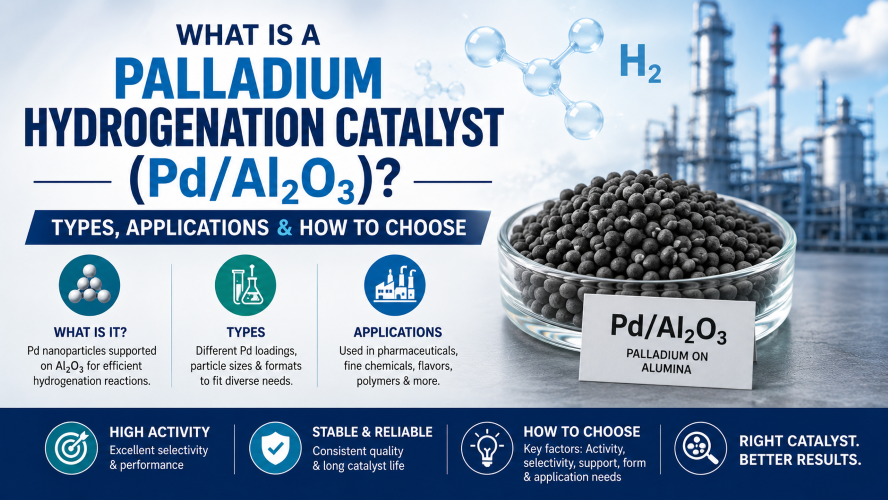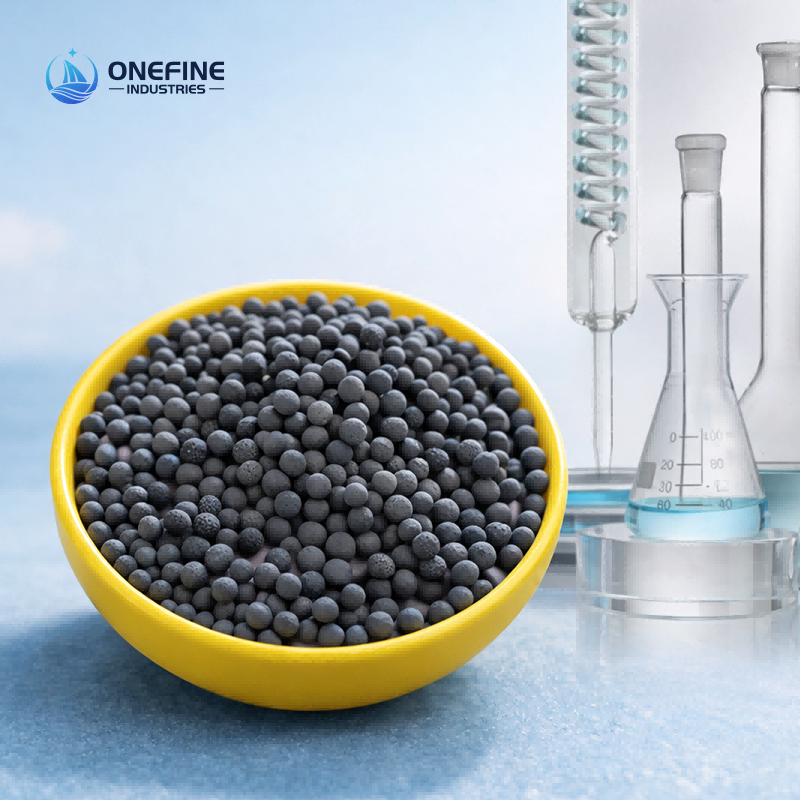
Palladium Catalyst for Hydrogenation (Pd/Al₂O₃)
High-performance palladium on alumina catalyst (Pd/Al₂O₃) for industrial hydrogenation reactions. Available in 0.1-2% Pd loading on alumina support. Exceptional activity, long service life, and excellent selectivity for pharmaceutical, petrochemical, and fine chemical synthesis.
Get QuoteKey Attributes
- Highest catalytic activity among noble metal hydrogenation catalysts under mild conditions (room temperature, low pressure)
- Spherical carrier form (2-4 mm) provides uniform packing and excellent flow characteristics for batch slurry and fixed-bed continuous reactors
- High turnover numbers (TON) with thousands to millions of catalytic cycles before deactivation
- Broad substrate scope—effective for alkenes, alkynes, nitro groups, aromatics, carbonyls, and hydrogenolysis reactions
- Regenerable through thermal treatment, chemical washing, or reductive reactivation to restore activity
- Precious metal recovery value offsets initial catalyst cost—modern refineries recover >95% of palladium from spent catalyst
- Advanced nanoparticle dispersion technology ensures uniform particle size distribution (2-10 nm) and maximum metal utilization, compatible with diverse solvent systems including aqueous, alcoholic, and non-polar organic media
- Tunable Pd loading (0.1%, 0.5%, 1%, 2%) to optimize cost-performance ratio for specific applications
Applications
- Pharmaceutical API synthesis—nitro group reduction, debenzylation, and deprotection reactions
- Fine chemical manufacturing—production of vitamins, fragrances, flavors, and specialty intermediates
- Petrochemical processing—acetylene removal from ethylene streams, aromatic hydrogenation, and olefin purification
- Agrochemical production—selective hydrogenation steps in pesticide and herbicide synthesis
- Polymer and specialty chemicals—hydrogenated styrene-butadiene rubber (HSBR) production, surfactant manufacturing
- Electronic chemicals—high-purity monomer and intermediate production for semiconductor applications
- Specialty chemicals & dyes—hydrogenation of essential oils and aroma compounds, reduction steps in synthetic dye manufacturing
- Surfactant production—hydrogenation of fatty acids and fatty alcohols for personal care and industrial applications
- Biorenewable chemicals—palladium catalysts for converting lignocellulosic biomass to platform chemicals
- Continuous flow chemistry—Pd/Al₂O₃ formulations optimized for fixed-bed flow reactors in modern manufacturing
Product Description
Key Takeaways:
- Tunable Specifications: Available in 0.1%, 0.5%, 1%, and 2% Pd loading on spherical alumina support (2-4 mm).
- Exceptional Activity: Advanced 2-10 nm nanoparticle dispersion ensures maximum metal utilization under mild conditions.
- Broad Applications: Ideal for pharmaceutical API synthesis (nitro group reduction), petrochemical processing, and fine chemical manufacturing.
- High Cost-Efficiency: Highly regenerable with >95% precious metal recovery value from spent catalyst, significantly offsetting initial investment.
What is a Palladium Hydrogenation Catalyst?
Palladium on alumina (Pd/Al₂O₃) is a heterogeneous catalyst consisting of palladium metal nanoparticles dispersed onto a high-surface-area alumina support. In hydrogenation reactions, palladium acts as the active catalytic site where molecular hydrogen (H₂) is adsorbed and dissociated into reactive hydrogen atoms that add to unsaturated bonds in organic substrates.
Palladium is classified as a noble metal from the platinum group, exhibiting exceptional catalytic activity for hydrogenation under mild conditions (often room temperature and low hydrogen pressure). Its unique electronic structure—with unfilled d-orbitals—allows it to readily adsorb and activate both hydrogen gas and organic substrates while maintaining sufficient activity for product desorption.
The alumina support serves critical functions: maximizing exposed palladium surface area (95-350 m²/g), stabilizing nanoparticles against sintering and agglomeration, providing mechanical strength for reactor packing, and ensuring uniform metal dispersion (2-10 nm particle size).
For a deeper look at how palladium's electronic structure drives its catalytic activity and how to choose the right Pd loading, see our guide: What is a Palladium Hydrogenation Catalyst?
Our Pd/Al₂O₃ catalyst is available in spherical form optimized for different reactor configurations:
- Spheres (2-4 mm): Spherical form provides uniform packing and good flow characteristics for both batch and continuous reactors
Key Benefits
- Exceptional activity under mild conditions: Pd/Al₂O₃ catalysts achieve high reaction rates at room temperature and low hydrogen pressure (1-10 bar), reducing energy costs and equipment requirements
- Versatile substrate scope: Effective for hydrogenation of alkenes, alkynes, nitro groups, aromatics, carbonyls, and hydrogenolysis of benzyl ethers and esters
- Uniform spherical form: Spherical Pd/Al₂O₃ (2-4 mm) provides uniform packing and excellent flow for both batch slurry reactors and fixed-bed continuous reactors
- High metal utilization efficiency: Advanced nanoparticle dispersion technology (2-10 nm particle size) maximizes exposed catalytic surface area per gram of precious metal
- Long service life and regenerability: Withstands thousands of catalytic cycles; deactivated catalysts can be regenerated via thermal treatment, chemical washing, or reductive reactivation
- Precious metal recovery value: Spent Pd/Al₂O₃ catalysts contain recoverable precious metal (modern refineries recover >95%), offsetting initial purchase cost through buy-back or toll-processing programs
- Broad solvent compatibility: Effective in aqueous, alcoholic, ethereal, and non-polar organic solvents, enabling flexibility in reaction medium selection
- High surface area support: Alumina support provides 95-350 m²/g surface area for maximum catalytic activity
Product Forms
Spheres (2-4 mm): Spherical form provides uniform packing and excellent flow characteristics, ideal for both batch and continuous reactor configurations. Ensures consistent catalyst distribution throughout the reactor bed.
Applications
Pharmaceutical and Fine Chemical Synthesis
Pd/Al₂O₃ catalysts are indispensable for pharmaceutical manufacturing due to the need for precise, selective reactions under mild conditions that preserve sensitive functional groups.
Key reactions:
- Nitro group reduction: Conversion of nitroaromatics to anilines, a fundamental step in many active pharmaceutical ingredient (API) syntheses
- Debenzylation: Removal of benzyl protecting groups from alcohols, amines, and carboxylic acids using Pd/Al₂O₃ under hydrogen
- Aromatic ring hydrogenation: Production of cyclohexane derivatives from benzene derivatives under elevated temperature and pressure
- Hydrogenolysis of C-halogen bonds: Removal of halogen substituents (Cl, Br, I) from aromatic rings
Pd/Al₂O₃ (1% or 2% loading) is the most commonly used formulation in pharmaceutical applications due to its balance of activity, selectivity, and cost-effectiveness.
Petrochemical Processing
The petrochemical industry uses Pd/Al₂O₃ catalysts for critical purification and transformation steps in olefin production and aromatic processing.
Key applications:
- Acetylene removal from ethylene streams: Pd/Al₂O₃ selectively hydrogenates trace acetylene to ethylene without over-hydrogenation to ethane, protecting downstream polyethylene catalysts from poisoning
- Aromatic hydrogenation: Production of cyclohexane, methylcyclohexane, and decalin from benzene, toluene, and naphthalene for solvent and chemical intermediate production
- Olefin purification: Removal of dienes and alkynes from mono-olefin streams to meet polymerization-grade specifications
- Hydrogenation of crude aromatics: Production of high-purity cycloalkanes for specialty solvent applications
Pd/Al₂O₃ sphere formulations are preferred for fixed-bed continuous reactors in petrochemical applications due to their uniform packing and mechanical strength.
Protecting Your Palladium Investment: Because palladium is highly sensitive to trace sulfur, arsenic, and chlorine poisoning, petrochemical and refinery installations typically position a dedicated guard bed upstream of the Pd/Al₂O₃ reactor. Our Desulfurization and Arsenic Removal Catalyst removes sulfur and arsenic ahead of hydrogenation duty, while our Copper-Nickel Desulfurization Catalyst handles sulfur, chlorine, and arsenic together for reforming and hydrocracking feed protection. Sizing the right guard bed upstream is often the difference between a Pd catalyst reaching its full multi-year service life and premature, irreversible poisoning.
Polymer and Specialty Chemicals
Pd/Al₂O₃ catalysts enable the production of specialty polymers and chemical intermediates through selective hydrogenation reactions.
Key applications:
- Hydrogenated styrene-butadiene rubber (HSBR): Palladium-catalyzed hydrogenation of unsaturated rubber to improve thermal stability, UV resistance, and weatherability for automotive and construction applications
- Surfactant production: Hydrogenation of unsaturated fatty acids and fatty alcohols to produce saturated surfactants for personal care and industrial cleaning products
- Dye and pigment intermediates: Selective hydrogenation steps in the synthesis of synthetic dyes and pigments
- Electronic chemicals: Production of high-purity monomers and intermediates for semiconductor and electronic component manufacturing
Flavor and Fragrance Industry
Pd/Al₂O₃ catalysts are used to produce key aroma compounds and flavor ingredients through selective hydrogenation of essential oils and natural extracts.
Key applications:
- Hydrogenation of essential oils: Modification of terpene profiles to produce desired scent characteristics
- Production of aldehydes and alcohols: Selective hydrogenation of unsaturated aldehydes to saturated alcohols for fragrance applications
- Synthesis of musk compounds: Palladium-catalyzed hydrogenation in the production of synthetic musk fragrances
- Flavor intermediate production: Hydrogenation steps in the synthesis of flavor compounds for food and beverage applications
Agrochemical Production
The agrochemical industry relies on Pd/Al₂O₃ catalysts for selective hydrogenation steps in the production of pesticides, herbicides, and plant growth regulators.
Key applications:
- Selective nitro group reduction: Conversion of nitroaromatics to anilines in pesticide synthesis without affecting other sensitive functional groups
- Alkene hydrogenation: Saturation of double bonds in herbicide and fungicide intermediates
- Heterocycle hydrogenation: Partial or complete hydrogenation of nitrogen-containing heterocycles in agrochemical synthesis
Selection Guide
By Application
- General hydrogenation (pharmaceutical, fine chemicals): Pd/Al₂O₃ 1% or 2% spheres
- Fixed-bed continuous reactor (petrochemical): Pd/Al₂O₃ 0.5-2% spheres (2-4 mm)
- Flow chemistry systems: Pd/Al₂O₃ sphere formulations optimized for flow reactor geometry
- High-temperature gas-phase hydrogenation: Pd/Al₂O₃ 0.5-1% spheres on high-surface-area alumina
By Reactor Configuration
- Batch slurry reactor: Spherical Pd/Al₂O₃ (2-4 mm)
- Fixed-bed continuous reactor: Spherical Pd/Al₂O₃ with high mechanical strength (2-4 mm)
- Flow chemistry: Specialized sphere formulations with optimized particle geometry and flow characteristics
By Pd Loading
- 0.1% Pd: Light hydrogenation reactions, cost-sensitive applications
- 0.5% Pd: Standard pharmaceutical and fine chemical applications
- 1% Pd: General-purpose workhorse for most hydrogenation reactions
- 2% Pd: High-activity requirements, fast reaction kinetics
Safety and Handling
Storage and Handling
Pd/Al₂O₃ catalysts are relatively stable compared to Pd/C catalysts, but proper handling is still essential:
- Store in sealed containers in a cool, dry environment (below 25°C)
- Protect from moisture absorption and contamination
- Avoid prolonged exposure to air to prevent catalyst deactivation
- Keep away from strong oxidizing agents and acids
Personal Protection
- Wear appropriate PPE: nitrile gloves, safety glasses, lab coat
- Avoid skin contact and inhalation of catalyst dust
- Work in well-ventilated areas or fume hoods
- Palladium compounds can cause skin sensitization in some individuals
Hydrogen Safety
- Hydrogen is highly flammable and forms explosive mixtures with air (4-75% in air)
- Ensure proper pressure relief and venting systems on hydrogenation reactors
- Use hydrogen detectors in reactor areas
- Follow all pressure vessel safety guidelines and local regulations
Catalyst Regeneration and Recovery
Regeneration Methods
Deactivated palladium catalysts can often be regenerated to restore activity:
- Solvent washing: Remove adsorbed organic contaminants using appropriate solvents (methanol, acetone, dichloromethane)
- Thermal treatment: Burn off carbonaceous deposits under controlled oxidative conditions (more common for alumina-supported catalysts; carbon-supported catalysts risk burning the support)
- Chemical treatment: Remove poisons (sulfur, phosphorus) using chemical treatments (oxidizing agents, chelating agents)
- Reductive reactivation: Hydrogen treatment at elevated temperature (150-300°C) to restore active Pd⁰ sites from oxidized PdO
Palladium Recovery
When catalysts can no longer be regenerated, the palladium metal must be recovered:
- Pyrometallurgical processing: High-temperature treatment to concentrate the metal in a precious metal alloy
- Hydrometallurgical processing: Dissolution with acids (aqua regia, HCl/H₂O₂) followed by purification and precipitation
- Recovery efficiency: Modern refineries can recover >95% of the palladium from spent catalysts
- Economic value: Palladium recovery value typically ranges from 60-80% of the original catalyst cost (depending on market price and catalyst formulation)
Many catalyst suppliers offer buy-back or toll-processing programs for spent catalyst, making recovery straightforward and economically attractive for end users.
Packaging & Shipping
We offer flexible packaging and shipping options to suit your project scale and logistics requirements.
Standard Packaging:
- 25 kg drums (moisture-proof, suitable for trial orders and small batches)
- 150 kg steel drums (standard bulk packaging for industrial orders)
- 500 kg super sacks (most popular for industrial bulk orders)
- 1000 kg jumbo bags (for large-scale projects)
- Custom packaging available on request
Minimum Order Quantity (MOQ):
- 1 ton (entry-level orders accepted — perfect for first-time customers)
- 5+ tons (standard bulk orders)
- Container-level supply for long-term partnerships
Container Loading Capacity:
- 20'GP container: 18-20 tons (palletized)
- 40'GP container: 22-24 tons (palletized)
- 40'HQ container: 24-26 tons
Loading Ports: We ship from major Chinese ports based on your requirements: Shanghai, Qingdao, Tianjin, Ningbo, and Shenzhen.
Lead Time:
- Stock orders: 7-15 days from payment confirmation
- Made-to-order: 20-30 days
Shipping Terms: FOB / CIF / CFR / EXW — flexible based on your destination and preferences.
Documents & Certificates
We provide complete documentation for every order:
📄 Technical Data Sheet (TDS) — Confirmed with you during product selection, ensuring exact specifications match your application requirements.
📄 Safety Data Sheet (SDS) — Provided before shipment, meeting all international transportation and handling standards.
📄 Certificate of Analysis (COA) — Issued for each production batch, delivered with your shipment for full quality traceability.
Additional documents available on request: Certificate of Origin (COO), Packing List, Commercial Invoice, Third-party Inspection Report (SGS / BV), Form E (for Middle East destinations with applicable tariff benefits).
FAQ
1. What is the difference between 0.1%, 0.5%, 1%, and 2% Pd loading? Higher Pd loading generally means faster reaction rates and higher activity, but also higher cost. Lower loadings (0.1-0.5%) suit cost-sensitive, high-volume applications, while higher loadings (1-2%) suit applications requiring fast kinetics or difficult substrates. Our technical team can recommend the right loading based on your feedstock and reactor conditions.
2. Can Pd/Al₂O₃ catalyst be regenerated and reused? Yes. Deactivated Pd/Al₂O₃ catalyst can typically be regenerated through solvent washing, thermal treatment, or reductive reactivation, extending its useful service life before final precious metal recovery is needed.
3. What packaging do you use for palladium catalyst shipments? We use sealed, moisture-proof containers (25 kg drums up to 1000 kg jumbo bags) to protect catalyst activity during transport, with full documentation (TDS/SDS/COA) provided for every shipment.
4. Do you offer spent catalyst buy-back for precious metal recovery? Please contact our technical team to discuss buy-back or toll-processing options for spent Pd/Al₂O₃ catalyst, as terms depend on catalyst condition and current palladium market price.
Need a Custom Solution?
For bulk pricing and grade recommendation, please send your feedstock composition & reactor conditions requirements to us. Our technical team will get back to you within 24 hours with a tailored solution.
Technical Specifications
| Palladium Loading | 0.1%, 0.5%, 1%, 2% by weight |
| Support Material | Alumina (Al₂O₃) |
| Carrier Form | Spheres, 2-4 mm |
| Surface Area | 95-350 m²/g (alumina support) |
| Bulk Density | 0.42-0.90 g/cm³ |
| Pore Volume | 0.45-1.0 ml/g |
| Pore Diameter | 5-35 nm |
| Moisture Content | ≤0.5% (as shipped) |
| Average Pd Particle Size | 2-10 nm (nanoparticle dispersion) |
| Crushing Strength | 15-90 N |
| Operating Temperature Range | 20-150°C (typical), up to 200°C (short-term) |
| Operating Pressure Range | 1-100 bar H₂ (typical) |
| Typical Solvents | Methanol, ethanol, ethyl acetate, THF, toluene, water |
| Shelf Life | 2 years when stored properly (cool, dry, sealed container) |
Related Products
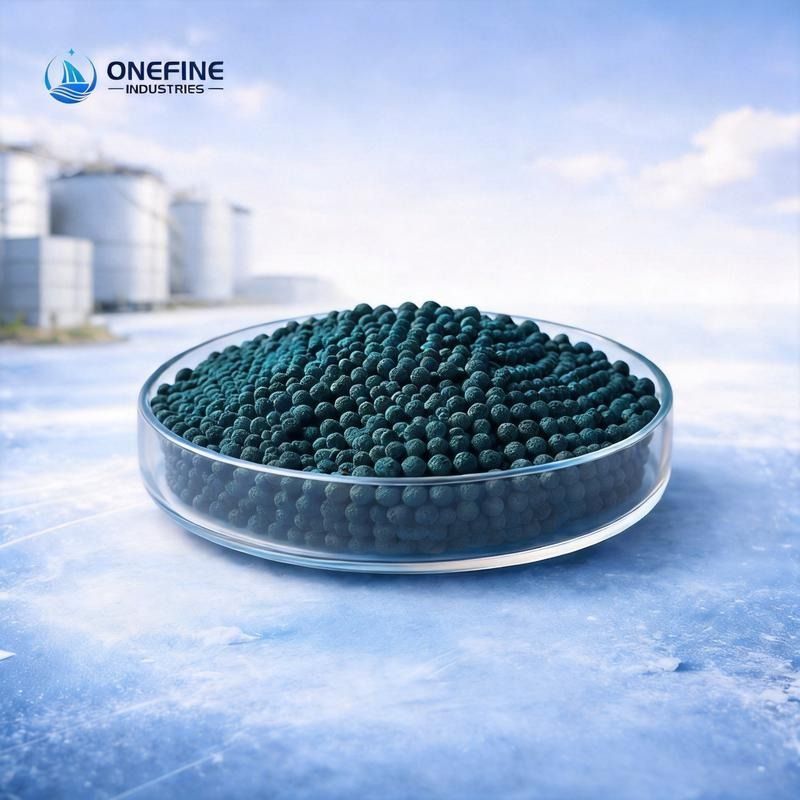
Desulfurization and arsenic removal catalyst
High-performance CuO/Al₂O₃-based desulfurization and arsenic removal catalyst, engineered for the ultra-deep removal of sulfur compounds and volatile arsenides to protect downstream noble metal catalysts. Available in bulk from 1 ton MOQ for Middle East industrial buyers.
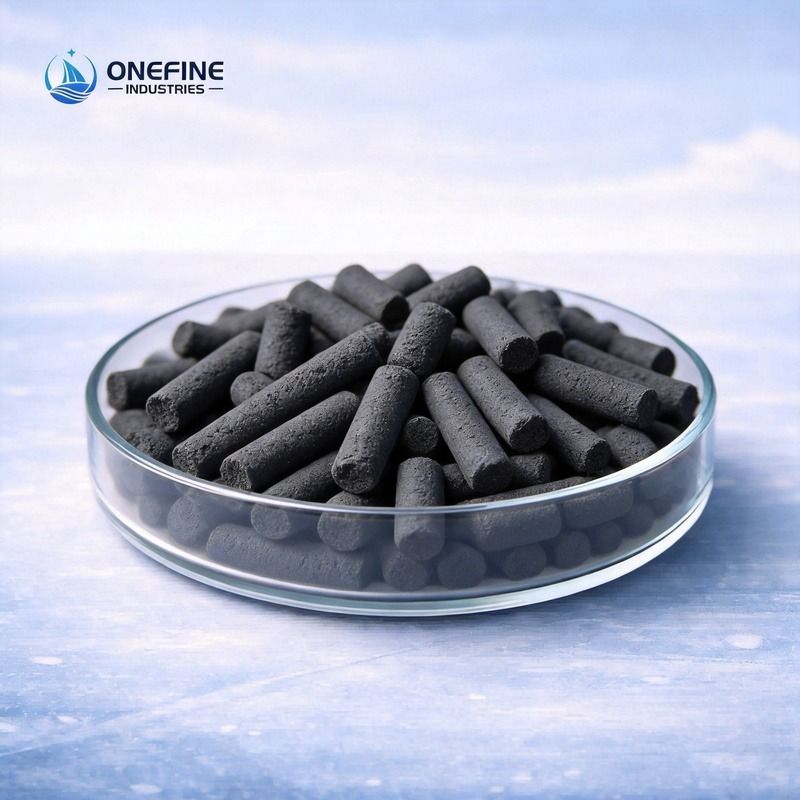
Copper-Nickel Desulfurization Catalyst
A Cu-Ni dual-system desulfurization catalyst for oil refining guard-bed applications. Removes inorganic and organic sulfur, trace chlorine, and arsenic impurities in a single step. Supplied in pre-reduced form for immediate use. Ideal as a protection agent for precious metal catalysts in reforming, hydrocracking, and isomerization units.