Mercury Removal Catalyst
High-capacity CuS/Al₂O₃ mercury removal catalyst engineered for the ultra-deep purification of natural gas, synthesis gas, and liquid hydrocarbons, permanently reducing elemental mercury to ≤ 0.01 µg/m³.
Get QuoteKey Attributes
- Formulated with highly reactive copper sulfide (CuS) evenly dispersed over a macroscopic alumina carrier for instantaneous mercury chemisorption.
- Achieves ultra-deep purification, stripping elemental and organic mercury species down to rigorous ≤ 0.01 µg/m³ thresholds.
- Provides massive stoichiometric containment limits, trapping ≥ 8.0 wt% mercury in gas applications to ensure long replacement cycles.
- Chemically anchors toxic mercury as insoluble cinnabar (HgS), completely preventing thermal or pressure-induced desorption.
- High mechanical integrity (≥ 50 N/particle) prevents structural collapse, dusting, and pressure drop surges in high-velocity reactors.
- Engineered for dual-phase operational flexibility, efficiently treating both high-pressure gas streams and viscous liquid hydrocarbon feeds.
- Shorter mass transfer zones derived from smaller particle options (1.4–2.8 mm) maximize the usable bed depth before breakthrough.
Applications
- Trace mercury scavenging in raw natural gas streams to prevent Liquid Metal Embrittlement (LME) in LNG cold box aluminum heat exchangers.
- Front-end guard bed protection for highly sensitive noble metal catalysts in light naphtha isomerization and reforming units.
- Liquid-phase mercury removal from Natural Gas Liquids (NGLs) and LPG prior to downstream fractionation or steam cracking.
- High-temperature purification of coal-derived synthesis gas (syngas) to shield copper-zinc methanol synthesis catalysts from poisoning.
- Eradication of volatile mercury from polymer-grade ethylene and propylene feeds to protect sensitive Ziegler-Natta or metallocene catalysts.
- Guard bed deployment in refinery off-gas recovery networks to ensure compliance with strict heavy metal atmospheric emission limits.
- Treatment of condensates and cracked liquid hydrocarbons to safeguard downstream severe-service centrifugal compressor impellers.
- Scavenging of mercury from hydrogen-rich recycle streams in hydrocracking and hydrotreating continuous loops.
Product Description
What is Mercury Removal Catalyst?
Key Takeaways
- Ultra-Deep Purification: Reduces elemental and organic mercury species to rigorous ≤ 0.01 µg/m³ thresholds, preventing Liquid Metal Embrittlement (LME).
- High Capacity: Delivers massive stoichiometric containment, trapping ≥ 8.0 wt% mercury in gas applications and ≥ 4.0 wt% in liquid streams.
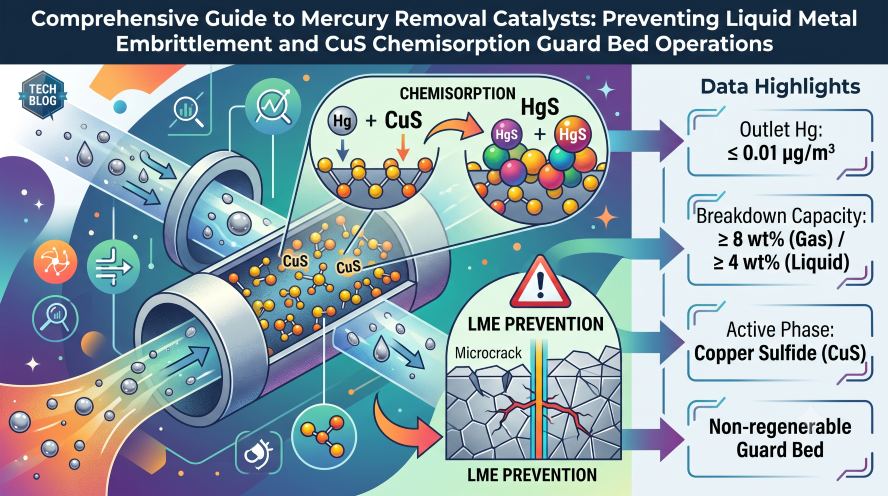
- Irreversible Chemisorption: Active copper sulfide (CuS) chemically anchors toxic mercury as insoluble cinnabar (HgS), completely preventing thermal or pressure-induced desorption.
The Mercury Removal Catalyst is a highly specialized, non-regenerable chemical adsorbent designed to eliminate trace elemental mercury (Hg⁰) and organic mercury compounds from industrial gas and liquid hydrocarbon streams. At its core, the catalyst consists of a meticulously engineered gamma-alumina (γ-Al₂O₃) spherical carrier that is homogeneously impregnated with active metal sulfides, specifically copper sulfide (CuS).
In modern petrochemical and natural gas processing, mercury is a highly toxic and destructive contaminant. Even at parts-per-billion (ppb) or parts-per-trillion (ppt) concentrations, mercury induces catastrophic Liquid Metal Embrittlement (LME) in aluminum heat exchangers (such as those used in LNG cold boxes) and irreversibly poisons precious metal catalysts (like palladium or platinum) in downstream hydrogenation units. To mitigate these risks, this catalyst functions as an essential guard bed.
The chemisorption mechanism relies on the exceptionally strong chemical affinity between elemental mercury and the sulfur atoms within the active CuS phase. When mercury-laden fluids diffuse into the alumina mesopores, the mercury chemically reacts with the copper sulfide to form mercuric sulfide (HgS, also known as cinnabar), a highly stable and insoluble mineral compound:
Hg⁰ (gas/liquid) + CuS (solid) → HgS (solid) + Cu (solid)
Because the γ-Al₂O₃ carrier is synthesized as small-diameter spherical beads (Φ 1.4–2.8 mm or 2.4–4.0 mm) with a massive macroscopic pore volume and high specific surface area, the mass transfer zone (MTZ) is drastically shortened. This highly dispersed active phase ensures rapid diffusion kinetics, allowing the catalyst to instantly trap mercury molecules before they can bypass the bed. The resulting HgS is permanently anchored within the ceramic matrix, completely eliminating the risk of mercury desorption or leaching, even under fluctuating temperature or pressure conditions. For a deeper look at LME prevention and gas vs. liquid-phase guard bed engineering, see our comprehensive mercury removal catalyst guide.
Key Benefits
- Ultra-Deep Mercury Eradication: Delivers unparalleled purification efficiency, consistently reducing the effluent mercury concentration to extremely stringent levels of ≤ 0.01 µg/m³, ensuring absolute protection for downstream aluminum equipment and noble metal catalysts.
- Exceptional Breakthrough Capacity: The optimized CuS impregnation provides a massive stoichiometric reservoir for mercury capture, achieving a breakthrough capacity of ≥ 8.0 wt% in gas-phase operations and ≥ 4.0 wt% in liquid-phase applications, leading to multi-year bed lifespans.
- Superior Physical Integrity: Manufactured as robust spherical beads with a guaranteed minimum crush strength of ≥ 50 N/particle and a low attrition rate of ≤ 5.0%. This structural durability prevents bed compaction, fine dusting, and excessive pressure drops under high flow rates.
- Broad Dual-Phase Applicability: Highly versatile kinetic profile allows for deployment in both high-velocity gas streams (GHSV: 300–3000 h⁻¹) and dense liquid hydrocarbon streams (LHSV: 2–10 h⁻¹) without loss of chemisorption efficiency.
- Extreme Operational Flexibility: Maintains highly stable performance across a broad thermodynamic window, effortlessly handling variable process pressures up to 5.0 MPa and temperatures ranging from ambient conditions up to 190 °C.
- Shortened Mass Transfer Zone: The engineered combination of small particle sizing (as low as 1.4 mm) and large internal pore volume significantly reduces the depth of the active reaction zone, allowing for maximum utilization of the catalyst bed volume before breakthrough occurs.
Applications
This CuS/Al₂O₃ mercury removal catalyst is globally deployed as a frontline sacrificial guard bed across multiple critical sectors of the energy and petrochemical industries:
- Liquefied Natural Gas (LNG) Pre-treatment: Placed upstream of the cryogenic liquefaction section. Natural gas frequently contains trace elemental mercury originating from subterranean reservoirs. If permitted to enter the main cryogenic heat exchanger (MCHE), mercury will amalgamate with the aluminum components, causing catastrophic Liquid Metal Embrittlement (LME) and structural cracking. This catalyst scrubs the feed gas to ≤ 0.01 µg/m³, securing the multi-billion-dollar cryogenic infrastructure.
- Synthesis Gas (Syngas) Purification: Utilized in coal-to-chemicals (CTC), coal-to-liquids (CTL), and steam methane reforming (SMR) plants. Raw syngas often carries volatile mercury species derived from coal or heavy feedstocks. By acting as a high-temperature (up to 190 °C) guard bed, this catalyst prevents the severe and irreversible mercury poisoning of copper-zinc based methanol synthesis catalysts and downstream water-gas shift reactors.
- Ethylene and Propylene Cracker Protection: Deployed to treat light liquid hydrocarbons, LPG, and naphtha feedstocks before they enter steam cracking furnaces. Mercury in liquid feeds can aggressively attack the cracked gas compressors and palladium-based selective hydrogenation catalysts. The catalyst's robust liquid-phase capacity (≥ 4.0 wt%) ensures safe, mercury-free operation for sensitive olefin production units.
- Refinery Off-Gas and Fuel Gas Treatment: Applied in refining networks to strip mercury from variable off-gas streams before they are routed to the plant fuel gas system or sent to the flare network, ensuring strict compliance with evolving environmental emission regulations regarding heavy metal atmospheric discharge.
Packaging & Shipping
We offer flexible packaging and shipping options to suit your project scale and logistics requirements.
Standard Packaging:
- 25 kg drums (moisture-proof, suitable for trial orders and small batches)
- 150 kg steel drums (standard bulk packaging for industrial orders)
- 500 kg super sacks (most popular for industrial bulk orders)
- 1000 kg jumbo bags (for large-scale projects)
- Custom packaging available on request
Minimum Order Quantity (MOQ):
- 1 ton (entry-level orders accepted — perfect for first-time customers)
- 5+ tons (standard bulk orders)
- Container-level supply for long-term partnerships
Container Loading Capacity:
- 20'GP container: 18-20 tons (palletized)
- 40'GP container: 22-24 tons (palletized)
- 40'HQ container: 24-26 tons
Loading Ports: We ship from major Chinese ports based on your requirements: Shanghai, Qingdao, Tianjin, Ningbo, and Shenzhen.
Lead Time:
- Stock orders: 7-15 days from payment confirmation
- Made-to-order: 20-30 days
Shipping Terms: FOB / CIF / CFR / EXW — flexible based on your destination and preferences.
Documents & Certificates
We provide complete documentation for every order:
📄 Technical Data Sheet (TDS) — Confirmed with you during product selection, ensuring exact specifications match your application requirements.
📄 Safety Data Sheet (SDS) — Provided before shipment, meeting all international transportation and handling standards.
📄 Certificate of Analysis (COA) — Issued for each production batch, delivered with your shipment for full quality traceability.
Additional documents available on request: Certificate of Origin (COO), Packing List, Commercial Invoice, Third-party Inspection Report (SGS / BV), Form E (for Middle East destinations with applicable tariff benefits).
Regeneration
Because the mercury removal process relies on an irreversible chemical transformation—converting elemental mercury (Hg⁰) and reactive copper sulfide (CuS) into stable mercuric sulfide (HgS)—this catalyst is strictly a non-regenerable, sacrificial material.
Unlike physical adsorbents (such as standard molecular sieves used for moisture removal), the chemical bonds formed within the cinnabar (HgS) matrix cannot be broken through standard thermal swing or pressure swing processes without extremely hazardous consequences. Attempting to thermally regenerate a saturated mercury guard bed (e.g., heating it above 350 °C) would cause the HgS to thermally decompose, subsequently vaporizing massive quantities of highly toxic mercury gas directly into the regeneration circuit or atmosphere, creating a catastrophic health, safety, and environmental (HSE) crisis.
Therefore, the catalyst bed is designed to operate continuously until the active CuS sites are fully consumed and the mercury concentration at the reactor outlet begins to approach the ≤ 0.01 µg/m³ breakthrough threshold. Once the bed is saturated (typically after 3 to 5 years of continuous service, depending on feed contamination levels), the vessel is isolated. The spent catalyst, which securely encapsulates the toxic mercury as an insoluble solid, is then carefully vacuum-discharged and sent to specialized, certified environmental processing facilities for safe disposal or industrial mercury recovery.
FAQ
Q1: Why is there a difference in breakthrough capacity between gas-phase (≥ 8 wt%) and liquid-phase (≥ 4 wt%) operations? The discrepancy stems from fundamental differences in fluid dynamics and mass transfer kinetics. In gas-phase streams (such as natural gas or syngas), the low viscosity of the fluid allows mercury vapor to rapidly and deeply diffuse into the internal mesoporous network of the alumina carrier, maximizing active site utilization. Conversely, in liquid-phase streams (such as naphtha or NGLs), the higher viscosity and liquid film resistance hinder deep pore diffusion. Consequently, liquid-phase chemisorption relies more heavily on the outer layer of the catalyst bead, resulting in a lower overall stoichiometric utilization (≥ 4 wt%) before breakthrough occurs.
Q2: Why is the maximum operating temperature limited to 190 °C? The 190 °C threshold is dictated by the thermal stability of the active metal sulfide phase. Operating below 190 °C ensures that the copper sulfide (CuS) remains chemically stable and highly reactive toward mercury. If the operating temperature significantly exceeds this limit for extended periods, the CuS phase can undergo thermal degradation, and there is an increased risk of sulfur sublimation or the premature desorption of captured heavy metals. Adhering to the ambient to 190 °C window guarantees irreversible mercury fixation.
Q3: How does this CuS/Al₂O₃ catalyst compare to sulfur-impregnated activated carbon (AC) for mercury removal? While sulfurized activated carbon is occasionally used for mercury removal, our CuS/Al₂O₃ catalyst offers drastically superior industrial performance. Activated carbon is highly susceptible to capillary condensation; if liquid hydrocarbons or moisture are present, the AC pores flood, instantly killing its mercury removal efficiency. Our highly robust alumina (γ-Al₂O₃) carrier is entirely immune to moisture flooding and liquid hydrocarbon condensation. Furthermore, alumina possesses vastly superior mechanical crush strength (≥ 50 N/particle) compared to fragile carbon, allowing it to withstand high operating pressures (up to 5.0 MPa) without fracturing into hazardous dust.
Q4: Can this catalyst handle feedstocks that contain high levels of moisture or hydrogen sulfide (H₂S)? Yes. The base alumina carrier maintains its structural integrity even in fully water-saturated gas streams. Additionally, unlike some metal oxide guard beds that are rapidly consumed by sulfur compounds, the active phase in this catalyst is already fully sulfided (CuS). Therefore, the presence of background hydrogen sulfide (H₂S) in the feed gas does not inhibit the mercury removal kinetics. In fact, trace H₂S can sometimes aid in maintaining the highly active sulfided state of the catalyst surface over prolonged operational campaigns.
Need a Custom Solution?
For bulk pricing and grade recommendation, please send your feedstock mercury concentration and gas/liquid phase operating conditions to us. Our technical team will get back to you within 24 hours with a tailored solution.
Technical Specifications
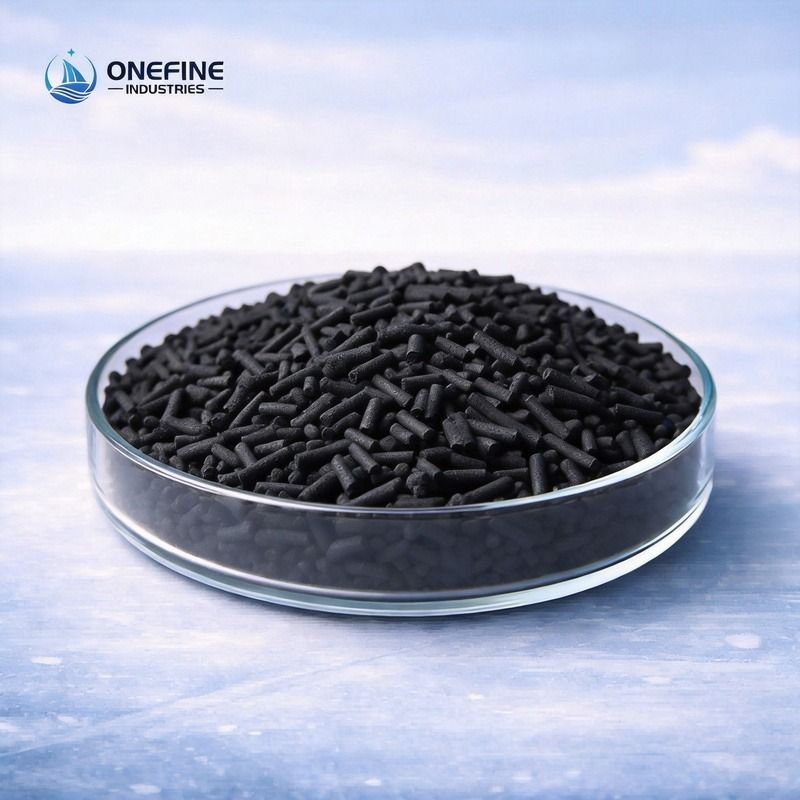
| Appearance | Black spherical beads |
| Active Component | Copper Sulfide (CuS) |
| Carrier Matrix | Alumina (γ-Al₂O₃) |
| Particle Size (Φ) | 1.4 ~ 2.8 mm / 2.4 ~ 4.0 mm |
| Bulk Density | 0.85 ± 0.10 kg/L |
| Average Crush Strength | ≥ 50 N/particle |
| Attrition Rate | ≤ 5.0% |
| Operating Pressure | Ambient ~ 5.0 MPa |
| Operating Temperature | Ambient ~ 190 °C |
| Liquid Space Velocity (LHSV) | 2 ~ 10 h⁻¹ |
| Gas Space Velocity (GHSV) | 300 ~ 3000 h⁻¹ |
| Outlet Mercury Content | ≤ 0.01 µg/m³ |
| Mercury Capacity (Gas Phase) | ≥ 8.0 wt% |
| Mercury Capacity (Liquid Phase) | ≥ 4.0 wt% |
Related Products
No related products.