Ni-Mo Hydrogenation Catalyst
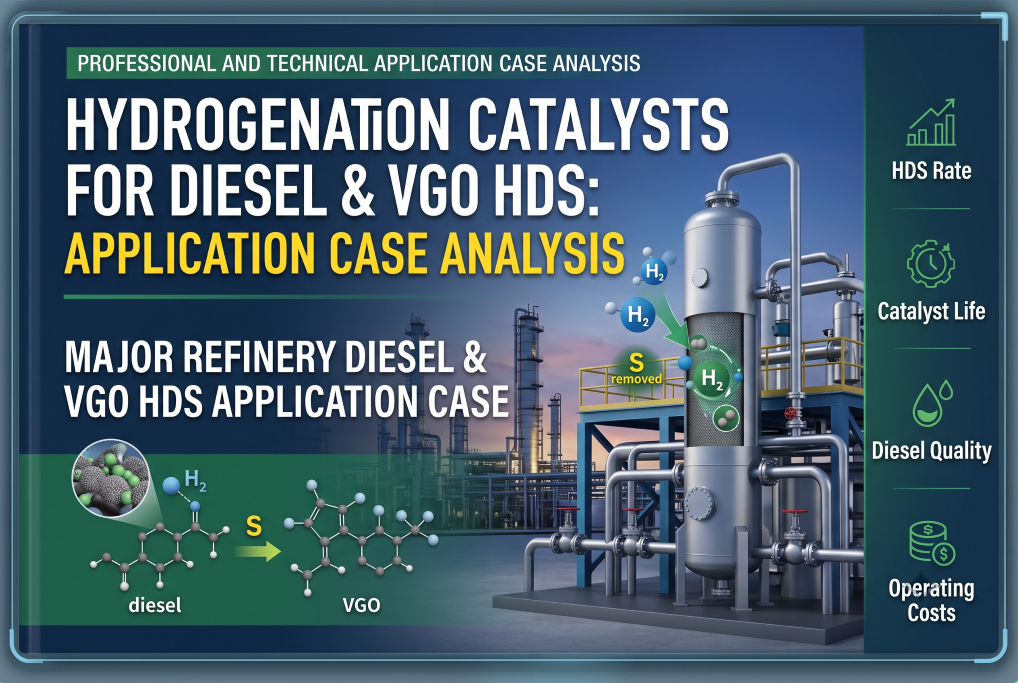
A high-performance nickel-molybdenum (Ni-Mo) hydrogenation catalyst designed for hydrodesulfurization (HDS) and hydrodenitrogenation (HDN) of medium to heavy petroleum fractions. Features superior hydrogenation activity, excellent stability, and long service life. Widely used in diesel hydrotreating, gas oil upgrading, and refractory sulfur removal. MOQ from 1 ton. Customizable appearance, particle size, and active component loading.
Get QuoteKey Attributes
- Higher Hydrogenation Activity vs. Co-Mo – The Ni-Mo-S active phase generates more hydrogenation sites than Co-Mo-S, delivering higher conversion on refractory sulfur compounds (4,6-dimethyldibenzothiophene) and superior aromatic saturation. This makes Ni-Mo the preferred choice when feedstocks contain high levels of difficult-to-treat sulfur species.
- TiO₂-Enhanced Composite Support – Unlike conventional pure γ-Al₂O₃ supports, the TiO₂-Al₂O₃ composite increases metal–support interaction, suppresses MoS₂ slab stacking, and improves resistance to thermal sintering — extending catalyst stability in severe hydrocracking pretreatment conditions.
- Superior HDN Capability – Ni-Mo catalysts break C–N bonds faster than equivalent Co-Mo systems, making them well suited for feeds with high nitrogen content (gas oils, coker distillates, FCC feedstocks) where nitrogen removal is critical for downstream catalyst protection.
- Wider Operating Window – With a light-off temperature as low as 160°C and stable operation up to 450°C, Ni-Mo catalysts cover both light-feed sweetening and heavy-feed deep hydrotreating in a single formulation — reducing the need for multiple catalyst SKUs across different process units.
- Trilobe / Quadrilobe Geometry Optimization – Multi-lobe extrudate shapes maximize external surface area and minimize intraparticle diffusion resistance, ensuring active sites are fully utilized even at high space velocities typical of diesel and gas oil hydrotreaters.
- Fully Tailorable Active Loading – NiO, MoO₃, and TiO₂ contents can be adjusted independently to optimize the HDS/HDN/aromatics saturation balance for specific feedstocks — from mild naphtha treating to severe vacuum gas oil hydroprocessing.
Applications
- Diesel Hydrodesulfurization (HDS) – Produces ultra-low-sulfur diesel (ULSD) meeting IMO 2020, Euro VI, and China National VI standards. Ni-Mo system excels at converting refractory sulfur compounds (dibenzothiophenes, 4,6-dimethyldibenzothiophene) that Co-Mo catalysts struggle with.
- Gas Oil Hydrotreating – Upgrades vacuum gas oil (VGO) and coker gas oil for downstream catalytic cracking or hydrocracking, removing sulfur, nitrogen, and metals that poison cracking catalysts.
- Naphtha Pretreatment for Catalytic Reforming – Removes sulfur, nitrogen, and olefins from naphtha feed before catalytic reforming, protecting platinum-based reforming catalysts from poisoning.
- Kerosene & Jet Fuel Desulfurization – Hydrotreats kerosene and jet fuel fractions to meet stringent sulfur specifications, improving fuel stability and reducing emissions in aviation applications.
- Natural Gas & Refinery Gas Sweetening – Converts mercaptans, COS, and organic sulfur species in gaseous feeds to H₂S for downstream removal by ZnO guard bed.
- Bio-Feedstock Co-Processing – Increasingly used for co-processing renewable feedstocks (vegetable oils, animal fats, pyrolysis bio-oils) in conventional refinery hydrotreaters, where Ni-Mo catalysts handle both sulfur removal and oxygenate hydrogenation.
- Vacuum Gas Oil (VGO) Pretreatment for Hydrocracking – Removes sulfur, nitrogen, and polycyclic aromatics from VGO ahead of the hydrocracker, protecting downstream cracking catalysts from nitrogen and metal poisoning while improving product yield and quality.
- Fluid Catalytic Cracking (FCC) Feed Pretreatment – Hydrotreats FCC feedstock to reduce sulfur (for SOx emission control), nitrogen (for cracking catalyst protection), and Conradson carbon residue, improving downstream conversion and product quality.
Product Description
What Is a Ni-Mo Hydrogenation Catalyst?
Key Takeaways:
- Active Phase Advantage: Ni-Mo-S phase provides superior hydrogenation sites compared to Co-Mo, excelling at refractory sulfur (e.g., 4,6-DMDBT) removal for ULSD compliance.
- Enhanced Support: Utilizes a TiO₂-Al₂O₃ composite support to suppress MoS₂ stacking and improve thermal resistance in severe hydrocracking pretreatments.
- Deep HDN Capability: Breaks C–N bonds faster than Co-Mo systems, crucial for high-nitrogen feeds like vacuum gas oil (VGO) and coker distillates.
- Broad Operating Window: Delivers stable operation from 160°C to 450°C, accommodating both light-feed sweetening and heavy-feed deep hydrotreating.
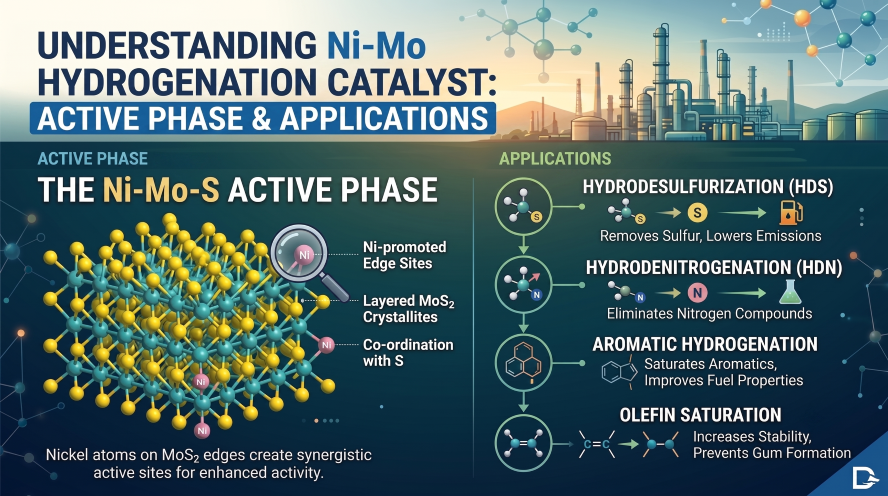
A nickel-molybdenum (Ni-Mo) hydrogenation catalyst is a high-activity hydrotreating catalyst system widely used in petroleum refining for medium to heavy feedstock upgrading. It consists of nickel oxide (NiO) and molybdenum trioxide (MoO₃) impregnated on a high-surface-area γ-alumina (γ-Al₂O₃) support with titanium dioxide (TiO₂) addition. Upon presulfiding, the active metals are converted to their sulfide forms — molybdenum disulfide (MoS₂) promoted by nickel sulfide (Ni₃S₂) — forming the catalytically active Ni-Mo-S phase that drives hydrodesulfurization (HDS) and hydrodenitrogenation (HDN) reactions.
For a deeper look at how this active phase forms and when to choose Ni-Mo over Co-Mo, see our guide: What is a Ni-Mo Hydrogenation Catalyst?
Ni-Mo catalysts are particularly effective for removing sulfur and nitrogen from heavier petroleum fractions (diesel, gas oil, vacuum residue) where refractory sulfur compounds (dibenzothiophenes with alkyl substituents) require higher hydrogenation activity than Co-Mo systems can provide. The addition of TiO₂ to the alumina support enhances metal dispersion and thermal stability, making Ni-Mo catalysts suitable for demanding hydrocracking pretreatment and deep desulfurization applications.
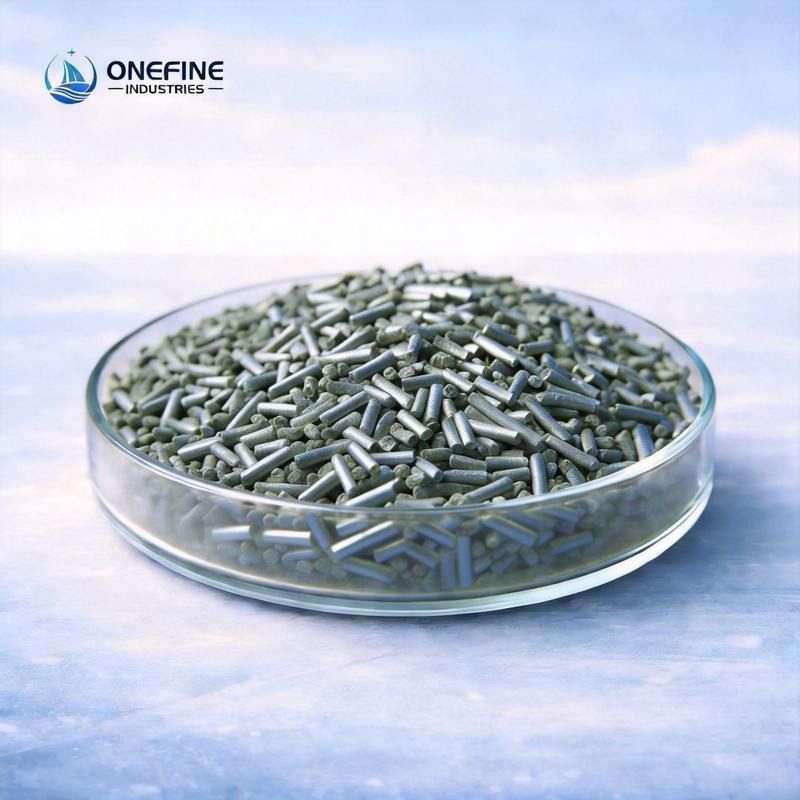
The catalyst is available in trilobe or quadrilobe extrudate geometries, each offering optimized mass transfer characteristics and pressure drop profiles for specific reactor designs and feed types.
Active Phase Chemistry
The catalytic activity of Ni-Mo catalysts is directly linked to the formation of the Ni-Mo-S active phase during presulfiding:
Oxide form (as shipped):
- Active metals: NiO (2-5 wt.%) + MoO₃ (12-16 wt.%)
- Support: γ-Al₂O₃ + TiO₂ (balance)
- The oxide form is stable for storage and transport
Sulfide form (after presulfiding):
- Active phase: MoS₂ crystallites promoted by Ni₃S₂ at the edges
- The Ni-Mo-S structure creates highly active sites for C-S and C-N bond cleavage
- Nickel acts as a promoter, increasing the number of active edge sites on MoS₂ slabs and enhancing hydrogenation activity
Why Ni-Mo (vs. Co-Mo or Ni-W)?
- Ni-Mo offers higher hydrogenation activity than Co-Mo for refractory sulfur compounds (dibenzothiophenes)
- Better HDN (hydrodenitrogenation) performance than Co-Mo — essential for feeds with high nitrogen content
- More economical than Ni-Mo-W for most diesel and gas oil applications
- Optimal balance of HDS/HDN activity for medium-boiling feeds (200-400°C distillation range)
Key Reactions
The Ni-Mo hydrogenation catalyst drives multiple simultaneous reactions in a single catalytic bed:
- Thiol hydrogenolysis: RSH + H₂ → RH + H₂S
- Sulfide hydrogenolysis: R₁SR₂ + 2H₂ → R₁H + R₂H + H₂S
- Disulfide hydrogenolysis: R₁SSR₂ + 3H₂ → R₁H + R₂H + H₂S
- Thiophene hydrogenolysis: C₄HS + 4H₂ → C₄H₁₀ + H₂S
- Benzothiophene HDS: C₈H₆S + 3H₂ → C₈H₁₀ + H₂S
- Dibenzothiophene HDS: C₁₂H₈S + 3H₂ → C₁₂H₁₂ + H₂S
- 4,6-Dimethyldibenzothiophene HDS: C₁₄H₁₂S + 3H₂ → C₁₄H₁₆ + H₂S (refractory sulfur)
- COS hydrogenolysis: COS + H₂ → CO + H₂S
- CS₂ hydrogenolysis: CS₂ + 4H₂ → CH + 2H₂S
- Hydrodenitrogenation (HDN): R-NH₂ + H₂ → RH + NH₃
- Olefin hydrogenation: CₙH₂ₙ + H₂ → CₙH₂ₙ₊₂
- Aromatics saturation: C₆H₆ + 3H₂ → C₆H₁₂ (partial)
How It Works
1. Deep Hydrodesulfurization (HDS) Ni-Mo catalysts achieve very high conversion of refractory sulfur species — particularly 4,6-dimethyldibenzothiophene (4,6-DMDBT) — through a hydrogenation pathway that Co-Mo catalysts cannot match as effectively. The mechanism involves partial hydrogenation of one aromatic ring in the dibenzothiophene structure, followed by C-S bond cleavage. This direct desulfurization (DDS) and hydrogenation (HYD) dual pathway is what enables Ni-Mo catalysts to produce ultra-low-sulfur diesel from challenging feeds.
2. Hydrodenitrogenation (HDN) Nitrogen compounds (pyridines, pyrroles, quinolines, indoles) are significantly more difficult to remove than sulfur compounds because C-N bonds require full aromatic ring hydrogenation before cleavage can occur. Ni-Mo catalysts provide the hydrogenation activity necessary to saturate nitrogen-containing aromatic rings, enabling efficient NH₃ release. This is essential for feeds with high nitrogen content (gas oils, coker distillates) because residual nitrogen poisons downstream hydrocracking and catalytic reforming catalysts.
3. Aromatic Saturation & Olefin Hydrogenation Ni-Mo catalysts partially saturate polyaromatic compounds and fully hydrogenate olefins, improving product stability, reducing gum formation, and increasing cetane number in diesel products. This saturation capability is a key differentiator from Co-Mo catalysts, which are more selective and less aggressive in aromatic hydrogenation.
Process Integration
Ni-Mo hydrogenation catalysts are deployed in fixed-bed downflow reactors within the refinery hydrotreating unit. The typical process flow:
- Feed Preparation: Raw feedstock (diesel, gas oil, etc.) is blended with hydrogen-rich recycle gas. The H₂/oil ratio is set based on feed sulfur and nitrogen content — higher contaminant levels require greater hydrogen supply.
- Catalytic Reaction: The mixture passes through the Ni-Mo catalyst bed at 250-420°C and 3.0-5.0 MPa. Sulfur, nitrogen, and olefin reactions proceed simultaneously across the catalyst's active Ni-Mo-S phase, producing H₂S, NH₃, and saturated hydrocarbons.
- Separation & Stabilization: Reactor effluent is cooled and separated into gas (H₂S, NH₃, excess H₂) and liquid (hydrotreated product) streams. For liquid hydrotreating, the product is sent to a stripper to remove dissolved H₂S and NH₃, and recycle gas is recovered after amine scrubbing. For gas-phase sweetening applications, the generated H₂S is instead captured downstream by a Zinc Oxide guard bed.
Presulfiding for Ni-Mo Systems
Ni-Mo catalysts require conversion from oxide form to the active Ni-Mo-S sulfide phase before feed introduction. The presulfiding protocol differs from Co-Mo in two key respects:
- Lower onset temperature: Ni-Mo oxide-to-sulfide conversion begins at approximately 160°C, requiring a slower initial ramp to avoid thermal shock during the early exothermic sulfidation reactions.
- Higher sulfur uptake: Due to the higher MoO₃ loading (12-16 wt.%) and additional NiO promoter, Ni-Mo catalysts typically require adequate sulfiding agent supply throughout the process to reach full sulfidation.
Presulfiding is typically completed over 8-24 hours using DMDS or CS₂ as the sulfur source, with H₂S breakthrough monitored in the reactor effluent. Incomplete sulfidation results in permanently reduced HDN and HDS activity — this is especially critical for Ni-Mo catalysts because unsulfided NiO sites can catalyze unwanted cracking reactions that damage product yield.
Typical Operating Environments
Ni-Mo catalysts are primarily deployed in medium-to-heavy feed hydrotreating applications. The ranges below are industry-typical reference ranges and may vary by unit design and feed conditions:
- Diesel HDS (ULSD production): The most common Ni-Mo application. Operating at 320-400°C and 3.0-5.0 MPa, LHSV typically 1.5-3.0 h⁻¹ with H₂/oil ratios of 300-500 Nm³/m³. The Ni-Mo system's strong refractory sulfur removal (4,6-DMDBT) supports compliance with ULSD specifications.
- Vacuum Gas Oil (VGO) Hydrotreating: Used as pretreatment before hydrocracking. Higher severity conditions (350-420°C, 5.0-10.0 MPa) are required due to the high nitrogen and polycyclic aromatic content of VGO. Ni-Mo catalysts are preferred over Co-Mo here because of their better HDN performance — residual nitrogen would poison the downstream hydrocracking catalyst.
- Coker Gas Oil Upgrading: Delayed coker gas oil contains elevated nitrogen, olefins, and conjugated dienes. Ni-Mo catalysts handle this challenging feed through simultaneous HDN, olefin saturation, and HDS. Operating temperatures are typically at the higher end of the range (380-430°C) to ensure adequate nitrogen removal.
- Bio-Feedstock Co-Processing: When co-processing vegetable oils or animal fats with petroleum-derived feeds, Ni-Mo catalysts simultaneously handle sulfur removal and oxygenate hydrogenation (converting fatty acid esters to hydrocarbons + H₂O). This application is gaining importance as refineries integrate renewable feedstocks.
Operating Conditions
The following are industry-typical reference ranges; actual conditions depend on reactor design and feed quality:
- Naphtha HDS: 200-350°C, 2.0-4.0 MPa, LHSV 2.0-6.0 h⁻¹, H₂/HC 150-300
- Diesel HDS (ULSD): 320-400°C, 3.0-5.0 MPa, LHSV 1.5-3.0 h⁻¹, H₂/HC 300-500
- Gas Oil Hydrotreating: 350-420°C, 5.0-10.0 MPa, LHSV 1.0-2.0 h⁻¹, H₂/HC 500-800
- Kerosene HDS: 280-360°C, 2.0-4.0 MPa, LHSV 2.0-5.0 h⁻¹, H₂/HC 150-300
- Gas-phase HDS: 200-380°C, 1.5-4.0 MPa, GHSV 1,000-3,000 h⁻¹, H₂/HC 50-100
Deactivation Mechanisms & Prevention
Ni-Mo catalysts can lose activity over time through several mechanisms:
- Coke Deposition: Carbonaceous deposits block active sites and pores, especially at higher temperatures or with feeds containing high concentrations of olefins or aromatics. This is partially reversible through regeneration.
- Metal Poisoning: Trace metals (arsenic, lead, silicon, sodium) in the feed can irreversibly poison active sites. For feeds with high metal content, a guard bed or pretreatment step is recommended.
- Sulfation / Over-oxidation: Exposure to oxygen or water at high temperatures can convert active sulfide phases back to less active oxide or sulfate forms. Strict control of feed quality and reactor atmosphere is essential.
- Thermal Sintering: Prolonged operation above the maximum design temperature causes sintering of MoS₂ crystallites and loss of active surface area. Temperature monitoring and control systems are critical.
- Mechanical Damage: Thermal cycling, pressure surges, or improper catalyst loading can cause particle breakage, increasing pressure drop and creating channeling. Proper loading procedures and stable operation minimize mechanical damage.
Best practices for maximizing catalyst life:
- Maintain feed quality within design specifications (sulfur, nitrogen, metals, water content)
- Avoid temperature excursions above the maximum rated temperature
- Ensure complete presulfiding before introducing feed
- Monitor pressure drop across the bed — sudden increases indicate fouling or particle breakage
- Use a guard bed or particulate filter upstream if feed contains suspended solids
- Plan regeneration cycles based on activity monitoring, not fixed time intervals
Ni-Mo-Specific Deactivation Concerns
While Ni-Mo catalysts share common deactivation pathways with other hydrotreating catalysts, two mechanisms are particularly relevant to the Ni-Mo system:
- Nitrogen Compound Adsorption Poisoning: High-nitrogen feeds (gas oils, coker distillates) can cause temporary activity loss through strong adsorption of basic nitrogen compounds (pyridines, quinolines) on the catalyst's acidic support sites. Unlike coke deposition, this form of deactivation is reversible — increasing reaction temperature temporarily restores activity.
- TiO₂ Leaching Under Severe Conditions: In the TiO₂-Al₂O₃ composite support system, prolonged exposure to high-pH environments (e.g., from NH₃ generated during HDN reactions) can cause gradual TiO₂ dissolution from the support matrix, reducing the metal-support interaction benefits that TiO₂ provides.
- Phosphorus Contamination from Refinery Streams: Phosphorus compounds (from corrosion inhibitors, crude oil additives, or FCC slurry oil recycle) can deposit on Ni-Mo catalyst surfaces and block active sites. Feed screening for phosphorus content and use of guard beds are recommended when this contamination pathway exists.
Regeneration & Service Life
When activity declines due to coke deposition, the catalyst can be regenerated through controlled oxidative burn-off:
Regeneration process:
- Stop feed and purge the reactor with inert gas (N₂)
- Introduce controlled amounts of air into the inert gas stream at low oxygen concentration (initially < 1% O₂)
- Gradually increase oxygen concentration while closely monitoring bed temperature to prevent runaway exotherm
- Complete regeneration when CO₂ evolution ceases, indicating all coke has been burned off
- Resulfidation is required before reintroducing feed
Service life expectations:
- Typical on-stream life: 3-5 years per cycle (depending on feed severity and operating conditions)
- Regeneration cycles: 1-3 regenerations possible, depending on the extent of irreversible deactivation
- Total useful life: 6-15 years with proper management
- Regeneration temperatures should not exceed 500°C to prevent irreversible phase transformation of the TiO₂ component
Packaging & Shipping
We offer flexible packaging and shipping options to suit your project scale and logistics requirements.
Standard Packaging:
- 25 kg drums (moisture-proof, suitable for trial orders and small batches)
- 150 kg steel drums (standard bulk packaging for industrial orders, with inner polyethylene liner to prevent moisture absorption)
- 500 kg super sacks (most popular for industrial bulk orders)
- 1000 kg jumbo bags (for large-scale projects)
- Custom packaging available on request
Minimum Order Quantity (MOQ):
- 1 ton (entry-level orders accepted — perfect for first-time customers)
- 5+ tons (standard bulk orders)
- Container-level supply for long-term partnerships
Container Loading Capacity:
- 20'GP container: 18-20 tons (palletized)
- 40'GP container: 22-24 tons (palletized)
- 40'HQ container: 24-26 tons
Loading Ports: We ship from major Chinese ports based on your requirements: Shanghai, Qingdao, Tianjin, Ningbo, and Shenzhen.
Lead Time:
- Stock orders: 7-15 days from payment confirmation
- Made-to-order: 20-30 days
Shipping Terms: FOB / CIF / CFR / EXW — flexible based on your destination and preferences.
Handling Note: During reactor loading, trilobe/quadrilobe geometry requires careful bed distribution to avoid channeling — mechanical loading with vibration-assisted leveling is recommended over sock loading for multi-lobe shapes. Shelf life in original sealed packaging exceeds 5 years.
Documents & Certificates
We provide complete documentation for every order:
📄 Technical Data Sheet (TDS) — Confirmed with you during product selection, ensuring exact specifications match your application requirements.
📄 Safety Data Sheet (SDS) — Provided before shipment, meeting all international transportation and handling standards.
📄 Certificate of Analysis (COA) — Issued for each production batch, delivered with your shipment for full quality traceability.
Additional documents available on request: Certificate of Origin (COO), Packing List, Commercial Invoice, Third-party Inspection Report (SGS / BV), Form E (for Middle East destinations with applicable tariff benefits).
FAQ
Q: What's the difference between Ni-Mo and Co-Mo hydrogenation catalysts? A: Ni-Mo catalysts generally offer higher hydrogenation activity and better hydrodenitrogenation (HDN) performance, making them well suited for heavier, higher-nitrogen feeds such as gas oil and coker distillates. Co-Mo catalysts are typically more selective for lighter, lower-nitrogen feeds. The right choice depends on your feedstock composition and reactor conditions.
Q: Does the catalyst need to be presulfided before use? A: Yes. The catalyst ships in oxide form and must be converted to its active sulfide phase through a presulfiding process (typically 8-24 hours using DMDS or CS₂) before introducing feed. Incomplete presulfiding permanently reduces catalytic activity.
Q: How long does the catalyst last, and can it be regenerated? A: Typical on-stream life is 3-5 years per cycle, with 1-3 regeneration cycles possible depending on feed severity and deactivation extent — giving a total useful life of roughly 6-15 years with proper management.
Q: What packaging and minimum order quantity do you offer? A: The catalyst ships in sealed steel drums with moisture-barrier liners. MOQ starts from 1 ton, with container-level supply (20'GP / 40'GP / 40'HQ) available for long-term partnerships.
Need a Custom Solution?
For bulk pricing and grade recommendation, please send your feedstock composition and reactor conditions to us. Our technical team will get back to you within 24 hours with a tailored solution.
Technical Specifications
| Appearance | Trilobe or quadrilobe extrudates (customizable) |
| Particle Size | Φ2.5 ± 1.0 mm (customizable upon request) |
| Bulk Density | 0.65 ± 0.10 kg/L |
| NiO Content | 2 – 5 wt.% (customizable) |
| MoO₃ Content | 12 – 16 wt.% (customizable) |
| TiO₂+Al₂O₃ Content | Balance (γ-Al₂O₃ + TiO₂ composite support) |
| Operating Temperature | 160 – 450°C |
| Operating Pressure | 1.5 – 5.0 MPa |
| Target Reactions | Hydrodesulfurization (HDS), hydrodenitrogenation (HDN), olefin saturation |
| Applicable Feeds | Diesel, gas oil, naphtha, kerosene, natural gas, refinery gas |
| Form | Extrudate (trilobe / quadrilobe – customer's choice) |
Related Products
Co-Mo Hydrogenation Catalyst
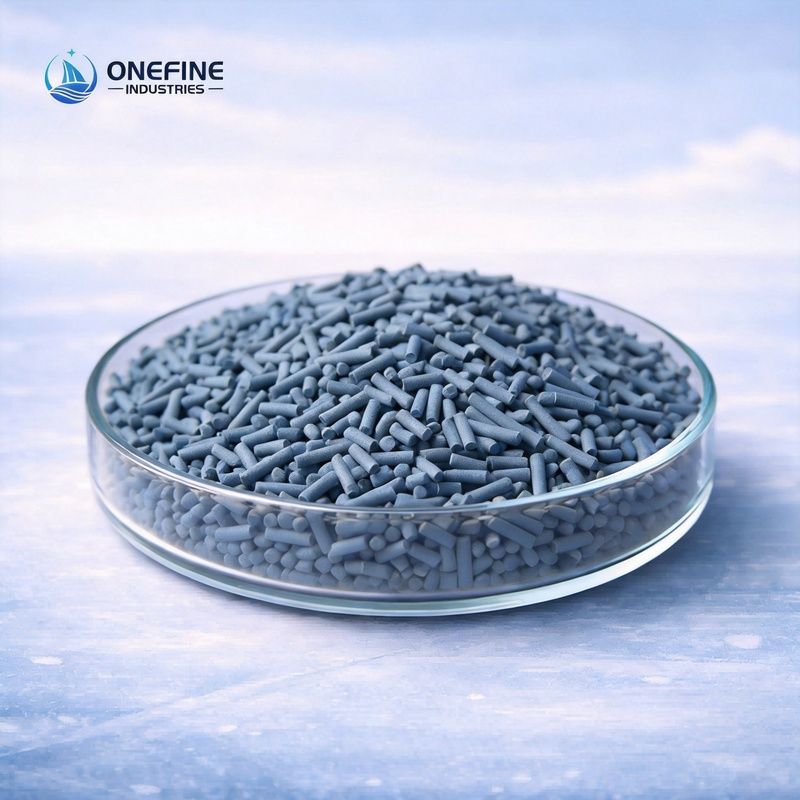
A high-performance cobalt-molybdenum (Co-Mo) hydrogenation catalyst designed for hydrodesulfurization (HDS) and hydrotreating of petroleum fractions and synthesis gas. Features low light-off temperature, high mechanical strength, and excellent stability. Widely used in ammonia plant feed purification, naphtha pretreatment, refinery reforming feed desulfurization, and natural gas sweetening. Available with MOQ from 1 ton, customizable appearance, particle size, and active component loading.
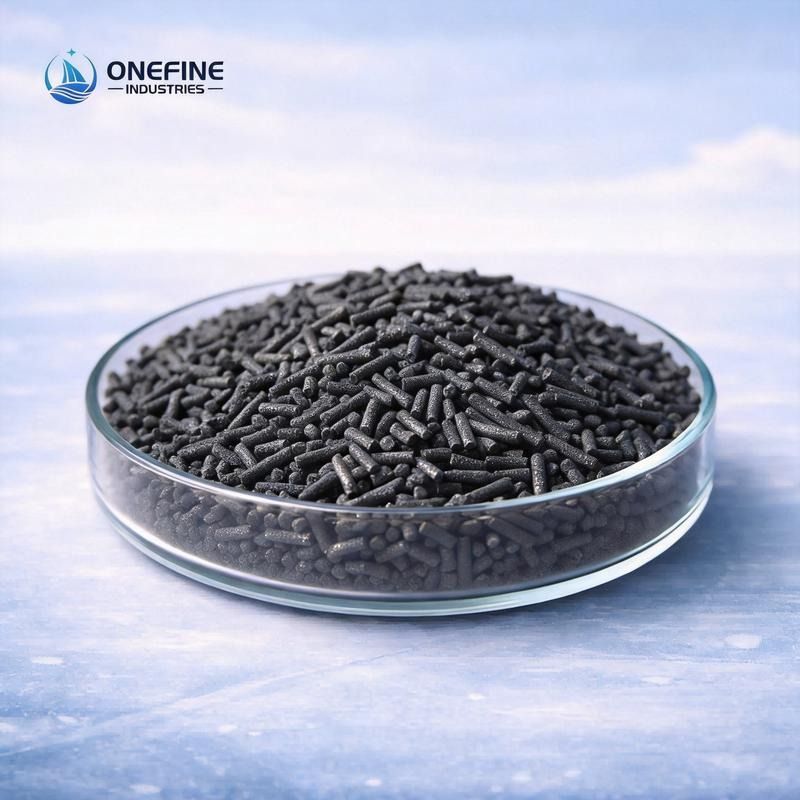
Ni-Mo-W hydrogenation catalyst
A trimetallic nickel-molybdenum-tungsten (Ni-Mo-W) hydrogenation catalyst engineered for ultra-deep hydrodesulfurization of challenging petroleum feeds. Combines the synergistic HDS activity of Mo-W mixed sulfide phases with Ni promoter for superior refractory sulfur removal. Widely used in diesel ULSD production, heavy gas oil upgrading, and severe hydrotreating service. Customizable appearance, particle size, and component loading.
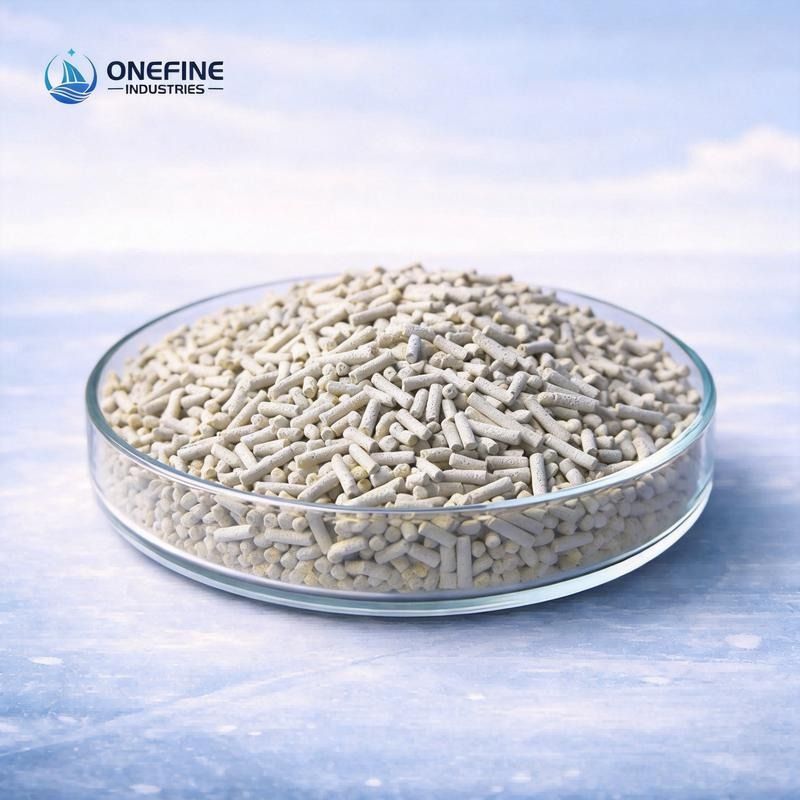
Zinc oxide desulfurization catalyst
High-purity zinc oxide (ZnO) desulfurization catalyst for fine removal of H₂S from natural gas, synthesis gas, hydrogen, and hydrocarbon feeds. Achieves outlet sulfur levels below 0.1 ppm through irreversible chemisorption. High sulfur capacity, long service life, and strong resistance to steam.