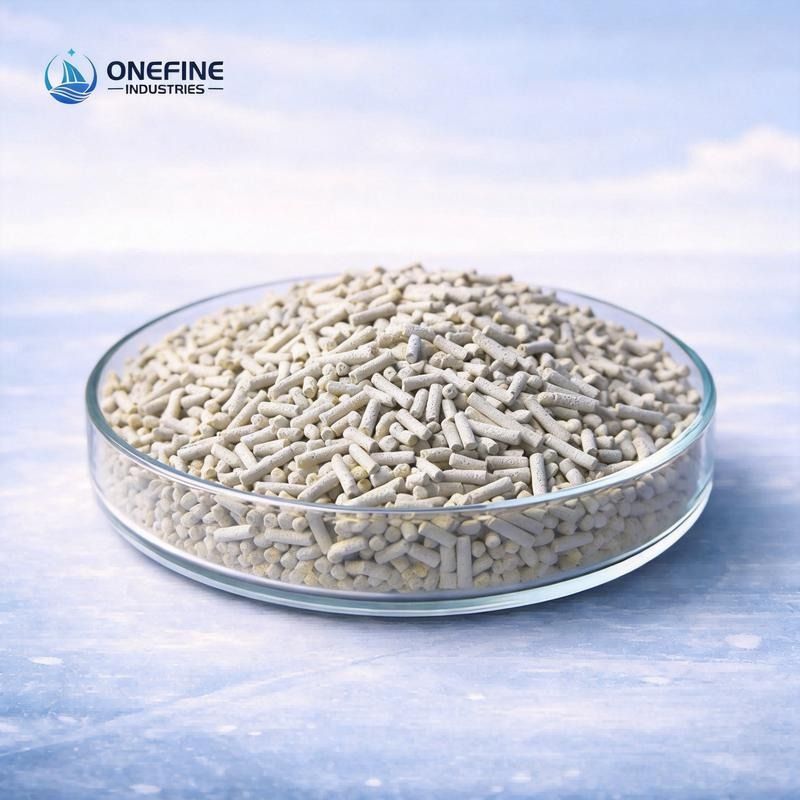
Iron Oxide Desulfurization Catalyst
High-efficiency iron oxide-based desulfurization catalyst for deep removal of H₂S from natural gas, biogas, syngas, coke oven gas, and various industrial gas streams. Features high sulfur capacity, excellent water resistance, and room-temperature operation — a cost-effective solution for both bulk and precision desulfurization applications.
Get QuoteKey Attributes
- Sub-ppm precision — Outlet H₂S ≤0.1 ppm. Ideal as polishing stage.
- High sulfur capacity — Working 15–30 wt.%, saturation up to 55 wt.%.
- Room temperature operation — 15–80°C, no heating required. Medium-temp grades to 120°C.
- Water-tolerant — No pulverization after water immersion. Ideal for wet gas.
- Regenerable — Aerobic regeneration, 3–5 cycles typical.
- Broad application — Natural gas, biogas, syngas, coke oven gas, food-grade CO₂. Removes mercaptans and COS/CS₂.
- High mechanical strength — Crush strength ≥50 N/cm, attrition ≤6 wt.%. No dusting or bed compaction in long-term service.
Applications
- Natural Gas Sweetening — Bulk or precision H₂S removal. Suits remote wellhead applications.
- Biogas & Landfill Gas — H₂S removal before combustion or RNG upgrading.
- Coke Oven Gas — Removes H₂S and mercaptans from high-load wet feeds.
- Syngas Purification — Guard bed for ammonia, methanol, hydrogen plants.
- Food-Grade CO₂ — Sub-ppm sulfur levels for carbonation and packaging.
- Chemical Synthesis — Protects catalysts in acetic acid, DMF, polypropylene processes.
- Refinery Tail Gas — Polishing step for amine regenerator off-gas and sour water stripper vapor.
- Downstream Catalyst Protection — Final-stage guard bed ahead of reforming, methanation, methanol synthesis, and low-temperature shift catalysts, preventing irreversible poisoning from trace sulfur.
Product Description
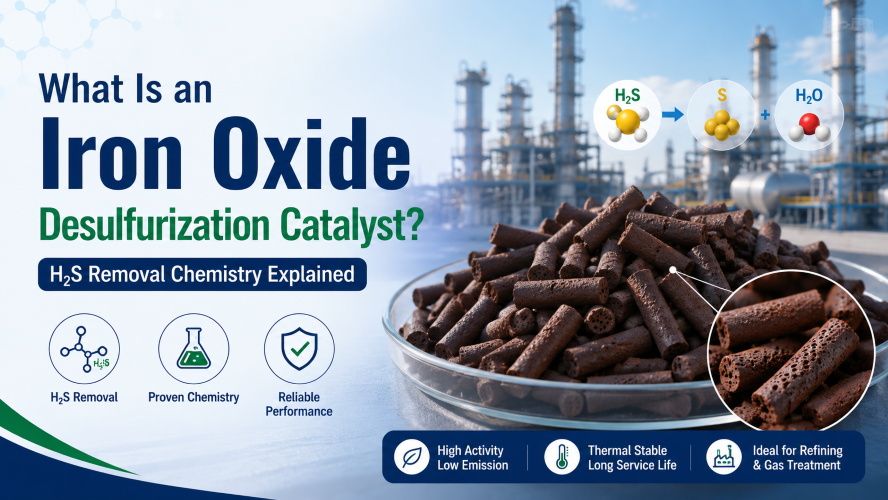
What Is an Iron Oxide Desulfurization Catalyst?
Key Takeaways:
- Room-Temperature Operation: Active chemisorption at 15–80°C eliminates feed pre-heating costs.
- Sub-ppm Precision: Achieves outlet H₂S ≤0.1 ppm for deep natural gas and biogas sweetening.
- Wet Gas Tolerance: Resists mudification in high-humidity streams; ideal for moisture-rich feeds.
- High Capacity & Regenerability: 15–30 wt.% working sulfur capacity with aerobic regeneration capabilities.
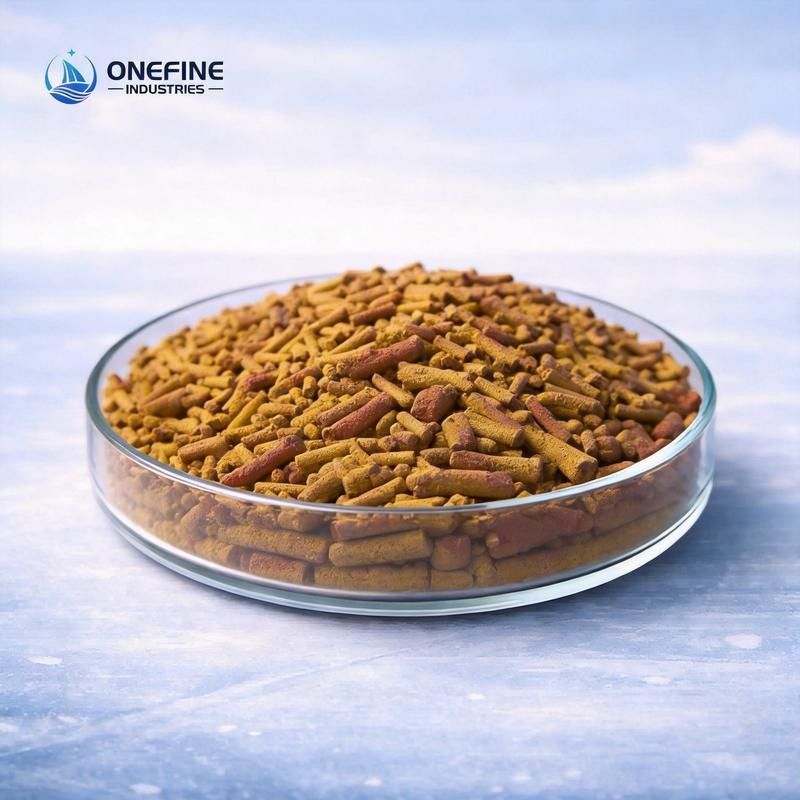
An iron oxide desulfurization catalyst is a high-efficiency, dry-type gas purification material that uses iron oxide (Fe₂O₃) as the primary active component — typically loaded at ≥35 wt.% and combined with specialized promoters and binders — to remove hydrogen sulfide (H₂S) from gas streams. The material is formed into uniform extrudates that provide high mechanical strength, low pressure drop, and consistent flow distribution in fixed-bed reactor service.
The desulfurization reaction is a well-established chemisorption process:
Fe₂O₃·H₂O + 3H₂S → Fe₂S₃·H₂O + 3H₂O
Hydrogen sulfide molecules in the feed gas contact the active iron oxide sites and undergo a solid-state conversion to iron sulfide (Fe₂S₃). The reaction proceeds spontaneously at ambient to moderate temperatures, requires no external energy input for room-temperature grades, and achieves outlet H₂S levels below 0.1 ppm under typical operating conditions.
What sets iron oxide desulfurizers apart from other dry desulfurization technologies is their combination of high sulfur capacity, room-temperature operation, excellent water tolerance, and low cost. They are the workhorse of industrial gas purification — deployed across natural gas, biogas, syngas, coke oven gas, and dozens of other applications where H₂S must be removed to protect downstream equipment, meet environmental standards, or satisfy product quality specifications.
Key Takeaways
- Sub-ppm precision: Outlet H₂S below 0.1 ppm achievable even with inlet loads up to 10,000 ppm — suitable as final polishing stage in multi-bed systems
- High sulfur capacity: 15–30 wt.% working capacity (up to 55 wt.% saturation) delivers extended service life and reduced replacement frequency
- No heating required: Room-temperature grades operate at 15–80°C, eliminating feed pre-heating costs and simplifying process design
- Water-tolerant: Maintains strength and activity after prolonged water immersion — no pulverization or mudification, critical for wet gas applications
- Regenerable option: Under aerobic conditions, spent catalyst can be regenerated by controlled oxidation, extending usable life
- Cost-effective: Among the lowest-cost dry desulfurization technologies, with simple operation and non-hazardous solid waste disposal
Desulfurization Chemistry & Regeneration Mechanism
The core desulfurization reaction converts iron oxide to iron sulfide:
Fe₂O₃·H₂O + 3H₂S → Fe₂S₃·H₂O + 3H₂O
This reaction is exothermic and proceeds spontaneously across a wide temperature range. The H₂S molecules diffuse into the porous iron oxide structure, where they react with active Fe₂O₃ sites to form stable Fe₂S₃. The reaction continues until the available iron oxide is fully converted — at which point the catalyst is considered "spent" and requires replacement or regeneration.
Regeneration (aerobic conditions only):
When the feed gas contains oxygen (typically 1–5% O₂), the spent iron sulfide can be regenerated:
2Fe₂S₃·H₂O + 3O₂ → 2Fe₂O₃·H₂O + 6S
The elemental sulfur deposits in the pore structure of the catalyst. Over multiple regeneration cycles, sulfur accumulation gradually reduces pore volume and activity — so regeneration is typically limited to 3–5 cycles before replacement is recommended. For anaerobic applications (no O₂ in feed), the catalyst is non-regenerable and operates as a single-use scavenger.
Organic sulfur removal:
Beyond direct H₂S chemisorption, iron oxide catalysts can also convert and absorb certain organic sulfur compounds — particularly carbonyl sulfide (COS) and carbon disulfide (CS₂) — through thermal hydrolysis and direct reaction mechanisms. This provides broader sulfur removal coverage than simple physical adsorbents, though the efficiency for organic sulfur is generally lower than for H₂S.
Technical Specifications
- Appearance | Yellow-brown extrudates (条状物)
- Particle Size | Φ(4 ± 0.5) mm
- Bulk Density | 0.70–1.00 kg/L
- Radial Crush Strength (mean) | ≥50 N/cm
- Attrition Rate | ≤6 wt.%
- Fe₂O₃ Content | ≥35 wt.% (with active promoters)
- Working Sulfur Capacity | ≥15–30 wt.%
- Desulfurization Accuracy | Outlet H₂S ≤0.1 ppm
- Specific Surface Area | ≥70–90 m²/g
- Operating Temperature | Ambient–120°C
- Operating Pressure | Ambient–8.0 MPa
Key Benefits
- Eliminates downstream catalyst poisoning — Even trace sulfur (ppb level) causes rapid and irreversible deactivation of reforming, methanation, methanol synthesis, and low-temperature shift catalysts. Iron oxide desulfurizers provide reliable final-stage protection, extending the life of expensive downstream catalysts and reducing unplanned shutdowns.
- Handles wet gas without performance loss — Unlike some desiccant-based desulfurizers that lose activity in the presence of moisture, iron oxide catalysts maintain strength and catalytic activity after prolonged water exposure. This makes them ideal for biogas, semi-water gas, and other inherently wet feed streams where moisture removal would add cost and complexity.
- Flexible temperature range — Room-temperature grades (15–80°C) suit low-temperature applications without heating; medium-temperature grades (up to 120°C) handle warmer feeds. This flexibility allows integration into diverse process configurations without requiring feed conditioning.
- Simple operation and maintenance — Fixed-bed configuration with no moving parts, no solvent circulation, and no energy input (room-temperature grades). The catalyst is loaded once and operates until breakthrough — then replaced or regenerated. Minimal operator intervention is required during normal service.
- Non-hazardous spent material — The spent catalyst (iron sulfide) is not classified as hazardous waste in most jurisdictions, simplifying disposal and reducing environmental compliance costs. This is a significant advantage over some alternative technologies that produce toxic or regulated byproducts.
- Scalable from pilot to industrial — The same catalyst chemistry works across scales — from small biogas digesters to large natural gas sweetening plants. Bed sizing is straightforward based on feed flow rate, H₂S concentration, and required service life.
⚠️ Application Note: For feeds with very high H₂S loads (>5,000 ppm), consider a two-stage configuration with a bulk removal stage (amine treating or high-capacity iron oxide) followed by a precision polishing bed. This maximizes the service life of the precision bed and reduces overall operating costs. Bed height-to-diameter ratio should be maintained at ≥3:1 for uniform flow distribution and to prevent channeling. Humidity should be as high as possible (preferably near saturated water vapor) for optimal activity, but liquid water must not enter the bed — install adequate knockout drums and mist eliminators upstream.
Process Integration
Iron oxide desulfurizers are deployed in fixed-bed adsorbers, typically configured for single-bed or dual-bed (lead-lag) operation:
- Feed preparation: The gas stream is filtered to remove particulates and liquid droplets. A moisture knockout drum and mist eliminator are essential — the catalyst tolerates high humidity but not liquid water carryover. Feed temperature should be within the catalyst's operating range (15–80°C for room-temperature grades).
- Adsorption: The feed passes through the iron oxide bed where H₂S is converted to Fe₂S₃. Outlet H₂S is monitored continuously or via periodic sampling. The reaction is exothermic — a slight temperature rise across the bed is normal and indicates active desulfurization.
- Breakthrough detection: When outlet H₂S approaches the specified limit (typically 0.1–1.0 ppm depending on application), the bed is taken offline. For dual-bed systems, the lead bed is replaced or regenerated while the lag bed continues service.
- Replacement or regeneration: Spent catalyst is either replaced with fresh material or regenerated by controlled oxidation (if the application allows aerobic conditions). Regeneration requires careful temperature control to avoid thermal runaway — the oxidation reaction is highly exothermic. After 3–5 regeneration cycles, catalyst replacement is recommended due to sulfur accumulation and pore blockage.
Typical Operating Parameters
- Natural gas sweetening: Ambient–60°C, space velocity 500–1500 h⁻¹, pressure up to 8.0 MPa
- Biogas desulfurization: Ambient–40°C, space velocity 300–800 h⁻¹, near atmospheric pressure
- Coke oven gas treatment: 30–80°C, space velocity 200–600 h⁻¹ (lower due to high H₂S and tar content)
- Precision polishing (post-amine): Ambient–60°C, space velocity 1000–2000 h⁻¹ (higher allowable due to low inlet H₂S)
Bed Design Considerations
- Single vs. dual bed: Single-bed for non-critical services with planned shutdowns; dual-bed (lead-lag) for continuous operation requiring on-line catalyst changeout
- Flow distribution: Uniform gas distribution is critical — channeling reduces effective bed utilization and causes premature breakthrough. Distributor plates or support grids are recommended
- Support layers: Inert ceramic balls at the top and bottom of the bed protect the catalyst from flow maldistribution and mechanical damage
- Monitoring: Continuous or frequent outlet H₂S monitoring is essential for timely catalyst changeout planning. A sudden rise in outlet H₂S indicates approaching exhaustion
Comparison: Iron Oxide vs. Zinc Oxide Desulfurizers
Iron oxide and zinc oxide desulfurizers are the two most common dry desulfurization technologies. They serve overlapping but distinct application windows:
- Operating temperature: Iron oxide works at ambient temperature (15–80°C); ZnO requires 200–400°C. For low-temperature applications, iron oxide is the only practical dry option without feed pre-heating.
- Sulfur capacity: Iron oxide working capacity is 15–30 wt.%; ZnO achieves ≥20–30 wt.%. Both are high-capacity options compared to physical adsorbents.
- Cost: Iron oxide is significantly lower in cost per ton than ZnO, making it the preferred choice for high-volume, cost-sensitive applications like biogas and natural gas sweetening.
- Regenerability: Iron oxide can be regenerated under aerobic conditions (limited cycles); ZnO is non-regenerable — the ZnS product is thermodynamically stable and cannot be converted back to ZnO by simple thermal or pressure swing.
- Application fit: Iron oxide excels in wet gas, low-temperature, and high-volume applications; ZnO is preferred for high-temperature, ultra-deep desulfurization (sub-ppb), and dry gas streams where its higher operating temperature is not a penalty.
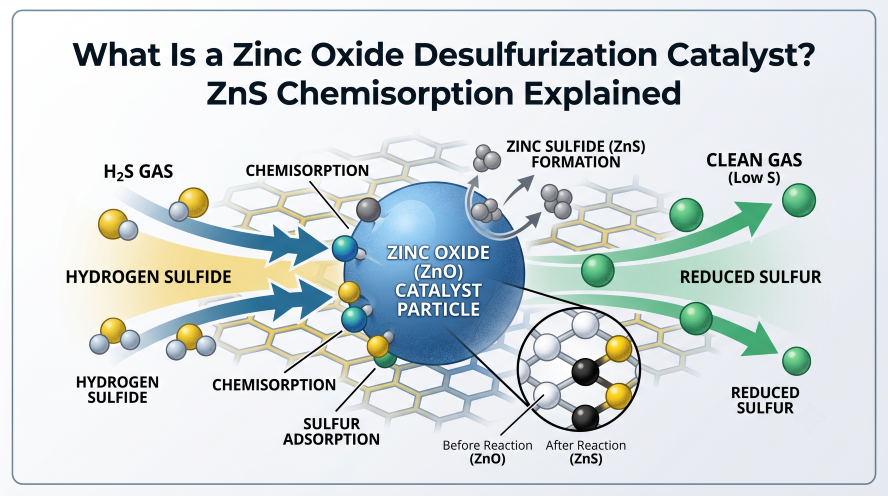
For many industrial applications, a two-stage approach is optimal — iron oxide handles bulk H₂S removal at ambient temperature and low cost, followed by our Zinc Oxide Desulfurization Catalyst for ultra-deep polishing to sub-ppb levels where required by downstream catalyst specifications. See our Zinc Oxide desulfurization guide for how the two technologies work together in a staged bed configuration.
For guidance on selecting between iron oxide and other desulfurization approaches for your specific feed conditions, see our companion guide: What Is an Iron Oxide Desulfurization Catalyst?
Packaging & Shipping
We offer flexible packaging and shipping options to suit your project scale and logistics requirements.
Standard Packaging:
- 25 kg drums (moisture-proof, suitable for trial orders and small batches)
- 50 kg bags (standard industrial packaging)
- 500 kg super sacks (most popular for industrial bulk orders)
- 1000 kg jumbo bags (for large-scale projects)
- Custom packaging available on request
Minimum Order Quantity (MOQ):
- 1 ton (entry-level orders accepted — perfect for first-time customers and trial applications)
- 5+ tons (standard bulk orders)
- Container-level supply for long-term partnerships
Container Loading Capacity:
- 20'GP: 18–20 tons
- 40'GP: 22–24 tons
- 40'HQ: 24–26 tons
Loading Ports: Shanghai, Qingdao, Tianjin, Ningbo, Shenzhen.
Lead Time:
- Stock orders: 7–15 days from payment confirmation
- Made-to-order: 20–30 days
Shipping Terms: FOB / CIF / CFR / EXW — flexible based on destination and requirements.
Documents & Certificates
We provide complete documentation for every order:
📄 Technical Data Sheet (TDS) — Confirmed during product selection to ensure exact specifications match your application requirements.
📄 Safety Data Sheet (SDS) — Provided before shipment, compliant with international transportation and handling standards.
📄 Certificate of Analysis (COA) — Issued per production batch for full quality traceability.
Additional documents available on request: Certificate of Origin (COO), Packing List, Commercial Invoice, Third-party Inspection Report (SGS / BV), Form E (for applicable tariff preferences).
Frequently Asked Questions
What is the difference between iron oxide and zinc oxide desulfurizers? Iron oxide operates at ambient temperature (15–80°C), is lower cost, and tolerates wet gas conditions well. Zinc oxide requires high temperature (200–400°C), achieves ultra-deep desulfurization (sub-ppb), and is preferred for dry gas streams where heating is not a penalty. For many applications, a two-stage approach (iron oxide for bulk + ZnO for polishing) is optimal.
Can iron oxide desulfurizer be regenerated? Yes, under aerobic conditions (when the feed gas contains 1–5% O₂), the spent iron sulfide can be regenerated by controlled oxidation back to iron oxide, depositing elemental sulfur in the pore structure. Regeneration is typically limited to 3–5 cycles due to sulfur accumulation. For anaerobic applications, the catalyst is non-regenerable and operates as a single-use scavenger.
What is the typical service life? Service life depends on feed H₂S concentration, flow rate, bed size, and required outlet specification. For typical natural gas sweetening applications (inlet H₂S 50–500 ppm), service life ranges from 6 months to 2 years. For high-H₂S feeds like biogas (1,000–10,000 ppm), service life may be 3–6 months. Proper bed sizing based on feed conditions is essential for optimal service life.
Is the spent catalyst hazardous waste? In most jurisdictions, spent iron oxide desulfurizer (iron sulfide) is not classified as hazardous waste, simplifying disposal and reducing environmental compliance costs. However, local regulations vary — always verify with your regional environmental authority before disposal. The material can often be landfilled or, in some cases, sold as a soil amendment (iron sulfide has agricultural applications).
Can it handle organic sulfur compounds? Iron oxide catalysts can remove some organic sulfur compounds — particularly carbonyl sulfide (COS) and carbon disulfide (CS₂) — through thermal hydrolysis and direct reaction mechanisms. However, the efficiency for organic sulfur is generally lower than for H₂S. For feeds with significant organic sulfur content, a hydrodesulfurization (HDS) catalyst upstream may be needed to convert organic sulfur to H₂S first.
What particle sizes are available? Standard size is Φ(4 ± 0.5) mm extrudates. Custom particle sizes and shapes (spheres, larger extrudates) can be discussed based on specific reactor dimensions and flow characteristics.
How does moisture affect performance? Iron oxide catalysts actually perform better with higher humidity — near-saturated water vapor is ideal for optimal activity. However, liquid water carryover must be avoided as it can cause bed compaction and flow maldistribution. Install adequate knockout drums and mist eliminators upstream to remove liquid water while allowing water vapor to pass.
Need a Custom Solution?
For bulk pricing and grade recommendation, please send your feed gas composition and H₂S concentration requirements to us. Our technical team will get back to you within 24 hours with a tailored solution.
Technical Specifications
| Appearance | Yellow-brown extrudates |
| Particle Size | Φ(4 ± 0.5) mm |
| Bulk Density | 0.70–1.00 kg/L |
| Radial Crush Strength (mean) | ≥50 N/cm |
| Attrition Rate | ≤6 wt.% |
| Fe₂O₃ Content | ≥35 wt.% (with active promoters) |
| Working Sulfur Capacity | ≥15–30 wt.% |
| Desulfurization Accuracy | Outlet H₂S ≤0.1 ppm |
| Specific Surface Area | ≥70–90 m²/g |
| Operating Temperature | Ambient–120°C |
| Operating Pressure | Ambient–8.0 MPa |