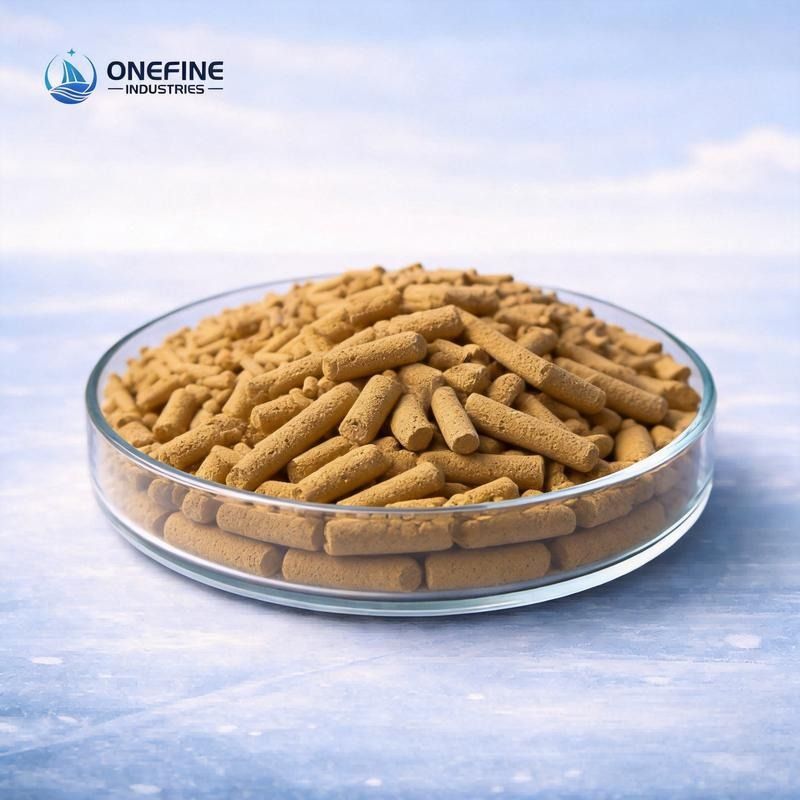
Ammonia refining desulfurization catalyst
A composite metal oxide-based desulfurization catalyst with multiple promoters, designed for H₂S removal in ammonia refining units of sour water strippers at refineries. Reduces H₂S to below 0.5 mg/m³ under low-temperature conditions. Also removes HCl and organic sulfur impurities. Exceptional water resistance.
Get QuoteKey Attributes
- Composite metal oxide formulation — Multiple promoters enhance activity and selectivity. Superior to single-component desulfurizers.
- Ultra-low outlet H₂S — Reduces H₂S to below 0.5 mg/m³. Protects downstream catalysts and equipment.
- Exceptional water resistance — Withstands 60h boiling or 60-day water immersion without mudification or hardening. Ideal for wet gas streams.
- High mechanical strength — Up to 130 N/cm crush strength. Maintains bed integrity under high-pressure operation.
- Multi-pollutant removal — Removes H₂S, HCl, and organic sulfur (COS, CS₂, mercaptans) in a single bed.
- Large sulfur capacity — Working sulfur capacity ≥20 wt.%. Extended service life and reduced replacement frequency.
- Low operating cost — High efficiency at low temperature. Low pressure drop. Minimal maintenance requirements.
Applications
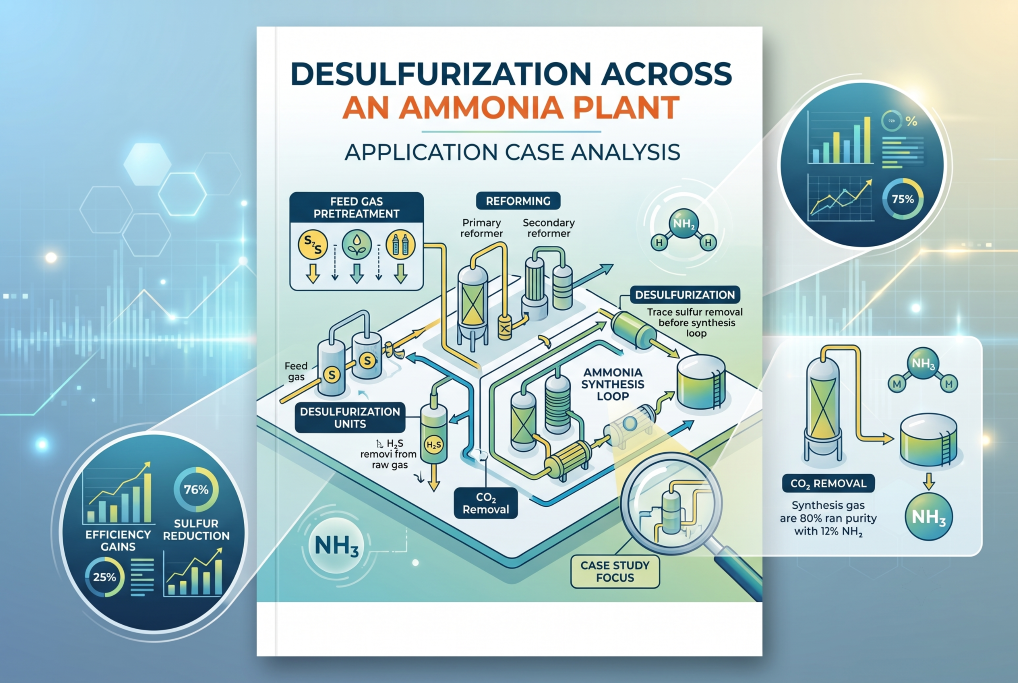
- Refinery Sour Water Stripper Ammonia Refining — Primary application. Removes H₂S from stripped ammonia gas to below 0.5 mg/m³. Protects downstream sulfur recovery units.
- Sour Water Stripping Units — Treats ammonia-rich gas from sour water strippers. Ensures clean ammonia for further processing or flare systems.
- Synthesis Gas Desulfurization — Removes H₂S from synthesis gas in ammonia, hydrogen, and methanol plants. Guards sensitive catalysts.
- Hydrogen Production Units — Polishes hydrogen streams. Prevents sulfur poisoning of downstream process catalysts.
- Ammonia Synthesis Feed Purification — Deep H₂S removal from feed gas. Protects reforming and methanation catalysts from deactivation.
- Organic Sulfur Hydrolysis — Converts COS, CS₂, and mercaptans. Comprehensive total sulfur control in a single bed.
- High-Moisture Gas Streams — Superior water resistance allows direct use in saturated or wet gas conditions without pre-drying.
- Acid Gas Guard Bed for HCl-Containing Streams — Combined H₂S/HCl removal in a single bed simplifies guard bed design where both contaminants are present.
- Fertilizer Complex Integrated Sulfur Management — Supports total sulfur control across integrated ammonia-based fertilizer complexes handling multiple sour gas streams.
Product Description
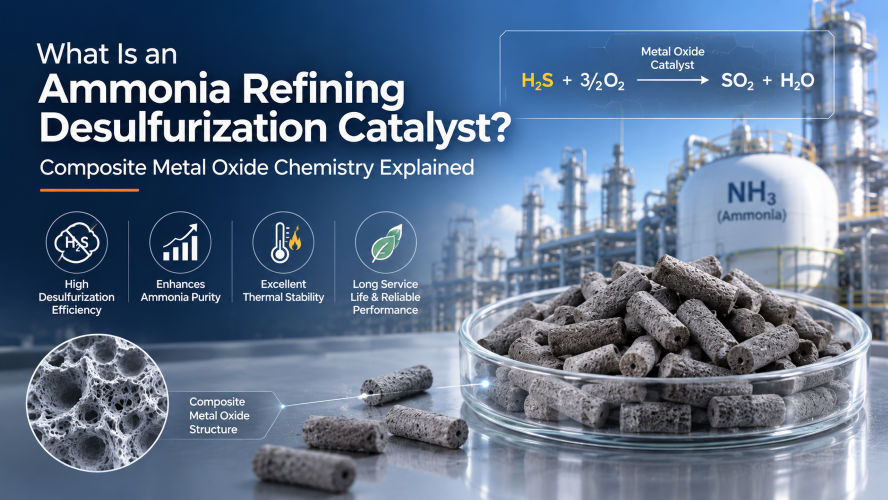
What Is an Ammonia Refining Desulfurization Catalyst?
Key Takeaways:
- Extreme Water Resistance: Withstands 60 hours of continuous boiling water without mudification.
- Composite Metal Oxides: Multi-promoter formulation outperforms standard ZnO in saturated gas conditions.
- Ultra-Low H₂S Outlet: Reduces hydrogen sulfide to below 0.5 mg/m³ at low temperatures.
- Multi-Pollutant Control: Simultaneously removes H₂S, HCl, and organic sulfur (COS, CS₂, mercaptans).
An ammonia refining desulfurization catalyst is a specialized purification material designed to remove hydrogen sulfide (H₂S) and other sulfur compounds from ammonia gas in refinery sour water stripper units. Unlike conventional ZnO desulfurization catalysts, this catalyst uses composite metal oxides as the primary active component, combined with active promoters, modification promoters, and structural promoters to achieve superior performance under low-temperature, high-moisture conditions.
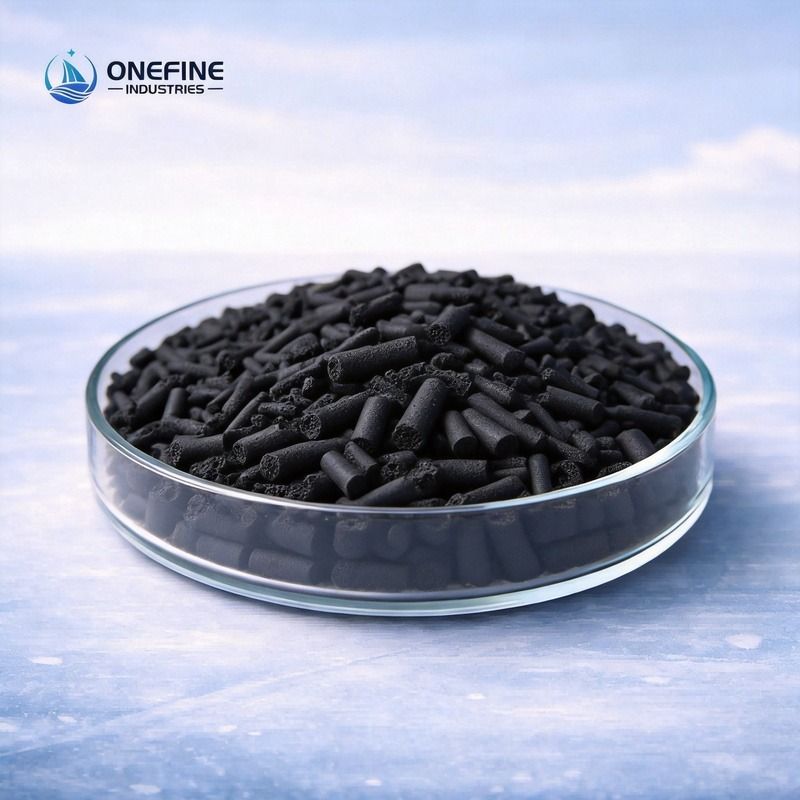
The product is available in two density grades: a standard grade (0.95±0.15 kg/L, ≥40 N/cm crush strength) for general service, and a high-density grade (1.15±0.15 kg/L, 130 N/cm crush strength) for demanding high-pressure applications. Both grades achieve outlet H₂S below 0.5 mg/m³ while simultaneously removing HCl and organic sulfur impurities.
The standout feature of this catalyst is its exceptional water resistance. Conventional desulfurizers often degrade, mudify, or harden when exposed to moisture. This composite metal oxide formulation withstands 60 hours of continuous boiling water or 60 days of water immersion without any mudification or hardening — a critical advantage in ammonia refining where gas streams are typically saturated with water vapor.
Beyond H₂S removal, the catalyst also removes hydrogen chloride (HCl) and hydrolyzes organic sulfur species including carbonyl sulfide (COS), carbon disulfide (CS₂), and mercaptans (RSH). This multi-pollutant capability simplifies process design by eliminating the need for separate guard beds.
For a deeper comparison of when to choose this catalyst versus a conventional ZnO-based desulfurizer, see our companion guide below.
Why Choose Our Ammonia Refining Desulfurization Catalyst?
1. Advanced Composite Metal Oxide Technology
Our catalyst uses a proprietary blend of composite metal oxides with multiple functional promoters — not a single-component formulation. This delivers higher activity, better selectivity, and longer service life compared to conventional ZnO or iron oxide desulfurizers.
2. Proven Performance in Refinery Ammonia Refining
Specifically designed for sour water stripper ammonia refining units. Achieves outlet H₂S below 0.5 mg/m³ under low-temperature conditions — meeting the strict requirements of modern refinery operations.
3. Unmatched Water Resistance
The defining advantage. Withstands 60 hours of boiling water or 60 days of water immersion without mudification or hardening. Most competing desulfurizers fail within 24 hours of boiling water exposure. This makes our catalyst uniquely suited for wet, saturated gas streams.
4. Superior Mechanical Strength
The high-density grade delivers 130 N/cm radial crush strength — 3× higher than the standard grade. Zero dusting, no bed compaction, consistent gas distribution throughout the catalyst life. Critical for tall-bed reactors and high-pressure service.
5. Multi-Pollutant Removal in One Bed
Removes H₂S, HCl, and organic sulfur compounds (COS, CS₂, mercaptans) simultaneously. Eliminates the need for separate acid gas guard beds. Simplifies process design and reduces capital cost.
6. High Sulfur Capacity, Low Cost
Working sulfur capacity ≥20 wt.% provides extended on-stream life. Combined with low-temperature operation and low pressure drop, total operating cost is significantly lower than conventional alternatives.
7. Flexible Application
While optimized for refinery ammonia refining, the catalyst also works effectively in synthesis gas desulfurization, hydrogen production units, and other H₂S removal applications. Compatible with a wide range of process conditions up to 8.0 MPa.
For feed gas that also carries phosphorus or oxygen compounds alongside sulfur — common in some synthesis gas and ammonia plant feed streams — our Deeply Refined Catalyst offers a broader four-in-one guard bed alongside this catalyst's wet-gas-optimized sulfur/HCl removal.
Packaging & Shipping
We offer flexible packaging and shipping options to suit your project scale and logistics requirements.
Standard Packaging:
- 25 kg drums (moisture-proof, suitable for trial orders and small batches)
- 150 kg steel drums (standard bulk packaging for industrial orders)
- 500 kg super sacks (most popular for industrial bulk orders)
- 1000 kg jumbo bags (for large-scale projects)
- Custom packaging available on request
Minimum Order Quantity (MOQ):
- 1 ton (entry-level orders accepted — perfect for first-time customers)
- 5+ tons (standard bulk orders)
- Container-level supply for long-term partnerships
Container Loading Capacity:
- 20'GP container: 18-20 tons (palletized)
- 40'GP container: 22-24 tons (palletized)
- 40'HQ container: 24-26 tons
Loading Ports: We ship from major Chinese ports based on your requirements: Shanghai, Qingdao, Tianjin, Ningbo, and Shenzhen.
Lead Time:
- Stock orders: 7-15 days from payment confirmation
- Made-to-order: 20-30 days
Shipping Terms: FOB / CIF / CFR / EXW — flexible based on your destination and preferences.
Storage: Store in cool, dry conditions. Shelf life: 3 years unopened. Protect from moisture and mechanical damage during transport.
Documents & Certificates
We provide complete documentation for every order:
📄 Technical Data Sheet (TDS) — Confirmed with you during product selection, ensuring exact specifications match your application requirements.
📄 Safety Data Sheet (SDS) — Provided before shipment, meeting all international transportation and handling standards.
📄 Certificate of Analysis (COA) — Issued for each production batch, delivered with your shipment for full quality traceability.
Additional documents available on request: Certificate of Origin (COO), Packing List, Commercial Invoice, Third-party Inspection Report (SGS / BV), Form E (for Middle East destinations with applicable tariff benefits).
Regeneration
This catalyst is designed for single-cycle service life under typical ammonia refining operating conditions. Regeneration feasibility depends on your specific sulfur loading and process conditions — contact our technical team to discuss whether regeneration is suitable for your application.
FAQ
Q: What makes this catalyst different from ZnO desulfurizers?
A: Unlike conventional ZnO desulfurizers that degrade in wet conditions, our composite metal oxide formulation offers exceptional water resistance (60h boiling / 60-day immersion without mudification). It also removes HCl and organic sulfur in addition to H₂S — ZnO only handles H₂S effectively.
Q: What is the difference between the two density grades?
A: The standard grade (0.95 kg/L, ≥40 N/cm) is suitable for most ammonia refining applications. The high-density grade (1.15 kg/L, 130 N/cm) provides 3× higher crush strength for high-pressure or tall-bed configurations.
Q: Can this catalyst handle wet gas streams?
A: Yes — this is its key advantage. The catalyst is specifically designed for high-moisture environments. It withstands 60 hours of boiling water without mudification or hardening, making it ideal for saturated ammonia gas from sour water strippers.
Q: Does it remove organic sulfur?
A: Yes. The catalyst hydrolyzes and absorbs COS, CS₂, and mercaptans in addition to H₂S. It also removes HCl. This multi-pollutant capability eliminates the need for separate guard beds.
Q: What is the typical service life?
A: Service life depends on inlet sulfur concentration and operating conditions. With working sulfur capacity ≥20 wt.%, the catalyst typically lasts 12-24 months under normal refinery ammonia refining conditions before breakthrough.
Q: Is this catalyst suitable for synthesis gas desulfurization?
A: Yes. While optimized for refinery ammonia refining, the catalyst is also effective for H₂S removal from synthesis gas in ammonia, hydrogen, and methanol production units.
Need a Custom Solution?
For bulk pricing and grade recommendation, please send your gas composition & moisture content requirements to us. Our technical team will get back to you within 24 hours with a tailored solution.
Technical Specifications
| Appearance | Extrudates (two grades) |
| Particle Size | Φ3-5mm |
| Bulk Density | 0.95±0.15 kg/L or 1.15±0.15 kg/L |
| Radial Crush Strength (mean) | ≥40 N/cm or 130 N/cm |
| Attrition Rate | ≤6.0 wt.% or ≤5.0 wt.% |
| Active Component | omposite metal oxides with active promoters, modification promoters, and structural promoters |
| Working Sulfur Capacity | ≥20 wt.% |
| Desulfurization Precision | Outlet H₂S ≤0.5 mg/m³ |
| Operating Temperature | Low temperature (suitable for ammonia refining conditions) |
| Operating Pressure | Ambient to 8.0 MPa |
Related Products
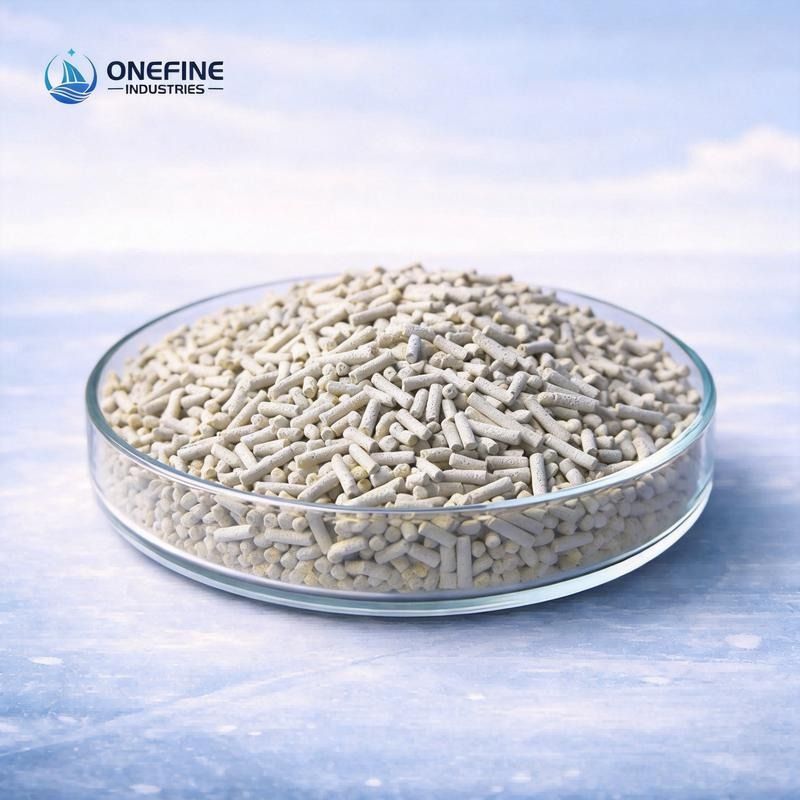
Zinc oxide desulfurization catalyst
High-purity zinc oxide (ZnO) desulfurization catalyst for fine removal of H₂S from natural gas, synthesis gas, hydrogen, and hydrocarbon feeds. Achieves outlet sulfur levels below 0.1 ppm through irreversible chemisorption. High sulfur capacity, long service life, and strong resistance to steam.
Deeply Refined Catalyst
A high-performance deeply refined catalyst based on copper oxide and zinc oxide active components, designed for deep purification of liquid hydrocarbons and synthesis gas. Achieves total sulfur removal down to ≤ 20 ppb through efficient desulfurization, dearsenication, dephosphorization, and deoxygenation. Features high mechanical strength, stable operation, and excellent low-temperature activity.