Dehydrogenation Catalyst
High-activity noble metal on macro-porous alumina catalyst designed for the catalytic oxidation and ultra-deep removal of trace hydrogen, carbon monoxide, and combustible hydrocarbons from CO2 and syngas streams.
Get QuoteKey Attributes
- Highly dispersed noble metal active sites drastically lower activation energy for trace H2 and CO combustion.
- Specialized low-silica, low-sodium macroporous alumina carrier prevents unwanted acidic side-reactions and coking.
- Exceptional thermal stability sustains catalytic integrity across a wide temperature gradient of 110°C to 500°C.
- Optimized gas diffusion kinetics easily process massive industrial gas volumes at space velocities up to 35,000 h-1.
- High physical crush strength (≥40 N) ensures long-term structural durability and minimal pressure drop in deep beds.
- Eliminates explosive hazards in downstream processes by achieving ultra-deep hydrogen removal to sub-ppm levels.
- Tolerates extreme process pressures ranging from ambient atmospheric conditions up to 20.0 MPa.
Applications
- Ultra-deep trace hydrogen removal from carbon dioxide (CO2) feedstock in industrial urea synthesis plants.
- Deoxygenation and dehydrogenation of synthesis gas streams to protect downstream oxo-alcohol catalytic units.
- Catalytic combustion of combustible impurities in the production of ultra-high-purity nitrogen and argon from ASUs.
- Trace hydrogen and carbon monoxide polishing in metallurgical blanketing gas networks.
- Safety guard bed operations preventing explosive H2/O2 mixtures in high-pressure petrochemical loops.
- Purification of recycle gas streams in complex synthetic natural gas (SNG) and methanation facilities.
- Elimination of trace hydrocarbons and combustibles in food-grade and beverage-grade CO2 recovery units.
- Pre-treatment purification of industrial gas streams utilized in advanced semiconductor manufacturing processes.
Product Description
What is Dehydrogenation Catalyst?
Key Takeaways
- Ultra-Deep Scavenging: Highly dispersed noble metal active sites (Pd/Pt) chemically combust trace H₂ and CO down to sub-ppm levels.
- Explosion Prevention: Safely neutralizes trace combustibles in CO₂ feedstocks to eliminate explosive hazards in high-pressure urea synthesis loops.
- Neutral Alumina Carrier: Uses a low-silica, low-sodium macroporous support that prevents unwanted acidic side-reactions and supports extreme space velocities up to 35,000 h⁻¹.
The Dehydrogenation Catalyst (often functionally classified as a Deoxo or Hydrogen Removal Catalyst) is an advanced catalytic oxidation agent specifically engineered for the ultra-deep elimination of trace combustible gases from industrial gas matrices. The structural foundation of this catalyst is an optimized, high-surface-area gamma-alumina (γ-Al2O3) carrier. This carrier is meticulously synthesized using low-silica, low-sodium pseudo-boehmite as the primary precursor. By strictly limiting silica and sodium impurities during the calcination phase, the resulting macro-porous alumina matrix exhibits exceptional thermal stability and drastically reduced surface acidity, which prevents unwanted side reactions such as carbon deposition or polymer cracking.
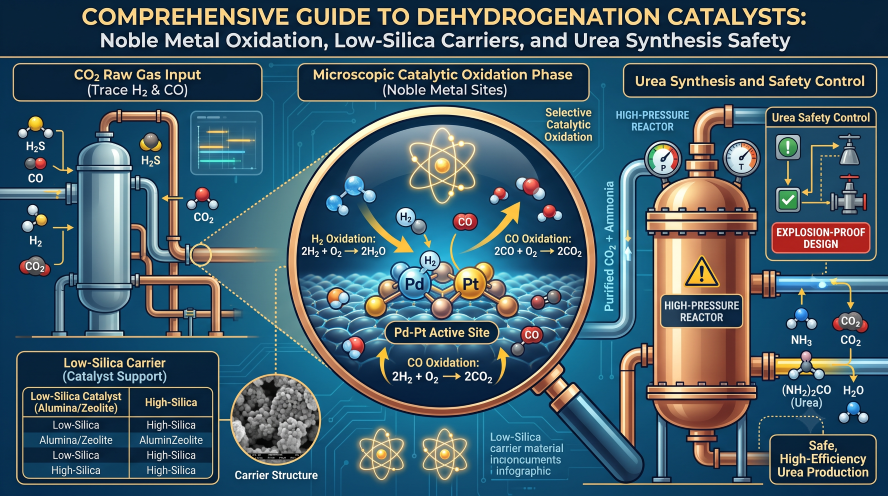
The highly active catalytic centers consist of homogeneously dispersed noble metals (typically Palladium or Platinum). When synthesis gas or carbon dioxide streams containing trace amounts of hydrogen (H2), carbon monoxide (CO), or volatile hydrocarbons pass through the catalyst bed in the presence of stoichiometric or slight excess oxygen, the noble metal sites facilitate a rapid, highly exothermic catalytic combustion. The primary oxidation reaction mechanisms are:
H2 + 0.5 O2 → H2O CO + 0.5 O2 → CO2
Because these reactions occur on the highly dispersed noble metal crystallites, the activation energy required to initiate the combustion is significantly lowered. This allows the catalyst to operate with exceptional kinetic efficiency even at lower initiation temperatures (starting from 110°C), converting the hazardous combustible traces into inert water vapor and carbon dioxide. The engineered macroporous geometry ensures that the mass transfer of reactant gases to the active sites is not diffusion-limited, enabling the bed to process massive fluid volumes continuously without risking untreated gas slip.
For the full engineering deep-dive on carrier chemistry and deactivation modes, see our Comprehensive Guide to Dehydrogenation Catalysts.
Key Benefits
- Ultra-Deep Hydrogen Scavenging: The highly dispersed noble metal active phase chemically combusts trace H2 and CO down to ultra-low sub-ppm levels, ensuring strict purity specifications are met for downstream chemical synthesis.
- Extreme Space Velocity Tolerance: Thanks to the uniquely engineered macro-porous alumina carrier, intra-particle gas diffusion is maximized. This allows the catalyst bed to support Gas Hourly Space Velocities (GHSV) ranging from 3,000 h-1 up to an astonishing 35,000 h-1, effectively minimizing required reactor size and capital expenditure.
- Broad Thermal Operational Window: The catalytic reaction initiates efficiently at temperatures as low as 110°C, yet the structural integrity of the low-silica/low-sodium alumina support prevents active-site sintering up to 500°C.
- Exceptional Mechanical Integrity: The catalyst boasts an average radial crush strength of ≥40 N/particle, preventing bed compaction, eliminating fine dust generation, and maintaining a stable, low pressure drop across the reactor.
- Suppression of Side Reactions: The specialized low-sodium, low-silica precursor ensures a chemically neutral carrier surface, preventing unwanted parasitic reactions such as methanation of CO or cracking of trace heavier hydrocarbons.
- Wide Pressure Envelope: Performs with stability across extreme pressure differentials, maintaining reaction kinetics from standard atmospheric pressure up to hyper-baric conditions of 20.0 MPa.
Applications in Detail
Urea Synthesis Carbon Dioxide Purification: In modern fertilizer production complexes, the CO2 feedstock routed to the urea synthesis reactor is typically sourced from the upstream ammonia plant's syngas decarbonization unit. This raw CO2 inevitably carries over trace amounts of unreacted H2 and CO. During urea synthesis, trace oxygen must be injected into the high-pressure reactor to passivate the stainless steel metallurgy and prevent severe corrosion. If the trace hydrogen is not removed, it will mix with the injected oxygen to form a highly explosive mixture within the high-pressure urea loop. This catalyst is deployed directly upstream of the urea reactor at pressures up to 20.0 MPa, safely neutralizing the explosive hazard.
Deep Purification of Synthesis Gas (Syngas): In chemical plants generating carbon monoxide or hydrogen for downstream oxo-alcohols, acetic acid, or specialized hydrogenation processes, strict stoichiometric ratios must be maintained. The dehydrogenation catalyst functions as a polishing bed to selectively combust and eliminate trace oxygen or trace hydrogen. Operating at extremely high space velocities (up to 35,000 h-1), the bed instantly strips the unwanted combustible or oxidizing agent, protecting sensitive downstream noble-metal-based catalytic units from irreversible side-reactions.
Noble Gas and Cryogenic Air Separation Polishing: In the production of ultra-high-purity nitrogen, argon, or helium from cryogenic air separation units (ASU), trace hydrogen and carbon monoxide must be eliminated to achieve ppb-level purity. The raw gas stream is blended with a precise micro-dose of oxygen and routed through this noble-metal catalyst, yielding water and CO2 that are subsequently adsorbed by downstream molecular sieve dehydration beds, leaving a perfectly pure noble gas stream.
Packaging & Shipping
We offer flexible packaging and shipping options to suit your project scale and logistics requirements.
Standard Packaging:
- 25 kg drums (moisture-proof, suitable for trial orders and small batches)
- 150 kg steel drums (standard bulk packaging for industrial orders)
- 500 kg super sacks (most popular for industrial bulk orders)
- 1000 kg jumbo bags (for large-scale projects)
- Custom packaging available on request
Minimum Order Quantity (MOQ):
- 1 ton (entry-level orders accepted — perfect for first-time customers)
- 5+ tons (standard bulk orders)
- Container-level supply for long-term partnerships
Container Loading Capacity:
- 20'GP container: 18–20 tons (palletized)
- 40'GP container: 22–24 tons (palletized)
- 40'HQ container: 24–26 tons
Loading Ports: We ship from major Chinese ports based on your requirements: Shanghai, Qingdao, Tianjin, Ningbo, and Shenzhen.
Lead Time:
- Stock orders: 7–15 days from payment confirmation
- Made-to-order: 20–30 days
Shipping Terms: FOB / CIF / CFR / EXW — flexible based on your destination and preferences.
Documents & Certificates
We provide complete documentation for every order:
📄 Technical Data Sheet (TDS) — Confirmed with you during product selection, ensuring exact specifications match your application requirements.
📄 Safety Data Sheet (SDS) — Provided before shipment, meeting all international transportation and handling standards.
📄 Certificate of Analysis (COA) — Issued for each production batch, delivered with your shipment for full quality traceability.
Additional documents available on request: Certificate of Origin (COO), Packing List, Commercial Invoice, Third-party Inspection Report (SGS / BV), Form E (for Middle East destinations with applicable tariff benefits).
Regeneration
Unlike physical adsorbents (such as molecular sieves or activated alumina) or sacrificial chemisorption agents (like zinc oxide desulfurizers) that physically trap contaminants and eventually become fully saturated, this Dehydrogenation Catalyst operates purely via continuous catalytic conversion. The noble metal active sites merely facilitate the chemical reaction without being stoichiometrically consumed or chemically altered by the reactants themselves. Under ideal operating conditions with clean feedstocks, the catalyst does not require cyclic thermal regeneration or desorption phases.
An industrial bed of this catalyst typically exhibits a continuous, uninterrupted operational lifespan of 3 to 5 years. However, the noble metal active sites are highly susceptible to permanent poisoning. Irreversible deactivation occurs if the feed gas is contaminated with trace heavy metals (such as arsenic or lead), volatile sulfur compounds (like H2S or mercaptans), or halogenated compounds (chlorides). These poisons permanently bind to the palladium/platinum crystallites, blinding the catalytic sites. Additionally, operating significantly above the 500°C thermal limit will induce severe thermal sintering, causing the highly dispersed noble metal particles to agglomerate, massively reducing the active-surface area. Once heavily poisoned or sintered, activity cannot be restored via standard in-situ steaming or oxidation, and the entire bed must be discharged and replaced with a fresh batch.
FAQ
Q1: Why is trace hydrogen removal so critical in urea synthesis plants?
In the urea manufacturing process, the primary feedstock is carbon dioxide (CO2) recovered from ammonia plant syngas, which inherently carries trace hydrogen (H2). Simultaneously, oxygen is deliberately injected into the high-pressure urea reactor to create a passive oxide layer on the inner stainless-steel walls, preventing catastrophic corrosion from the highly aggressive carbamate solution. If the trace H2 is not removed upstream, it will mix with this injected O2 inside the reactor, creating a highly volatile, explosive mixture under high pressure and temperature. The dehydrogenation catalyst safely combusts the H2 into water before it enters the urea loop, ensuring plant safety.
Q2: How does the catalyst handle extreme variations in gas flow rates?
The catalyst is structurally engineered using a macroporous pseudo-boehmite derived alumina carrier, providing an extensive network of large internal pores that virtually eliminates gas diffusion resistance. Combined with the highly active noble metal sites, the chemical reaction occurs almost instantaneously upon contact, allowing the bed to process varying Gas Hourly Space Velocities (GHSV) from a baseline of 3,000 h-1 all the way up to an extreme 35,000 h-1.
Q3: Why is the "low-silica, low-sodium" property of the alumina carrier important?
Standard alumina carriers often contain residual sodium and silica that create strong acidic and basic sites on the catalyst's surface. In complex gas streams containing hydrocarbons or carbon monoxide, these acidic/basic sites can trigger unwanted catalytic side-reactions such as hydrocarbon cracking, coking, or unintended methanation. By utilizing a highly purified, low-silica and low-sodium precursor, the carrier surface remains chemically neutral, strictly limiting the reaction to the intended noble-metal-driven combustion of hydrogen and carbon monoxide.
Q4: What causes the irreversible failure of this noble-metal catalyst?
The primary cause of premature failure is chemical poisoning. Noble metals like Palladium and Platinum have an extreme chemical affinity for sulfur compounds (like H2S) and heavy metals (like arsenic). If upstream gas purification fails and allows these poisons into the bed, they will permanently bond to the noble metal crystallites, completely blinding the active sites. A secondary cause is thermal sintering: if a massive spike in hydrogen concentration occurs, the resulting exothermic combustion can push the localized bed temperature well beyond the 500°C limit, melting and agglomerating the noble metal, permanently destroying its active surface area.
Need a Custom Solution?
For bulk pricing and grade recommendation, please send your feed composition and space velocity requirements to us. Our technical team will get back to you within 24 hours with a tailored solution.
Technical Specifications
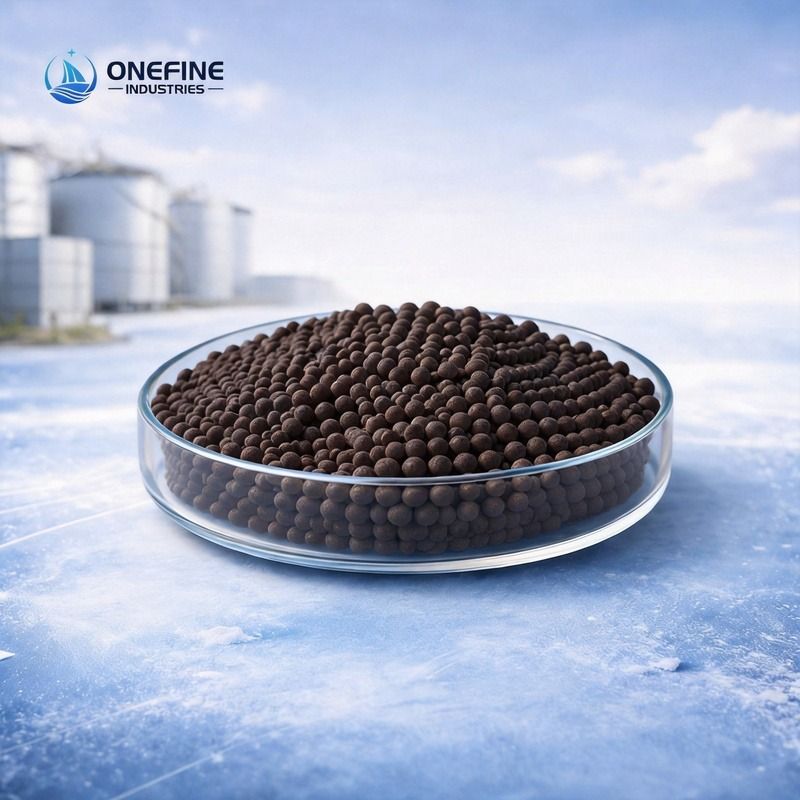
| Appearance | Gray-black spherical beads |
| Diameter (Φ) | 2.0–5.0 mm (customizable) |
| Bulk Density | 0.70 ± 0.10 kg/L |
| Average Crush Strength | ≥40 N |
| Operating Temperature | 110 to 500°C |
| Operating Pressure | Ambient to 20.0 MPa |
| Gas Space Velocity | 3000–35000 h-1 |
| Carrier Material | Low-silica/low-sodium macroporous Al2O3 |
| Active Component | Highly dispersed noble metal |
| Specific Surface Area | ≥150 m²/g |
| Catalyst Type | Catalytic oxidation / Deoxo |
Related Products
No related products.