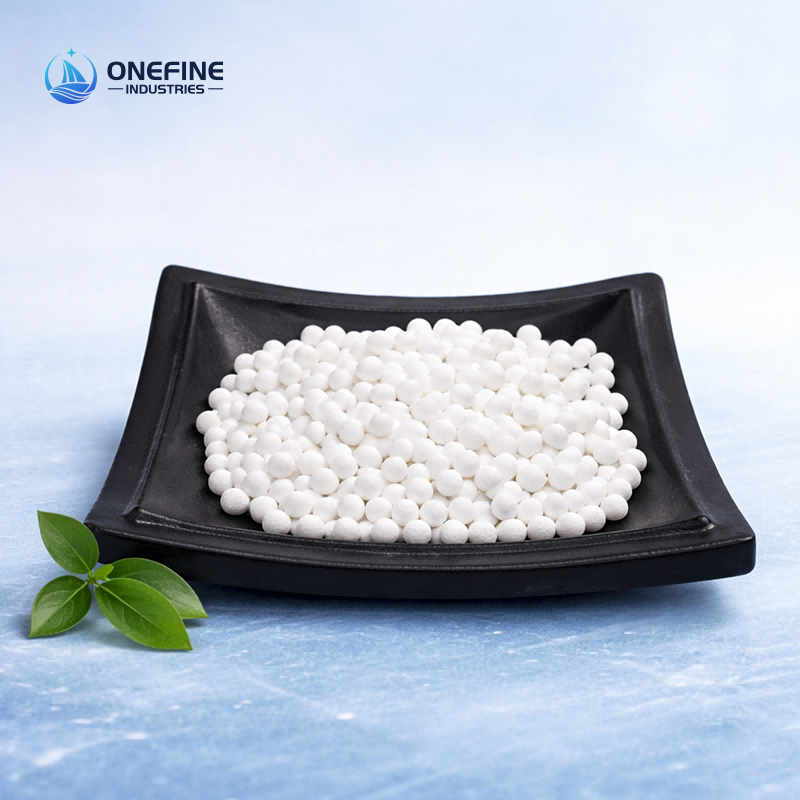
Dry adsorbent
Modified activated alumina-based adsorbent manufactured by ball-rolling process, loaded with high-content active components for simultaneous removal of H₂S and water from gas-phase and liquid-phase hydrocarbon streams. Features large pore diameter, high surface area, fast reaction kinetics, and excellent regenerability — the ideal adsorbent for impurity removal in olefin-containing feeds.
Get QuoteKey Attributes
- Dual-function H₂S and moisture removal — Captures both H₂S and water in a single bed, cutting the need for separate treatment stages.
- Modified activated alumina base — High-content active-species loading delivers strong capacity and selectivity even in complex feeds.
- Large pore diameter, high surface area — Fast mass transfer and rapid impurity uptake under industrial conditions.
- Ball-rolling manufacturing process — Uniform spherical beads with strong mechanical durability and low dust generation.
- Strong regenerability — Thermally regenerable across multiple cycles, lowering lifetime operating costs versus sacrificial adsorbents.
- Olefin-compatible — High selectivity for H₂S/H₂O over olefins, ideal for ethylene, propylene, and butene streams.
Applications
- Olefin Plant Feed Purification — Protects Ziegler-Natta, metallocene, and other polymerization catalysts from H₂S/moisture poisoning.
- Natural Gas & Refinery Gas Sweetening and Drying — Meets pipeline specs and prevents corrosion in storage and distribution lines.
- Liquid Hydrocarbon Pretreatment — Polishes naphtha and light gasoline ahead of reforming, isomerization, or hydroprocessing.
- Synthesis Gas Purification — Protects methanol, ammonia, and Fischer-Tropsch catalysts from H₂S/H₂O poisoning.
- Compressed Air & Instrument Gas Treatment — Dual-function protection for pneumatic instruments and control valves.
- Recycle Gas Treatment — Maintains low H₂S/moisture levels in hydrogen-rich recycle streams to protect compressors and catalysts.
- LPG / NGL Purification — Removes H₂S and moisture from LPG and natural gas liquids ahead of storage or further processing.
- Landfill Gas / Biogas Pretreatment — Simultaneous H₂S and moisture control ahead of upgrading or utilization equipment.
Product Description
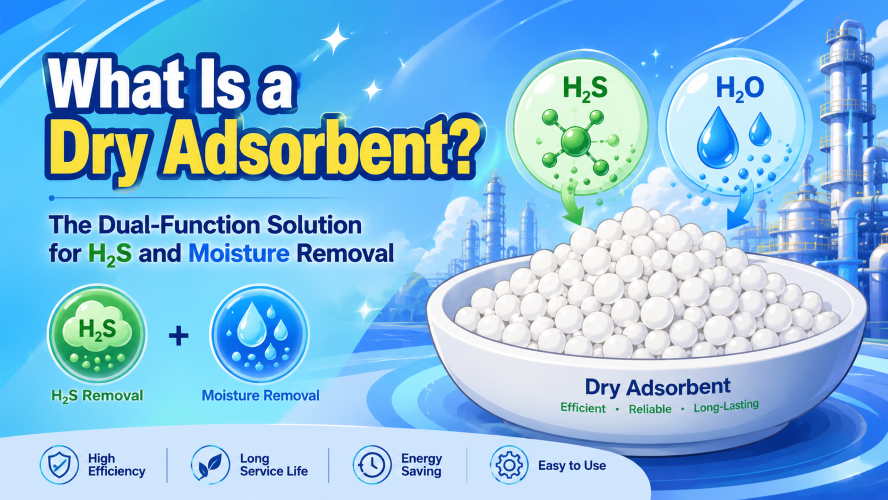
What Is a Dry Adsorbent?
Key Takeaways:
- Dual-Function Action: Removes both H₂S and moisture in a single bed, cutting equipment footprint in half.
- Olefin-Compatible: High selectivity prevents co-adsorption or reaction with ethylene, propylene, and butenes.
- Thermal Regenerability: Restores capacity across multiple thermal cycles, lowering lifetime OPEX versus scavengers.
- Modified Alumina Base: Large pore diameter and high surface area (≥ 300 m²/g) ensure rapid mass transfer.
A dry adsorbent is a modified activated alumina-based material engineered for the simultaneous removal of hydrogen sulfide (H₂S) and water from gas-phase and liquid-phase hydrocarbon streams. It is manufactured via a ball-rolling (pan granulation) process, in which a high-surface-area activated alumina base is impregnated with high-content active components and formed into uniform spherical beads. This combination delivers both high adsorption capacity and high selectivity for H₂S and moisture — even in complex feed matrices containing olefins.
Unlike single-function desiccants (which target only water) or conventional H₂S scavengers (which target only sulfur), this dual-function adsorbent addresses both impurities in a single fixed bed, simplifying process design and lowering both capital and operating costs.
Key Takeaways
- Dual protection in one bed: Simultaneous H₂S and water removal eliminates the need for separate desulfurization and drying stages
- Olefin-compatible: High selectivity avoids co-adsorbing or reacting with ethylene, propylene, and butenes
- Regenerable: Thermal regeneration restores capacity across multiple cycles, reducing lifetime operating costs
- Robust mechanical properties: Uniform spherical beads with high crush strength and low dust for stable bed hydraulics
Adsorption Mechanism
The dry adsorbent operates through a combination of physical adsorption and chemical interaction:
Moisture removal: The high-surface-area activated alumina base (γ-Al₂O₃ phase) provides abundant hydroxyl (–OH) groups and polar sites that attract water molecules through hydrogen bonding, achieving deep drying even at low partial pressures.
H₂S removal: The loaded active components provide specific chemical affinity for hydrogen sulfide, capturing it through chemisorption and retaining it as stable surface species within the bed.
Both mechanisms proceed rapidly at ambient to moderate temperatures, so the adsorbent works across a wide range of process conditions without feed pre-heating.
Technical Specifications
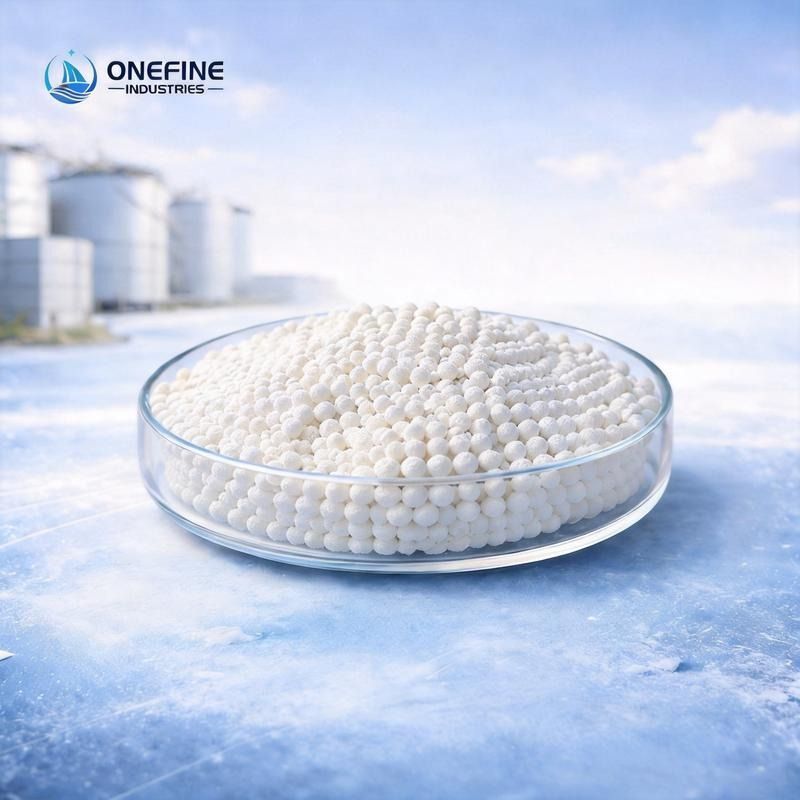
- Appearance | White spherical beads
- Particle Size (Grade 1) | Φ(2–5) mm
- Particle Size (Grade 2) | Φ(1–3) mm
- Bulk Density | 0.80 ± 0.10 kg/L
- Specific Surface Area | ≥ 300 m²/g
- Pore Volume | ≥ 0.35 mL/g
- Average Point Crush Strength (2–5 mm) | ≥ 30 N
- Average Point Crush Strength (1–3 mm) | ≥ 25 N
- Static Water Adsorption Capacity (RH 60%, 25°C) | ≥ 15 wt.%
- Attrition Loss | ≤ 1.0 wt.%
- Al₂O₃ + Active Components | ≥ 92 wt.%
- Manufacturing Process | Ball-rolling (pan granulation)
- Regeneration Temperature | 180–280°C
- Regeneration Time | 2–3 hours
- Operating Temperature | Ambient to 80°C (typical)
- Operating Pressure | Ambient–6.0 MPa
- Primary Function | Simultaneous H₂S and H₂O removal from gas and liquid streams
Key Benefits
- Simplified process design — One bed instead of separate desulfurization and drying stages reduces equipment count and footprint
- Olefin selectivity — High selectivity for H₂S and H₂O over olefins minimizes product loss and side reactions
- Fast kinetics, high capacity — Large pore diameter and surface area extend bed service life and reduce change-out frequency
- Regenerable operation — Thermal regeneration offers cost savings over single-use scavengers
- Mechanical durability — Withstands industrial fixed-bed conditions without excessive attrition or dusting
- Versatile phase compatibility — Effective on both gas-phase and liquid-phase hydrocarbon streams
⚠️ Application Note: For feeds with very high H₂S or moisture loads, consider upstream bulk removal (e.g., amine treating, glycol dehydration) to maximize the service life of this polishing bed. Bed sizing should be based on feed impurity levels, flow rates, and required outlet specifications. For related deep-drying needs, see our Activated Alumina product line.
Process Integration
Dry adsorbents are typically deployed in fixed-bed adsorbers, in single-bed or dual-bed (lead-lag or swing) operation:
- Feed conditioning: Feed is filtered to remove particulates and liquid droplets. Gas inlet temperature should stay within the adsorbent's operating range (typically ambient to 80°C).
- Adsorption: H₂S and water are captured simultaneously as the feed passes through the bed; outlet impurity levels are monitored for breakthrough.
- Breakthrough detection: Regular effluent sampling for H₂S and moisture determines when the bed needs regeneration.
- Regeneration: The spent bed is heated (hot dry gas or steam stripping) to drive off adsorbed water and H₂S, then cooled and returned to service. Full regeneration parameters are covered in the dedicated Regeneration section below.
Typical Application Parameters
- Gas-phase treating (natural gas, refinery gas, syngas): Ambient to 60°C, GHSV 500–3,000 h⁻¹
- Liquid-phase treating (naphtha, olefin feeds): Ambient to 80°C, LHSV 2–10 h⁻¹
- Compressed air drying: Ambient temperature, superficial velocity 0.3–0.6 m/s
- Bed depth-to-diameter ratio: Recommended ≥ 3:1 for uniform flow distribution
Bed Design Guidelines
- Single vs. dual bed: Single-bed for non-critical services; dual-bed (lead-lag or swing) for continuous on-line regeneration
- Inlet distribution: Proper flow distribution prevents channeling and premature breakthrough
- Support layers: Inert ceramic balls protect against flow maldistribution and mechanical damage
- Monitoring: Regular outlet sampling for both H₂S and moisture supports timely regeneration planning
For the full principles and process comparison, see our companion guide: What Is a Dry Adsorbent?
Regeneration
Unlike sacrificial H₂S scavengers (iron sponge, zinc oxide) that must be discarded once spent, this dry adsorbent is thermally regenerable across multiple cycles:
- Regeneration temperature: 180–280°C
- Regeneration time: 2–3 hours per cycle
- Regeneration method: Hot dry gas or steam stripping drives off the adsorbed water and H₂S, restoring the bed's adsorption capacity
- Cycle life: Thermal regeneration can be repeated across multiple cycles before eventual replacement, lowering lifetime media consumption compared to single-use scavengers
- Configuration: Dual-bed (lead-lag or swing) systems allow one bed to regenerate while the other remains in service, supporting continuous operation
Packaging & Shipping
We offer flexible packaging and shipping options to suit your project scale and logistics requirements.
Standard Packaging:
- 25 kg drums (moisture-proof, suitable for trial orders and small batches)
- 150 kg steel drums (standard bulk packaging for industrial orders)
- 500 kg super sacks (most popular for industrial bulk orders)
- 1000 kg jumbo bags (for large-scale projects)
- Custom packaging available on request
Minimum Order Quantity (MOQ):
- 1 ton (entry-level orders accepted — perfect for first-time customers)
- 5+ tons (standard bulk orders)
- Container-level supply for long-term partnerships
Container Loading Capacity:
- 20'GP: 18–20 tons
- 40'GP: 22–24 tons
- 40'HQ: 24–26 tons
Loading Ports: Shanghai, Qingdao, Tianjin, Ningbo, Shenzhen.
Lead Time:
- Stock orders: 7–15 days from payment confirmation
- Made-to-order: 20–30 days
Shipping Terms: FOB / CIF / CFR / EXW — flexible based on destination and requirements.
Documents & Certificates
We provide complete documentation for every order:
📄 Technical Data Sheet (TDS) — Confirmed during product selection to ensure exact specifications match your application requirements.
📄 Safety Data Sheet (SDS) — Provided before shipment, compliant with international transportation and handling standards.
📄 Certificate of Analysis (COA) — Issued per production batch for full quality traceability.
Additional documents available on request: Certificate of Origin (COO), Packing List, Commercial Invoice, Third-party Inspection Report (SGS / BV), Form E (for applicable tariff preferences).
Frequently Asked Questions
What is the difference between this dry adsorbent and a regular desiccant? Regular desiccants (silica gel, activated alumina, molecular sieves) target only water. This dry adsorbent is a modified, dual-function material that removes both H₂S and water in a single bed.
What is the difference between this dry adsorbent and a ZnO desulfurization catalyst? ZnO catalysts operate at high temperatures (200–400°C) and focus on H₂S removal only. This dry adsorbent works at ambient to moderate temperatures, removes both H₂S and water, and is regenerable.
Can this adsorbent be used in olefin-containing streams? Yes — high selectivity avoids co-adsorbing or reacting with olefins, making it well suited for olefin plant feed purification.
How is the adsorbent regenerated? Thermally, typically with hot dry gas or steam stripping to drive off adsorbed water and H₂S; the bed is then cooled and returned to service.
What particle sizes are available? Two standard grades: Φ(2–5) mm (crush strength ≥ 30 N) and Φ(1–3) mm (crush strength ≥ 25 N). Custom sizes can be discussed.
Is this adsorbent regenerable? Yes — unlike sacrificial H₂S scavengers (iron sponge, zinc oxide), this adsorbent can be thermally regenerated multiple times.
What feeds is this adsorbent compatible with? Both gas-phase (natural gas, refinery gas, syngas, compressed air) and liquid-phase hydrocarbons (naphtha, light gasoline, olefin feeds).
Need a Custom Solution?
For bulk pricing and grade recommendation, please send your feed composition and required H₂S/moisture outlet specifications to us. Our technical team will get back to you within 24 hours with a tailored solution.
Technical Specifications
| Appearance | White spherical beads |
| Particle Size | Φ(1–5) mm |
| Bulk Density | 0.80 ± 0.10 kg/L |
| Specific Surface Area | ≥ 300 m²/g |
| Pore Volume | ≥ 0.35 mL/g |
| Average Point Crush Strength | ≥ 25–30 N |
| Static Water Adsorption Capacity (RH 60%, 25°C) | ≥ 15 wt.% |
| Attrition Loss | ≤ 1.0 wt.% |
| Al₂O₃ + Active Components | ≥ 92 wt.% |
| Manufacturing Process | Ball-rolling (pan granulation) |
| Regeneration Temperature | 180–280°C |
| Regeneration Time | 2–3 hours |
| Operating Temperature | Ambient to 80°C (typical) |
| Operating Pressure | Ambient–6.0 MPa |
| Primary Function | Simultaneous H₂S and H₂O removal from gas and liquid streams |