Methanation Catalyst
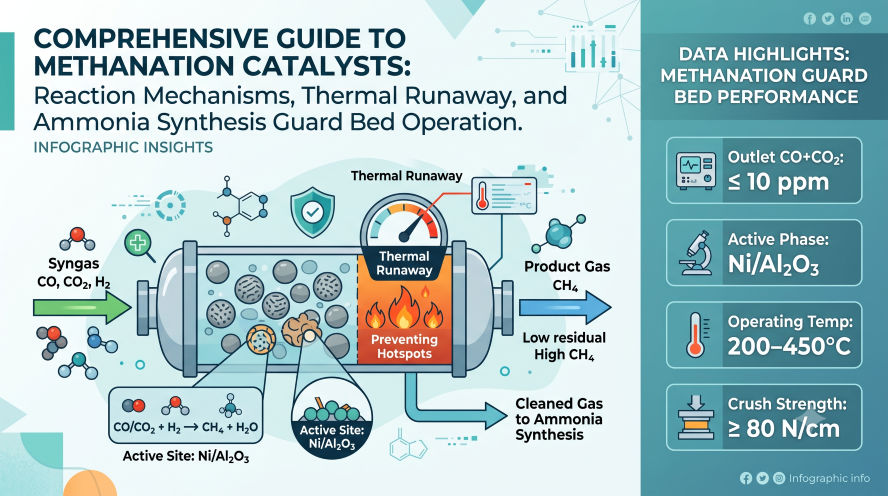
High-performance Ni/Al₂O₃-based methanation catalyst designed for ultra-deep removal of trace CO and CO₂ in ammonia synthesis and hydrogen purification units, reducing carbon oxides to ≤ 10 ppm.
Get QuoteKey Attributes
- Synergistic Ni/Al₂O₃ formulation provides dense active sites for rapid, ultra-deep hydrogenation of carbon oxides.
- Assures complete protection for sensitive iron-based ammonia synthesis catalysts by reducing CO+CO₂ to ≤ 10 ppm.
- Advanced alumina carrier matrix prevents active nickel phase sintering even at elevated operational temperatures up to 450°C.
- Exceptional physical robustness (crush strength up to ≥ 80 N/cm) prevents dusting and pressure drop accumulation over multi-year runs.
- Optimized macroscopic pore volumes allow for highly efficient mass transfer across gas hourly space velocities of up to 10,000 h⁻¹.
- Exhibits strong resistance against typical trace impurities, maintaining stability in feeds with < 0.2 ppm total chlorine.
- Offered in both cylindrical and spherical forms to perfectly match specific reactor pressure drop and void fraction requirements.
Applications
- Final stage purification of hydrogen-nitrogen syngas in large-scale Haber-Bosch ammonia synthesis plants.
- Protection of downstream catalytic hydrotreaters in high-purity hydrogen generation units (SMR).
- Polishing of synthetic gas streams in Coal-to-Gas (CTG) and Coal-to-Liquid (CTL) conversion complexes.
- Trace CO₂ elimination from hydrogen streams utilized in refinery hydrocracking and hydrodesulfurization (HDS) networks.
- Removal of unreacted CO in substitute natural gas (SNG) final stage methanation reactors.
- Guard bed operation protecting noble-metal fuel cell stacks from irreversible CO-induced catalyst poisoning.
- Purification of syngas derived from biomass gasification prior to methanol or DME catalytic synthesis.
- Upgrading of pressure swing adsorption (PSA) tail gases recovering high-purity H₂.
Product Description
What is Methanation Catalyst?
Key Takeaways
- Ultra-Deep Hydrogenation: Ni/Al₂O₃ formulation chemically converts trace carbon oxides into methane, reducing outlet CO+CO₂ to ≤ 10 ppm.
- Broad Space Velocity: Optimized pore volume supports rapid gas mass transfer for space velocities (GHSV) from 2,000 h⁻¹ up to 10,000 h⁻¹.
- Catalyst Protection: Acts as a crucial purification guard bed in ammonia synthesis and hydrogen units to protect sensitive downstream iron or noble-metal catalysts.
The Methanation Catalyst is an engineered nickel-based (Ni) catalyst supported on a high-surface-area gamma-alumina (γ-Al₂O₃) carrier, enhanced with specialized structural promoters. In modern chemical processing, trace carbon monoxide (CO) and carbon dioxide (CO₂) in synthesis gas act as severe, permanent poisons to downstream catalysts, particularly the iron-based or ruthenium-based catalysts used in ammonia synthesis. This methanation catalyst functions as a crucial purification step, promoting the highly exothermic hydrogenation of residual carbon oxides into inert methane and water vapor.
The catalytic mechanism relies on the homogeneous dispersion of nickel active sites across the macroporous and mesoporous alumina matrix. When exposed to synthesis gas at elevated temperatures, the carbon oxides chemisorb onto the metallic nickel crystallites and react with activated hydrogen molecules:
CO + 3H₂ ⇌ CH₄ + H₂O (ΔH = −206.3 kJ/mol)
CO₂ + 4H₂ ⇌ CH₄ + 2H₂O (ΔH = −165.0 kJ/mol)
Because both reactions are highly exothermic and volume-reducing, the precise optimization of the Al₂O₃ carrier prevents active-site sintering (thermal degradation) while maintaining high diffusion rates. The catalyst effectively processes inlet CO+CO₂ concentrations up to 0.7%, reliably driving the outlet concentration down to ≤ 10 ppm across a broad operational window of 0.8–4.0 MPa. For a deeper look at the reaction chemistry and guard bed engineering behind these numbers, see our comprehensive methanation catalyst guide.
Key Benefits
- Ultra-Deep Purification: Chemically converts trace carbon oxides into methane, ensuring the final outlet gas contains ≤ 10 ppm of CO+CO₂, fully protecting downstream synthesis loops.
- High Thermal Stability: The robust γ-Al₂O₃ matrix prevents nickel crystallite agglomeration, allowing stable operation continuously across a wide temperature gradient of 200°C to 450°C.
- Broad Space Velocity Range: Optimized pore volume architecture supports rapid gas mass transfer, accommodating variable gas hourly space velocities (GHSV) from 2,000 h⁻¹ up to 10,000 h⁻¹ without bypass.
- Excellent Mechanical Integrity: Available in cylindrical (≥ 80 N/cm) and spherical (≥ 50 N/particle) shapes, ensuring high resistance to physical attrition, minimizing pressure drops, and preventing bed channeling.
- Tolerance to Fluctuations: Specifically formulated with structural promoters to withstand sudden spikes in syngas feed concentrations (up to 0.7% total carbon oxides) without uncontrolled thermal runaway.
- Extended Operational Lifespan: Features strong resistance against typical trace upstream contaminants, tolerating feed oxygen levels up to 0.3% and total chlorine up to 0.2 ppm.
Applications
This methanation catalyst is a mandatory guard unit deployed in multiple large-scale industrial gas processing facilities:
- Ammonia Synthesis Plants (Haber-Bosch Process): Positioned immediately downstream of the low-temperature shift (LTS) converters and CO₂ removal sections. The catalyst scrubs residual CO and CO₂ from the nitrogen-hydrogen syngas mixture. Since oxygen-containing compounds irreversibly oxidize the active iron catalysts in the ammonia synthesis loop, this methanation step guarantees an oxygen-free feed (≤ 10 ppm), sustaining ammonia production efficiency.
- High-Purity Hydrogen Production (SMR/PSA Units): Utilized in Steam Methane Reforming plants where ultra-high-purity hydrogen is required for refinery hydrocracking or fuel cells. The catalyst chemically eliminates carbon oxide impurities that slip through upstream pressure swing adsorption (PSA) beds, preventing poison accumulation in sensitive downstream catalytic hydrotreaters.
- Synthetic Natural Gas (SNG) and Coal-to-Gas (CTG): Deployed in the final methanation stages of coal gasification streams. While primary methanators handle bulk conversion, this catalyst acts as the polishing bed at 200–450°C and 0.8–4.0 MPa, driving the thermodynamic equilibrium of the remaining CO/CO₂ to completion and maximizing the methane yield of the synthetic gas grid.
Packaging & Shipping
We offer flexible packaging and shipping options to suit your project scale and logistics requirements.
Standard Packaging:
- 25 kg drums (moisture-proof, suitable for trial orders and small batches)
- 150 kg steel drums (standard bulk packaging for industrial orders)
- 500 kg super sacks (most popular for industrial bulk orders)
- 1000 kg jumbo bags (for large-scale projects)
- Custom packaging available on request
Minimum Order Quantity (MOQ):
- 1 ton (entry-level orders accepted — perfect for first-time customers)
- 5+ tons (standard bulk orders)
- Container-level supply for long-term partnerships
Container Loading Capacity:
- 20'GP container: 18-20 tons (palletized)
- 40'GP container: 22-24 tons (palletized)
- 40'HQ container: 24-26 tons
Loading Ports: We ship from major Chinese ports based on your requirements: Shanghai, Qingdao, Tianjin, Ningbo, and Shenzhen.
Lead Time:
- Stock orders: 7-15 days from payment confirmation
- Made-to-order: 20-30 days
Shipping Terms: FOB / CIF / CFR / EXW — flexible based on your destination and preferences.
Documents & Certificates
We provide complete documentation for every order:
📄 Technical Data Sheet (TDS) — Confirmed with you during product selection, ensuring exact specifications match your application requirements.
📄 Safety Data Sheet (SDS) — Provided before shipment, meeting all international transportation and handling standards.
📄 Certificate of Analysis (COA) — Issued for each production batch, delivered with your shipment for full quality traceability.
Additional documents available on request: Certificate of Origin (COO), Packing List, Commercial Invoice, Third-party Inspection Report (SGS / BV), Form E (for Middle East destinations with applicable tariff benefits).
Regeneration
Unlike physical adsorbents, methanation catalysts facilitate a permanent chemical transformation and do not undergo continuous adsorption-desorption cycles. Therefore, traditional "regeneration" is rare, and the bed operates continuously for 3 to 5+ years. However, proper activation and handling are critical for longevity. The catalyst must be strictly activated (reduced) using a controlled flow of hydrogen and nitrogen at 350–400°C to convert the inactive NiO into the active Ni metal phase before introducing syngas.
Permanent deactivation occurs through two primary mechanisms: sulfur poisoning (forming inactive nickel sulfides, Ni₃S₂) and high-temperature sintering. Feed gas total sulfur must remain strictly < 0.1 ppm. In cases of low-temperature carbon deposition (Boudouard reaction), a highly controlled steam-air decoking procedure can sometimes recover partial activity, but this risks structural damage. Once the active nickel surface area is permanently sintered or poisoned, the catalyst bed is entirely discharged and replaced.
FAQ
Q1: Why is methanation preferred over physical adsorption for final CO/CO₂ removal? Physical adsorbents struggle to economically capture sub-percent levels of CO and CO₂ down to parts-per-million limits at high flow rates. Methanation chemically consumes these impurities via an irreversible reaction with the abundant hydrogen already present in the syngas, achieving a guaranteed outlet purity of ≤ 10 ppm without requiring complex cyclic regeneration vessels.
Q2: What is the primary cause of premature failure in methanation catalysts? Sulfur poisoning and thermal runaway are the leading causes. Even parts-per-billion (ppb) levels of hydrogen sulfide (H₂S) will progressively convert active metallic nickel into inert nickel sulfide. Furthermore, because methanation is highly exothermic, unexpected spikes in feed CO/CO₂ can cause localized temperature surges beyond 500°C, leading to irreversible thermal sintering of the nickel crystallites.
Q3: How do I choose between the spherical and cylindrical forms of this catalyst? The choice depends on reactor design and pressure drop limitations. Spherical beads (Φ 2–4 mm) offer excellent packing density and higher geometric surface area, which is ideal for uniform gas distribution. Cylindrical pellets (Φ 5×5 mm) provide superior radial crush strength (≥ 80 N/cm) and a higher void fraction, making them suitable for deeper catalyst beds where minimizing pressure drop is the primary engineering constraint.
Q4: Does the catalyst require pre-reduction before operation? Yes, unless purchased in a pre-reduced and stabilized state. Standard oxidized methanation catalysts contain nickel oxide (NiO) which possesses no catalytic activity. Operators must perform an in-situ reduction utilizing a heated hydrogen-rich gas stream to transition the NiO into catalytically active, zero-valent metallic nickel (Ni) prior to routing the sour synthesis gas into the reactor.
Need a Custom Solution?
For bulk pricing and grade recommendation, please send your feedstock CO/CO₂ concentration and reactor operating conditions to us. Our technical team will get back to you within 24 hours with a tailored solution.
Technical Specifications
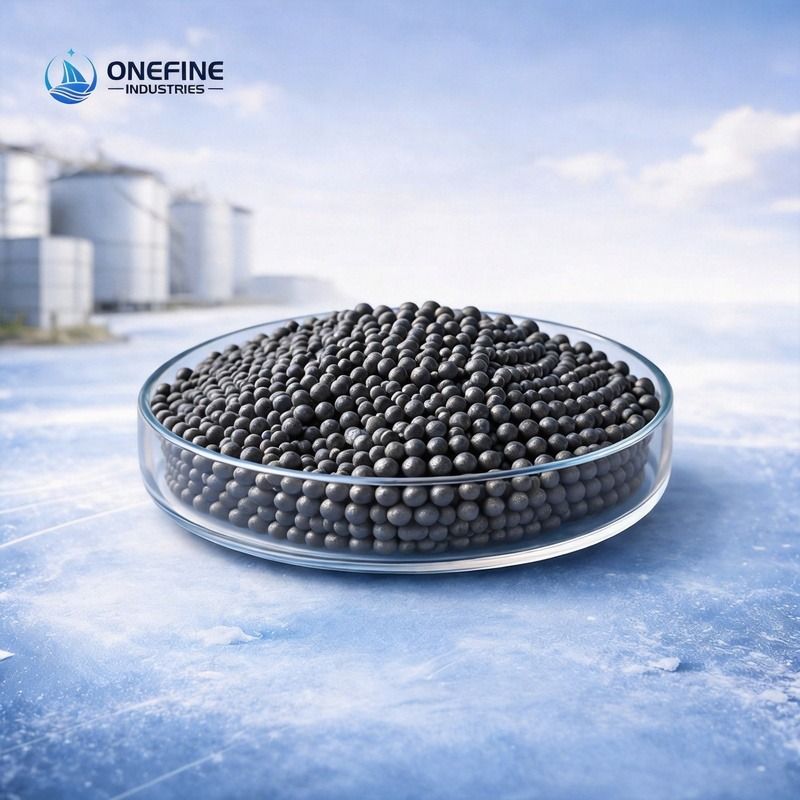
| Appearance | Dark gray cylindrical or spherical beads |
| Dimensions | Φ5×5 mm (Cylinder) / Φ2-4 mm (Sphere) |
| Bulk Density | 1.00-1.20 kg/L (Cylinder) / 0.70-0.90 kg/L (Sphere) |
| Radial Crush Strength | ≥ 80 N/cm (Cylinder) / ≥ 50 N/particle (Sphere) |
| Operating Temperature | 200 – 450 °C |
| Operating Pressure | 0.8 – 4.0 MPa |
| Gas Hourly Space Velocity | 2,000 – 10,000 h⁻¹ |
| Feed Gas Inlet CO+CO₂ | ≤ 0.7% |
| Outlet Gas CO+CO₂ | ≤ 10 ppm |
| Trace Feed Sulfur Limit | < 0.1 ppm |
| Trace Feed Oxygen Limit | < 0.3% |
| Nickel Oxide (NiO) Content | ~ 25 wt% (typical industry range) |
| Specific Surface Area | ≥ 150 m²/g |
Related Products
No related products.