Hydroconversion catalyst
A high-performance hydroconversion catalyst for converting organic sulfur compounds and olefins in gas-phase hydrocarbon feeds. Suitable for refinery dry gas, natural gas, oilfield gas, and water gas pretreatment ahead of ammonia, methanol, and hydrogen production units. Low light-off temperature, broad feedstock compatibility, and long service life.
Get QuoteKey Attributes
- High Organic Sulfur & Olefin Conversion – Simultaneously converts organic sulfur compounds (thiols, sulfides, thiophene, COS) and hydrogenates olefins in a single catalytic bed, delivering clean feed to downstream processes.
- Low Light-Off Temperature – Active from 250°C, reaching peak conversion in the typical 300–380°C range. Lower operating temperature reduces energy consumption and extends catalyst service life.
- High Mechanical Strength – Crushing strength ≥ 50 N/granule with attrition loss ≤ 3.0%, resistant to particle breakage under high-pressure and high-space-velocity conditions.
- Broad Feedstock Compatibility – Works with refinery dry gas, petroleum fractions, refinery gas, natural gas, oilfield gas, and water gas – one catalyst for multiple gas-phase feed types.
- Olefin-Tolerant Formulation – Designed to handle feeds with up to 8% olefin content without excessive exotherm, making it suitable for refinery dry gas applications.
- Ultra-Low Outlet Sulfur (typical performance) – Achieves sub-ppm sulfur in effluent gas when paired with a zinc oxide (ZnO) guard bed, protecting sensitive downstream reforming and synthesis catalysts.
Applications
- Ammonia Plant Feed Gas Desulfurization – Protects reforming and synthesis catalysts by removing organic sulfur from natural gas, refinery gas, and light hydrocarbon feeds.
- Methanol Plant Feed Purification – Hydroconverts organic sulfur in syngas feedstocks before the reformer, preventing catalyst poisoning downstream.
- Refinery Hydrogen Production Units – Desulfurizes naphtha and light gasoil feeds to hydrogen production units (SMR, ATR), safeguarding nickel-based reforming catalysts.
- LNG & Natural Gas Sweetening – Removes trace organic sulfur compounds (mercaptans, COS, thiophene) from natural gas streams prior to liquefaction or pipeline delivery.
- Petrochemical Feedstock Pretreatment – Pre-treats light oil and gaseous hydrocarbon feeds for downstream catalytic processes by eliminating sulfur contaminants.
- Claus Tail Gas Hydrogenation – Converts SO₂ and organic sulfur in Claus plant tail gas to H₂S for recycle, improving overall sulfur recovery efficiency.
- Oilfield Associated Gas Treatment – Removes organic sulfur and olefins from oilfield associated gas before compression or reinjection, reducing downstream corrosion and catalyst poisoning risk.
- Water Gas / Syngas Purification for Fertilizer Plants – Protects shift and methanation catalysts in coal-to-chemicals and syngas-based fertilizer plants by removing organic sulfur species.
- Fischer-Tropsch Syngas Pretreatment – Conditions syngas feed ahead of FT synthesis reactors by removing sulfur poisons and saturating olefins that would otherwise deactivate cobalt/iron catalysts.
Product Description
What Is a Hydroconversion Catalyst?
Key Takeaways:
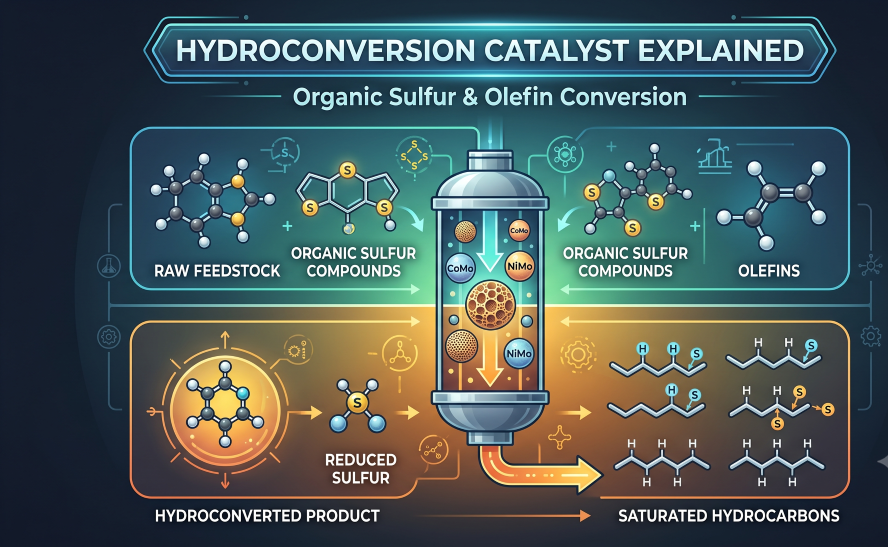
- Dual Functionality: Simultaneously converts complex organic sulfur (COS, thiols, thiophenes) to H₂S and saturates olefins in a single catalytic bed.
- Olefin Tolerant: Safely processes gas-phase feeds with up to 8% olefin content without excessive exotherms.
- Low Light-Off Temperature: Highly active from 250°C, optimizing energy consumption for refinery dry gas and syngas purification.
- Sub-ppm Purity: Achieves < 0.1 ppm outlet sulfur when paired with a downstream zinc oxide (ZnO) guard bed.
A hydroconversion catalyst is a specialized catalytic material designed to convert organic sulfur compounds and olefins in gas-phase hydrocarbon feeds through hydrogenation reactions. The catalyst transforms organic sulfur species — including mercaptans, sulfides, disulfides, thiophenes, and carbonyl sulfide (COS) — into hydrogen sulfide (H₂S), which is then captured by a downstream zinc oxide (ZnO) guard bed to produce essentially sulfur-free feed gas. For a deeper look at the chemistry and where this fits into your process, see our guide: What is a Hydroconversion Catalyst?
Simultaneously, the catalyst hydrogenates olefins into saturated paraffins, which prevents downstream catalyst fouling from olefin polymerization and reduces exothermic heat release in subsequent processing stages.
Unlike simple adsorption-based desulfurization (e.g. ZnO alone), hydroconversion catalysts actively break C-S bonds through catalytic hydrogenolysis, enabling them to handle complex sulfur species that ZnO cannot remove directly. This makes hydroconversion catalyst a common pretreatment step ahead of ammonia, methanol, and hydrogen production processes.
Active Phase Chemistry (General Principle)
Catalytic activity in this class of catalyst depends on the active sulfide phase formed during presulfiding — typically a molybdenum or tungsten disulfide phase promoted by cobalt or nickel sulfide, supported on γ-alumina for its high surface area and thermal stability. This is general industry chemistry shared across sulfide hydrotreating catalysts, not specific proprietary data.
Key Reactions
- Thiol hydrogenolysis – RSH + H₂ → RH + H₂S
- Sulfide hydrogenolysis – R₁SR₂ + 2H₂ → R₁H + R₂H + H₂S
- Disulfide hydrogenolysis – R₁SSR₂ + 3H₂ → R₁H + R₂H + H₂S
- Thiophene hydrogenolysis – C₄H₄S + 4H₂ → C₄H₁₀ + H₂S
- COS hydrogenolysis – COS + H₂ → CO + H₂S
- Olefin hydrogenation – CₙH₂ₙ + H₂ → CₙH₂ₙ₊₂
How It Works
- Step 1 – Hydroconversion Stage: The catalyst converts organic sulfur species to H₂S and hydrogenates olefins in the presence of hydrogen, typically in the 250–450°C range.
- Step 2 – H₂S Removal Stage: The generated H₂S is captured by a downstream zinc oxide (ZnO) guard bed, delivering sulfur-free gas to the reformer or synthesis reactor.
Operating Conditions (Typical Reference Range)
- Operating Temperature – 250 – 450°C
- Operating Pressure – Atmospheric – 6.0 MPa
- Gas Hourly Space Velocity (GHSV) – 1,000 – 3,000 h⁻¹
- Liquid Hourly Space Velocity (LHSV) – 2.0 – 4.0 h⁻¹
- Feed Olefin Content – < 8%
- Outlet Sulfur Content – < 0.1 ppm (with downstream ZnO guard)
These are typical industry reference ranges for this catalyst class. Actual performance depends on your specific feed composition and reactor design — please contact us with your process data for a tailored recommendation.
Presulfiding Requirement
The catalyst is shipped in oxide form and must be sulfided before use to reach full activity. Presulfiding converts the active metal oxides to their corresponding sulfide forms, which are the catalytically active phases. Common methods include gas-phase sulfiding (DMDS or CS₂ in a H₂/N₂ stream with programmed temperature ramp) and in-situ liquid-phase sulfiding during reactor warm-up. Complete sulfidation is critical — incomplete presulfiding leads to permanently reduced activity.
Safety and Handling
Because presulfiding and normal operation both involve hydrogen sulfide (H₂S) — a toxic, flammable gas with an odor threshold well below its dangerous exposure level — safe handling procedures matter as much as catalyst performance itself.
During presulfiding:
- Sulfiding agents (DMDS, CS₂) and the H₂S generated during the process require proper ventilation, gas detection, and adherence to your site's process safety management procedures
- Follow a controlled temperature ramp during sulfiding — heating too quickly can cause incomplete or uneven sulfidation, and in some cases a sharper-than-expected H₂S release
- Ensure flare or vent gas systems are sized to handle the H₂S generated during breakthrough
During normal operation and catalyst handling:
- H₂S monitoring at reactor outlets and in surrounding work areas is standard practice, particularly during startup, shutdown, and catalyst change-out
- Spent catalyst may retain residual sulfur compounds and should be handled, stored, and disposed of according to local hazardous material regulations — do not assume spent catalyst is inert
- Standard PPE (gloves, safety glasses) plus site-specific H₂S safety protocols (monitors, escape respirators where required) apply during catalyst loading and unloading
- Avoid exposing unloaded catalyst to air for extended periods without proper precautions, as pyrophoric behavior is possible with some sulfided hydrotreating catalysts depending on formulation — consult your safety data sheet and site procedures before unloading
We provide a full Safety Data Sheet (SDS) with every order — see Documents & Certificates below — and our technical team can discuss presulfiding and handling procedures specific to your reactor configuration.
Deactivation Mechanisms & Prevention
- Coke Deposition – The most common deactivation mode, especially at higher temperatures or with heavier feeds. Partially reversible through regeneration.
- Metal Poisoning – Trace metals in the feed (arsenic, lead, mercury) can irreversibly poison active sites; guard beds may be required.
- Sintering – Prolonged exposure above the design temperature limit causes permanent surface area loss.
- Physical Damage – Thermal cycling or improper loading can cause particle breakage or bed channeling.
Best practices: keep feed sulfur within design range, avoid temperature excursions, ensure complete presulfiding, and monitor pressure drop for early signs of fouling.
Regeneration
When activity declines primarily due to coke deposition, the catalyst can be regenerated by controlled oxidative burn-off: purge with inert gas, introduce controlled low-concentration air while monitoring bed temperature, and complete once CO₂ evolution ceases. Proper regeneration can restore a significant portion of original activity; some facilities use off-site regeneration services for more precise temperature control.
Related Hydrogenation Catalyst Range
Sorbsieve also supplies a broader range of hydrogenation catalysts (Co-Mo, Ni-Mo, and Ni-Mo-W based) for liquid-phase petroleum fraction hydrotreating — a different application from this gas-phase hydroconversion catalyst. Contact us with your process data and we'll recommend the right grade for your specific feed and objectives.
Packaging & Shipping
We offer flexible packaging and shipping options to suit your project scale and logistics requirements.
Standard Packaging:
- 25 kg drums (moisture-proof, suitable for trial orders and small batches)
- 150 kg steel drums (standard bulk packaging for industrial orders)
- 500 kg super sacks (most popular for industrial bulk orders)
- 1000 kg jumbo bags (for large-scale projects)
- Custom packaging available on request
Minimum Order Quantity (MOQ):
- 1 ton (entry-level orders accepted — perfect for first-time customers)
- 5+ tons (standard bulk orders)
- Container-level supply for long-term partnerships
Container Loading Capacity:
- 20'GP container: 18-20 tons (palletized)
- 40'GP container: 22-24 tons (palletized)
- 40'HQ container: 24-26 tons
Loading Ports: We ship from major Chinese ports based on your requirements: Shanghai, Qingdao, Tianjin, Ningbo, and Shenzhen.
Lead Time:
- Stock orders: 7-15 days from payment confirmation
- Made-to-order: 20-30 days
Shipping Terms: FOB / CIF / CFR / EXW — flexible based on your destination and preferences.
Documents & Certificates
We provide complete documentation for every order:
- 📄 Technical Data Sheet (TDS) — Confirmed with you during product selection, ensuring exact specifications match your application requirements.
- 📄 Safety Data Sheet (SDS) — Provided before shipment, meeting all international transportation and handling standards.
- 📄 Certificate of Analysis (COA) — Issued for each production batch, delivered with your shipment for full quality traceability.
Additional documents available on request: Certificate of Origin (COO), Packing List, Commercial Invoice, Third-party Inspection Report (SGS / BV).
FAQ
- Q: How is a hydroconversion catalyst different from a ZnO adsorbent alone? A: ZnO adsorption can only remove H₂S directly. A hydroconversion catalyst first breaks down complex organic sulfur species (thiophenes, COS, mercaptans) into H₂S through catalytic hydrogenolysis, which ZnO alone cannot do. The two are typically used together — hydroconversion catalyst upstream, ZnO guard bed downstream.
- Q: Can this catalyst handle feeds with high olefin content? A: Yes, this grade is formulated to tolerate feed olefin content up to approximately 8% without excessive exotherm, making it suitable for refinery dry gas applications.
- Q: How often does the catalyst need regeneration or replacement? A: This depends heavily on feed severity and operating conditions. Coke-related activity loss can typically be addressed through oxidative regeneration; please contact us with your process data for a service life estimate specific to your application.
- Q: Do you provide pre-sulfided catalyst? A: Please contact our technical team to discuss pre-sulfided options and startup support for your specific reactor configuration.
Need a Custom Solution?
For bulk pricing and grade recommendation, please send your feedstock composition & reactor conditions to us. Our technical team will get back to you within 24 hours with a tailored solution.
Technical Specifications
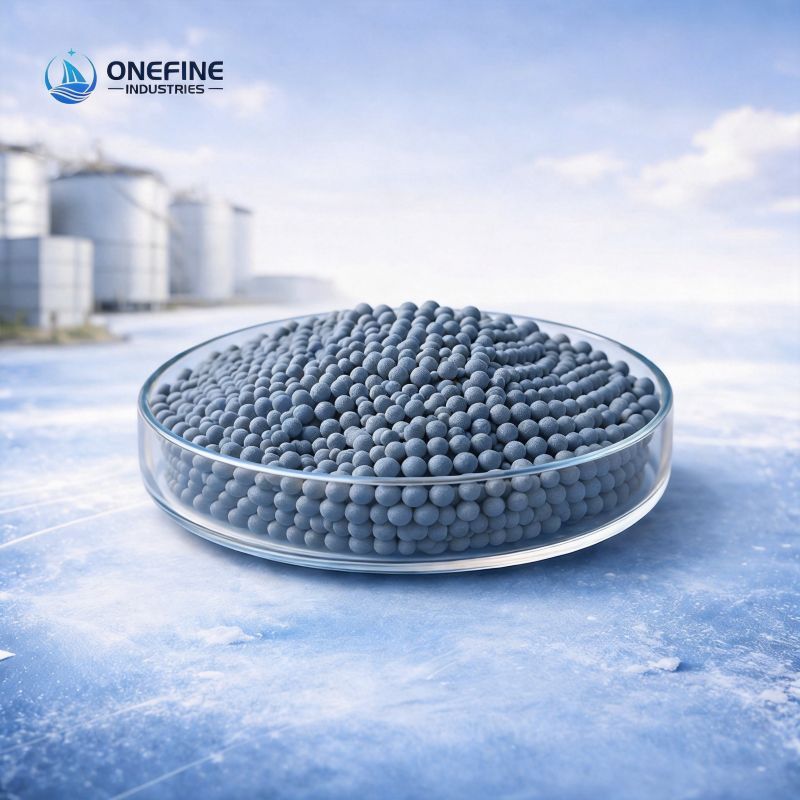
| Appearance | Grey-blue spheres |
| Particle Size | Φ2 – 4 mm |
| Bulk Density | 0.65 ± 0.10 kg/L |
| Crushing Strength | ≥ 50 N/granule |
| Loss on Attrition | ≤ 3.0% |
| Olefin Tolerance | < 8% in feed gas |
| Applicable Feeds | Refinery dry gas, petroleum fractions, refinery gas, natural gas, oilfield gas, water gas |
| Target Reactions | Organic sulfur hydroconversion, olefin hydrogenation |
| Operating Temperature (typical range) | 250 – 450°C |
| Operating Pressure (typical range) | Atmospheric – 6.0 MPa |
| Space Velocity (typical range) | GHSV 1,000 – 3,000 h⁻¹; LHSV 2.0 – 4.0 h⁻¹ |
| Outlet Sulfur Content (typical, with downstream ZnO guard) | < 0.1 ppm |
Related Products
No related products.