Why Does Activated Alumina Dust and Channel During Regeneration Cycles?
Key Takeaways
- Dusting and channeling reinforce each other; generated fines alter local packing density, concentrating gas flow into narrow paths that accelerate further attrition.
- A regeneration heating ramp that is too fast causes uneven moisture desorption and local recondensation, mechanically stressing the porous binder.
- Liquid water carry-over from upstream separators releases abrupt heat upon contact, physically fracturing the bead surface where the droplet lands.
- A slow but steady rise in pressure drop across the bed is the clearest early-warning signal of accumulating fines and developing flow maldistribution.
Operators running thermal swing adsorption (TSA) units on activated alumina often notice two problems showing up together: a slow but steady rise in pressure drop across the bed, and fine dust turning up in downstream filters and valves. These aren't two separate failures — they're usually two symptoms of the same underlying stress on the bed, and understanding the link helps explain why a bed that looked fine for years can start degrading faster than expected.
Dusting and Channeling Are Linked, Not Separate Problems
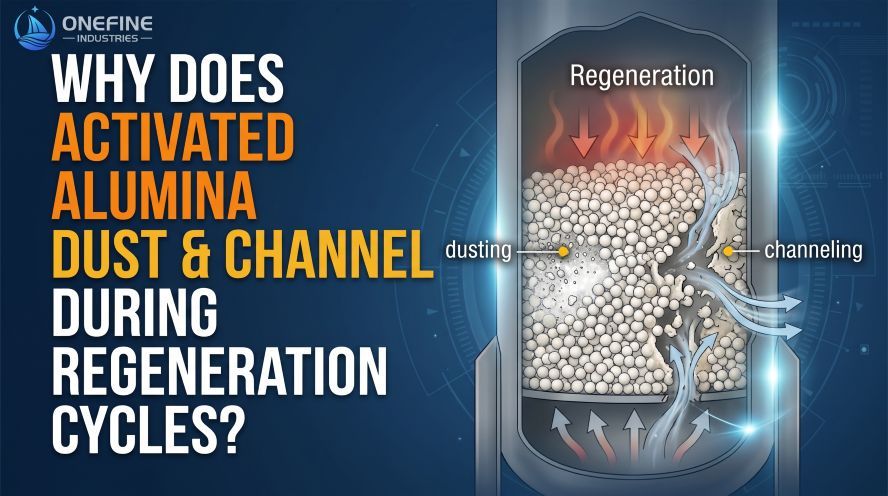
Dusting is the physical breakdown of alumina beads into fines — material generated when beads crack, abrade against each other, or lose binder integrity. Channeling is a flow problem: instead of moving evenly across the full cross-section of the bed, the gas finds a lower-resistance path and concentrates there, leaving other parts of the bed poorly contacted.
These two issues are frequently reported as different symptoms of the same root cause rather than independent events. Fines generated by dusting settle and redistribute within the bed, changing the local packing density; wherever the bed becomes locally looser or more compacted, the gas preferentially follows the path of least resistance — which is exactly the definition of channeling. Once channeling starts, flow concentrates through a narrower section of the bed, and that concentrated flow accelerates local attrition in that zone, generating more fines. The two problems reinforce each other.
For background on how activated alumina's porous, agglomerated structure gives it its adsorption capacity in the first place, see What Is Activated Alumina?
Root Cause 1: Thermal Stress During the Regeneration Heating Ramp
Activated alumina beads are formed by agglomerating transition-alumina particles into a porous structure. During regeneration, adsorbed moisture has to leave that structure as the bed heats up. If the heating ramp is too fast, the lower layers desorb water before the upper, cooler sections have warmed through — and the regeneration gas, now carrying that desorbed moisture, can locally re-saturate and condense again on the still-cold upper layers. Because the bead's strength comes from that same agglomerated, porous structure, this uneven wetting-and-heating cycle, repeated over many regenerations, is a plausible mechanical driver of binder weakening and powder formation.
A gentler, more gradual heating ramp reduces this risk because it gives moisture more time to desorb evenly through the bed instead of flashing off unevenly and recondensing elsewhere.
Root Cause 2: Mechanical Attrition From Bed Movement
Every adsorption/regeneration cycle involves some physical movement in the bed — beads settle slightly over time, and if flow direction differs between the adsorption and regeneration steps, the bed can shift slightly with each reversal. Repeated settling and micro-movement mean beads keep rubbing against each other and the vessel internals, generating fines over the life of the bed. This is a normal, gradual wear mechanism — but it accelerates sharply if the support grid or flow distributor isn't functioning correctly, concentrating turbulence on one section instead of spreading it evenly.
Root Cause 3: Liquid Carry-Over Reaching the Bed
Activated alumina is designed to adsorb water vapor — not liquid water. If liquid droplets are carried over from an upstream separator (or condense inside the vessel itself), the impact is mechanically and thermally more severe than vapor-phase adsorption: liquid contact releases heat abruptly at the point of contact and can physically stress the bead surface, accelerating binder breakdown exactly where the droplet lands. This is one of the more preventable causes, since it traces back to upstream separator performance rather than the adsorbent itself.
Root Cause 4: Bed Support and Loading Issues
Channeling also has purely mechanical causes that have nothing to do with thermal cycling: uneven loading during the initial fill, a damaged or corroded support grid, or operating the bed at a flow rate low enough that the gas no longer maintains even distribution across the full cross-section. These issues can exist from day one of a bed's life and tend to get worse — not better — as dusting adds loose fines into an already uneven void structure.
What This Costs in Practice
The visible consequences compound each other over the life of a bed:
- Rising pressure drop — as fines accumulate and local compaction increases, resistance to flow climbs, which in industrial dryers is tracked over the life of the bed as the clearest early-warning signal of a developing problem
- Downstream equipment fouling — dust that migrates past the bed support screens ends up in after-filters and can foul control valves
- Incomplete regeneration — channeling during the regeneration step means some zones of the bed never get fully dried, so those zones carry residual moisture into the next adsorption cycle and reduce the bed's effective working capacity
- Shortened bed life — once dusting and channeling are reinforcing each other, the rate of degradation tends to accelerate rather than stay linear, which is why a bed can seem stable for a long stretch and then decline noticeably faster
Reducing the Risk
None of these mechanisms can be eliminated completely — some attrition and some thermal cycling stress is inherent to any thermally regenerated bed — but the rate can be controlled:
- A controlled, gradual heating ramp during regeneration (rather than a fast temperature jump) reduces uneven desorption and recondensation
- Verifying upstream liquid/gas separation performance reduces the risk of liquid carry-over reaching the bed
- Confirming the support grid and flow distributor are intact and correctly loaded addresses the purely mechanical causes of channeling
- Attrition-resistant bead quality — a property that varies meaningfully between alumina grades — directly affects how much fines generation a given number of cycles produces
Recommended Products from Sorbsieve
- Activated Alumina for Purification — porous, agglomerated alumina desiccant for thermal swing adsorption and gas purification service.
FAQ
Is dusting always a sign the bed needs replacing? No. Some fines generation is normal, gradual wear over the life of any thermally regenerated bed. It becomes a concern when the rate accelerates sharply or combines with rising pressure drop and visible fouling downstream.
Can a faster regeneration cycle make dusting worse? A faster heating ramp raises the risk of uneven desorption and local recondensation, one of the mechanical stresses behind binder weakening. A gradual ramp reduces that specific risk, though it won't eliminate ordinary attrition from bed movement.
Is this the same as normal end-of-life capacity decline? No. Capacity decline from saturation is a separate, expected aging process. Dusting and channeling are mechanical/operational issues that can show up well before a bed reaches end of capacity, and can accelerate how quickly capacity declines.
Can better upstream separation fix channeling on its own? It addresses one root cause — liquid carry-over — but not the others. Thermal cycling stress and mechanical bed movement are inherent to any thermally regenerated bed, so upstream separation reduces risk rather than eliminating channeling entirely.
Looking for Bulk Supply of Activated Alumina?
Sorbsieve is a trusted bulk supplier of Activated Alumina and complete industrial adsorbents, serving industrial buyers across the Middle East.
We provide:
- ✅ Container-level supply (20'GP / 40'GP / 40'HQ)
- ✅ Full documentation (COA / TDS / SDS / COO)
- ✅ Multiple packaging options
- ✅ Technical support for adsorbent selection and system optimization
- ✅ Fast quote response for industrial inquiries
Contact our team for bulk pricing, product samples, and technical consultation.