How Much Carbon Molecular Sieve Do You Need for a PSA Nitrogen Generator?
The Kinetic Engine of PSA Nitrogen Generation
In modern chemical processing, electronics manufacturing, food packaging, and laser metal fabrication industries, the requirement for on-site nitrogen generation has largely replaced total reliance on conventional cryogenic liquid nitrogen deliveries. At the very heart of these efficient on-site Pressure Swing Adsorption (PSA) systems is the Carbon Molecular Sieve (CMS) . This highly engineered, porous carbon matrix acts as the sole separation medium, stripping oxygen molecules from compressed atmospheric air to yield a continuous, reliable stream of dry, high-purity nitrogen gas.
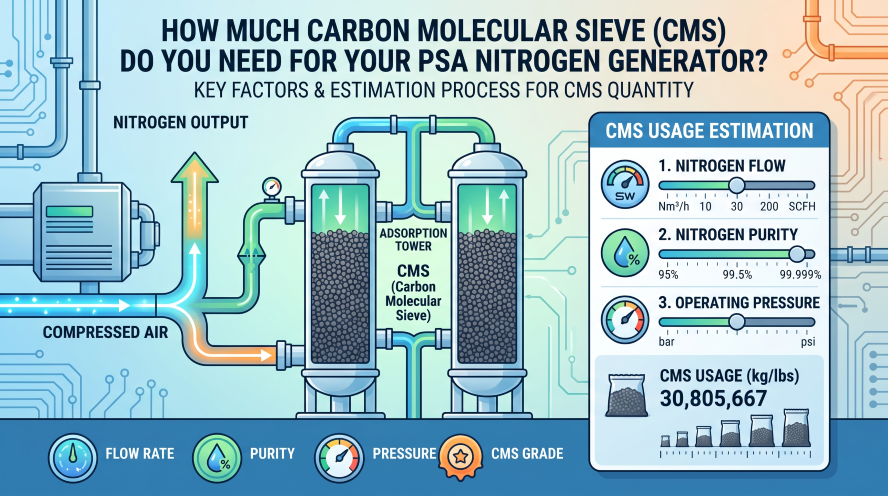
A recurring and critical engineering question emerges during the initial design, scaling, or refurbishment of these PSA plants: exactly how much Carbon Molecular Sieve is required to produce a specific flow rate of nitrogen?
The answer is not derived from a simple, fixed linear ratio. The required mass of CMS is dynamically dictated by the desired output nitrogen purity — which spans a wide operational range from a basic 95% up to an ultra-high 99.999% purity. The operational cycle time, adsorption pressure, geometric bulk density, and the specific kinetic yield properties of the chosen CMS grade all play pivotal roles in the calculation. Undersizing the adsorption bed guarantees premature oxygen breakthrough and purity failure, while arbitrarily oversizing leads to severe compressor inefficiency and inflated capital expenditure. This guide dissects the kinetic sieving mechanism of CMS, defines the core Air-to-Nitrogen parameters of PSA sizing, and provides the mathematical framework to calculate your optimal CMS loading requirement.
Key Takeaways
- Carbon Molecular Sieve (CMS) separates air via kinetic sieving, utilizing 0.3–0.5 nm micropores that allow oxygen to diffuse faster than nitrogen.
- The required CMS mass increases exponentially with target nitrogen purity; achieving 99.999% purity demands an Air-to-Nitrogen (A/N) ratio of 7.5:1 or higher.
- Liquid water carryover causes hydrothermal breakdown, while compressor oil vapor permanently blinds the micropores, requiring strict upstream pre-filtration.
The Kinetic Separation Mechanism and Pore Dynamics
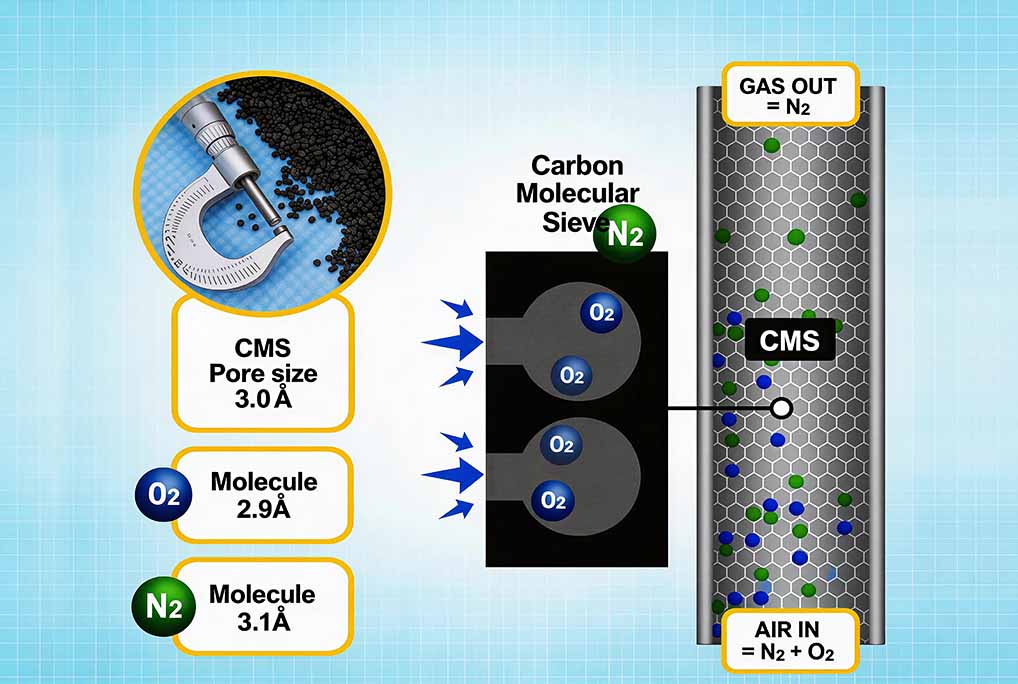
To accurately calculate the required CMS volume, process engineers must first understand that Carbon Molecular Sieve does not operate on thermodynamic equilibrium adsorption (unlike silica gel or activated alumina absorbing moisture). Instead, CMS relies entirely on a highly precise kinetic sieving principle.
The separation of standard atmospheric air — roughly 78% nitrogen, 21% oxygen, and 1% argon — relies on the microscopic disparity in diffusion rates of oxygen and nitrogen molecules into the internal CMS pore structure. High-quality CMS matrices are manufactured with a remarkably uniform micropore distribution, strictly concentrated between 0.3 nm and 0.5 nm.
The Angstrom-Level Disparity:
- Oxygen (O₂): kinetic diameter of approximately 3.46 Å (0.346 nm)
- Nitrogen (N₂): kinetic diameter of approximately 3.64 Å (0.364 nm)
Because the engineered 0.3–0.5 nm micropores of CMS are narrower than the nitrogen molecule but slightly wider than the oxygen molecule, O₂ diffuses into the carbon structure significantly faster than N₂. During the high-pressure adsorption phase (typically 0.7 to 1.0 MPa), oxygen is rapidly driven into the micropores and trapped. The bulkier nitrogen molecules bypass the pores and flow through the interstitial spaces between the CMS pellets, exiting the top of the adsorption tower as purified product gas.
This kinetic advantage is strictly time-dependent. If the high-pressure adsorption phase is held too long, nitrogen eventually forces its way into the pores, degrading separation efficiency. This is why precise tuning of the PSA cycle time — and matching total CMS mass to flow velocity — is a firm engineering requirement.
Purity Requirements and the Air-to-Nitrogen (A/N) Ratio
The single most dominant variable determining how much CMS you need is the required nitrogen purity. Standard PSA nitrogen systems deliver a purity spectrum ranging from 95% up to 99.999% (often called 5-Nines purity).
As target purity increases, the difficulty of stripping out the final trace oxygen molecules scales exponentially. To achieve 99.999% purity (max 10 ppm O₂ slip), the PSA tower must run a shorter adsorption cycle and use a larger CMS volume to capture trace oxygen before breakthrough.
This efficiency curve is quantified by the Air-to-Nitrogen (A/N) Ratio — the volume of compressed air that must be processed to yield one unit of pure nitrogen product:
- At 95% purity: A/N ratio is approximately 2:1
- At 99.5% purity: A/N ratio climbs to approximately 3:1
- At 99.99% purity: A/N ratio increases to approximately 5:1
- At 99.999% purity: A/N ratio can reach 7.5:1 or higher
Arbitrarily over-specifying "99.999% purity" for an application like tank blanketing that only realistically needs 95–99% purity results in a massively over-sized CMS bed, inflating both capital expenditure and long-term compressor electrical costs.
For engineers sizing the oxygen-side counterpart of PSA gas separation, the same A/N-ratio logic applies in reverse to zeolite-based oxygen generators — see our companion guide, How Much Molecular Sieve Do You Need for a PSA Oxygen Plant?
The Sizing Equation, Yield, and Bulk Density
To determine the required CMS mass for a twin-tower PSA system, engineers use the Specific Nitrogen Yield metric supplied by the CMS producer's technical documentation — typically a minimum yield of ≥ 28 m³/t under standard reference conditions. This parameter represents the volume of nitrogen produced per hour, per ton of CMS, at a specific reference purity.
Converting Mass to Vessel Volume
Calculating bare mass is only the first step — engineers must convert it into a physical geometric volume. CMS is typically supplied as extruded cylindrical pellets with a consistent bulk density:
- Standard bulk density range: 0.60 to 0.70 g/cm³ (600–700 kg/m³)
- Regular-type sieves: recommended filling density of 0.65–0.68 g/cm³
- High-density variants: 0.70–0.73 g/cm³
For example, if a PSA tower requires 1,500 kg of regular CMS, dividing by a median bulk density of 650 kg/m³ gives a required internal vessel volume of approximately 2.3 cubic meters. Standard testing methods such as GB/T 16913 confirm that delivered bulk density aligns with design parameters.
Bed Geometry and Flow Fluidization
You cannot pour this volume into any randomly sized vessel. Bed geometry directly affects the superficial velocity of the compressed air. A tower designed too short and wide moves air too slowly, causing uneven bed utilization and flow channeling. A tower designed too tall and narrow pushes superficial velocity past the fluidization limit — the resulting upward kinetic force lifts and smashes the carbon extrudates, crushing the sieve into fine dust and destroying the bed. High-grade CMS is rated for a compressive strength of ≥ 60 N/particle (ASTM D4179) to resist these operational stresses.
Maintenance Protocols and Long-Term Performance
While CMS is designed to operate for the entire service life of the PSA generator, this longevity is strictly conditional on rigorous upstream air conditioning. Compressed atmospheric air carries water vapor, particulate dust, and vaporized compressor lubricant — if these contaminants bypass pre-filtration, they inflict severe, irreversible damage on the sensitive 0.3–0.5 nm pore structure.
Liquid water carryover causes physical degradation of the carbon extrudates: the rapid influx of pressurized air into a water-logged bed generates violent hydrothermal stress, leading to pellet disintegration. The resulting carbon dust clogs pneumatic valves, blinds downstream particulate filters, and restricts gas flow.
Hydrocarbon oil vapor is an even more insidious threat. Oil droplets condense on the high-surface-area (600–1,000 m²/g) carbon matrix, coating pellets and permanently blinding the micropores — "oil blinding" cannot be thermally reversed or chemically flushed under standard field conditions. To protect CMS lifespan, plant engineers must maintain refrigeration or desiccant air dryers and deploy a cascade of coalescing and activated carbon pre-filters upstream. In systems where moisture control is critical, a dedicated Activated Alumina pre-drying stage is a common complementary guard bed ahead of the CMS tower.
For a real-world sizing and system-design walkthrough, see our application case: Carbon Molecular Sieve for Nitrogen Generation
Recommended Products from Sorbsieve
Sorbsieve's industrial-grade CMS is engineered with a uniform 0.3–0.5 nm micropore distribution for reliable kinetic separation across the 95%–99.999% purity range, backed by full technical documentation for PSA system sizing.
Frequently Asked Questions (FAQ)
Q1: What determines the compressed air requirement for a nitrogen generator?
A1: The compressed air requirement is dictated by the desired nitrogen purity level, target dew point, and the specific kinetic yield of the CMS grade selected. Producing nitrogen at 99.5% purity requires roughly 3 units of air for every 1 unit of nitrogen — ultra-high purity demands substantially more.
Q2: Why did my CMS lose separation efficiency rapidly?
A2: CMS efficiency loss is predominantly caused by upstream air quality issues or pressure fluctuations. CMS is highly sensitive to liquid water and compressor lubricating oil — if oil vapor slips past pre-filtration, it condenses inside the 0.3–0.5 nm pores, causing irreversible "oil blinding."
Q3: Is Carbon Molecular Sieve a consumable that requires regular replacement?
A3: No. CMS is not a standard consumable and is typically installed for the entire service life of the nitrogen generator. With properly maintained upstream air purification, a PSA nitrogen generator can operate continuously for years without a CMS replacement.
Q4: How does PSA technology compare to membrane separation for high purity?
A4: PSA generators using CMS can achieve up to 99.999% purity, while membrane generators using polymer fibers typically cap out around 99.5%. PSA systems offer a superior air-to-nitrogen ratio for high-purity requirements, reducing long-term energy consumption.
Looking for Bulk Supply of Carbon Molecular Sieve?
Sorbsieve is a trusted bulk supplier of Carbon Molecular Sieve and complete industrial adsorbents, serving industrial buyers across the Middle East.
We provide:
- ✅ Container-level supply (20'GP / 40'GP / 40'HQ)
- ✅ Full documentation (COA / TDS / SDS / COO)
- ✅ Multiple packaging options
- ✅ Technical support for CMS grade selection and PSA system sizing
- ✅ Fast quote response for industrial inquiries
Contact our team for bulk pricing, product samples, and technical consultation.
Related Products
Carbon Molecular Sieve for Nitrogen Generation (CMS)
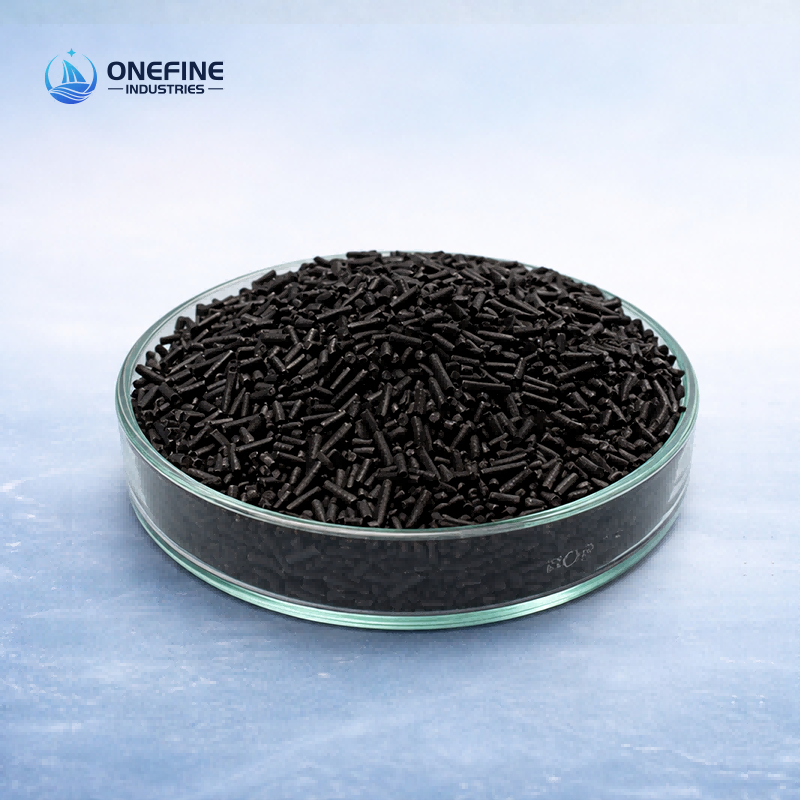
High-performance carbon molecular sieve (CMS) for PSA nitrogen generators. Uniform micropore distribution (0.3-0.5nm) ensures efficient oxygen-nitrogen separation. Delivers 95-99.999% nitrogen purity with 3-5 year service life. Bulk supply for industrial buyers worldwide.
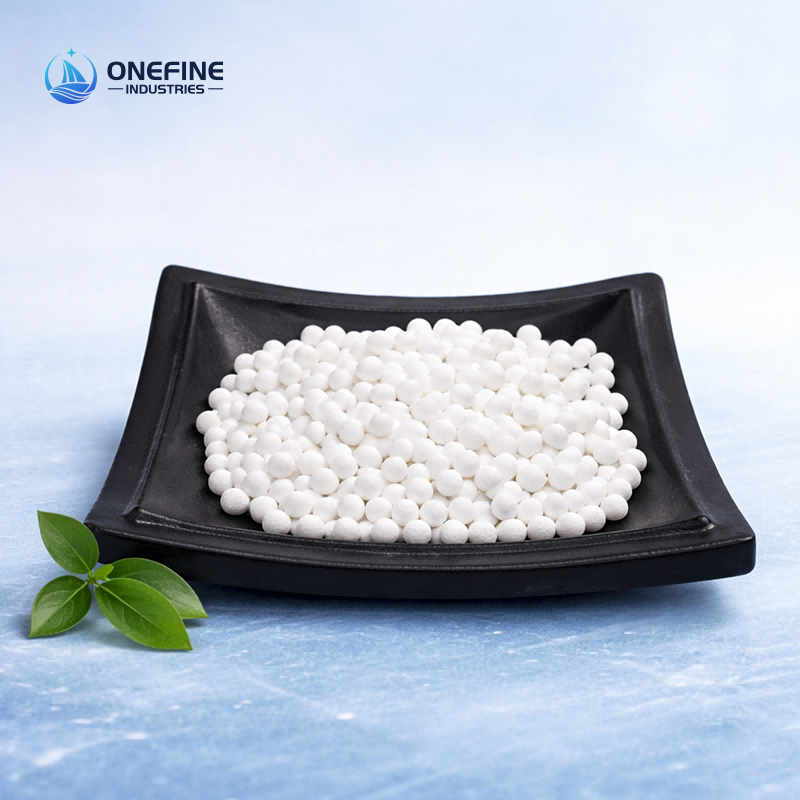
Activated Alumina for Purification
High-performance activated alumina (γ-Al₂O₃) adsorbent and desiccant for industrial gas/liquid drying, water defluoridation, and purification. White spherical beads with high surface area (≥300 m²/g), excellent crush strength, and full thermal regenerability. Available in multiple particle sizes for compressed air dryers, water treatment, and catalyst carrier applications.