How Do You Know When to Replace a Dehydrogenation Catalyst?
Key Takeaways
- Because this catalyst handles safety-critical catalytic combination duty, its performance is judged on achieving complete reaction in a single pass rather than gradual capacity fade.
- A narrowing temperature rise (ΔT) across the bed under stable feed conditions is the clearest and earliest indicator of declining conversion capability.
- If continuous safety analyzers detect residual hydrogen or oxygen breaking through downstream, the catalyst has failed and requires immediate, unscheduled replacement.
- Gradual thermal sintering of the noble metal phase typically causes slow ΔT decline, whereas trace contaminant poisoning can block active sites abruptly.
A dehydrogenation catalyst used for catalytic combination duty — removing trace hydrogen or oxygen from a process stream to eliminate an explosive atmosphere — doesn't fail the way a typical adsorbent does. There's no gradual drop in product purity to track. Instead, the catalyst's job is to drive an exothermic reaction to completion every single pass, and when it can no longer do that reliably, the consequence is a safety exposure, not just a quality dip. Knowing the warning signs early — and knowing which signs point to which failure mode — is what keeps a guard bed doing its job instead of becoming the weak link.
Why This Catalyst's Decline Looks Different
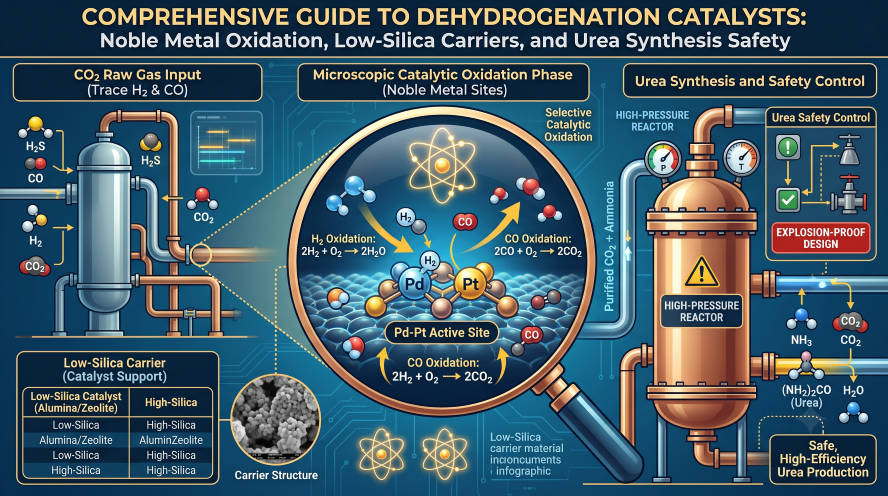
Most catalysts in a purification train are judged by breakthrough curves or capacity fade over weeks. A catalytic combination catalyst is judged on a single pass, every pass. For background on how the active phase and carrier are built to support that duty, see our dehydrogenation catalyst basics. The short version: performance here is binary in a way few other catalysts are — either the reaction goes to completion, or trace reactive gas carries through to the next stage of the process.
Signal 1: Declining Temperature Rise Across the Bed
Because the catalytic combination reaction is exothermic, the bed shows a measurable temperature rise between inlet and outlet under stable feed conditions. As active sites lose activity, less reaction occurs per pass and that temperature rise narrows. This is usually the earliest and most useful signal, because it's gradual and trendable — operators can watch it drift down over weeks or months rather than being caught by surprise. A narrowing ΔT at otherwise unchanged feed rate and composition is the clearest early indicator that the catalyst bed is losing conversion capability, well before any gas actually breaks through downstream.
Signal 2: Downstream Gas Breakthrough on Safety Analyzers
Where the first signal is gradual, this one is a hard stop. If residual hydrogen or oxygen is detected downstream of the bed by continuous gas analyzers — particularly if concentration trends upward toward the lower explosive limit — the catalyst is no longer completing the reaction and replacement becomes immediate, not scheduled. This is exactly the failure mode our urea synthesis safety application case walks through in a real plant context: a safety-duty catalyst bed is one place where "monitor and plan for next turnaround" isn't an acceptable response once breakthrough is confirmed.
What's Behind the Signals: Sintering vs Poisoning
Both signals above can trace back to one of two deactivation pathways, and distinguishing them matters for how plant teams respond:
- Thermal sintering of the noble metal active phase reduces the exposed active surface area over time, especially after repeated or extended high-temperature exposure. This pathway is generally gradual and, once advanced, not reversible — it shows up mainly as a slow ΔT decline over a long operating run.
- Poisoning from trace contaminants in the feed gas (sulfur compounds and other impurities are the usual suspects) blocks active sites more abruptly and can accelerate a ΔT decline faster than sintering alone would. Whether poisoning is partially recoverable depends heavily on the specific contaminant and exposure level, which is why feed gas quality upstream of the bed is worth checking whenever ΔT decline accelerates unexpectedly.
Because these two pathways can overlap in a single bed's life, the practical approach is less about diagnosing which one is dominant and more about trending ΔT consistently enough to catch either one before it reaches the breakthrough stage.
Don't Skip the Physical Inspection
Activity-based signals don't catch everything. During scheduled turnarounds, a rising pressure drop across the bed points to a separate issue — physical fouling or dust accumulation — that can restrict flow and distort both of the signals above even if the catalyst's chemical activity is still reasonable. A visual check of pellet integrity and any physical degradation during these inspections is worth doing alongside the instrumentation data, not instead of it.
Recommended Products from Sorbsieve
Dehydrogenation Catalyst — our Dehydrogenation Catalyst is supplied in bulk to industrial buyers across the Middle East, with full technical documentation for every batch.
FAQ
How often should a dehydrogenation catalyst be replaced? There's no fixed interval — service life depends on feed gas quality, operating temperature, and how consistently the bed is monitored. Trending bed ΔT over time is a more reliable guide than working off a calendar date.
Can a dehydrogenation catalyst be regenerated instead of replaced? It depends on the deactivation pathway. Sintering-driven activity loss is generally not reversible through regeneration. Poisoning-driven loss may be partially recoverable in some cases, depending on the specific contaminant involved — this is a case-by-case technical question best confirmed against your actual feed gas analysis.
What happens if a dehydrogenation catalyst isn't replaced in time? Residual hydrogen or oxygen can carry through to the downstream process instead of being fully converted, which is exactly the explosive-atmosphere risk this catalyst exists to prevent. This is the scenario our urea synthesis safety application case covers in more detail.
Does feed gas composition affect how fast the catalyst deactivates? Yes — trace contaminants in the feed gas are the main driver of poisoning-related activity loss, separate from the gradual sintering that happens regardless of feed quality. Consistent feed gas quality upstream of the bed extends service life.
Looking for Bulk Supply of Dehydrogenation Catalyst?
Sorbsieve is a trusted bulk supplier of Dehydrogenation Catalyst and complete industrial adsorbents, serving industrial buyers across the Middle East.
We provide:
- ✅ Container-level supply (20'GP / 40'GP / 40'HQ)
- ✅ Full documentation (COA / TDS / SDS / COO)
- ✅ Multiple packaging options
- ✅ Technical support for Dehydrogenation Catalyst selection and system optimization
- ✅ Fast quote response for industrial inquiries
Contact our team for bulk pricing, product samples, and technical consultation.