How Do You Know When to Replace a Hydroconversion Catalyst?
Key Takeaways
- Rising reactor temperature, specifically an accelerating rate of temperature increase, is the earliest signal of catalyst aging.
- Downstream fouling, indicated by rising pressure drop and visible gum, points to declining diolefin and olefin saturation activity.
- An increase in reactive organic sulfur reaching downstream units indicates declining sulfur conversion capacity.
- A single indicator can be misleading; confirm exhaustion when temperature creep, fouling, and sulfur slip trend together alongside shorter cycles.
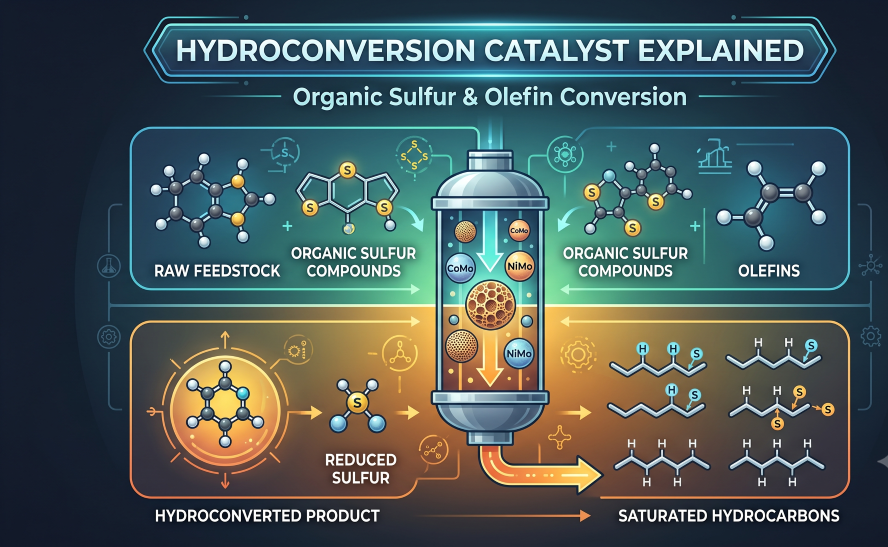
A Hydroconversion Catalyst performs two jobs at once: it saturates diolefins and olefins to prevent downstream gum and polymer formation, and it converts light, reactive organic sulfur compounds into heavier sulfur species that are easier to remove further down the process train. For the full chemistry behind this dual mechanism, see our guide on hydroconversion catalyst basics. This article focuses on the operating side — the signals that tell you the catalyst has genuinely reached end-of-run, rather than just needing a minor adjustment.
A Dual-Function Catalyst Doesn't Age on One Clock
Most guard-bed catalysts have a single job, so a single trend tells you when they're spent. A Hydroconversion Catalyst is different — its olefin/diolefin saturation activity and its organic sulfur conversion activity don't necessarily decline at the same rate. Feed composition, temperature history, and coking tendency all affect the two functions differently. This means a healthy reading on one front (say, good diolefin saturation) doesn't guarantee the catalyst is still doing its sulfur-conversion job well. Operators who only track one indicator can miss an early decline on the other side.
Rising Reactor Temperature Is the Earliest Signal
Like most hydrotreating catalysts, a Hydroconversion Catalyst loses activity gradually over its service life. The standard operating response is to raise reactor temperature to hold conversion steady — this is normal and expected early in a run. What signals the catalyst is approaching replacement is the rate of that temperature increase accelerating, or the required temperature approaching the metallurgical or process design limit of the reactor. At that point, there's no more temperature margin left to compensate for further activity loss.
Downstream Fouling Points to Declining Olefin Conversion
If diolefin and olefin saturation activity is slipping, unconverted unsaturated compounds pass downstream and polymerize into gum. In practice this shows up as rising pressure drop in downstream equipment, visible gum or discoloration in liquid samples, and more frequent filter or strainer cleaning than the unit's normal maintenance pattern. These are downstream symptoms rather than direct catalyst measurements, but they're often the first thing operators notice in the field.
Sulfur Slip Points to Declining Conversion Capacity
On the sulfur side, declining conversion activity lets more of the original light, reactive organic sulfur compounds pass through unconverted instead of being shifted into heavier species. The practical sign is an increase in reactive sulfur reaching downstream units at a level higher than the unit's historical baseline — worth checking against your own stream analysis rather than a fixed number, since feed sulfur content varies by source.
Pressure Drop and Shortening Cycles Confirm the Trend
A single high-pressure-drop reading can come from a temporary feed upset rather than catalyst exhaustion, so it's worth confirming the pattern over more than one cycle. If temperature creep, downstream fouling, and sulfur slip are all trending the same direction together, and the interval between turnarounds is shrinking compared to the catalyst's earlier cycles, that combination is a stronger basis for a replacement decision than any single reading on its own.
Recommended Products from Sorbsieve
Hydroconversion Catalyst — our hydroconversion catalyst is supplied in bulk to industrial buyers across the Middle East, with full technical documentation for every batch.
FAQ
What does a Hydroconversion Catalyst actually do? It simultaneously hydrogenates diolefins/olefins to prevent gum formation and converts light organic sulfur compounds into heavier species that are easier to remove downstream. See our hydroconversion catalyst basics guide above for the full mechanism.
Can a Hydroconversion Catalyst be regenerated instead of replaced? Regeneration can sometimes restore activity lost to reversible fouling, but activity lost to genuine aging is not recoverable. Whether regeneration is worthwhile depends on the cause of the decline and should be assessed case by case with your technical team.
What happens if replacement is delayed too long? Continued operation past end-of-run typically means more unconverted olefins and sulfur compounds reaching downstream equipment, which can accelerate fouling and shorten the life of downstream units.
How often does a Hydroconversion Catalyst need to be replaced? Service life depends heavily on feed composition, operating severity, and temperature history, so there's no single fixed interval — it's best tracked against your own unit's temperature, pressure drop, and downstream quality trends rather than a generic timeline.
Looking for Bulk Supply of Hydroconversion Catalyst?
Sorbsieve is a trusted bulk supplier of Hydroconversion Catalyst and complete industrial adsorbents, serving industrial buyers across the Middle East.
We provide:
- ✅ Container-level supply (20'GP / 40'GP / 40'HQ)
- ✅ Full documentation (COA / TDS / SDS / COO)
- ✅ Multiple packaging options
- ✅ Technical support for Hydroconversion Catalyst selection and system optimization
- ✅ Fast quote response for industrial inquiries
Contact our team for bulk pricing, product samples, and technical consultation.