How Do You Know When to Replace Dry Adsorbent? H2S and Moisture Breakthrough Warning Signs
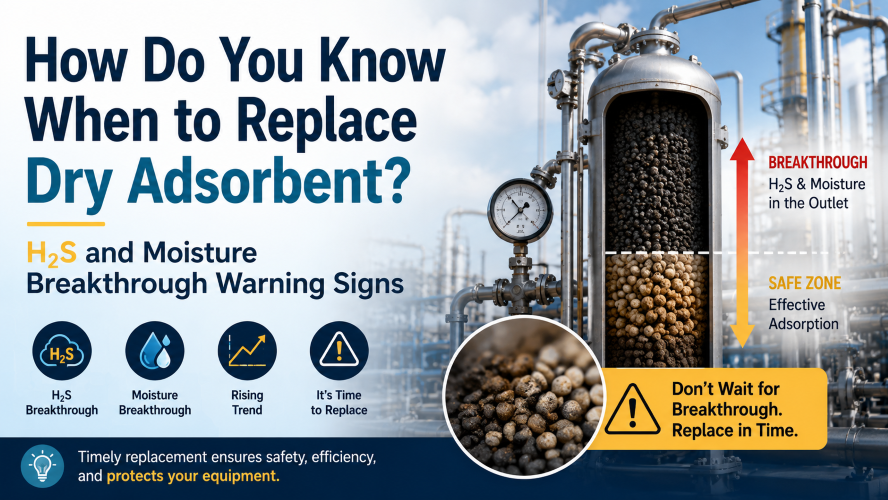
A dry adsorbent bed is doing two jobs at once — removing hydrogen sulfide (H₂S) and controlling moisture — and that dual function is exactly what makes replacement timing harder to judge than it is for a single-function desiccant. The two capacities don't always run out at the same time, so relying on a single signal (like a fixed calendar interval) can leave you blind to an early breakthrough on whichever function saturates first. This guide walks through the specific warning signs for each function, the operating factors that shorten service life, and what to do once you spot early signs of breakthrough.
Why Dual-Function Failure Doesn't Look Like Single-Function Failure
A conventional desiccant bed has one capacity curve to track: moisture. A dry adsorbent bed has two independent capacity curves running in parallel — one for H₂S chemisorption and one for moisture physisorption — and they respond to different variables. Inlet gas humidity, temperature, and flow rate mainly drive how fast the moisture capacity depletes, while H₂S concentration and gas composition drive the sulfur-removal capacity separately. In many real operating conditions the two capacities deplete at noticeably different rates, which means a bed can still look "fine" on one measurement while quietly approaching breakthrough on the other.
Key Takeaways
- Dry adsorbents manage dual capacity curves for H₂S chemisorption and moisture physisorption, which deplete at different rates depending on feed conditions.
- A steadily rising outlet dew point trend is the earliest warning for moisture breakthrough, preceding downstream condensation or icing.
- Odor detection for H₂S is unreliable due to olfactory fatigue; continuous analyzer tracking is mandatory to catch early sulfur breakthrough.
Signs of Moisture Breakthrough
Moisture breakthrough on a dry adsorbent bed generally shows up through a handful of practical indicators:
- Rising outlet dew point. This is the most direct signal. A dew point that is climbing steadily over successive readings — even if it hasn't yet crossed your process specification — is worth flagging before it does.
- Downstream condensation or icing. In systems where the treated gas feeds into cold sections, cryogenic equipment, or pressure-let-down valves, unexpected condensation or ice formation downstream is a practical (if lagging) sign that moisture control has already slipped.
- Increasing pressure drop across the bed. While pressure drop increases are more commonly associated with fines generation or channeling than with saturation itself, a steadily climbing pressure drop combined with rising dew point readings points toward a bed that needs attention on both fronts.
Signs of H₂S Breakthrough
H₂S breakthrough is often the more safety-critical of the two functions to monitor closely, and it deserves its own dedicated tracking rather than being inferred indirectly:
- Rising outlet H₂S concentration on a continuous analyzer. This is the only reliable early-warning method. Relying on smell alone is risky — H₂S causes olfactory fatigue at higher concentrations, meaning the ability to detect it by odor can actually decrease as exposure continues, which is the opposite of what you'd want from a warning system.
- Corrosion indicators downstream. H₂S is corrosive to many common metals used in downstream piping and equipment. Unexplained corrosion or sulfide staining downstream of the adsorbent bed is a lagging indicator that some H₂S has already been getting through.
- Product or gas quality complaints from downstream processes. If a downstream unit that is sensitive to trace sulfur (such as a catalyst bed or a gas quality specification point) starts showing sulfur-related issues, it's worth checking the dry adsorbent bed's H₂S removal performance even if no alarm has triggered yet.
Operating Factors That Shorten Service Life
Several operating conditions influence how quickly a dry adsorbent bed approaches breakthrough on either function:
- Higher inlet gas humidity accelerates moisture capacity depletion and can also reduce H₂S chemisorption efficiency in some adsorbent chemistries, since excess moisture can compete for active sites.
- Higher H₂S loading in the feed gas naturally shortens the sulfur-removal capacity window — sustained high-sulfur feed will always deplete capacity faster than intermittent low-level exposure.
- Elevated gas flow rate reduces the residence time gas spends in contact with the adsorbent, which can push both capacities toward earlier breakthrough if the bed wasn't sized with sufficient margin for that flow condition.
- Temperature swings can affect adsorption equilibrium for both functions, and repeated thermal cycling (in systems with variable operating temperature) tends to accelerate physical degradation of the adsorbent media over time.
Because these factors interact rather than acting independently, the safest practice is treating any single generic "replace every X months" guideline as a starting assumption to validate against your own analyzer and dew point trend data — not as a fixed rule.
What to Do When You See Early Warning Signs
- Confirm the trend, not a single reading. One elevated dew point or H₂S reading can be a measurement anomaly. A consistent upward trend across multiple readings is what actually indicates approaching breakthrough.
- Sample the bed if practical. Where sampling ports allow it, checking adsorbent condition at different bed depths can show whether saturation is progressing as expected from the inlet or whether channeling is causing uneven depletion.
- Plan replacement before full breakthrough, not after. Ordering lead time, shipping, and installation downtime all need to be planned around your monitoring trend — waiting until you see hard breakthrough on a specification sheet removes your buffer for a controlled changeout.
- Talk to your supplier about your specific operating conditions. Because service life depends so heavily on your particular combination of humidity, H₂S loading, flow rate, and temperature, a supplier who understands your operating envelope can give a far more useful estimate than any generic figure.
Recommended Products from Sorbsieve
Sorbsieve's Dry Adsorbent is engineered for combined H₂S and moisture removal in a single bed, and pairs naturally with a 4A Molecular Sieve as a complementary moisture-control layer in systems where a dedicated dehydration stage follows the H₂S removal step. Full technical guidance on how the two functions work is covered in our What Is a Dry Adsorbent?
FAQ
Can I extend dry adsorbent service life through regeneration?
Regeneration feasibility depends on the specific adsorbent chemistry and your process conditions. We recommend confirming regeneration parameters with our technical team for your specific system rather than assuming a generic regeneration protocol will apply.
Which function usually fails first, H2S or moisture removal?
It depends entirely on your specific operating conditions — inlet humidity and H₂S loading don't move together, so either function can saturate first depending on your gas composition and process design. This is exactly why independent monitoring of both dew point and H₂S concentration is recommended rather than assuming one tracks the other.
Is odor a reliable way to detect H₂S breakthrough?
No. Odor detection is not a reliable safety or process control method because the human sense of smell for H₂S can become fatigued at higher concentrations, meaning perceived odor intensity does not reliably track actual concentration. A continuous H₂S analyzer is the appropriate monitoring method.
Does higher gas flow rate always shorten dry adsorbent life?
Higher flow rates reduce contact time between the gas and the adsorbent bed, which can push both H₂S and moisture capacities toward earlier breakthrough if the bed wasn't sized with adequate margin for that flow condition. Proper bed sizing at the design stage accounts for expected flow variability.
Looking for Bulk Supply of Dry Adsorbent?
Sorbsieve is a trusted bulk supplier of dry adsorbent and complete industrial adsorbents, serving industrial buyers across the Middle East.
We provide:
- ✅ Container-level supply (20'GP / 40'GP / 40'HQ)
- ✅ Full documentation (COA / TDS / SDS / COO)
- ✅ Multiple packaging options
- ✅ Technical support for dry adsorbent selection and system optimization
- ✅ Fast quote response for industrial inquiries
Contact our team for bulk pricing, product samples, and technical consultation.
Related Products

Dry adsorbent
Modified activated alumina-based adsorbent manufactured by ball-rolling process, loaded with high-content active components for simultaneous removal of H₂S and water from gas-phase and liquid-phase hydrocarbon streams. Features large pore diameter, high surface area, fast reaction kinetics, and excellent regenerability — the ideal adsorbent for impurity removal in olefin-containing feeds.
4A Molecular Sieve
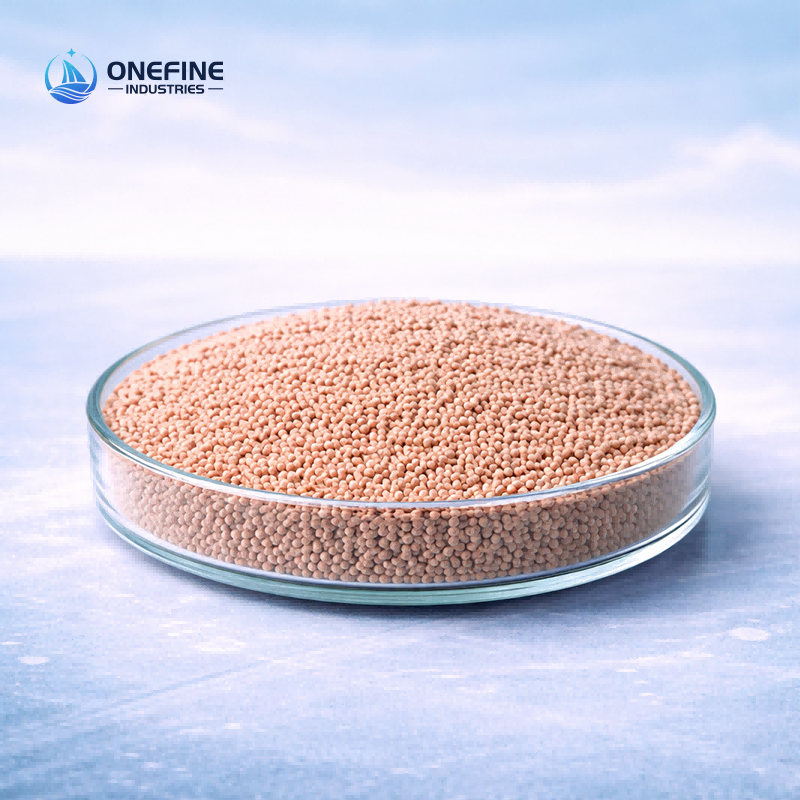
General-purpose 4A molecular sieve desiccant for industrial air drying, solvent dehydration, CO2 removal, and static packaging applications. High capacity, long service life.