How Many Times Can You Regenerate CD Adsorbent Before Fresh Replacement Makes More Sense?
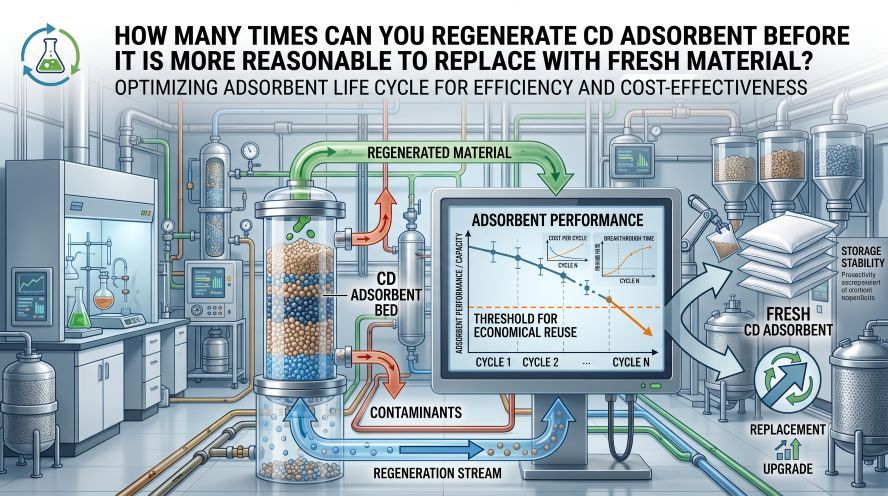
Sorbsieve's CD adsorbent is rated for N₂ purge regeneration at temperatures up to 340°C, with a typical service life of 6 months to 2 years depending on operating conditions. That's a genuinely useful design feature — but "regenerable" is not the same as "regenerate forever." Every operator running a PE/PP feed purification train eventually hits the same question: is this bed still worth another regeneration cycle, or has it quietly crossed into the territory where a fresh charge is the cheaper, safer option? The answer isn't a fixed number — it's a pattern you can read from your own operating data, once you know what to look for.
Key Takeaways
- CD adsorbent removes contaminants via chemisorption; thermal regeneration up to 340°C restores most, but not all, of its capacity.
- Typical service life ranges from 6 months to 2 years, heavily dependent on contamination severity and field regeneration completeness.
- A shortening time-to-breakthrough and rising baseline contaminant levels are the most reliable quantifiable signals that fresh replacement is needed.
The Chemistry Behind Why Regeneration Capacity Declines
CD adsorbent works through chemisorption — the alumina surface, enhanced with special modifiers, forms genuine chemical bonds with the contaminants it targets: alcohols, ethers, aldehydes, ketones, peroxides, water, and mercaptans. This is fundamentally different from how a molecular sieve captures water.
- Physisorption (as in molecular sieves): Water molecules are held by weak van der Waals forces inside a uniform pore structure. Heat reverses this cleanly and close to completely, which is why 3A/4A/5A/13X beds can be thermally cycled hundreds of times with minimal capacity loss per cycle.
- Chemisorption (as in CD adsorbent): The bond between the polar functional groups (–OH, –CHO, –CO–, –O–) and the alumina's active sites is stronger and directional. N₂ purge regeneration at up to 340°C reverses a significant portion of this bonding — that's what makes the product regenerable at all — but chemisorbed species are inherently harder to fully desorb than physisorbed ones.
The practical consequence, well established in adsorbent engineering generally, is that each regeneration cycle typically restores most — but not necessarily all — of the original capacity. Some fraction of active sites can remain occupied by residual contaminant, or the surface can undergo minor structural changes at repeated high-temperature exposure. Over successive cycles, this produces a gradual capacity decline rather than a hard cutoff — the bed doesn't suddenly "stop working," it slowly needs to work harder for the same throughput.
What Actually Determines How Many Cycles You'll Get
There's no single number that applies across every installation, because the variables that drive degradation are specific to your feed and operating conditions:
- Contamination severity (the biggest variable). Feed streams with higher concentrations of oxygenates, water, or mercaptans load more contaminant onto the bed per cycle, which means more residual occupation after each regeneration. A lightly contaminated stream might support many more cycles than a heavily loaded one.
- Regeneration completeness. The product's rated regeneration conditions are N₂ at 99% purity, up to 340°C. Falling short on any of these — purge gas purity, actual bed temperature reached (not just the setpoint), or purge duration — leaves more residual contaminant behind and accelerates cumulative capacity loss. This is one of the most common reasons operators see faster-than-expected decline: the field regeneration procedure quietly drifts from the rated conditions over time.
- Feed composition mix. Since the adsorbent handles multiple contaminant classes simultaneously (oxygenates, water, mercaptans), a feed that's heavy in one class — mercaptans, for instance — may stress the bed differently than one dominated by oxygenates, even at similar total contaminant loading.
- Operating temperature and pressure during the adsorption phase. The product's rated operating window is 10–120°C at atmospheric to 6.0 MPa. Running consistently near the upper end of that range, or with pressure swings outside the design envelope, can affect both adsorption efficiency and how cleanly the bed regenerates afterward.
This is exactly why the product's documented service life is a range — 6 months to 2 years — rather than a single figure. Your actual position within that range, and how many regeneration cycles you get before replacement becomes the better option, is a function of your specific feed and operating discipline, not a fixed industry constant.
Reading the Signals — How to Tell a Cycle Is Underperforming
Because capacity decline is gradual rather than sudden, the most reliable way to catch it is through consistent monitoring rather than waiting for an obvious failure:
- Outlet contaminant trending. Track outlet oxygenate/water/mercaptan levels after each regeneration, not just at initial startup. A rising baseline — even while still within spec — is an early warning that the bed's effective capacity is shrinking cycle over cycle.
- Time-to-breakthrough shortening. If the bed reached breakthrough after, say, eight months of service on the first charge, but only five months after the second regeneration, that's a direct, quantifiable signal of capacity decline — and a much more reliable indicator than visual inspection or a fixed calendar assumption.
- Regeneration duration creeping up. If it's taking longer purge time to bring outlet contaminant readings back down to baseline after each cycle, that's often a sign the bed is retaining more residual material than it used to.
- Pressure drop trending. A gradual rise in bed pressure drop, tracked separately from chemical performance, can indicate physical changes in the granules (attrition, fines generation) that compound the chemical capacity issue.
Combining at least two of these — most commonly outlet trending plus time-to-breakthrough — gives a far more reliable read than relying on any single metric, since chemical capacity loss and physical degradation don't always show up on the same timeline.
Weighing Another Regeneration Cycle Against Fresh Replacement
Once you have a few cycles of data, the decision comes down to comparing two costs — and the comparison usually isn't close once you look at it directly:
The case for another regeneration cycle:
- Regeneration cost is typically limited to N₂ purge gas and the utility cost of reaching 340°C — a relatively small operating expense
- No new material purchase or logistics required
- Makes sense when outlet monitoring shows the bed is still performing close to its original capacity
The case for fresh replacement:
- A fresh charge carries known, documented capacity — no uncertainty about how much of the original 15 wt.% water/methanol adsorption capacity actually remains
- For polymerization-grade feed with tight contaminant tolerances, the risk of an under-performing regenerated bed causing catalyst poisoning or off-spec polymer typically outweighs the cost difference versus a new charge
- Once time-to-breakthrough has shortened meaningfully across two or more cycles, further regeneration is often just deferring — not avoiding — an eventual replacement, while carrying more process risk in the meantime
For most PE/PP feed purification trains, the practical pattern is: regenerate as long as outlet performance and breakthrough timing stay close to baseline, and switch to fresh material once the data shows a consistent, cycle-over-cycle decline rather than normal variation. Treating regeneration as free and unlimited — without tracking this data — is usually where operators get caught by an unplanned shutdown from unexpected breakthrough.
Building a Simple Tracking Framework
You don't need sophisticated instrumentation to make this decision well — consistent record-keeping is usually enough:
- Log per cycle: feed volume processed, regeneration date, actual peak regeneration temperature achieved, purge duration, and outlet contaminant reading immediately after regeneration
- Compare cycle-over-cycle: plot time-to-breakthrough and post-regeneration outlet baseline across successive cycles — a clear downward trend in performance is your signal, well before the bed reaches a hard failure
- Set a decision threshold in advance: define what outlet reading or breakthrough interval would trigger replacement rather than another regeneration, before you're mid-crisis with a purity excursion already underway
This turns "when should we replace it" from a judgment call made under pressure into a data-driven decision made calmly, ahead of time.
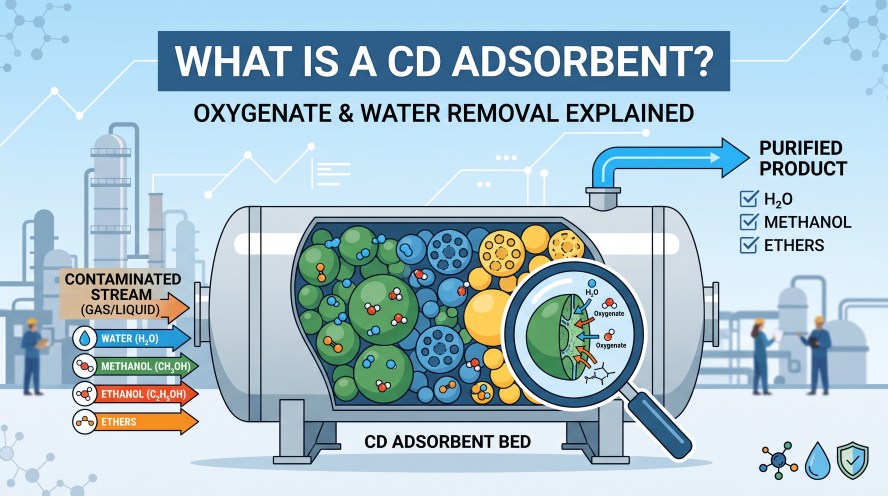
CD adsorbent typically runs as the middle stage of a three-part purification train — downstream of a COS Adsorbent removing sulfur species, and upstream of a CO-polishing stage such as Ethylene Purification Adsorbent . For the fundamentals of how CD adsorbent works, see our companion guide: What Is a CD Adsorbent? Oxygenate & Water Removal Explained
Recommended Products from Sorbsieve
FAQ
Q: What's the maximum regeneration temperature for CD adsorbent?
A: Regeneration uses N₂ purge gas at 99% purity, at temperatures up to 340°C. Exceeding this can accelerate degradation of the alumina structure and reduce the benefit of future cycles.
Q: How long does CD adsorbent typically last before replacement?
A: Service life ranges from 6 months to 2 years, depending on inlet contaminant concentration, operating temperature and pressure, space velocity, and required outlet purity — actual life varies significantly by installation.
Q: Does every regeneration cycle restore full adsorption capacity?
A: Not necessarily. Because the adsorption mechanism is chemisorption-based rather than physisorption, regeneration restores a significant portion of capacity but typically not 100%, meaning available capacity can decline gradually with each successive cycle.
Q: Is there a fixed number of regeneration cycles before I must replace the bed?
A: There's no universal fixed number — it depends heavily on contamination severity and how closely field regeneration matches the rated conditions (N₂ purity, 340°C, adequate purge time). Tracking outlet performance and time-to-breakthrough after each cycle is far more reliable than assuming a generic cycle count.
Q: What's the earliest warning sign that a bed needs replacing instead of another regeneration?
A: A shortening time-to-breakthrough across successive cycles is usually the clearest signal — for example, if service life drops noticeably from one cycle to the next even though feed conditions haven't changed, that points to cumulative capacity loss rather than a one-off operational variance.
Q: Can incomplete regeneration in the field make future cycles less effective?
A: Yes. If actual regeneration conditions fall short of the rated 340°C/N₂ 99% purity specification — due to equipment limitations or shortened purge time — more residual contaminant is left on the bed, which compounds capacity loss faster than the rated regeneration procedure would predict.
Looking for Bulk Supply of CD Adsorbent?
Sorbsieve is a trusted bulk supplier of CD adsorbent and complete industrial adsorbents, serving industrial buyers across the Middle East.
We provide:
- ✅ Container-level supply (20'GP / 40'GP / 40'HQ)
- ✅ Full documentation (COA / TDS / SDS / COO)
- ✅ Multiple packaging options
- ✅ Technical support for CD adsorbent selection and system optimization
- ✅ Fast quote response for industrial inquiries
Contact our team for bulk pricing, product samples, and technical consultation.
Related Products
COS adsorbent
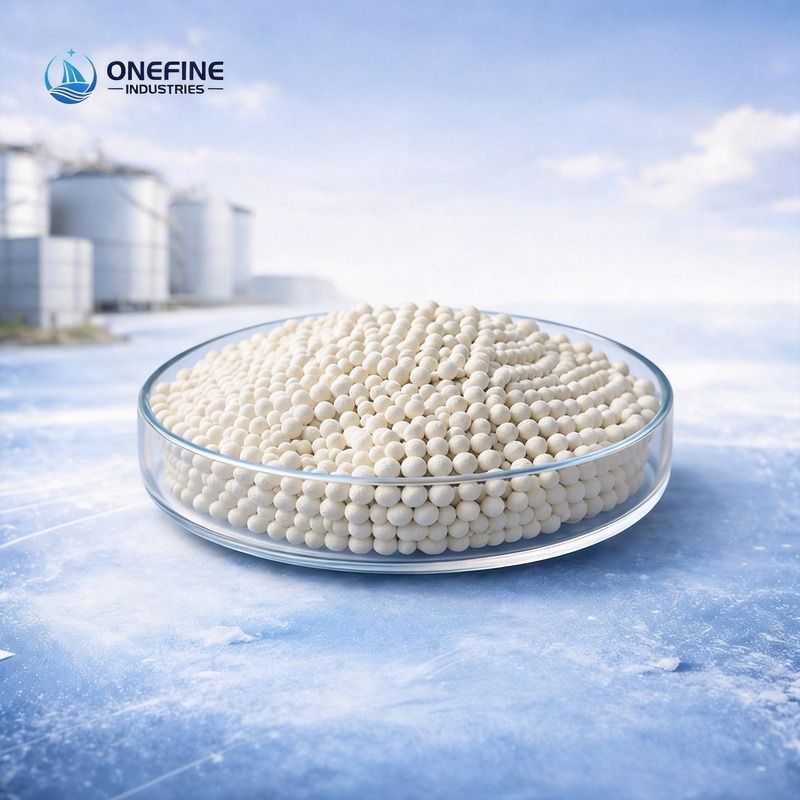
An advanced purification adsorbent catalyst based on specialty alumina with active components. Performance equivalent to imported Selexsorb COS adsorbent. Strong chemical adsorption capacity for selective removal of trace COS, CS₂, and H₂S from cracked C₂–C₄ unsaturated hydrocarbon streams. Also effectively removes CO₂, H₂O, chlorides, cyanides, and other common poisons. Operates at ambient to low temperatures for deep feedstock purification.
CD adsorbent
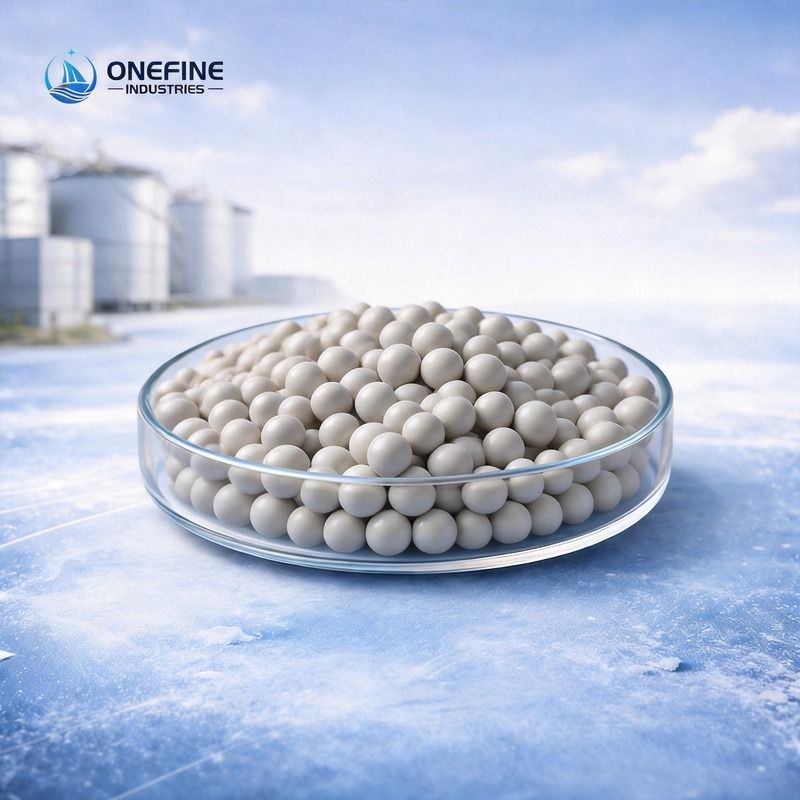
An advanced purification adsorbent catalyst based on specialty alumina with special modifiers. Performance equivalent to imported Selexsorb CD adsorbent. Strong chemical adsorption capacity for selective removal of trace oxygenated organic compounds (alcohols, ethers, aldehydes, ketones, peroxides) from C₂–C₄ unsaturated hydrocarbon streams in polyethylene and polypropylene units. Also effectively adsorbs water and mercaptans for deep feedstock purification. Operates at ambient to low temperatures.
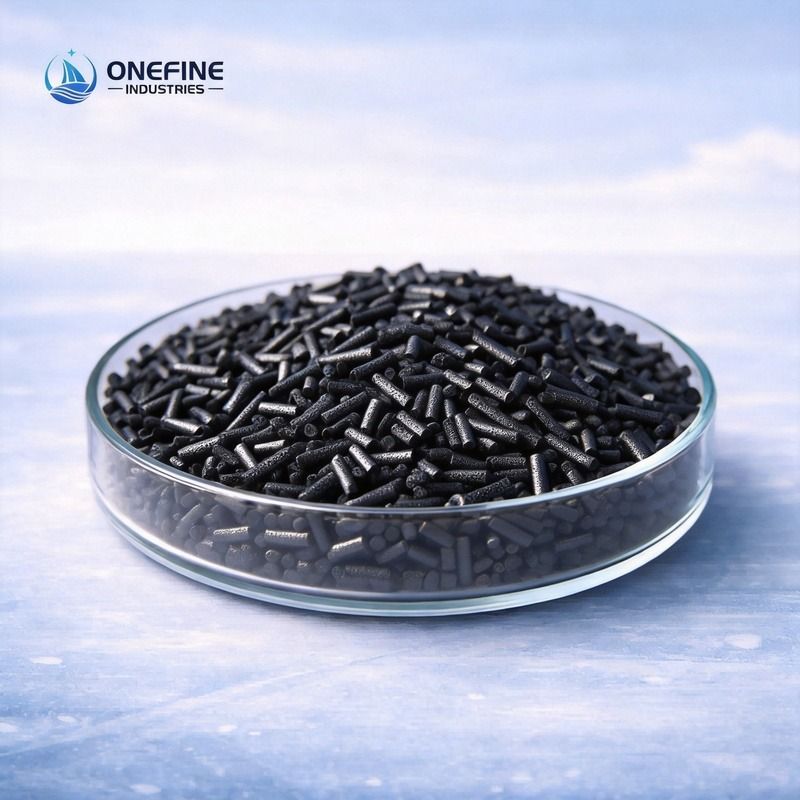
Ethylene Purification Adsorbent
A CuO-ZnO adsorbent designed for the removal of CO from polymer-grade ethylene feedstock, while also removing trace amounts of O₂, H₂S, COS, AsH₃, and PH₃. Prepared by co-precipitation method with uniformly dispersed active components. Features high selectivity, high activity, excellent mechanical strength, large capacity, and easy operation. Protects polymerization catalysts from poisoning and ensures stable polyethylene production.