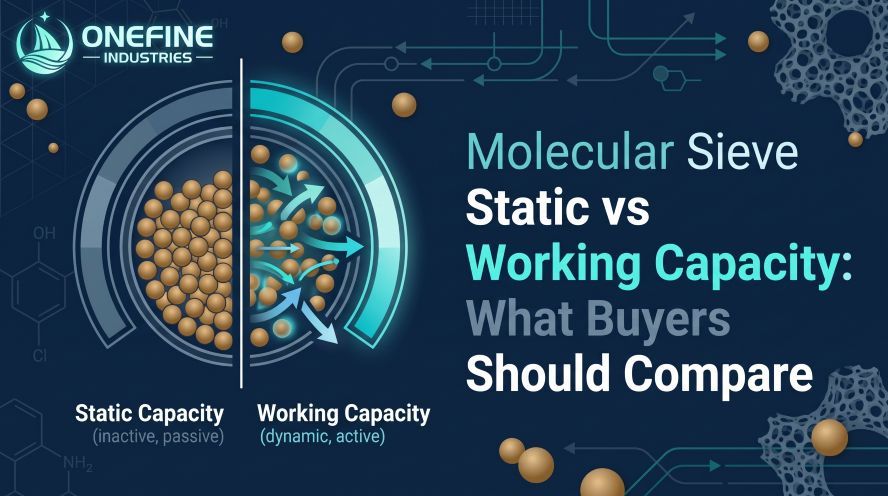
Molecular Sieve Static vs Working Capacity: What Buyers Should Compare
Key Takeaways
- Static water capacity is a result under stated test conditions. It does not directly specify how much water an operating bed can remove before its outlet limit is reached.
- Working capacity depends on the actual adsorption and regeneration duty, including the moving mass-transfer zone and the bed's condition.
- Compare quotations on a common test and process basis. A larger percentage alone does not establish longer cycles or a smaller required charge.
Intro
Two molecular sieve quotations show different water-capacity percentages. The higher number looks attractive, particularly when a buyer wants longer drying cycles. Before selecting the material, establish what each percentage measures. A laboratory capacity result and a plant's acceptable drying time answer different questions.
For background on the material, our 4A molecular sieve guide explains the adsorption mechanism. This article addresses a narrower purchasing problem: how to compare capacity claims without turning a laboratory result into an unsupported process guarantee.
Read the Conditions Beside the Percentage
A useful example comes from BASF's published 4A datasheet. It lists minimum water adsorption of 21.5% by weight at 55% relative humidity and 20°C, with an activated sample. Those conditions belong to that BASF document; they are not a new specification for Sorbsieve material.
The practical lesson is to request the conditions alongside every capacity number. Ask whether the result uses an activated sample or material as delivered, and identify the test method and reporting basis. A percentage copied without these details is difficult to compare responsibly.
Separate the supplier's specification limit from an individual batch result. A typical value, a contractual minimum and a measured certificate entry have different roles. Ask which one appears in the quotation rather than silently treating them as interchangeable.
Why the Bed Reaches Its Outlet Limit Before Full Saturation
Zeochem distinguishes equilibrium capacity from dynamic capacity in its technical FAQ. Its explanation includes the mass-transfer zone, contaminants, aging, and feed and regeneration conditions. These factors prevent a simple conversion from a static percentage to usable plant capacity.
In a flowing bed, uptake progresses through a region rather than filling every particle simultaneously. The outlet can reach its specified moisture limit while parts of the bed still have unused adsorption capacity. That is why the acceptance endpoint matters: “before breakthrough” requires an explicit outlet criterion.
For a quotation review, request the outlet limit, measurement basis and operating endpoint together. A trial judged at one moisture limit cannot automatically validate a cycle promised at a stricter one. Keep those requirements visible in the comparison sheet rather than leaving them in separate email threads.
Compare the Cycle, Not Just the Fresh Sample
Regeneration establishes the starting condition for the next adsorption step. A fresh activated laboratory sample and a bed returning from its actual cycle are different starting points. Review the proposed capacity against the specified regeneration arrangement rather than assuming each cycle begins with a laboratory-fresh charge.
A published industrial TSA modeling study in Catalysts treats equilibrium, mass transfer, heat transfer and pressure drop separately. Its mass-transfer model includes transport through the surrounding film and within the particles. This explains why material capacity alone cannot describe a complete adsorber.
The study is not a design model for a buyer's particular dryer. Its operating settings should not be copied into a different installation. For purchasing purposes, use it to frame a clear question: what process information supports the supplier's proposed working-capacity figure?
Request that answer for the actual feed, temperature, pressure, flow, vessel arrangement and regeneration sequence. If those inputs are unavailable, keep the proposal conditional. Do not fill the gap with a universal percentage discount from static capacity.
Keep Laboratory Acceptance and Process Acceptance Separate
An incoming-material test can check an agreed material property. A process trial can assess whether a specified charge meets an operating requirement under recorded conditions. Passing one does not automatically establish the other.
A practical review separates three records:
- Material acceptance: product identity, sample preparation, method, test conditions and agreed capacity limit.
- Operating basis: feed composition, water loading, flow basis, vessel charge and the approved adsorption and regeneration cycle.
- Trial acceptance: outlet criterion, measurement method, trial duration and the conditions under which a result is accepted.
These are suggested purchasing records, not a universal acceptance standard. Agree them with the supplier and responsible plant team before the trial. Our trial order guide covers the commercial sequence; the capacity review supplies the technical comparison basis.
If performance later declines, retain the original trial conditions for comparison. The 4A replacement signs guide addresses maintenance evidence separately. A change in cycle performance should prompt investigation rather than an immediate conclusion that the delivered static-capacity result was false.
How to Compare Two Offers
Start by checking that both offers refer to the intended grade and particle form. Then align their laboratory methods. Where methods differ, record the difference and ask for comparable evidence instead of ranking the bare numbers.
Next, ask each supplier to distinguish measured material data from estimated process performance. Any cycle-length proposal should state its inputs, endpoint and assumptions. Put exclusions and unresolved feed information beside the estimate, where the reviewer can see them.
Finally, compare the complete supply proposal: confirmed specification, required quantity, packaging, documentation and agreed trial scope. Avoid assigning a price premium to a capacity advantage that has not been demonstrated on a common basis.
Recommended Products from Sorbsieve
- Industrial 4A molecular sieve — an option to evaluate for compatible industrial drying duties. Confirm the selected grade and specification against the process; this article does not assign a working-capacity value to it.
FAQ
Can I multiply the charge by the static percentage to predict a cycle?
That calculation gives a quantity on the laboratory capacity basis. It does not establish usable removal before the operating outlet limit is reached.
Is a lower static result proof of a worse quotation?
First align the methods and conditions. Then assess whether any measured difference matters to the intended duty and acceptance requirements.
Is there a universal static-to-working conversion factor?
No factor is established here. Request a process-specific basis and suitable validation rather than assuming a fixed derating applies to every dryer.
Looking for Bulk Supply of 4A Molecular Sieve?
Sorbsieve is a bulk supplier of molecular sieve and industrial adsorbents, serving industrial buyers across the Middle East.
We provide:
- Container-level supply options
- COA, TDS, SDS and COO documentation requests
- Packaging options for industrial orders
- Product selection discussions based on your stated duty
- Quotations for the confirmed grade and quantity
MOQ starts at 1 ton. Send the feed composition, flow basis, operating pressure and temperature, moisture requirement and regeneration arrangement with your inquiry.
Related Reading

What is 4A Molecular Sieve? Uses, Specifications & How It Works
Everything you need to know about 4A molecular sieve: how it works, its 4Å pore size, physical adsorption process, and main industrial applications like air drying and CO2 removal.
How to Place a Trial Order: A Step-by-Step Guide for Molecular Sieve & Catalyst Buyers
A step-by-step guide to placing a trial order for molecular sieves and catalysts — inquiry, MOQ, documentation, lead time, and what happens after a successful trial.

How Do You Know When to Replace 4A Molecular Sieve in a Compressed Air or Industrial Gas Drying System?
Rising dew point, dusting, pressure drop, and other warning signs that tell you it's time to replace the 4A molecular sieve in your compressed air or industrial gas drying system.