How Do You Know When to Replace Refrigerant Molecular Sieve (XH Series) in an AC/Refrigeration Filter Drier?
Key Takeaways
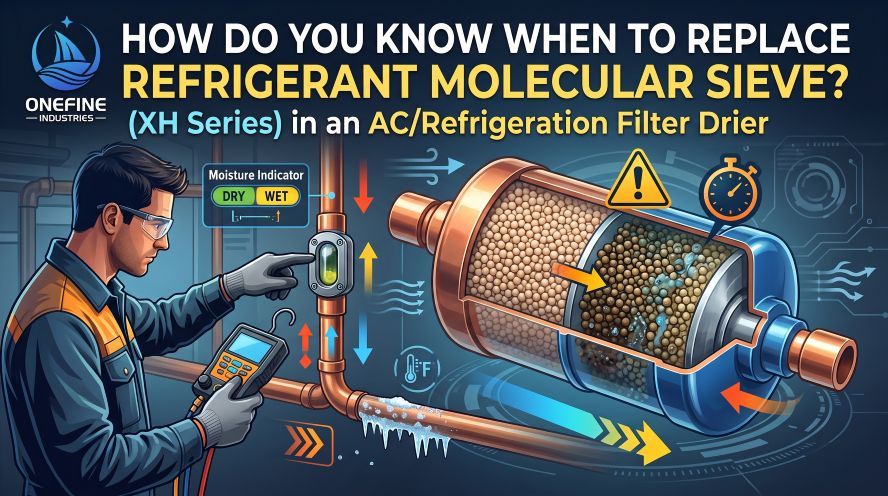
- A fading green or yellow sight glass moisture indicator signals that the sieve's adsorption capacity is being exceeded.
- Free moisture that is no longer captured can freeze downstream at the expansion valve, causing intermittent cooling and flow blockage.
- A rising pressure drop across the drier points to a structurally degrading sieve that is restricting flow rather than simply filtering it.
- Sustained moisture exposure reacts with POE lubricants to form acidic compounds that degrade copper tubing and compressor windings over time.
A filter drier looks like a passive, maintenance-free part of a refrigeration or AC system — until the molecular sieve core inside it reaches saturation. Once that happens, the drier stops protecting the system, and the consequences spread quietly through the refrigerant circuit long before anyone notices a performance drop. Knowing the real signals of a spent refrigerant molecular sieve, rather than guessing on a fixed replacement interval, is what separates planned maintenance from an expansion valve failure in the middle of a service call. For the underlying mechanism, see our guide on what a refrigerant molecular sieve is.
Why the Molecular Sieve Saturates in the First Place
Refrigerant molecular sieve, commonly supplied in XH-series grades, is selected specifically for its pore structure: small enough to capture water molecules from the refrigerant and lubricant oil, while allowing the refrigerant itself to pass through unobstructed. Every system carries some residual moisture from manufacturing, brazing, or incomplete evacuation during installation and servicing. The molecular sieve's job is to strip that moisture out and hold it — but adsorption capacity is finite. Once the sieve's internal surface is fully loaded with water, it can no longer adsorb additional moisture, and the drier effectively becomes a flow-through component with no protective function left.
Signal 1: The Sight Glass Moisture Indicator Changes Color
The most direct and widely used replacement signal is the moisture indicator built into (or installed just after) the filter drier. These indicators use a chemically sensitive element that shifts from green to yellow as moisture content in the refrigerant rises. A stable green reading means the molecular sieve is still actively managing moisture. A fading green or a shift toward yellow signals that the sieve's adsorption capacity is being exceeded, and the system is a strong candidate for drier replacement. If the color returns to green shortly after a service event, that is a different situation — it means the sieve absorbed a one-time moisture load (for example, after opening the system for repair) and is still functioning. A yellow reading that persists under normal operating conditions is the clearer warning of actual saturation.
Signal 2: Expansion Valve Icing or Inconsistent Cooling
When moisture is no longer being captured by the molecular sieve, it travels downstream with the refrigerant to the expansion valve or capillary tube — the point in the system where pressure and temperature drop sharply. Free moisture at that location can freeze, forming ice that partially or fully blocks refrigerant flow. The symptom on the equipment side is usually intermittent or progressively worsening cooling performance, sometimes paired with a system that seems to "recover" briefly after a defrost cycle only to restrict again. This is a downstream consequence of sieve saturation, not a standalone drier problem, but it is often the first thing a technician notices before tracing it back to the filter drier. For a deeper walkthrough of this specific failure path, see our filter drier icing guide.
Signal 3: A Rising Pressure Drop Across the Drier
As the molecular sieve bed saturates and, in poorly selected or aging driers, begins to break down structurally, flow resistance through the core can increase. A measurable pressure differential between the inlet and outlet side of the filter drier — beyond what the system's baseline design accounts for — points to a drier that is restricting flow rather than simply filtering it. This is typically checked with gauges on either side of the drier during a service visit, and it is a useful cross-check against the sight glass reading, since the two signals can appear at slightly different points in the saturation curve.
Why Waiting Too Long Carries Real Cost
Delaying replacement after these signals appear does more than risk a repeat visit. Moisture in the refrigerant circuit reacts with the polyester (POE) lubricants used in most modern systems, and that reaction can form acidic compounds over time. Sustained acid exposure degrades copper tubing, compressor windings, and other internal components — damage that is far more expensive to resolve than a routine drier swap. Treating the moisture indicator and flow signals as early warnings, rather than optional ones, is what keeps a simple component replacement from escalating into a compressor-level failure.
Matching the Replacement to the Right Grade
Not every refrigerant and system combination calls for the same XH-series grade — molecular sieve pore size and adsorption characteristics are matched to the refrigerant type and the moisture tolerance of the compressor and lubricant in use. Installing a mismatched grade can shorten service life or leave moisture protection gaps even with a brand-new drier. For full grade specifications and refrigerant compatibility, see our refrigerant molecular sieve product page.
Recommended Products from Sorbsieve
- Refrigerant Molecular Sieve (XH Series) — Sorbsieve's bulk-supply refrigerant molecular sieve grades for AC and refrigeration filter driers (already linked above).
FAQ
How often should a filter drier's molecular sieve be replaced? There's no universal fixed interval — it depends on the moisture load the system was exposed to during installation or servicing, and how it's used day to day. The moisture indicator and pressure drop checks described above are more reliable than a calendar-based schedule.
Can a yellow moisture indicator return to green without replacing the drier? Yes, in one specific situation: if the system was recently opened for service and the sieve absorbed a one-time moisture load, the indicator can return to green as the sieve manages that load. A yellow reading that persists under otherwise normal operating conditions is the clearer sign of actual saturation rather than a temporary spike.
What happens if a saturated molecular sieve drier isn't replaced in time? Moisture that the sieve can no longer capture travels downstream, where it can freeze at the expansion valve and restrict refrigerant flow, and react with POE lubricants to form acidic compounds that degrade copper tubing and compressor components over time.
Is the molecular sieve grade the same for every refrigerant type? No. Pore size and adsorption characteristics are matched to the specific refrigerant and the moisture tolerance of the compressor and lubricant in use — installing a mismatched grade can shorten service life or leave protection gaps. Check grade compatibility before replacement.
Looking for Bulk Supply of Refrigerant Molecular Sieve?
Sorbsieve is a trusted bulk supplier of refrigerant molecular sieve (XH series) and complete industrial adsorbents, serving industrial buyers across the Middle East.
We provide:
- ✅ Container-level supply (20'GP / 40'GP / 40'HQ)
- ✅ Full documentation (COA / TDS / SDS / COO)
- ✅ Multiple packaging options
- ✅ Technical support for refrigerant molecular sieve grade selection and system compatibility
- ✅ Fast quote response for industrial inquiries
Contact our team for bulk pricing, product samples, and technical consultation.
Related Reading
What Is a Refrigerant Molecular Sieve? XH Series Explained
How XH Series refrigerant molecular sieves work, how to choose between XH-7, XH-9, and XH-11 grades, and how to install, maintain, and troubleshoot filter driers in HVAC&R systems.
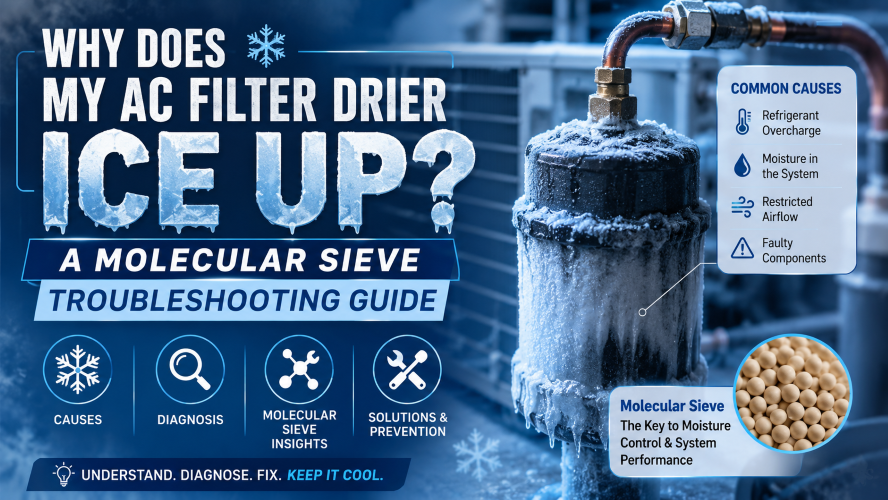
Why Does My AC Filter Drier Ice Up? A Molecular Sieve Troubleshooting Guide
A practical troubleshooting guide explaining why AC and refrigeration filter driers ice up — covering desiccant saturation, restriction, wrong molecular sieve type, and poor evacuation as root causes, plus step-by-step diagnosis and fixes.