Dry Adsorbent for H₂S Removal and Dehydration in Sour Natural Gas Refinery Gas: Application Case Analysis

Industry Context
Key Takeaways
- Dry Adsorbent utilizes a single bed to simultaneously chemisorb H₂S and physically adsorb moisture from sour natural gas and refinery gas streams.
- The ratio of H₂S to moisture in the specific feed gas determines which adsorption function will be consumed first and set the practical change-out interval.
- Because H₂S chemisorption capacity is permanently consumed during operation, the bed must be managed on a scheduled replacement basis rather than indefinite thermal regeneration.
- Procurement planning should track cumulative sulfur loading alongside operating signals rather than relying on a fixed calendar schedule.
Sour natural gas and the refinery gas streams derived from it carry both H₂S and water vapor — two contaminants that most single-function media can't handle together. Running separate desulfurization and dehydration beds adds vessels, pressure drop, and maintenance points to a gas processing train. A dual-function dry adsorbent addresses both contaminants in a single bed, which is the role it plays in this application.
The Process Problem: Two Contaminants, One Bed
In sour natural gas and associated refinery gas streams, H₂S must be removed to meet pipeline specification and protect downstream equipment from sulfide corrosion, while moisture must be controlled to prevent hydrate formation and protect downstream catalysts or cryogenic equipment from water damage. Treating these separately — a chemical scavenger for H₂S plus a desiccant bed for moisture — means two vessels and two change-out schedules. Where space, pressure drop budget, or capital cost make a single combined bed more practical, a dual-function adsorbent that chemisorbs H₂S while also adsorbing moisture in the same bed volume simplifies the train.
How the Dual-Function Bed Fits the Gas Train
The adsorbent is typically installed as a single guard-bed vessel positioned to treat the sour gas stream before it reaches pipeline-spec delivery or a downstream processing unit sensitive to both sulfur and moisture. Because the H₂S removal mechanism is chemisorption rather than physical adsorption, the bed's sulfur capacity is consumed as it reacts with H₂S in the feed; this is a different service-life model from a purely physical desiccant, which is why the basics are worth reviewing in our dry adsorbent basics guide if this is your first time specifying one.
Why Feed Gas Composition Matters for Bed Performance
Feed gas composition for sour natural gas and refinery gas streams varies site to site — the ratio of H₂S loading to moisture loading is not fixed, and that ratio affects how the two functions inside a single bed actually get used. A stream with high H₂S relative to moisture content will consume the chemisorption capacity faster than the desiccant capacity, while a stream dominated by moisture with only trace H₂S does the opposite. Because the two functions share the same bed volume, operators specifying a dual-function adsorbent need a reasonably accurate picture of their own stream's H₂S-to-moisture ratio — not just the individual contaminant levels — to right-size the bed and anticipate which function will set the practical change-out interval. This is a site-specific engineering judgment rather than a fixed design rule, and it's worth confirming with technical support before finalizing a bed design, since published composition ranges for "typical" sour gas vary enough between fields that applying a generic number to a specific stream risks under- or over-sizing the bed.
Service Life: Why This Is a Replacement-Driven Bed, Not a Regeneration Cycle
For the H₂S-chemisorption side of the bed, capacity is consumed as the active sites react with sulfur compounds — once that capacity is used up, thermal cycling alone does not restore it the way it would for a purely physical adsorbent. In practice, operators plan around scheduled replacement rather than indefinite regeneration for the sulfur-loaded fraction of the bed. The moisture-adsorption side behaves more like a conventional desiccant and can tolerate more regeneration cycles, but because both functions share the same bed, the sulfur-capacity side is usually the one that sets the practical change-out interval. Watching for the operating indicators covered in dry adsorbent replacement signs — rather than assuming a fixed calendar interval — is the more reliable way to plan the swap.
How This Differs from Sorbsieve's Other Dry Adsorbent Use Case
This site also covers Dry Adsorbent's role in the COS Adsorbent / CD Adsorbent polymer-grade olefin purification train, where the feed stream and the contaminant profile are different — that case is about preparing olefin feedstock for polymerization, not about treating a sour gas stream for pipeline delivery. The chemistry of H₂S chemisorption is the same underlying mechanism, but the stream, the downstream requirement, and the practical operating conditions differ enough that the two are genuinely separate applications rather than the same case told twice.
What This Means for Procurement Planning
For buyers sourcing Dry Adsorbent for this type of service, the practical implication is that replacement lead time matters more than it would for a single-function medium. Because the sulfur-chemisorption side of the bed is consumed through use rather than restored by regeneration, the bed's service interval is tied directly to actual H₂S throughput rather than a calendar schedule — which means procurement planning benefits from tracking cumulative sulfur loading alongside the operating signals described above, rather than ordering replacement material only after a breakthrough event is already underway. Buyers running multiple sour gas trains, or operating in regions where shipping lead time adds weeks to a reorder, may find it practical to hold a buffer inventory sized to their historical change-out interval rather than ordering reactively. This is a sourcing and inventory question as much as a technical one, and it's the kind of planning conversation worth having with a supplier who can commit to consistent batch specification across repeat orders.
Choosing Between Dry Adsorbent and a Single-Function Alternative
Not every sour gas stream needs a combined bed — if your stream is predominantly wet with only trace H₂S, or predominantly sour with little moisture concern, a single-function medium may be the simpler and more cost-effective choice. Our dry adsorbent vs activated alumina walks through how to decide which fits your specific gas stream composition.
Looking for Bulk Supply of Dry Adsorbent?
Sorbsieve is a trusted bulk supplier of Dry Adsorbent and complete industrial adsorbents, serving industrial buyers across the Middle East.
We provide:
- ✅ Container-level supply (20'GP / 40'GP / 40'HQ)
- ✅ Full documentation (COA / TDS / SDS / COO)
- ✅ Multiple packaging options
- ✅ Technical support for Dry Adsorbent selection and system optimization
- ✅ Fast quote response for industrial inquiries

Related Reading
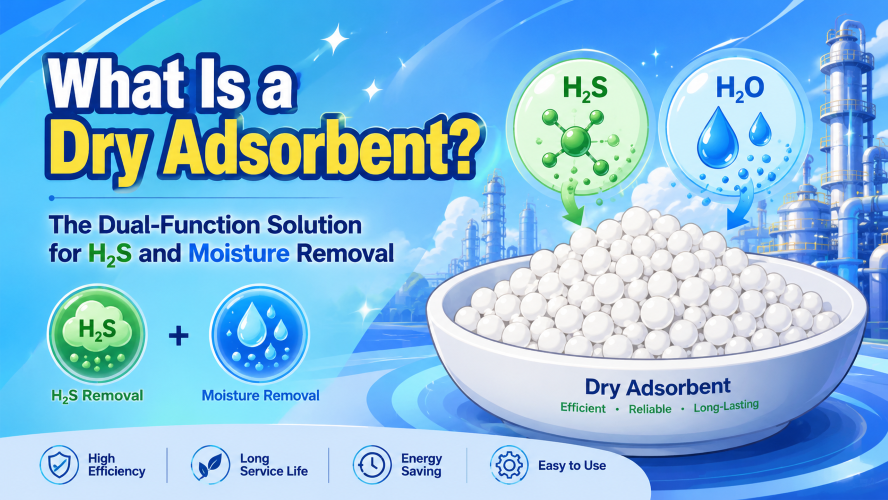
What Is a Dry Adsorbent? The Dual-Function Solution for H₂S and Moisture Removal
A dry adsorbent removes H₂S and moisture from hydrocarbon streams in a single, regenerable bed — ideal for olefin-containing feeds.

How Do You Know When to Replace Dry Adsorbent? H2S and Moisture Breakthrough Warning Signs
How to recognize early H2S and moisture breakthrough signs in a dry adsorbent bed, what operating conditions shorten service life, and when to plan replacement.

Dry Adsorbent vs Activated Alumina: Which One Does Your Gas Stream Need?
Dry Adsorbent handles H₂S and moisture in a single bed, while Activated Alumina handles moisture on its own. Here's how to tell which one your gas stream actually needs.