Protecting Downstream Catalysts from H₂S and Arsenic in Natural Gas Processing: Application Case Analysis
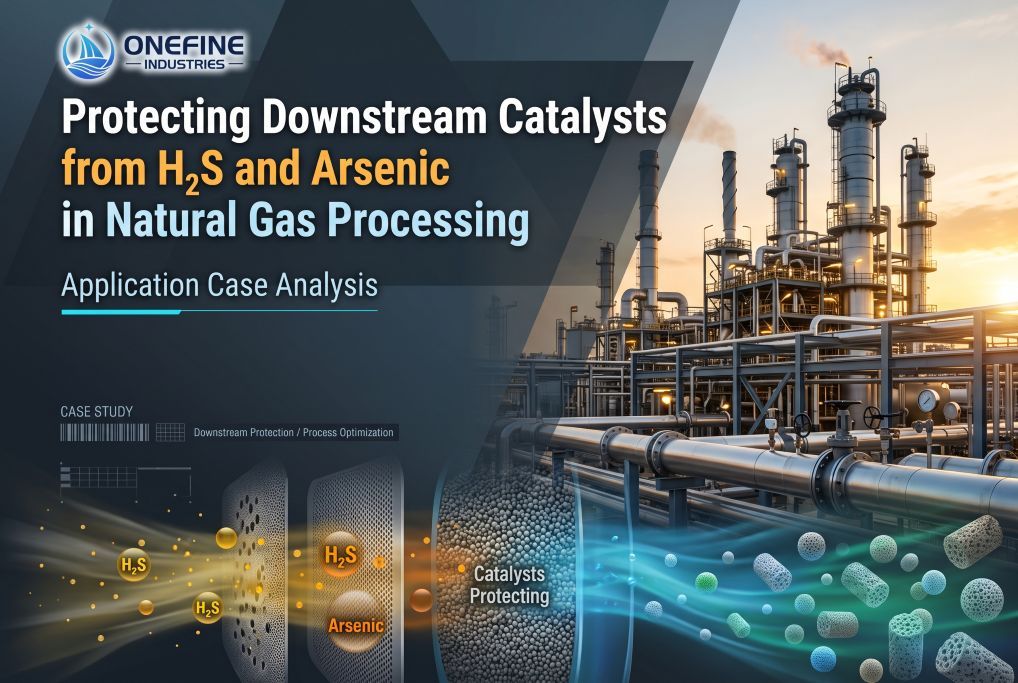
Industry Context
Key Takeaways
- Trace H₂S and arsenic in natural gas feed can permanently poison palladium hydrogenation catalysts used in downstream processing units.
- A dedicated CuO/Al₂O₃ guard bed is installed upstream of the hydrogenation reactor to chemically bind H₂S and arsenic before they reach the noble metal.
- Arsenic bonds essentially permanently with the palladium surface, causing irreversible capacity loss that routine regeneration cycles cannot fix.
- The guard bed must see the gas in its final composition (sweetened and dried) to avoid consuming its own adsorption capacity on bulk contaminants.
Raw natural gas rarely arrives at a processing plant clean. Alongside the hydrocarbons, it can carry trace hydrogen sulfide and, depending on the field and gathering system, trace arsenic compounds that travel with the gas stream into downstream units. Neither contaminant threatens the wellhead equipment in any dramatic way — the real cost shows up later, in the catalyst beds further down the process train, where even parts-per-billion levels of these impurities can shorten catalyst life dramatically.
Where the Contamination Comes From
As natural gas moves through gathering, dehydration, and NGL (natural gas liquids) recovery, trace sulfur compounds and arsenic species present in the raw gas don't simply disappear — they partition into the processed streams and travel with them. By the time NGLs are fractionated into individual components (ethane, propane, butanes) for further processing, these contaminants are still present at low but catalytically significant concentrations.
Why Downstream Hydrogenation Catalysts Are the Vulnerable Point
Many natural gas processing trains include a hydrogenation step — for example, converting trace diolefins or acetylenes in an NGL stream before it's sent to polymer-grade propylene or ethylene production, or before LPG is finished for sale. These hydrogenation units typically run on palladium hydrogenation catalysts, chosen for their selectivity and activity at relatively mild conditions.
That same selectivity makes palladium catalysts highly sensitive to poisoning. Hydrogen sulfide chemisorbs onto active palladium sites, while arsenic compounds (commonly arriving as arsine, AsH₃) bond even more aggressively and essentially permanently with the metal surface. Unlike some forms of catalyst deactivation that can be reversed with regeneration, arsenic poisoning of a noble metal catalyst is not something a routine regen cycle fixes — the capacity lost to arsenic is lost for good. Operators who've run arsenic-contaminated feed through an unprotected hydrogenation unit have seen catalyst cycle lengths collapse well below normal, turning what should be a multi-year catalyst life into a fraction of that. For the failure mechanisms behind this, see our palladium catalyst basics guide.
The Role of a Guard Bed Upstream of the Catalyst
The standard protection strategy is a guard bed — a dedicated adsorbent bed installed ahead of the hydrogenation reactor, not inside it. A copper oxide on alumina (CuO/Al₂O₃) type material, such as Sorbsieve's desulfurization and arsenic removal catalyst, is built for exactly this dual job: it chemically binds H₂S and arsenic compounds from the gas stream before they ever reach the downstream catalyst bed. For the underlying chemistry, see our arsenic removal catalyst basics gWhat is a Palladium Hydrogenation Catalyst? Pd/Al₂O₃ Explaineduide.
Running both contaminants through one guard bed, rather than two separate systems, is what makes this approach practical at plant scale — it adds one vessel to the process train instead of two, and it means the expensive palladium catalyst downstream only ever sees gas that's already been cleaned of the species that would shorten its life.
Where This Fits in the Process Train
In a typical layout, the guard bed sits immediately upstream of the hydrogenation reactor, after primary gas treating (amine sweetening, dehydration) but before the feed reaches the catalyst. This positioning matters: the guard bed needs to see the gas in its final composition — sweetened and dried — so its own adsorption capacity isn't consumed by bulk contaminants it wasn't designed to handle. For operators running NGL hydrogenation, LPG finishing, or any gas processing step that depends on a sensitive metal catalyst downstream, this guard bed is the difference between planned catalyst change-outs and an unplanned shutdown.
Looking for Bulk Supply of Desulfurization and Arsenic Removal Catalyst?
Sorbsieve is a trusted bulk supplier of Desulfurization and Arsenic Removal Catalyst and complete industrial adsorbent and catalyst solutions, serving industrial buyers across the Middle East.
We provide:
- ✅ Container-level supply (20'GP / 40'GP / 40'HQ)
- ✅ Full documentation (COA / TDS / SDS / COO)
- ✅ Multiple packaging options
- ✅ Technical support for guard bed sizing and system selection
- ✅ Fast quote response for industrial inquiries
Contact our team for bulk pricing, product samples, and technical consultation.
Related Products
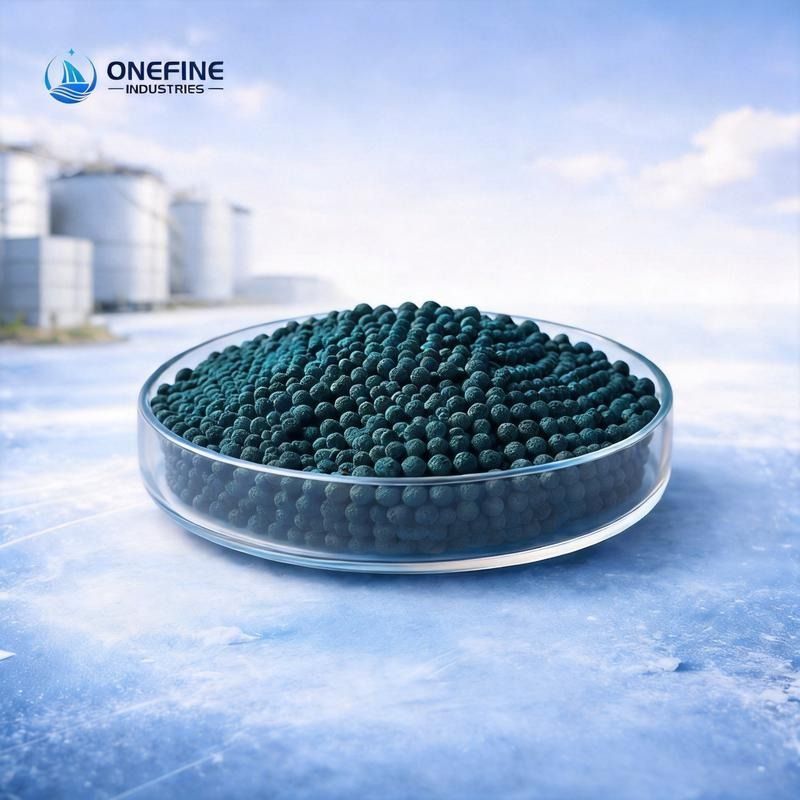
Desulfurization and arsenic removal catalyst
High-performance CuO/Al₂O₃-based desulfurization and arsenic removal catalyst, engineered for the ultra-deep removal of sulfur compounds and volatile arsenides to protect downstream noble metal catalysts. Available in bulk from 1 ton MOQ for Middle East industrial buyers.
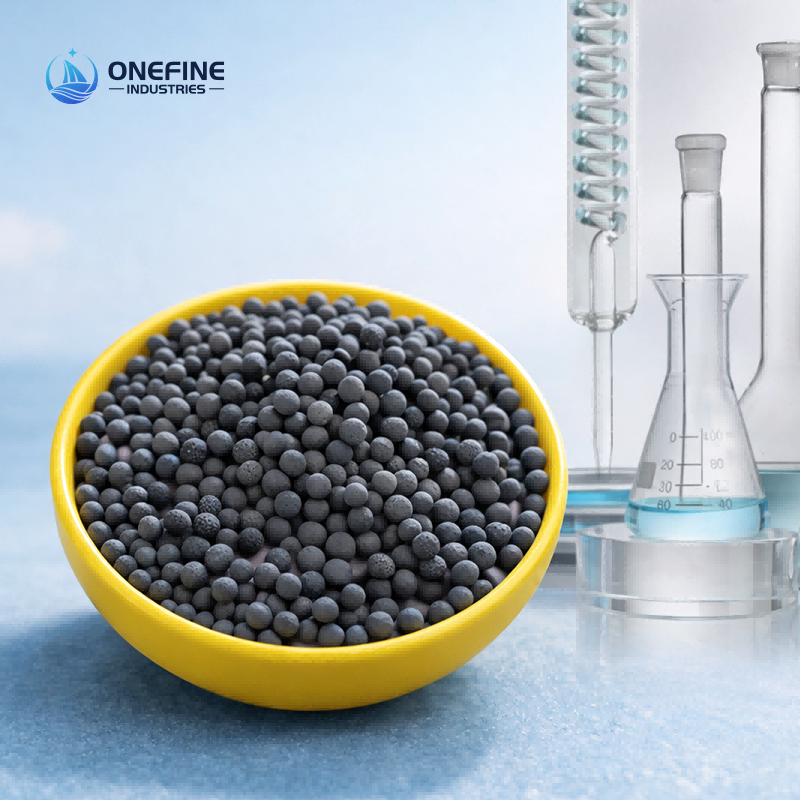
Palladium Catalyst for Hydrogenation (Pd/Al₂O₃)
High-performance palladium on alumina catalyst (Pd/Al₂O₃) for industrial hydrogenation reactions. Available in 0.1-2% Pd loading on alumina support. Exceptional activity, long service life, and excellent selectivity for pharmaceutical, petrochemical, and fine chemical synthesis.
Related Reading
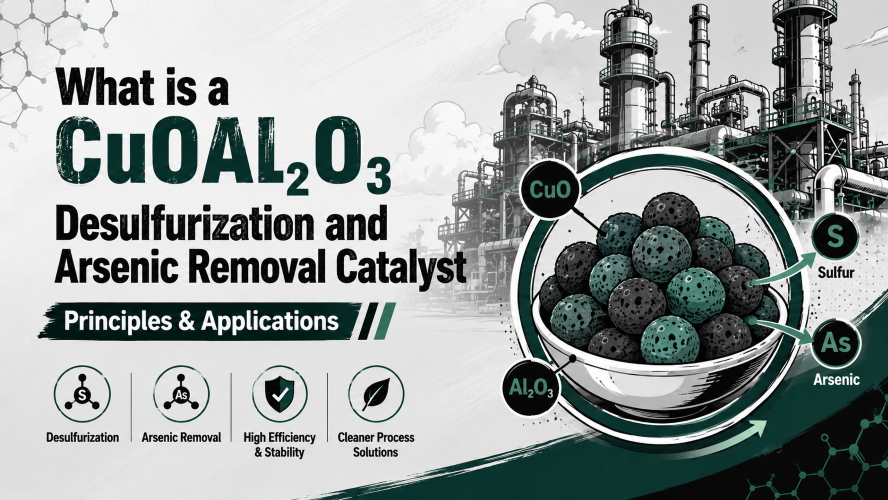
What is a CuO/Al₂O₃ Desulfurization and Arsenic Removal Catalyst? Principles & Applications
A guide to CuO/Al₂O₃ desulfurization and arsenic removal catalysts — how irreversible chemisorption works, key specifications, and how these sacrificial guard beds protect sensitive noble metal catalysts in refineries and petrochemical plants.
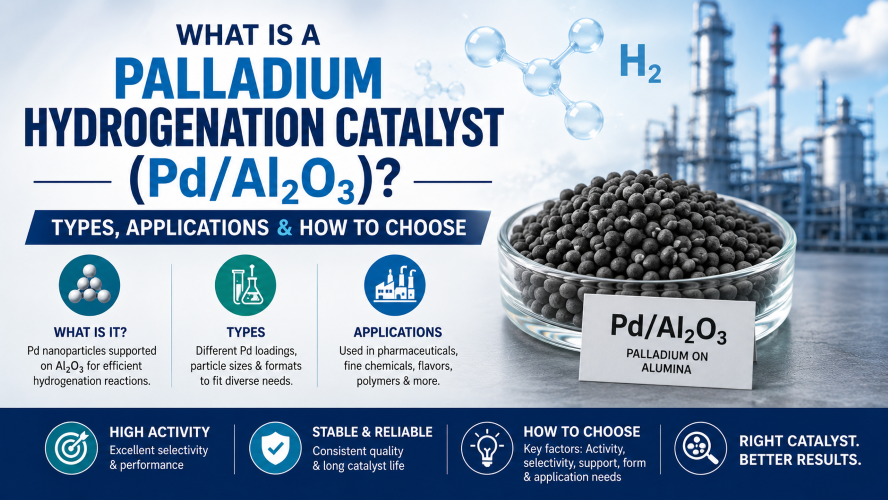
What is a Palladium Hydrogenation Catalyst? Pd/Al₂O₃ Explained
Palladium hydrogenation catalyst (Pd/Al₂O₃) is one of the most widely used noble metal catalysts in industrial chemistry. This guide covers how it works, Pd loading options, key applications, and regeneration & recovery.