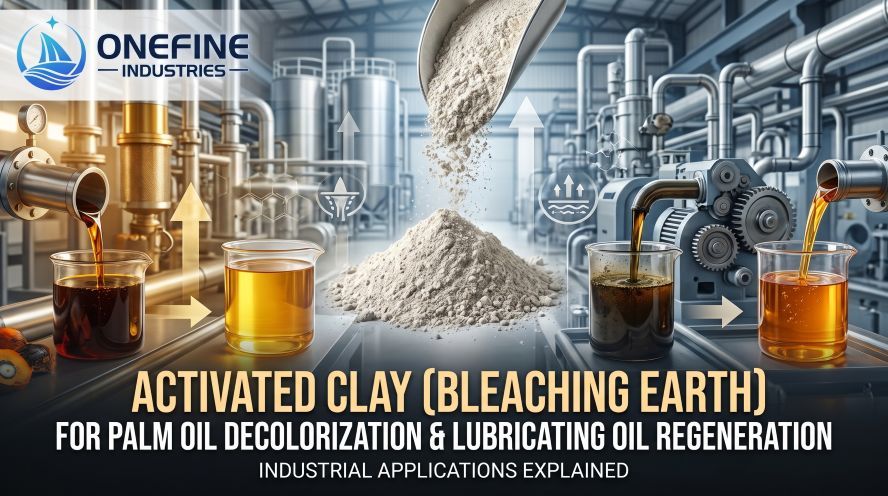
Activated Clay (Bleaching Earth) for Palm Oil Decolorization and Lubricating Oil Regeneration: Industrial Applications Explained
Key Takeaways
- Acid activation leaches out cations, opening up the clay's internal pore network and significantly increasing its active surface area and acidity.
- Through physical and chemical adsorption, activated clay effectively removes dissolved color bodies and polar impurities that standard filtration cannot address.
- In palm oil refining, bleaching earth is mixed with heated oil under vacuum to adsorb natural carotenoid pigments and trace oxidation products.
- In used lubricating oil regeneration, the acid-clay process acts as a final polishing step to adsorb residual oxidation products and restore base oil clarity.
Activated clay — also known as bleaching earth — is one of the most widely used adsorbent materials in industrial purification processes. Derived from naturally occurring clay minerals such as bentonite, sepiolite, or attapulgite and enhanced through acid activation, it is best known for removing unwanted color, impurities, and oxidation products from liquids. Two of its most established industrial applications are edible oil decolorization — particularly in palm oil refining — and the regeneration of used lubricating oil. This article explains how activated clay works and why it remains a standard choice across both industries.
What Is Activated Clay (Bleaching Earth)?
Activated clay starts as a natural clay mineral with an inherently layered, porous structure. To enhance its adsorptive performance, the raw clay is treated with a mineral acid — typically sulfuric or hydrochloric acid — in a process known as acid activation. This treatment leaches out cations such as aluminum, iron, and magnesium from the clay's crystal structure, which opens up the internal pore network and increases both surface area and surface acidity.
The result is a material with a much higher capacity to adsorb polar compounds than untreated clay. Depending on the intended application, activated clay is produced at different activation levels — from mildly activated (closer to natural clay) to heavily acid-activated, with some grades blended with activated carbon for applications requiring broader adsorption capability.
How Activated Clay Works: The Adsorption Mechanism
The core mechanism behind activated clay's performance is physical and chemical adsorption. Its porous internal structure provides a large active surface area, and the acid activation step increases the number of active adsorption sites available on that surface. Polar and semi-polar compounds in oil — pigments, oxidation byproducts, soaps, phospholipids, and trace metals — are drawn to and held on this surface as the oil passes through or is mixed with the clay.
This is fundamentally different from filtration, which only removes solid particulates. Adsorption allows activated clay to remove dissolved color bodies and chemical impurities that filtration alone cannot address. Once the clay has reached its adsorption capacity, it is separated from the treated oil by filtration, leaving behind "spent" or "spent bleaching earth" that still retains residual oil and adsorbed impurities.
Application 1: Palm Oil Decolorization (Bleaching)
In edible oil refining, activated clay plays its most recognized role in the bleaching stage — typically positioned after degumming and neutralization, and before deodorization. Crude and pre-treated palm oil carries natural pigments, primarily carotenoids (which give the characteristic orange-red color) and chlorophyll derivatives, along with trace oxidation products and residual soaps left over from earlier processing steps.
During bleaching, the oil is heated and mixed with activated clay under vacuum — vacuum conditions help limit oxidation of the oil at elevated temperature while the clay adsorbs the pigments and other polar impurities. After a defined contact period with agitation, the spent clay is removed by filtration, leaving oil with significantly reduced color and improved oxidative stability heading into deodorization.
The dosage and activation grade of clay used depends on the oil's initial color level, its quality, and the target specification for the finished product — refiners typically select clay type and dosage based on trial runs rather than a fixed universal figure, since crude oil quality varies by source and season.
Application 2: Used Lubricating Oil Regeneration
The second major industrial use of activated clay is in re-refining used lubricating oil — commonly referred to as the acid-clay (or clay-finishing) process. As engine and industrial lubricants age in service, they accumulate oxidation products, degraded additive residues, carbon particles, and dark color bodies that compromise their performance.
In a typical re-refining sequence, used oil first goes through dehydration and removal of light fuel fractions, followed by treatment steps to separate out heavier contaminants. Activated clay is then applied as a finishing or polishing step — adsorbing residual oxidation products, additive breakdown compounds, and color bodies that earlier separation stages leave behind. This step is what gives re-refined base oil its characteristic clarity and improved stability before it is blended back into finished lubricant products.
It's worth noting that clay treatment conditions in used oil re-refining vary considerably depending on the feedstock oil's condition, the upstream process design, and the specific re-refiner's setup — unlike edible oil bleaching, there is no single standard set of parameters, and processors generally calibrate based on their own feed characteristics.
Why Processors Choose Activated Clay
Across both applications, activated clay remains popular for several practical reasons:
- Proven adsorption performance for color bodies and polar impurities that other methods struggle to remove economically
- Process flexibility — clay type, activation level, and dosage can be adjusted to match feedstock variability
- Established, scalable process design that fits into both continuous and batch refining lines
- Relatively straightforward handling and filtration compared to more complex purification technologies
The main operational consideration is spent clay management — because spent bleaching earth retains residual oil, it requires proper handling, and in some cases is treated as a waste stream requiring environmentally responsible disposal or further processing.
FAQ
What's the difference between natural clay and acid-activated clay? Natural clay has adsorption capability on its own, but acid activation significantly increases its surface area and number of active adsorption sites, making acid-activated grades far more effective for demanding bleaching and purification tasks.
How is the right clay dosage determined for palm oil bleaching? There's no universal fixed dosage — refiners typically run trial bleaching tests to match clay type and quantity to their specific crude oil's color level, impurity profile, and target finished-product specification.
Can activated clay fully restore used lubricating oil to new-oil quality? Clay treatment significantly improves color, clarity, and stability by removing oxidation products and residues, but it works as part of a broader re-refining sequence rather than a single standalone step — the overall process design determines final base oil quality.
What happens to spent bleaching earth after use? Spent clay still contains residual oil and adsorbed impurities, so it typically requires appropriate handling and disposal in line with local environmental regulations, and in some operations is processed further to recover residual oil value.
In Summary
Activated clay's adsorption-driven purification capability makes it a long-standing, practical solution across two very different industrial contexts — bringing clarity and stability to both edible oils and re-refined lubricating base oils. Understanding the underlying mechanism — acid-enhanced porosity driving polar-compound adsorption — helps explain why it remains a standard process step rather than being replaced by newer technologies in either industry.
Related Reading
How Do You Know When to Replace a Copper-Nickel Desulfurization Catalyst?
Learn the performance, analytical, and physical signals that indicate a Copper-Nickel Desulfurization Catalyst guard bed needs replacing.
How Do You Know When to Replace a Deeply Refined Catalyst?
How to recognize breakthrough, pressure drop, and capacity signs that mean a Deeply Refined Catalyst guard bed needs replacing, not just continued service.
How Do You Know When to Replace a High or Low Temperature Shift Catalyst?
The different ways a high-temperature (Fe-Cr) and low-temperature (Cu-Zn-Al) shift catalyst age — and the specific warning signs for each bed before replacement.