COS Adsorbent vs CD Adsorbent: Key Differences and Why Your Purification Train Needs Both
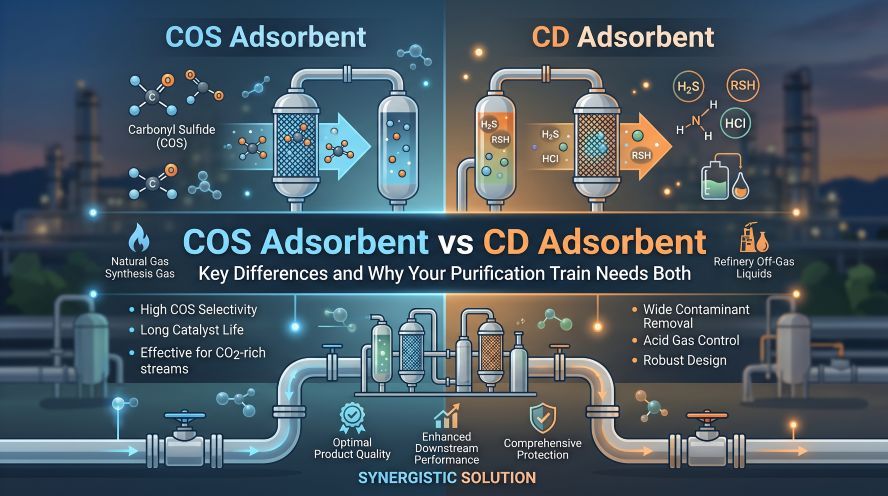
For buyers new to polymer-grade olefin purification, "COS Adsorbent" and "CD Adsorbent" often come up in the same conversation — not because they compete for the same job, but because they belong to the same purification train. Assuming one can substitute for the other is a common sourcing mistake, and it usually shows up later as off-spec feed or unplanned downtime. This guide breaks down what each product actually removes, where each one sits in the process, and why "which one should I buy" is the wrong question. The right question is "do I have both stages covered."
Key Takeaways
- COS Adsorbent and CD Adsorbent are sequential purification stages in the same train, not competing alternatives.
- COS Adsorbent targets sulfur-based impurities like COS, CS₂, and H₂S earlier in the purification sequence.
- CD Adsorbent targets oxygenates and residual water further downstream where sulfur removal leaves off.
- Skipping either stage typically surfaces later as severe catalyst poisoning or polymer-grade off-spec product.
Quick Comparison: What Each Product Actually Does
- COS Adsorbent — positioned earlier in the purification sequence, focused on sulfur-based impurities that would otherwise pass through to downstream polymerization catalysts.
- CD Adsorbent — positioned after the desulfurization stage, focused on oxygenates and residual moisture that sulfur removal alone does not address.
The two products are complementary by design, addressing different impurity classes at different points in the same feed stream.
In a typical polymer-grade olefin purification train, desulfurization comes first, oxygenate and moisture removal comes next, and CO removal (handled by a separate adsorbent) follows further downstream. COS Adsorbent and CD Adsorbent occupy the first two of those stages. Understanding this sequence matters more than picking "the better product," because the two are solving different chemistry problems, not competing to solve the same one.
What Does a COS Adsorbent Remove?
A COS Adsorbent is built to handle carbonyl sulfide, carbon disulfide, and hydrogen sulfide — sulfur species that are notoriously difficult to remove with conventional drying media alone, since COS and CS₂ don't respond to simple physical adsorption the way water does. Left in the feed stream, these sulfur compounds are a direct threat to downstream polymerization catalysts, which are highly sensitive to sulfur poisoning. For a deeper look at the chemistry involved, see our guide on what a COS Adsorbent actually does.
What Does a CD Adsorbent Remove?
A CD Adsorbent picks up where sulfur removal leaves off. It's designed to remove oxygenates (such as trace alcohols and other oxygen-containing compounds) along with residual water that can carry through the earlier stages of the purification train. Oxygenates and moisture are a separate impurity class from sulfur compounds — removing sulfur does not remove them, and vice versa. This is precisely why a purification train that only includes a desulfurization stage can still deliver off-spec feed downstream: the sulfur problem may be fully solved while the oxygenate/moisture problem remains untouched. For the full breakdown of this product's role, see what a CD Adsorbent removes and why.
Key Differences at a Glance
- Primary Target: COS Adsorbent — sulfur compounds (COS, CS₂, H₂S). CD Adsorbent — oxygenates and residual water.
- Position in the Purification Train: COS Adsorbent sits earlier in the sequence; CD Adsorbent sits downstream of it.
- What Happens If Skipped: Skipping COS Adsorbent risks sulfur carryover and catalyst poisoning downstream. Skipping CD Adsorbent risks oxygenate and moisture carryover into polymer-grade feed, even if sulfur has already been removed.
- Relationship to Each Other: Not interchangeable — each addresses an impurity class the other does not touch.
- Procurement Takeaway: Evaluating "COS Adsorbent vs CD Adsorbent" as a substitution question misses the point — the real evaluation is whether your purification train has both impurity classes covered, and at what stage each one needs to sit.
Why This Is a Sequence, Not a Choice
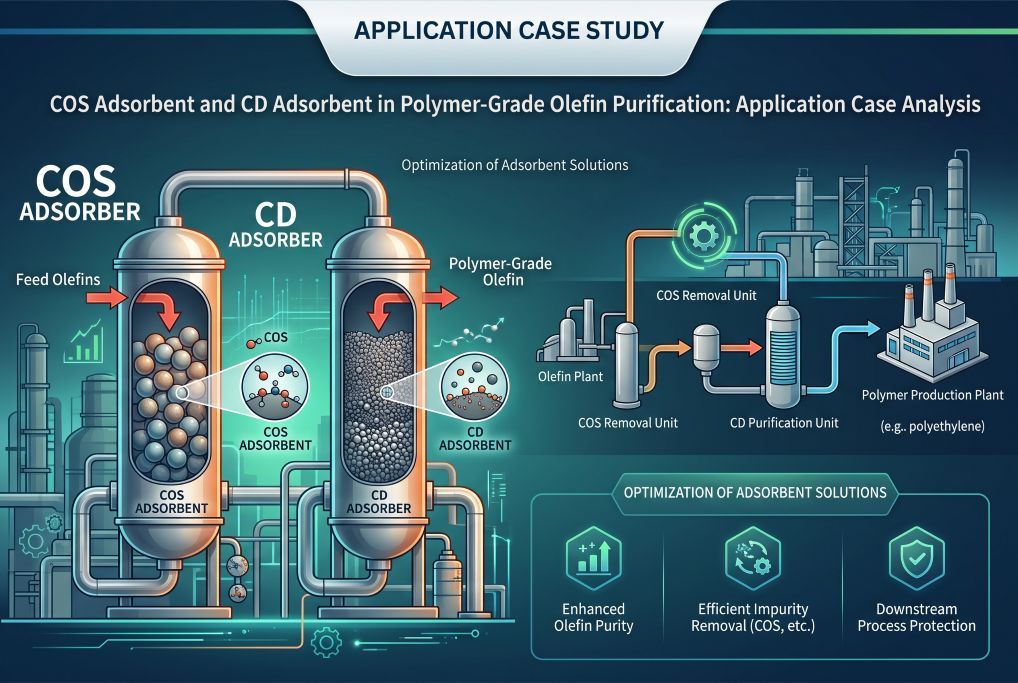
The most common mistake we see from buyers evaluating these two products is treating this as an either/or decision, the way you might compare two competing molecular sieve grades. It isn't. COS Adsorbent and CD Adsorbent are designed to work as two stages of the same purification path, each catching what the other is not built to catch. A real-world example of this two-stage configuration in a polymer-grade olefin purification system is documented in our COS and CD Adsorbent application case, which walks through how both products function together in an actual plant setup.
If your current setup only has one of the two stages in place, the practical question isn't "which one is better" — it's "which impurity class am I currently leaving unaddressed."
This distinction matters most when buyers are evaluating purification costs and try to consolidate to a single adsorbent to simplify procurement. Consolidating sulfur removal and oxygenate/moisture removal into one product isn't a matter of picking a "more efficient" grade — the two impurity classes require different removal mechanisms, and a single adsorbent optimized for one will not reliably handle the other. Budget and vessel-count considerations are valid parts of a procurement decision, but they should be weighed against the downstream cost of catalyst poisoning or off-spec product, not used as a reason to skip a stage entirely.
FAQ
Can CD Adsorbent be used instead of COS Adsorbent?
No. CD Adsorbent is not designed to remove sulfur compounds such as COS, CS₂, or H₂S. Using it as a substitute for COS Adsorbent would leave sulfur impurities unaddressed.
If my feed gas is already low in sulfur, do I still need CD Adsorbent?
Sulfur content and oxygenate/moisture content are independent variables. Low sulfur levels don't indicate low oxygenate or moisture levels, so the need for CD Adsorbent should be assessed separately based on your feed composition.
How do I know if my current purification setup is missing a stage?
The clearest signals are downstream: catalyst poisoning symptoms typically point to a sulfur-removal gap, while off-spec polymer feed related to oxygenates or moisture typically points to a CD Adsorbent gap. A feed composition analysis is the most reliable way to confirm which stage, if any, is missing.
Are the two products ever combined in a single vessel?
System design varies by plant configuration. Speak with our technical team about your specific feed composition and process layout for a tailored recommendation.
Do COS Adsorbent and CD Adsorbent require different regeneration approaches?
Because they're designed to remove different impurity classes, their regeneration considerations are evaluated separately rather than assumed to be identical. Our technical team can walk through regeneration planning for each product based on your operating conditions once your purification train layout is confirmed.
Recommended Products from Sorbsieve
Looking for Bulk Supply of COS Adsorbent and CD Adsorbent?
Sorbsieve is a trusted bulk supplier of COS Adsorbent, CD Adsorbent, and complete industrial adsorbents, serving industrial buyers across the Middle East.
We provide:
- ✅ Container-level supply (20'GP / 40'GP / 40'HQ)
- ✅ Full documentation (COA / TDS / SDS / COO)
- ✅ Multiple packaging options
- ✅ Technical support for purification train selection and system optimization
- ✅ Fast quote response for industrial inquiries
Contact our team for bulk pricing, product samples, and technical consultation.
Related Products
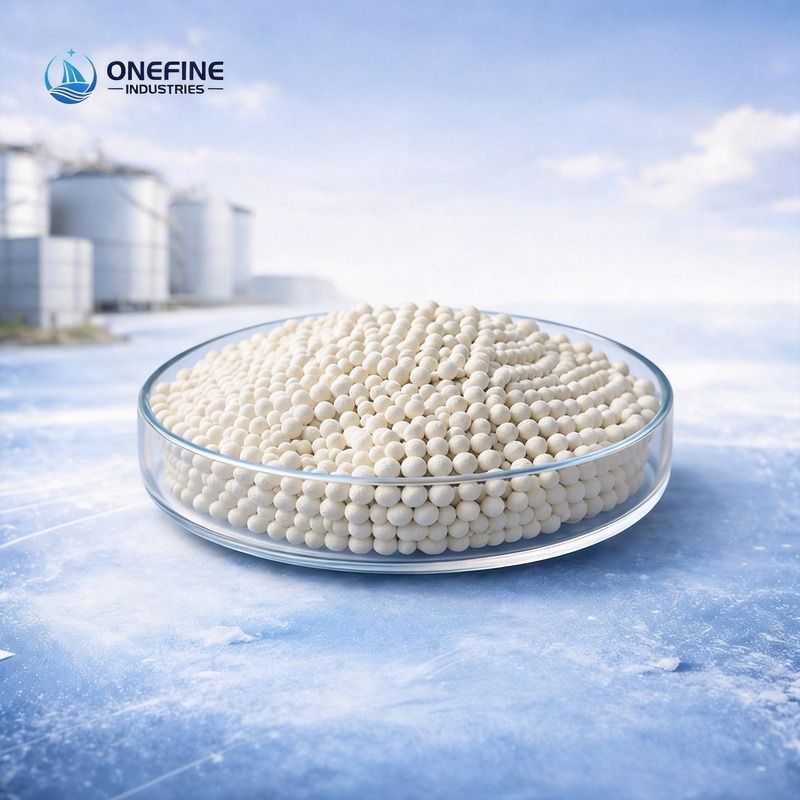
COS adsorbent
An advanced purification adsorbent catalyst based on specialty alumina with active components. Performance equivalent to imported Selexsorb COS adsorbent. Strong chemical adsorption capacity for selective removal of trace COS, CS₂, and H₂S from cracked C₂–C₄ unsaturated hydrocarbon streams. Also effectively removes CO₂, H₂O, chlorides, cyanides, and other common poisons. Operates at ambient to low temperatures for deep feedstock purification.
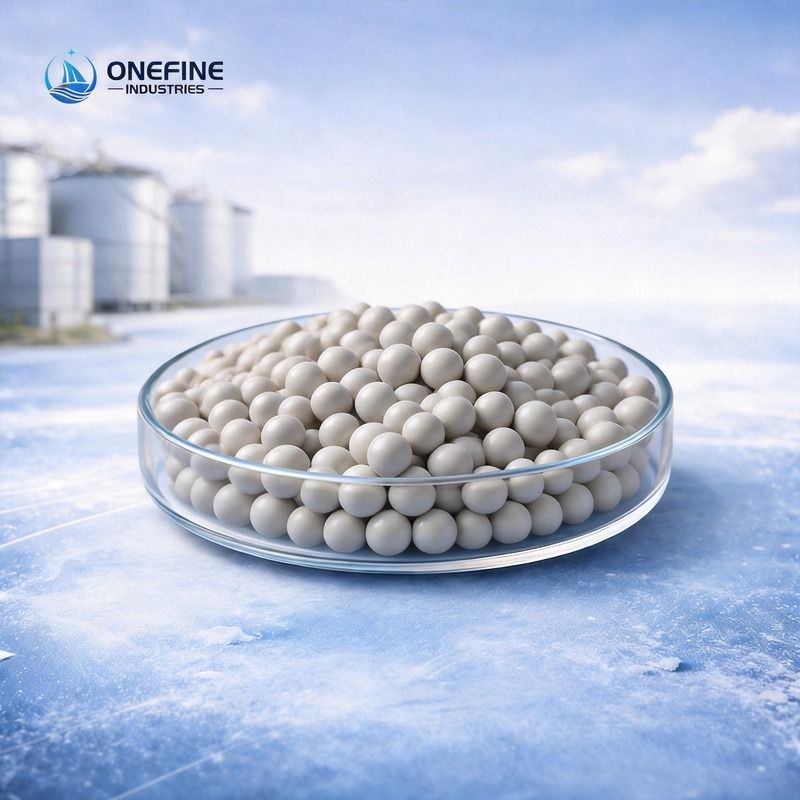
CD adsorbent
An advanced purification adsorbent catalyst based on specialty alumina with special modifiers. Performance equivalent to imported Selexsorb CD adsorbent. Strong chemical adsorption capacity for selective removal of trace oxygenated organic compounds (alcohols, ethers, aldehydes, ketones, peroxides) from C₂–C₄ unsaturated hydrocarbon streams in polyethylene and polypropylene units. Also effectively adsorbs water and mercaptans for deep feedstock purification. Operates at ambient to low temperatures.
Related Reading
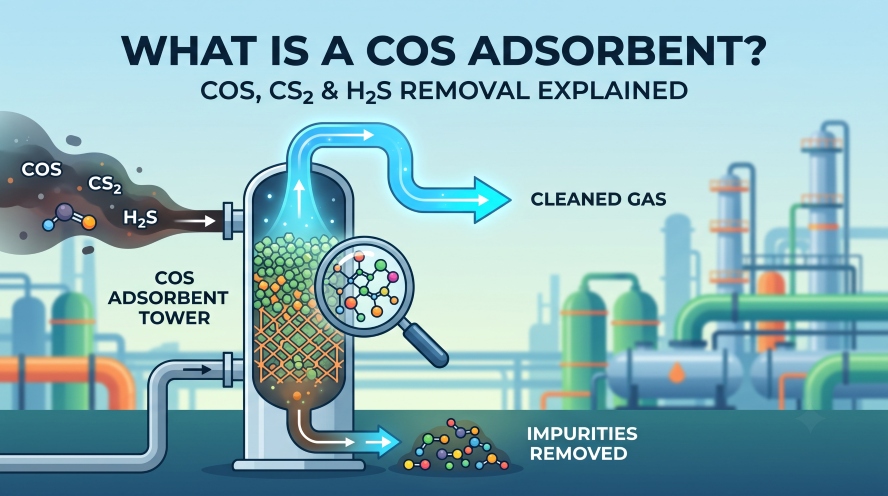
What Is a COS Adsorbent? COS, CS2 & H2S Removal Explained
A COS adsorbent removes COS, CS2, and H2S from cracked C2–C4 olefin streams, protecting polymerization catalysts. Learn how it works and where it fits in the purification train.
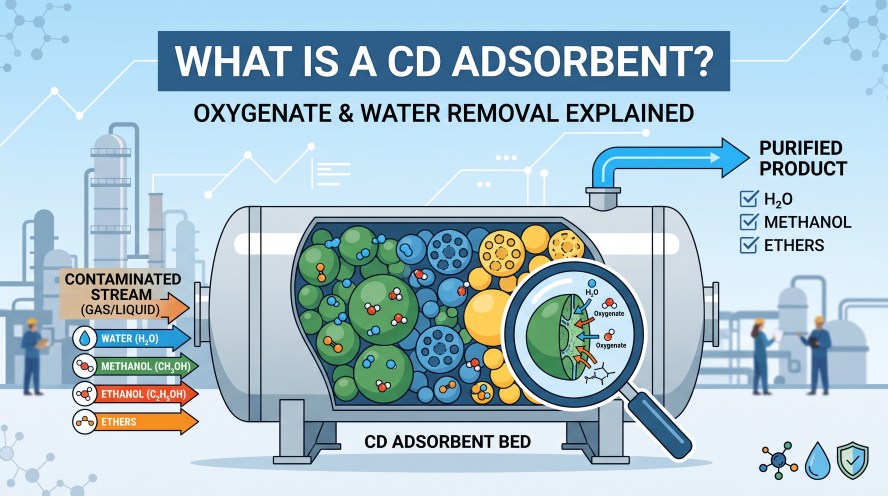
What Is a CD Adsorbent? Oxygenate & Water Removal Explained
How activated alumina protects the carbon molecular sieve bed in a PSA nitrogen generation train — bulk moisture removal upstream of precision gas separation.