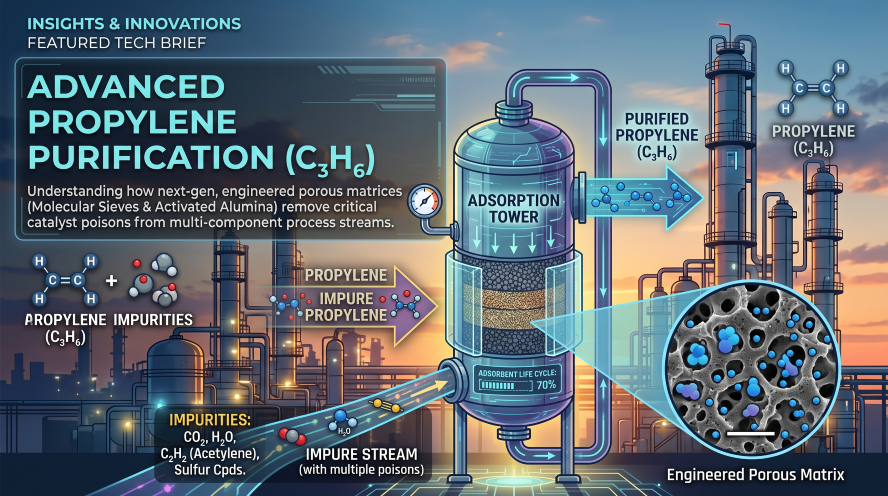
What Is a Propylene Purification Adsorbent?
Getting propylene to polymerization-grade purity is a multi-stage job, and the last stage almost always comes down to one stubborn contaminant: carbon monoxide (CO). Even at trace levels, CO can deactivate the catalysts used to produce polypropylene. A propylene purification adsorbent is the guard bed material built specifically to catch CO — along with several other trace gases — before the propylene stream reaches the reactor.
Key Takeaways
- What it does: Strips CO, O₂, H₂S, COS, AsH₃, and PH₃ from propylene feed streams down to trace or below-detectable levels.
- How it works: A CuO-ZnO active phase, made by co-precipitation, combines catalytic oxidation with chemisorption.
- Why it matters: Polymerization catalysts (Ziegler-Natta, metallocene) are highly sensitive to these contaminants — even ppm-level CO can cause deactivation.
- Where it sits: Usually the last guard bed in the purification train, downstream of desulfurization and drying stages.
Why CO Removal Is the Central Job
Among the possible contaminants in a propylene stream, CO stands out because of how strongly it binds to the active sites on polymerization catalysts. Once bound, catalyst productivity drops — plants see it as reduced yield, off-spec resin, or both. Other contaminants tend to cause slower fouling, but CO poisoning can happen quickly, which is why propylene purification adsorbents are engineered around CO as the primary target, while still handling O₂, H₂S, COS, AsH₃, and PH₃ as secondary contaminants in the same bed.
How a CuO-ZnO Adsorbent Actually Works
The active material is a copper oxide–zinc oxide system made by co-precipitation, which distributes the two components evenly at a fine scale. CO removal here isn't simple physical adsorption — it's catalytic oxidation. CO reacts with available oxygen on the CuO-ZnO surface and converts to CO₂, a far less harmful byproduct. At the same time, H₂S and COS react with CuO to form copper sulfide, while arsine (AsH₃) and phosphine (PH₃) are chemisorbed onto the active metal surface. Handling all of this in one fixed bed keeps the purification train simpler than running separate beds for each individual contaminant.
Where This Guard Bed Fits in the Purification Train
Propylene rarely arrives ready for polymerization straight from a steam cracker or a catalytic cracking recovery unit. It usually passes through several purification stages first. Sulfur removal typically comes first, handled by products like COS Adsorbent, purpose-built for H₂S and COS. The stream then often moves through a stage targeting oxygenates, residual moisture, and mercaptans — the role filled by products like CD Adsorbent. The propylene purification adsorbent usually sits at the end of that sequence, as a final polishing stage focused on CO and any remaining trace contaminants before the stream enters the polymerization reactor. Asking a single adsorbent to cover all three roles at once typically shortens bed life and makes outlet purity less consistent, which is why this staged approach is the more common configuration.
If you're also evaluating the upstream stages, our guides on What Is a COS Adsorbent? and What Is a CD Adsorbent? cover how each of those stages is selected and sized.
What Happens If CO Isn't Removed
Skipping or under-sizing this guard bed tends to show up downstream rather than immediately. Ziegler-Natta and metallocene catalysts both lose activity in the presence of CO, and the effect builds over the life of the catalyst bed. That means a plant might not connect declining yield or drifting resin properties to CO exposure until well after the fact. Because the damage accumulates quietly, this guard bed is generally treated as a required stage rather than an optional add-on.
Beyond Polypropylene: Other Places This Adsorbent Shows Up
Protecting PP polymerization catalysts is the main use case, but the same logic applies anywhere propylene feeds a catalyst-sensitive downstream process. Propylene used in cumene production and acrylonitrile production goes through comparable purity requirements, since those catalysts are also intolerant of CO and trace sulfur compounds. Propylene recovered from catalytic cracking units (PRU streams) tends to carry a more variable contaminant profile than steam cracker propylene, which often makes this stage even more important.
Selecting the Right Configuration
Feed composition varies a lot between a steam cracker outlet, a PRU recovery stream, and a recycled process stream, so the right bed size and expected replacement interval depend on actual inlet contaminant levels, operating temperature and pressure, and the outlet purity required downstream. There's no single number that applies across every plant — service life follows from what's actually in the feed, not a fixed industry-wide figure.
Recommended Products from Sorbsieve
- Propylene Purification Adsorbent — the CuO-ZnO guard bed adsorbent covered in this guide.
- COS Adsorbent — upstream desulfurization stage in the same purification train.
- CD Adsorbent — mid-train stage for oxygenates, moisture, and mercaptans removal.
FAQ
Q1: Can this adsorbent be regenerated, or is it single-use?
It operates on a sacrificial chemisorption mechanism for most of the contaminants it targets, meaning it's replaced rather than regenerated once its capacity is exhausted.
Q2: Does feed source (steam cracker vs. PRU) change how this adsorbent should be sized?
Yes. Propylene recovered from catalytic cracking units often carries a broader and less predictable contaminant mix than steam cracker propylene, which can affect bed sizing and service intervals.
Q3: Is this adsorbent only relevant to polypropylene plants?
No. Any process using propylene as feedstock for a catalyst-sensitive reaction — including cumene and acrylonitrile production — can require the same level of CO and trace-contaminant control.
Q4: What's the risk of skipping this purification stage?
Polymerization catalysts can be irreversibly deactivated by trace CO, leading to reduced yield and off-spec product — often without an obvious immediate signal that something is wrong.
Closing CTA
Looking to specify the right purification train for your propylene feed? Sorbsieve's technical team can help you match each stage — desulfurization, oxygenate/moisture removal, and CO guard bed — to your actual feed composition.
Looking for Bulk Supply of Propylene Purification Adsorbent?
Sorbsieve is a trusted bulk supplier of Propylene Purification Adsorbent and complete industrial adsorbents, serving industrial buyers across the Middle East.
We provide:
- ✅ Container-level supply (20'GP / 40'GP / 40'HQ)
- ✅ Full documentation (COA / TDS / SDS / COO)
- ✅ Multiple packaging options
- ✅ Technical support for adsorbent selection and system optimization
- ✅ Fast quote response for industrial inquiries
Contact our team for bulk pricing, product samples, and technical consultation.
Related Products
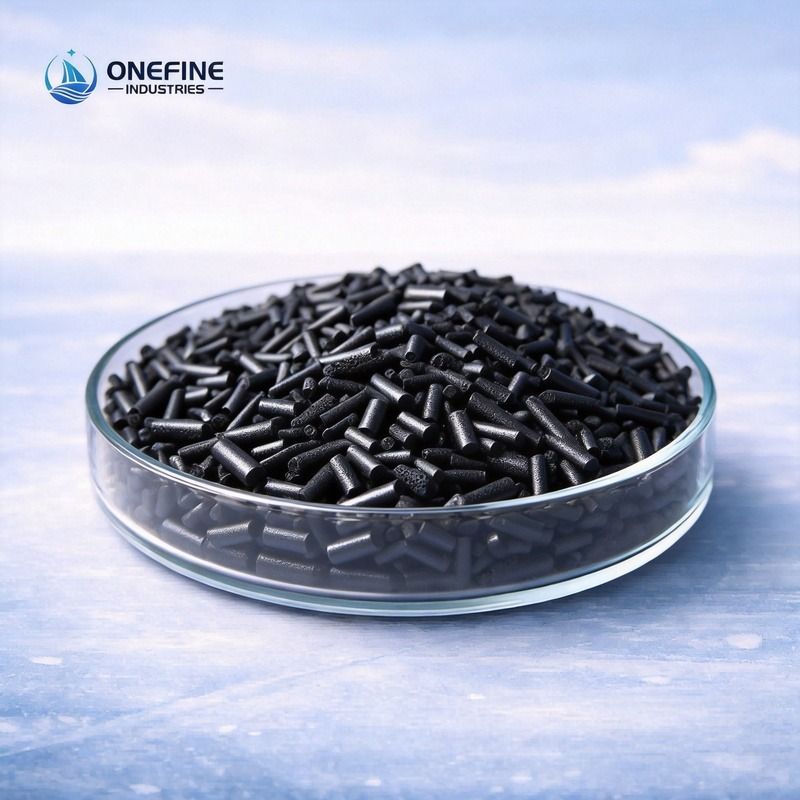
Propylene Purification Adsorbent
A CuO-ZnO adsorbent designed for the removal of CO from polymer-grade propylene feedstock, while also removing trace amounts of O₂, H₂S, COS, AsH₃, PH₃, and other impurities. Prepared by co-precipitation method with uniformly dispersed active components. Features high selectivity, high activity, excellent mechanical strength, large capacity, and easy operation. Protects polymerization catalysts from poisoning and ensures stable polypropylene production.
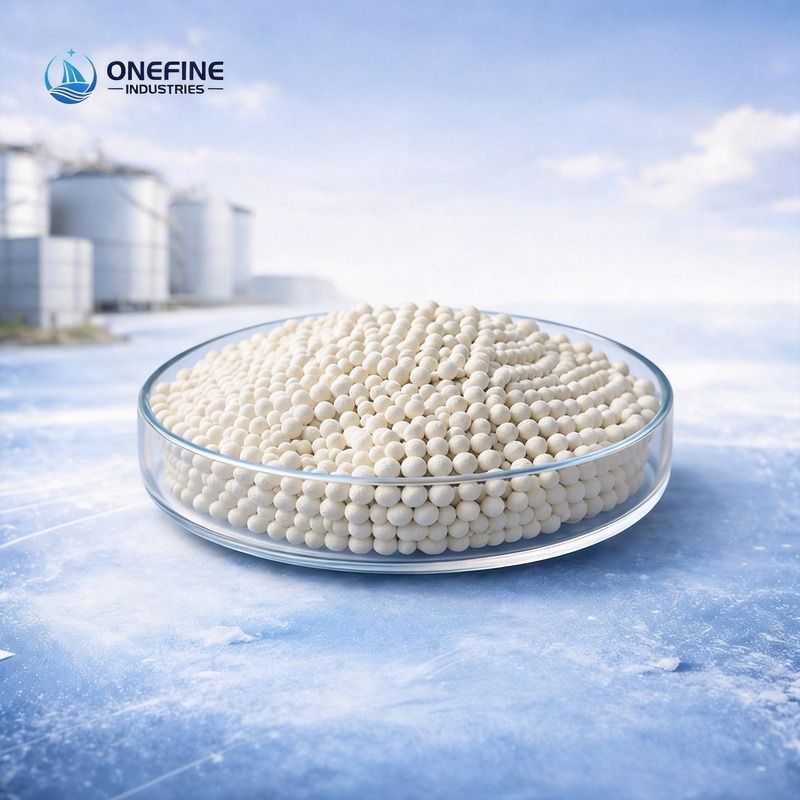
COS adsorbent
An advanced purification adsorbent catalyst based on specialty alumina with active components. Performance equivalent to imported Selexsorb COS adsorbent. Strong chemical adsorption capacity for selective removal of trace COS, CS₂, and H₂S from cracked C₂–C₄ unsaturated hydrocarbon streams. Also effectively removes CO₂, H₂O, chlorides, cyanides, and other common poisons. Operates at ambient to low temperatures for deep feedstock purification.
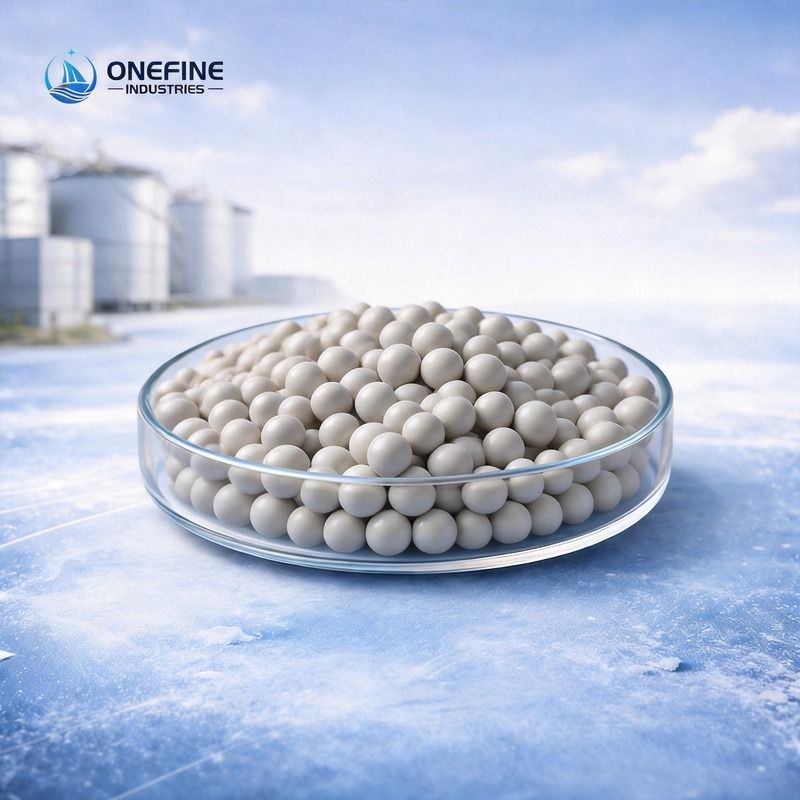
CD adsorbent
An advanced purification adsorbent catalyst based on specialty alumina with special modifiers. Performance equivalent to imported Selexsorb CD adsorbent. Strong chemical adsorption capacity for selective removal of trace oxygenated organic compounds (alcohols, ethers, aldehydes, ketones, peroxides) from C₂–C₄ unsaturated hydrocarbon streams in polyethylene and polypropylene units. Also effectively adsorbs water and mercaptans for deep feedstock purification. Operates at ambient to low temperatures.
Related Reading
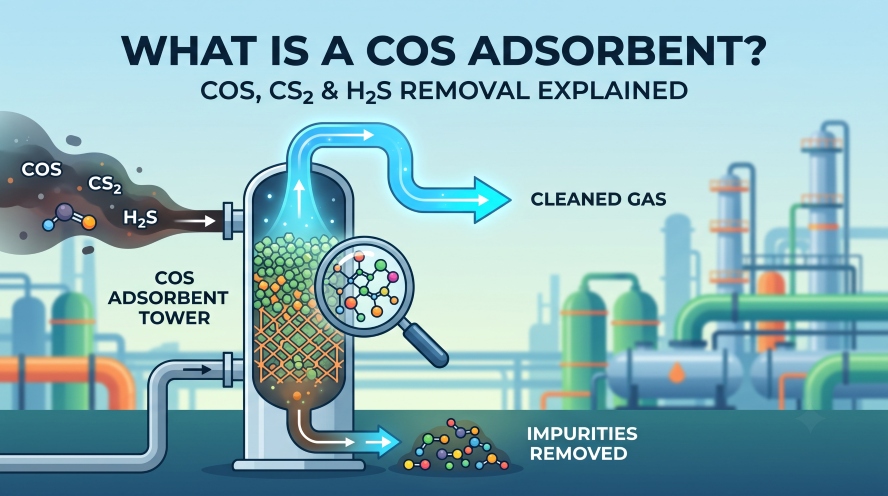
What Is a COS Adsorbent? COS, CS2 & H2S Removal Explained
A COS adsorbent removes COS, CS2, and H2S from cracked C2–C4 olefin streams, protecting polymerization catalysts. Learn how it works and where it fits in the purification train.
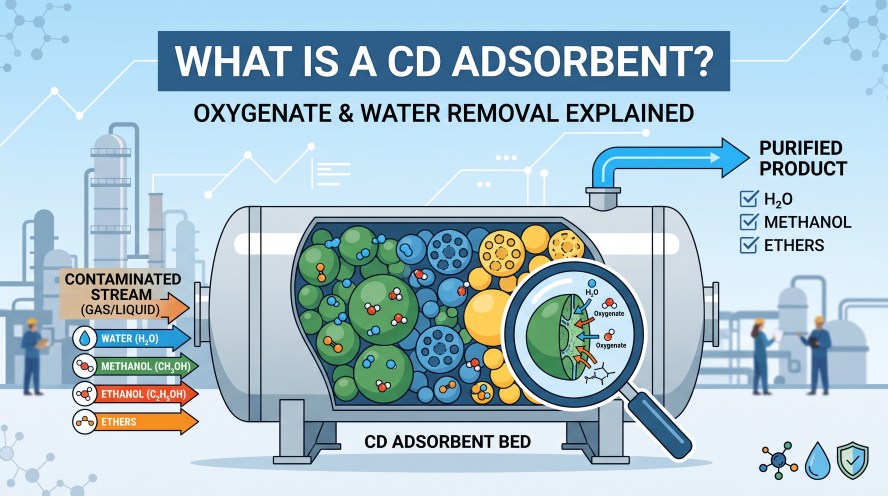
What Is a CD Adsorbent? Oxygenate & Water Removal Explained
How activated alumina protects the carbon molecular sieve bed in a PSA nitrogen generation train — bulk moisture removal upstream of precision gas separation.
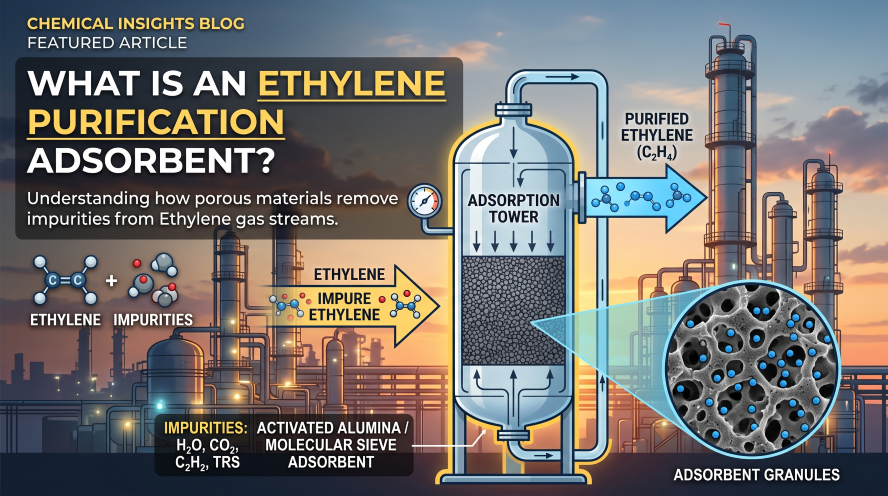
What Is an Ethylene Purification Adsorbent?
A guide to how CuO-ZnO adsorbents remove CO and trace contaminants from polymer-grade ethylene, why polymerization catalysts need this protection, and where this guard bed fits in a typical purification train.