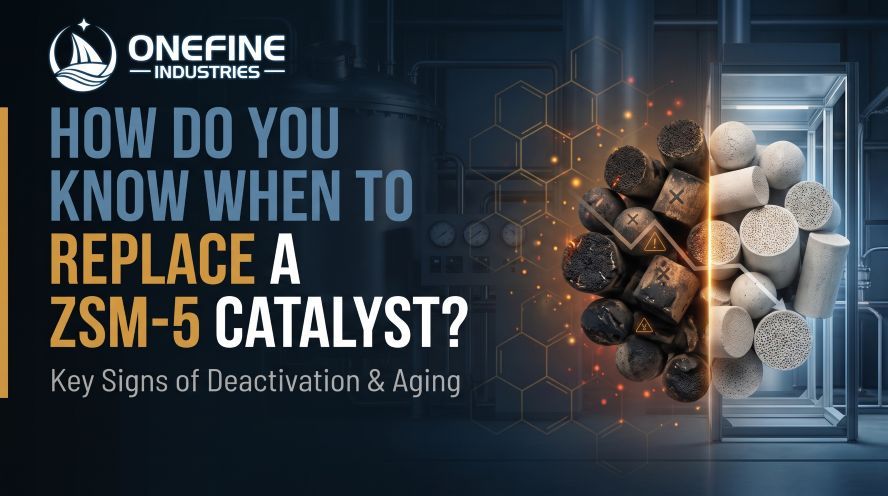
How Do You Know When to Replace a ZSM-5 Catalyst?
Key Takeaways
- An upward creep in outlet VOC concentration under steady operating conditions is usually the first measurable sign of catalyst change.
- Needing a higher light-off or operating temperature to maintain the same VOC destruction rate indicates a declining active-site density.
- If destruction efficiency continues to trend down cycle after cycle despite regular burn-offs, the bed is accumulating irreversible hydrothermal damage.
- A persistent increase in pressure drop across the bed that stays elevated after regeneration suggests physical changes rather than reversible coking.
ZSM-5 catalyst is widely used in industrial VOC emission control systems, where its MFI framework and hydrothermal stability make it well suited to catalytic oxidation duty — see zsm-5 catalyst basics for how it works. Like any catalyst exposed to a continuous process stream, it doesn't stay at peak performance forever. This guide covers what causes a ZSM-5 charge to lose effectiveness in VOC treatment service, and how to tell a catalyst that still has life left in it from one that's due for replacement.
What Causes a ZSM-5 Catalyst to Lose Performance in VOC Service
Two deactivation mechanisms matter most in catalytic VOC oxidation, and they behave very differently.
- Coking (reversible). Partially oxidized or cracked organic byproducts can deposit inside the micropores and on active sites during operation, especially if the inlet stream runs rich or the oxidation reaction isn't going to completion. This is the deactivation mode a regeneration burn-off is designed to reverse.
- Hydrothermal aging and dealumination (irreversible). Catalytic combustion of VOCs produces water vapor as a reaction product, and sustained exposure to that water vapor at operating temperature gradually strips aluminum from the zeolite framework. This reduces the acid sites the catalyst relies on, and no regeneration step brings that framework structure back.
- Contaminant exposure. VOC streams that carry chlorinated compounds or other reactive contaminants can affect active sites over time in a way ordinary coking doesn't. If the feed stream composition has shifted — a new solvent, a new process line feeding into the same abatement system — it's worth checking whether that's a factor.
Coking is something a regeneration cycle manages. Hydrothermal aging is something that accumulates no matter how well the system is run, and eventually it's what ends the catalyst's service life.
Key Signs It's Time to Replace, Not Just Regenerate
- Outlet VOC concentration creeping up at the same operating conditions. If destruction efficiency was holding steady and is now drifting, even slightly, that's usually the first measurable sign something has changed in the catalyst bed.
- Needing a higher operating temperature to hold the same conversion. A rising light-off or operating temperature to maintain the same VOC destruction rate is a classic sign of declining active-site density — the system is compensating for lost activity rather than the catalyst doing the work on its own.
- Regeneration doesn't bring performance back. A normal burn-off should restore most of the activity lost to coking. If destruction efficiency keeps trending down cycle after cycle despite regular regeneration, that points to irreversible hydrothermal damage rather than a fouling problem.
- Pressure drop across the bed stays elevated after regeneration. Coking-related pressure drop should largely clear with a proper burn-off. A persistent increase suggests physical changes in the catalyst rather than something regeneration can fix.
- Shorter intervals between regenerations. If the catalyst needs burning off more often just to hold the same destruction efficiency, the margin is shrinking — often a useful early warning before performance drops sharply.
Regeneration vs. Replacement: The Practical Test
After any regeneration, the question is whether performance came back close to where it was after the previous cycle, or whether the baseline itself is drifting down.
- If regeneration restores performance close to the prior cycle's level, the catalyst still has usable life — coking is the dominant mechanism, and the system is managing it correctly.
- If each regeneration recovers a little less than the one before it, the catalyst is accumulating permanent damage and is on a path toward replacement, even before it fails the outlet standard outright.
Operating severity matters too. A system running hotter than necessary, or handling a wetter process stream, will age ZSM-5 faster regardless of how well regeneration is managed — so a faster-than-expected decline is worth checking against actual operating conditions before concluding the catalyst batch itself is the problem.
Practical Guidance for Operators
- Track outlet VOC levels and operating temperature as a trend, not a single reading — the direction matters more than any one data point.
- Compare post-regeneration performance cycle-over-cycle rather than only against the original fresh baseline.
- Note any changes in feed composition (new solvents, new upstream processes) that could introduce contaminants the catalyst wasn't sized for.
- Review operating temperature and moisture load if decline is faster than expected, before assuming the catalyst charge itself is at fault.
- When the trend is unclear, it's worth discussing your specific stream composition and operating history with your catalyst supplier rather than guessing from general rules of thumb.
Recommended Products from Sorbsieve
FAQ
How long does a ZSM-5 catalyst typically last in VOC emission control service? Service life depends heavily on operating temperature, moisture content of the stream, and feed composition, so it varies by installation. Tracking the trend in outlet VOC levels and regeneration frequency is a more reliable guide than a fixed timeline.
Can a ZSM-5 catalyst be regenerated more than once? Yes, as long as the dominant deactivation mode is coking. Each regeneration cycle that recovers less performance than the last is a sign the catalyst is accumulating irreversible hydrothermal damage.
Does higher humidity in the VOC stream shorten catalyst life? Water vapor exposure at operating temperature is a primary driver of hydrothermal aging in zeolite catalysts, so a consistently wetter stream or higher operating temperature will generally shorten service life compared to a drier, cooler-running system.
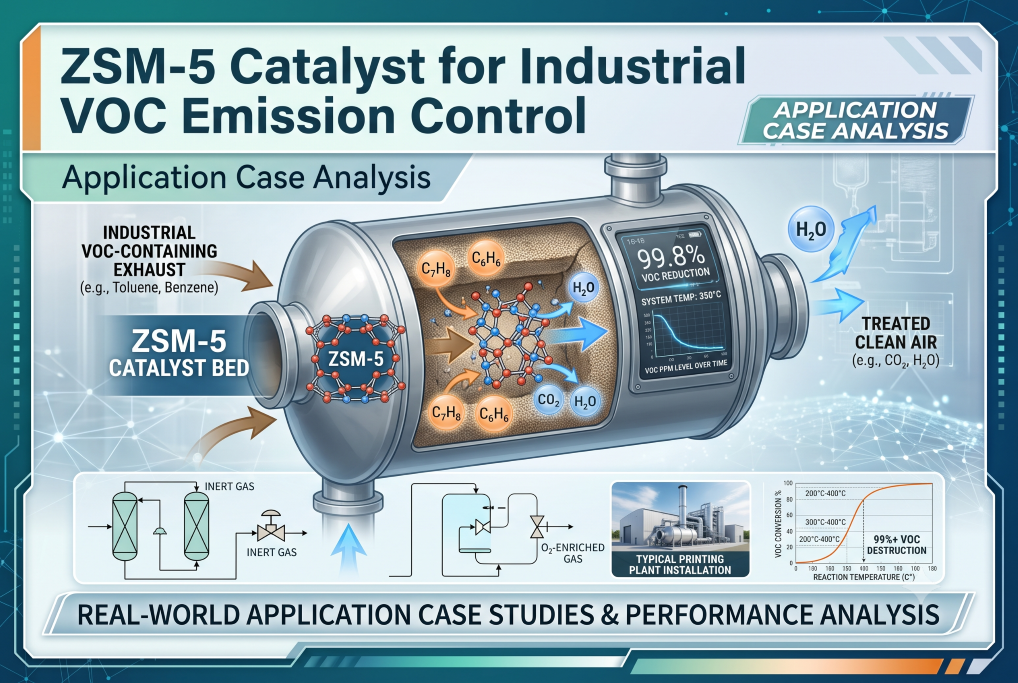
What's the difference between a ZSM-5 catalyst used for VOC oxidation and one used in refining? They're the same underlying MFI zeolite structure, but formulation, binder system, and form factor are matched to the specific duty. For VOC emission control applications, see zsm-5 voc application case【★内链3:Internal Link → ZSM-5 Catalyst for Industrial VOC Emission Control: Application Case Analysis 应用案例】for how it's applied in practice.
Looking for Bulk Supply of ZSM-5 Catalyst?
Sorbsieve is a trusted bulk supplier of ZSM-5 catalyst and complete industrial adsorbents, serving industrial buyers across the Middle East.
We provide:
- ✅ Container-level supply (20'GP / 40'GP / 40'HQ)
- ✅ Full documentation (COA / TDS / SDS / COO)
- ✅ Multiple packaging options
- ✅ Technical support for ZSM-5 catalyst selection and system optimization
- ✅ Fast quote response for industrial inquiries
Contact our team for bulk pricing, product samples, and technical consultation.