Why Is Your Ethylene/Propylene Purification Adsorbent Bed Breaking Through Early? Troubleshooting Guide
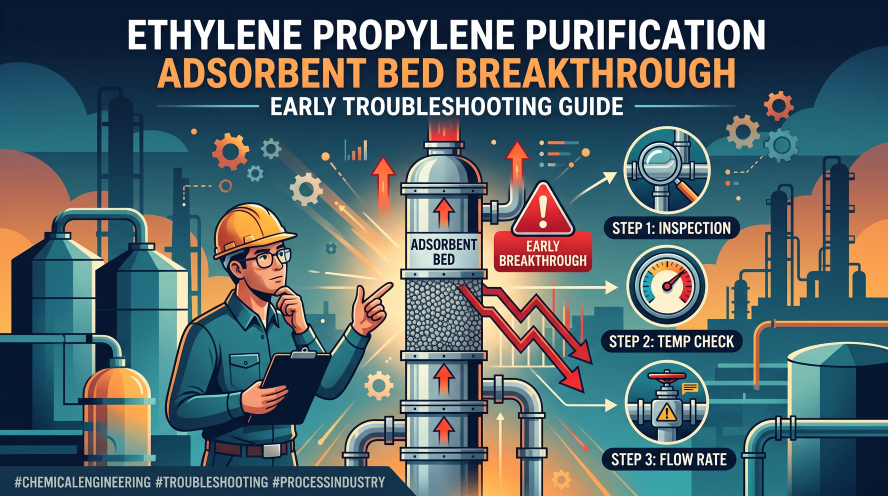
In polymer-grade ethylene and propylene production, the Ethylene Purification Adsorbent or its sister grade, Propylene Purification Adsorbent , serves as the final polishing stage in the purification train — positioned downstream of dedicated sulfur removal and oxygenate/moisture removal beds. Its primary job is deep CO removal: stripping residual carbon monoxide down to levels that won't poison downstream Ziegler-Natta or metallocene polymerization catalysts. Because copper and zinc oxide also carry inherent affinity for trace sulfur and polar species, the bed provides secondary polishing capacity against whatever slips past the upstream stages — but when it breaks through early, it's rarely just "the media is used up." Four distinct mechanisms — sulfate buildup during regeneration, moisture overload, copper sintering, and incomplete sulfur conversion — each shorten working capacity in different ways. Understanding which one is happening determines whether the fix is a process change or a media replacement.
Key Takeaways
- Early breakthrough in CuO-ZnO purification beds is often driven by irreversible sulfate formation (ZnSO₄/CuSO₄) during improperly controlled regeneration cycles.
- Moisture slip from upstream drying stages kinetically hinders H₂S chemisorption, forcing early breakthrough and promoting COS formation.
- Copper sintering, accelerated by thermal cycling and trace chlorides, causes a permanent, non-regenerable loss of active surface area.
Irreversible Sulfate Formation During Regeneration
CuO-ZnO adsorbents remove hydrogen sulfide and other sulfur species by chemisorption, forming ZnS and CuS/Cu₂S as the active sites become sulfided. In a properly operated system, oxidative regeneration converts these sulfides back to ZnO and CuO, restoring capacity for the next cycle.
The problem arises when regeneration conditions aren't tightly controlled. Multiple industrial and academic studies on ZnO-based desulfurization sorbents confirm that when regeneration oxygen concentration is too high relative to the sulfur loading, or when regeneration temperature runs too low, a portion of the sulfided sites converts to zinc sulfate (ZnSO₄) and copper sulfate (CuSO₄) instead of reverting to the active oxide form. Sulfate is far more thermally stable than the sulfide it replaced — it does not decompose back to usable oxide under normal regeneration conditions, and it physically blocks the pore mouths and active surface that would otherwise chemisorb sulfur in the next cycle.
This is a cumulative, one-way loss. Each regeneration cycle that runs slightly off-spec locks away a small fraction of the bed's total capacity as inert sulfate. Operators typically don't notice anything wrong for many cycles — the bed still "passes" each regeneration — until the accumulated dead capacity is large enough that the working bed can no longer absorb a full cycle's sulfur load, and breakthrough starts arriving noticeably earlier than the original design curve predicted.
What to check: regeneration gas oxygen concentration relative to sulfur loading, and whether the outlet temperature during regeneration consistently reaches the specified plateau. A gradual, cycle-over-cycle shortening of breakthrough time (rather than a sudden failure) is the signature of sulfate accumulation.
Moisture Slip Overwhelming the Guard Bed
CuO-ZnO purification beds are typically positioned downstream of a dedicated drying stage in the purification train. When that upstream drying step underperforms — due to its own approaching saturation, a temperature excursion, or incomplete regeneration — excess moisture slips into the CuO-ZnO bed.
This matters because water actively interferes with the sulfur chemisorption reaction itself. Research on ZnO-based desulfurization sorbents has documented that elevated moisture concentrations significantly hinder the reaction between ZnO and H₂S, measurably shortening breakthrough time even when the bed's nominal sulfur capacity hasn't changed. In effect, the adsorbent is competing against water molecules for the same active sites, and water often wins the kinetic race at typical operating temperatures.
There's a second-order effect worth flagging: at certain CO and moisture concentrations, H₂S can react with CO on the sulfided sorbent surface to regenerate small amounts of COS (carbonyl sulfide) in situ — a side reaction whose rate is itself moisture-dependent. This means a wet feed doesn't just reduce capacity; it can also change what sulfur species show up downstream, which is a useful diagnostic clue (see Section 4).
What to check: dew point of the gas entering the CuO-ZnO bed, and whether the upstream drying stage's own breakthrough curve is on schedule. If moisture slip lines up with the timing of early breakthrough events, the root cause is upstream, not in the CuO-ZnO bed itself.
Copper Sintering and Trace Chloride Poisoning
The copper component in a CuO-ZnO adsorbent isn't just along for the ride — it contributes meaningfully to both sulfur capacity and CO chemisorption capacity. But copper is a mobile species at elevated temperature, and its active surface area shrinks over time through sintering: small, well-dispersed copper particles gradually agglomerate into larger, less active clusters.
Published deactivation studies on Cu/ZnO systems consistently identify two accelerants for this sintering process. First, thermal cycling itself — repeated heating through regeneration temperature ranges — promotes copper particle migration and coalescence, particularly when steam or moisture is present in the regeneration atmosphere. Second, even trace levels of chloride in the feed gas or regeneration gas measurably accelerate copper sintering; the literature is consistent that chloride contamination is one of the more aggressive, if often overlooked, threats to Cu/ZnO catalyst and adsorbent lifetime.
Unlike sulfate formation, sintering isn't reversible by adjusting regeneration parameters — once copper particles have coarsened, that lost surface area doesn't come back. This mechanism tends to produce a slow, steady decline in both sulfur and CO removal capacity across many cycles, distinguishable from sulfate accumulation mainly by ruling out the regeneration-condition explanation first.
What to check: any known or suspected chloride source upstream (process water, certain catalysts, or piping materials), and whether the decline in capacity affects CO removal performance as well as sulfur removal — a parallel decline in both points toward copper-specific degradation rather than a purely zinc-related issue.
COS Slip From Incomplete Sulfur Conversion
Not every early breakthrough shows up as elevated H₂S. Carbonyl sulfide (COS) can form in situ inside the purification train through two documented pathways: a homogeneous gas-phase reaction between CO and H₂S, and a heterogeneous reaction between CO₂ and H₂S occurring directly on the sulfided sorbent surface. Both pathways are suppressed by the presence of hydrogen and water in some conditions, but under certain CO/CO₂ ratios and low-moisture conditions, COS formation can become the dominant sulfur breakthrough species rather than H₂S itself.
This matters operationally because COS is chemically distinct from H₂S — a CuO-ZnO bed optimized and monitored primarily for H₂S removal may not be equally effective at capturing COS, meaning sulfur can slip downstream even while H₂S-specific monitoring shows the bed performing normally. Plants that rely solely on H₂S detection for breakthrough alarms are, in effect, partially blind to this failure mode.
What to check: if downstream analyzers detect total sulfur or catalyst poisoning symptoms without a corresponding H₂S alarm, COS slip should be investigated specifically, including reviewing CO/CO₂ concentrations in the feed relative to the bed's original design basis.
Why This Matters: The Downstream Cost of Missing It
Even trace-level sulfur breakthrough carries an outsized cost. Published research on polypropylene production has demonstrated that trace hydrogen sulfide contamination measurably degrades Ziegler-Natta catalyst efficiency and alters the final polymer's properties — this isn't a theoretical risk, it's a documented industrial finding. Combined with the risk of CO or oxygenate slip toward downstream hydrogenation and drying stages, an early-breaking purification bed is rarely just a "replace it and move on" event — it's worth identifying which of the four mechanisms above is actually driving the failure.
For the fundamentals of how each grade works, see our companion guides: What Is an Ethylene Purification Adsorbent? and What Is a Propylene Purification Adsorbent?
Recommended Products from Sorbsieve
Ethylene Purification Adsorbent — CuO-ZnO based adsorbent engineered as the final polishing stage for deep CO removal in polymer-grade ethylene purification trains, with secondary polishing capacity for residual sulfur and oxygenates.
Propylene Purification Adsorbent — Sister product using the same CuO-ZnO formulation, adapted for propylene purification service.
FAQ
Q1: How can I tell whether early breakthrough is caused by sulfate formation or copper sintering?
A1: Sulfate formation is closely tied to regeneration conditions — check whether oxygen concentration and outlet temperature during regeneration consistently hit specification. If they do, and capacity is still declining steadily across many cycles, copper sintering (often accelerated by trace chloride) becomes the more likely explanation. A parallel decline in both sulfur and CO removal performance also points toward copper-specific degradation rather than a purely regeneration-related issue.
Q2: Can a sulfate-fouled bed be recovered, or does it need replacement?
A2: Once zinc sulfate and copper sulfate have formed, they are not converted back to active oxide under standard regeneration conditions. Some sulfate can be removed through high-temperature thermal decomposition or exposure to a reducing atmosphere, but this is a specialized reactivation step, not routine regeneration, and isn't always practical at the plant level. In most cases, once accumulated sulfate has meaningfully reduced working capacity, replacement is the more reliable path forward.
Q3: Why would my H₂S monitoring show normal readings while downstream catalysts still show poisoning symptoms?
A3: This is the classic signature of COS slip. COS can form in situ from CO and H₂S (or CO₂ and H₂S) even when the bed is performing adequately against H₂S itself. If downstream symptoms appear without a corresponding H₂S alarm, it's worth checking total sulfur or COS-specific monitoring rather than relying on H₂S detection alone.
Q4: Does moisture slip permanently damage a CuO-ZnO adsorbent, or is the capacity loss temporary?
A4: Moisture interferes with the sulfur chemisorption reaction kinetically — it competes with H₂S for active sites during the adsorption cycle — but this is not itself a permanent structural change to the adsorbent. Once the upstream drying issue causing the moisture slip is corrected, the bed's underlying capacity is not inherently reduced by this mechanism alone. That said, prolonged wet operation can indirectly accelerate other degradation pathways, including sintering, so a moisture excursion is worth correcting promptly even though it isn't itself irreversible.
Looking for Bulk Supply of Industrial Adsorbents?
Sorbsieve is a trusted bulk supplier of Ethylene/Propylene Purification Adsorbent and complete industrial adsorbents, serving industrial buyers across the Middle East.
We provide:
- ✅ Container-level supply (20'GP / 40'GP / 40'HQ)
- ✅ Full documentation (COA / TDS / SDS / COO)
- ✅ Multiple packaging options
- ✅ Technical support for adsorbent selection and system optimization
- ✅ Fast quote response for industrial inquiries
Contact our team for bulk pricing, product samples, and technical consultation.
Related Products
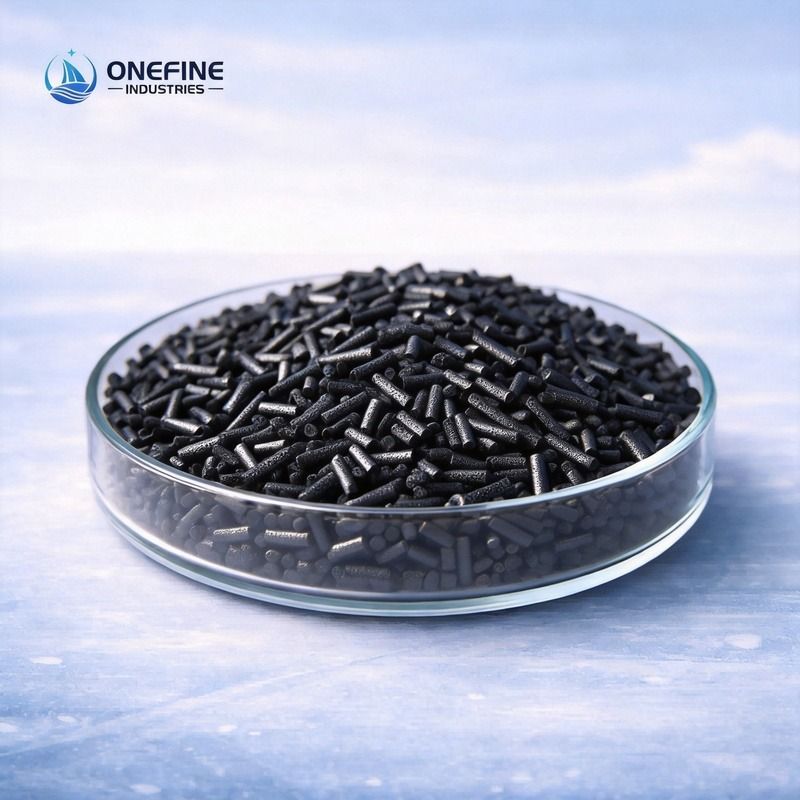
Ethylene Purification Adsorbent
A CuO-ZnO adsorbent designed for the removal of CO from polymer-grade ethylene feedstock, while also removing trace amounts of O₂, H₂S, COS, AsH₃, and PH₃. Prepared by co-precipitation method with uniformly dispersed active components. Features high selectivity, high activity, excellent mechanical strength, large capacity, and easy operation. Protects polymerization catalysts from poisoning and ensures stable polyethylene production.
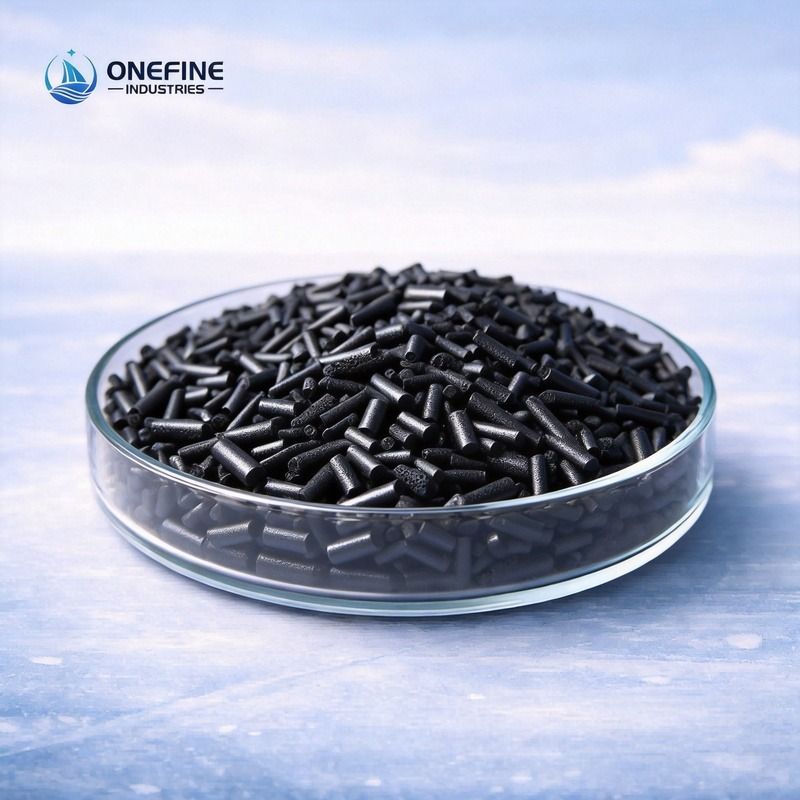
Propylene Purification Adsorbent
A CuO-ZnO adsorbent designed for the removal of CO from polymer-grade propylene feedstock, while also removing trace amounts of O₂, H₂S, COS, AsH₃, PH₃, and other impurities. Prepared by co-precipitation method with uniformly dispersed active components. Features high selectivity, high activity, excellent mechanical strength, large capacity, and easy operation. Protects polymerization catalysts from poisoning and ensures stable polypropylene production.
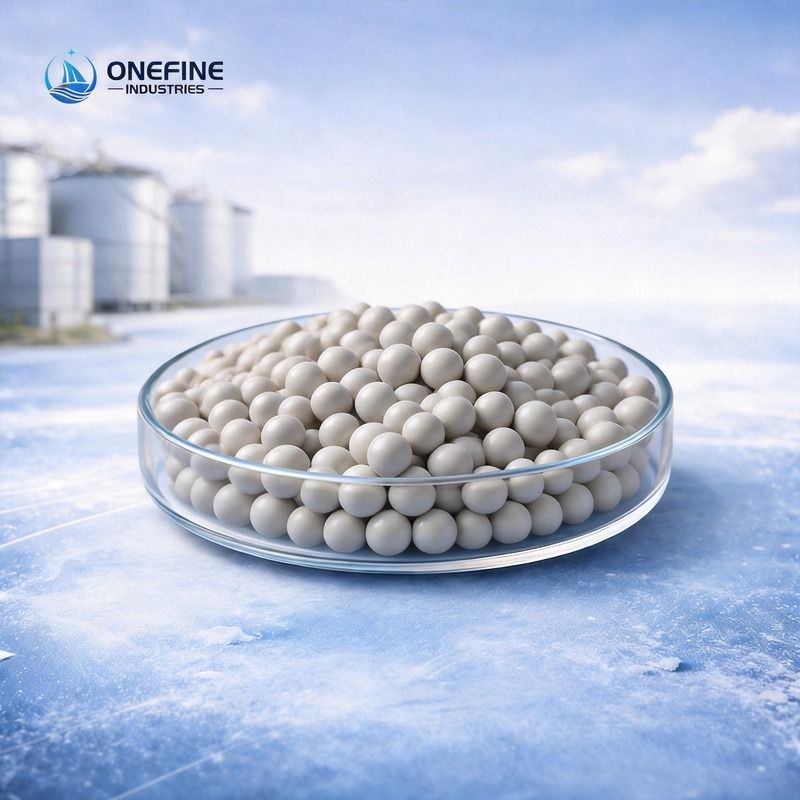
CD adsorbent
An advanced purification adsorbent catalyst based on specialty alumina with special modifiers. Performance equivalent to imported Selexsorb CD adsorbent. Strong chemical adsorption capacity for selective removal of trace oxygenated organic compounds (alcohols, ethers, aldehydes, ketones, peroxides) from C₂–C₄ unsaturated hydrocarbon streams in polyethylene and polypropylene units. Also effectively adsorbs water and mercaptans for deep feedstock purification. Operates at ambient to low temperatures.
Related Reading
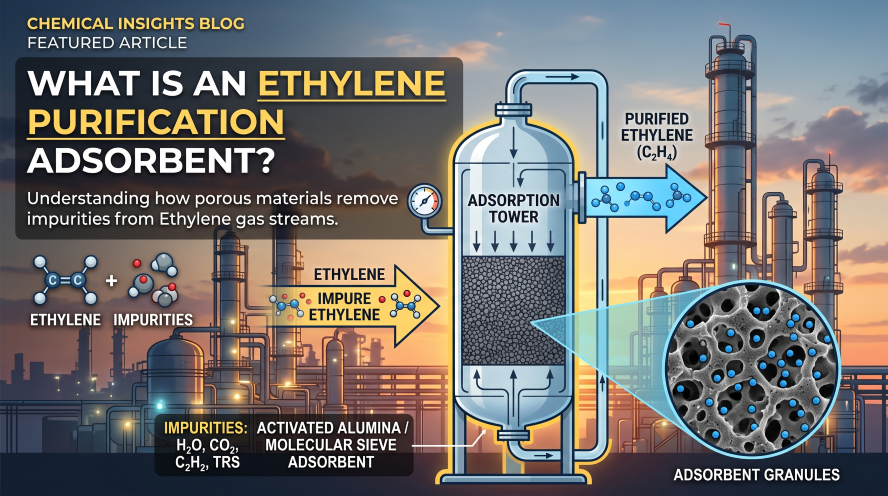
What Is an Ethylene Purification Adsorbent?
A guide to how CuO-ZnO adsorbents remove CO and trace contaminants from polymer-grade ethylene, why polymerization catalysts need this protection, and where this guard bed fits in a typical purification train.
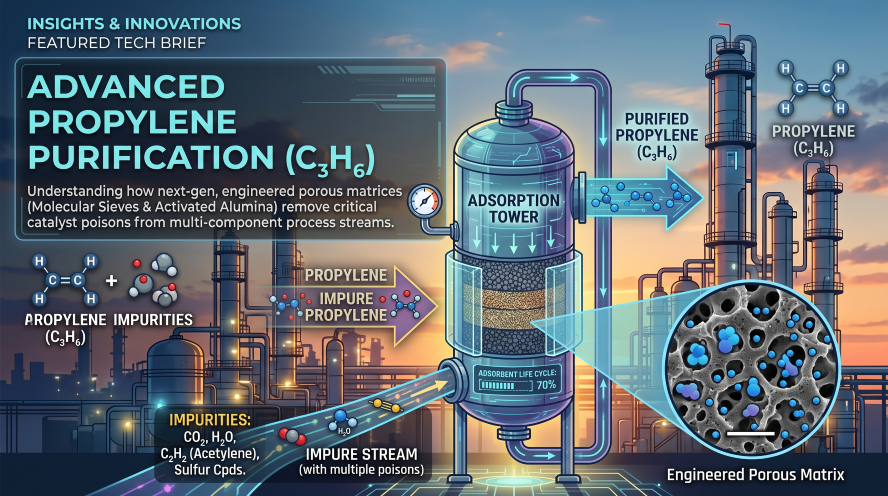
What Is a Propylene Purification Adsorbent?
A guide to how CuO-ZnO adsorbents remove CO and trace contaminants from polymer-grade propylene, why polymerization catalysts need this protection, and where this guard bed fits in a typical purification train.