Three-Stage Purification Train for Polymer-Grade Ethylene and Propylene: From COS Removal to Final CO Polishing
Industry Context
Key Takeaways
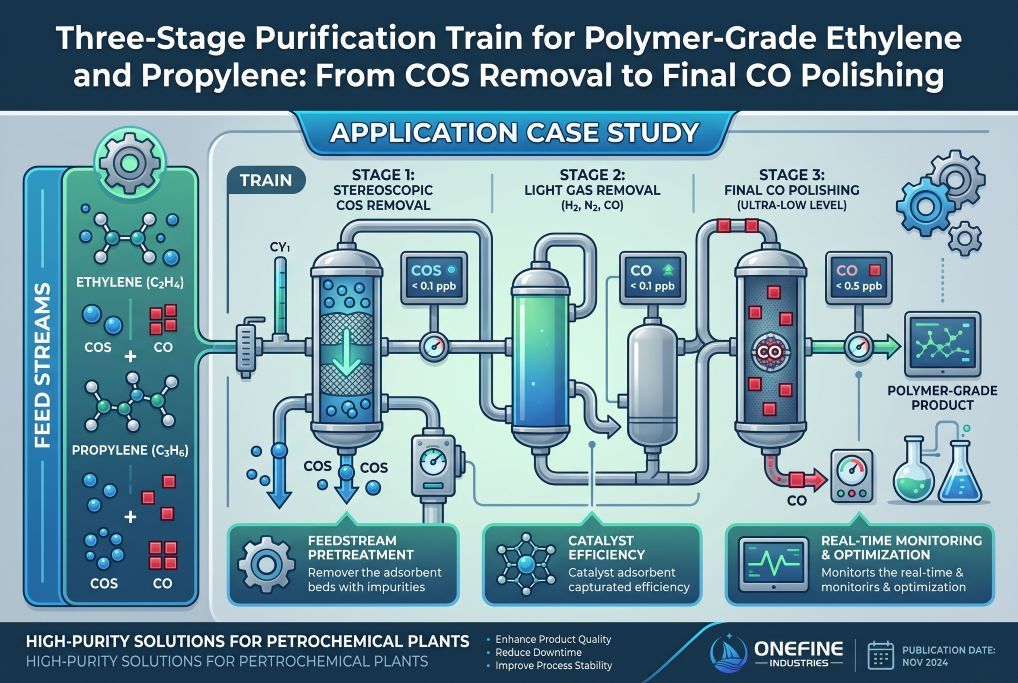
- Stage 1 utilizes a dedicated COS Adsorbent to directly capture carbonyl sulfide from hydrogen-free olefin streams before it reaches sensitive beds.
- Stage 2 employs a CD Adsorbent to clear polar contaminants like moisture and oxygenates that promote gum formation and poison active catalyst sites.
- Stage 3 acts as the final polishing step, using a copper-zinc active phase to convert and capture trace carbon monoxide upstream of the reactor.
Polymer-grade ethylene and propylene are not simply "high-purity" monomers — they are feedstocks engineered to meet the extreme poison sensitivity of downstream polymerization catalysts. Ziegler-Natta, metallocene, and chromium-based catalyst systems can lose activity from contaminant levels far below what would matter in any other petrochemical process. To protect these catalysts, olefin purification trains are built as a sequence of specialized adsorbent stages, each targeting a different class of impurity carried over from upstream cracking and recovery units. This case walks through a representative three-stage train — sulfur removal, polar-compound polishing, and final carbon monoxide removal — and explains why the sequence itself is part of the engineering, not just the chemistry.
Why Polymer-Grade Feedstock Needs Multiple Guard Beds
A single purification step is rarely enough for polymer-grade service. Feed streams leaving a cracker or recovery unit typically carry several unrelated impurity families at once — trace sulfur compounds, residual moisture and oxygenates, and carbon monoxide — and no single adsorbent chemistry is optimized to remove all of them efficiently. Treating them together in one bed also risks cross-interference, where one adsorption mechanism competes with or masks another. The industry-standard response is a guard bed train: each stage is sized and formulated for one impurity class, positioned in the order that protects the most sensitive stage downstream from being prematurely exhausted by the impurities that should have been captured earlier.
Stage 1: Removing COS Before It Reaches the Reactor
The first stage addresses carbonyl sulfide (COS), a trace sulfur species that survives upstream desulfurization more easily than H₂S because it does not respond the same way to conventional treatment chemistry. Left untreated, COS acts as a catalyst poison in much the same way sulfur compounds do across olefin polymerization systems, and it can also carry through to contaminate polymer product quality. This is a distinct purification task from COS hydrolysis in syngas service — here, the goal is direct capture of COS from an essentially hydrogen-free olefin stream, not conversion into H₂S for downstream scrubbing. Our COS Adsorbent is formulated specifically for this role, positioned as the first guard bed in the train so that sulfur-bearing species never reach the more sensitive stages that follow.
Stage 2: Clearing Oxygenates, Moisture, and Mercaptans
Once bulk sulfur is addressed, the stream still carries polar contaminants — residual moisture, oxygenated hydrocarbons (alcohols, aldehydes, ethers), and mercaptans — that were never fully removed upstream. These compounds behave differently from COS: they tend to adsorb strongly onto catalyst active sites, promote gum and oligomer formation in the reactor, and in some cases interfere with the same catalyst systems that COS threatens, just through a different chemical pathway. A dedicated polar-compound adsorbent — what we refer to as the CD stage — is designed to target this entire class of impurities in one bed rather than requiring separate treatment for each compound type. Our CD Adsorbent fills this role as the second stage of the train.
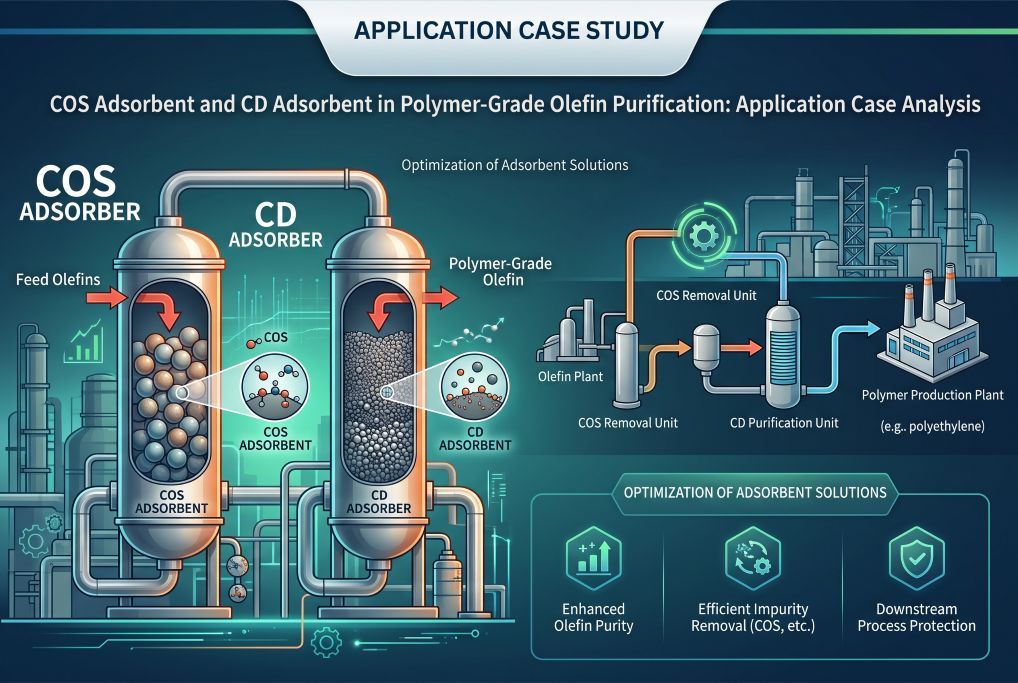
These first two stages — COS removal followed by CD-stage polishing — are common enough as a standalone configuration that we've covered them in depth in a separate case study: COS and CD case study. That piece focuses specifically on how the two-stage sulfur-to-polar-compound sequence is configured and sized; this case picks up where it leaves off, at the third stage most polyolefin producers still need before feed is reactor-ready.
Stage 3: Final CO Polishing Before Polymerization
Carbon monoxide is, pound for pound, one of the most aggressive poisons a polymerization catalyst can encounter. Unlike bulk sulfur or moisture, CO coordinates directly and strongly to the active metal centers used in most olefin polymerization catalyst systems, and even trace residual levels — the kind that survive upstream sulfur and polar-compound removal without issue — can measurably suppress catalyst activity or shorten catalyst life. This is why a dedicated final polishing stage sits closest to the reactor in a well-designed train, rather than relying on the first two stages to catch everything.
This is also the stage most purification trains still lack a dedicated, well-documented solution for — which is where this case adds the most value beyond the COS/CD story above. Our Ethylene Purification Adsorbent and Propylene Purification Adsorbent are formulated around a copper-zinc active phase engineered to chemically bind and convert residual carbon monoxide, functioning as the final guard bed immediately upstream of the polymerization reactor. Ethylene and propylene streams are treated as sister applications of the same underlying chemistry — the active phase performs the same CO-polishing role in both monomer streams, with the two product lines differentiated for the specific flow and loading conditions of each service.
Why the Sequence Matters as Much as the Chemistry
The order of these three stages is not arbitrary. Placing sulfur removal first protects the CD stage from having to compete with sulfur species for adsorption capacity. Placing the CD stage second means the moisture and oxygenate load — which is typically higher-volume than the trace CO the final stage handles — is cleared before it can dilute or foul the copper-zinc active phase in the polishing bed. And placing CO polishing last means the most poison-sensitive, most expensive-to-regenerate stage only has to handle the one impurity it was specifically formulated for, rather than being asked to do double duty as a catch-all. Running the beds out of this sequence, or undersizing an earlier stage, typically shows up first as premature breakthrough at the final CO-polishing stage — the most costly place in the train for that to happen.
FAQ
Are the Ethylene and Propylene Purification Adsorbents interchangeable? They share the same copper-zinc active chemistry for CO removal, but each is engineered for the flow characteristics and loading conditions of its specific monomer stream. We size and recommend the grade based on your actual process conditions rather than treating the two as drop-in substitutes.
Does every polymer-grade ethylene or propylene plant need all three stages? It depends on the upstream feedstock and how much sulfur, moisture, and CO are already being removed elsewhere in the process. Some configurations combine or omit stages based on actual contaminant loading — we're glad to review your feed specification and recommend a train configuration accordingly.
What happens if the final CO-polishing stage is skipped? Trace CO that would otherwise be captured passes straight to the polymerization reactor, where it can suppress catalyst activity or shorten catalyst life even at very low concentrations. This is generally the most sensitive point of failure in an otherwise well-designed purification train.
Looking for Bulk Supply of Ethylene and Propylene Purification Adsorbents?
Sorbsieve is a trusted bulk supplier of COS, CD, and CO-polishing adsorbents for polymer-grade olefin purification, serving industrial buyers across the Middle East.
We provide:
- ✅ Container-level supply (20'GP / 40'GP / 40'HQ)
- ✅ Full documentation (COA / TDS / SDS / COO)
- ✅ Multiple packaging options
- ✅ Technical support for purification train design and staging
- ✅ Fast quote response for industrial inquiries
Contact our team for bulk pricing, product samples, and technical consultation.
Related Products
COS adsorbent
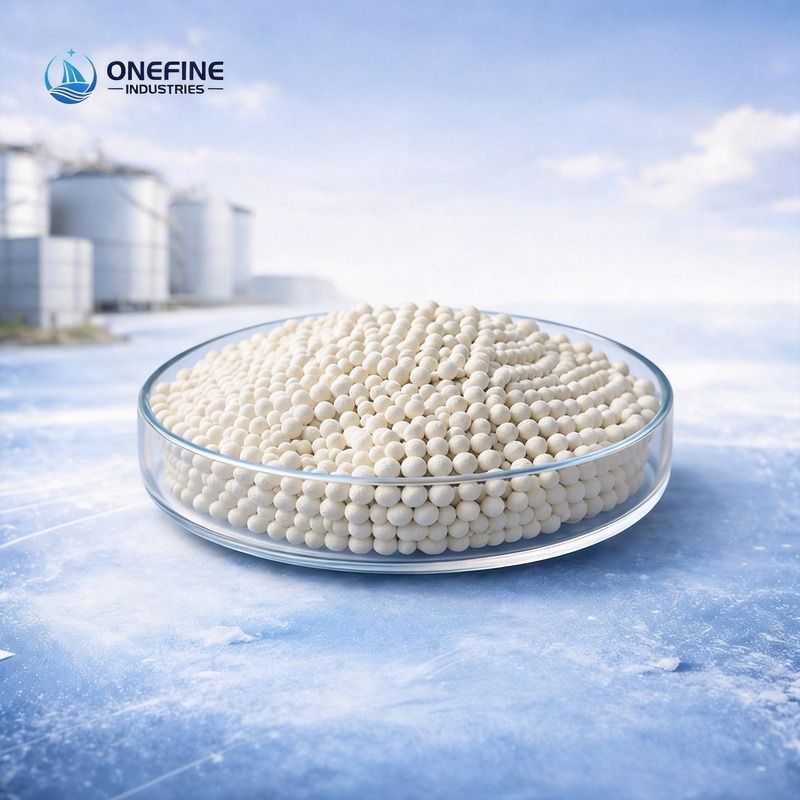
An advanced purification adsorbent catalyst based on specialty alumina with active components. Performance equivalent to imported Selexsorb COS adsorbent. Strong chemical adsorption capacity for selective removal of trace COS, CS₂, and H₂S from cracked C₂–C₄ unsaturated hydrocarbon streams. Also effectively removes CO₂, H₂O, chlorides, cyanides, and other common poisons. Operates at ambient to low temperatures for deep feedstock purification.
Ethylene Purification Adsorbent
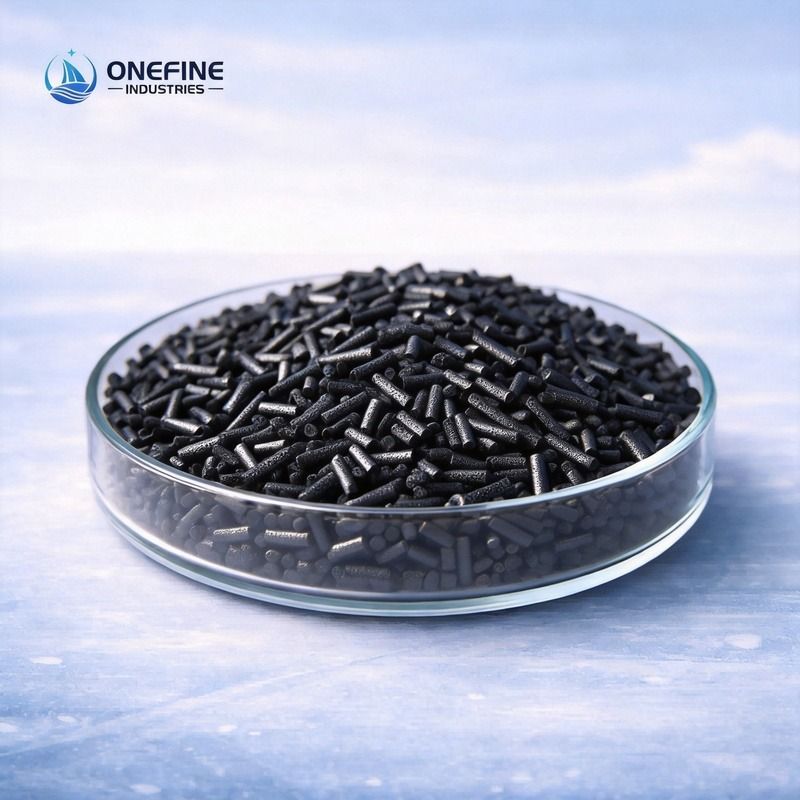
A CuO-ZnO adsorbent designed for the removal of CO from polymer-grade ethylene feedstock, while also removing trace amounts of O₂, H₂S, COS, AsH₃, and PH₃. Prepared by co-precipitation method with uniformly dispersed active components. Features high selectivity, high activity, excellent mechanical strength, large capacity, and easy operation. Protects polymerization catalysts from poisoning and ensures stable polyethylene production.
Propylene Purification Adsorbent
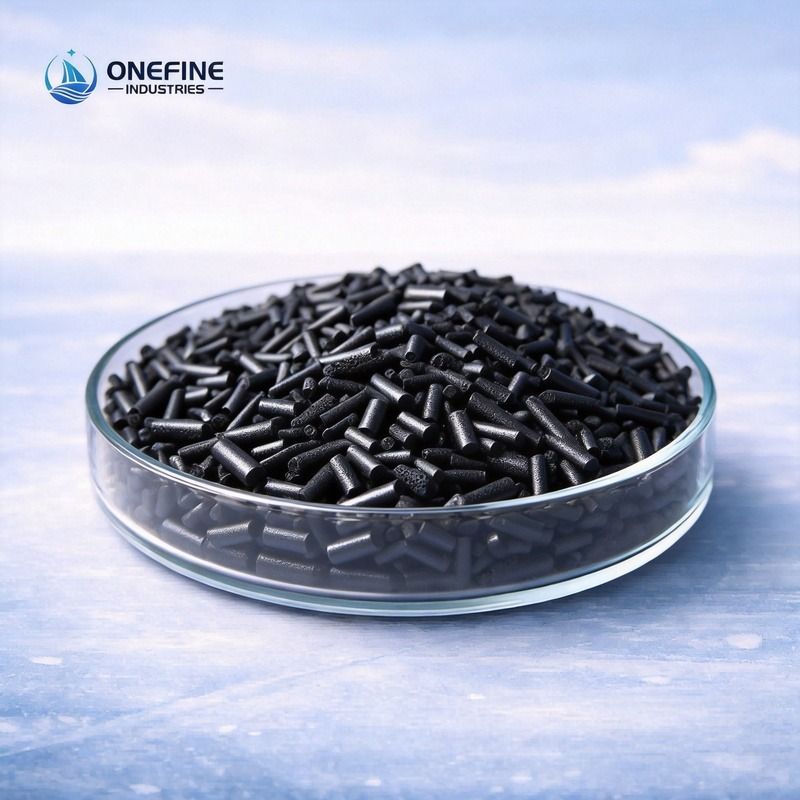
A CuO-ZnO adsorbent designed for the removal of CO from polymer-grade propylene feedstock, while also removing trace amounts of O₂, H₂S, COS, AsH₃, PH₃, and other impurities. Prepared by co-precipitation method with uniformly dispersed active components. Features high selectivity, high activity, excellent mechanical strength, large capacity, and easy operation. Protects polymerization catalysts from poisoning and ensures stable polypropylene production.
Related Reading
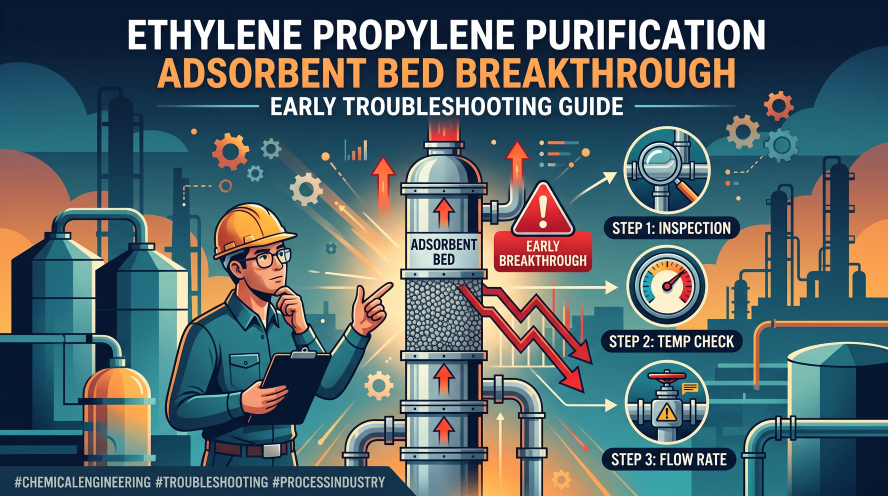
Why Is Your Ethylene/Propylene Purification Adsorbent Bed Breaking Through Early? Troubleshooting Guide
Early breakthrough in a CuO-ZnO ethylene/propylene purification bed is rarely just "the media is used up." This guide breaks down four distinct failure mechanisms — sulfate formation, moisture overload, copper sintering, and COS slip — and how to tell which one is driving your early breakthrough.
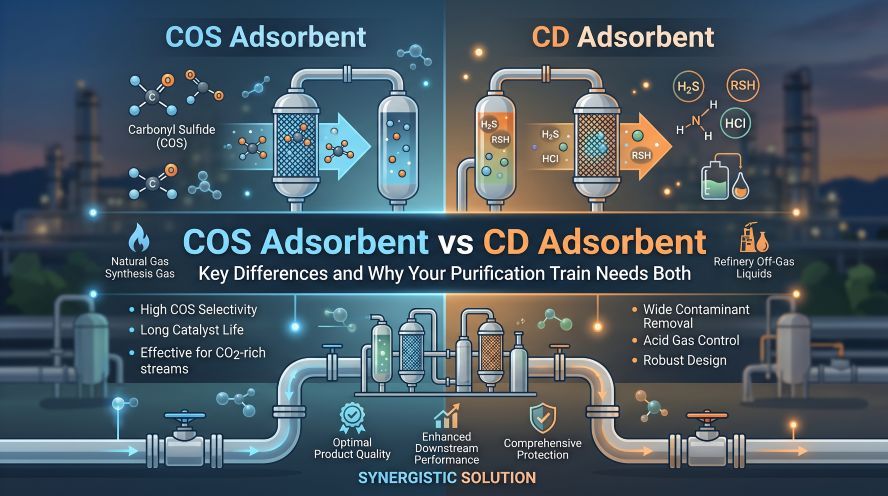
COS Adsorbent vs CD Adsorbent: Key Differences and Why Your Purification Train Needs Both
COS Adsorbent and CD Adsorbent are often mentioned together but aren't interchangeable — they're sequential stages in the same purification train, not competing alternatives. This guide explains what each product removes, why the sequence matters, and why "which one should I buy" is the wrong question to ask.