4A Molecular Sieve for Natural Gas: How Combined Dehydration and Impurity Removal Works
Key Takeaways
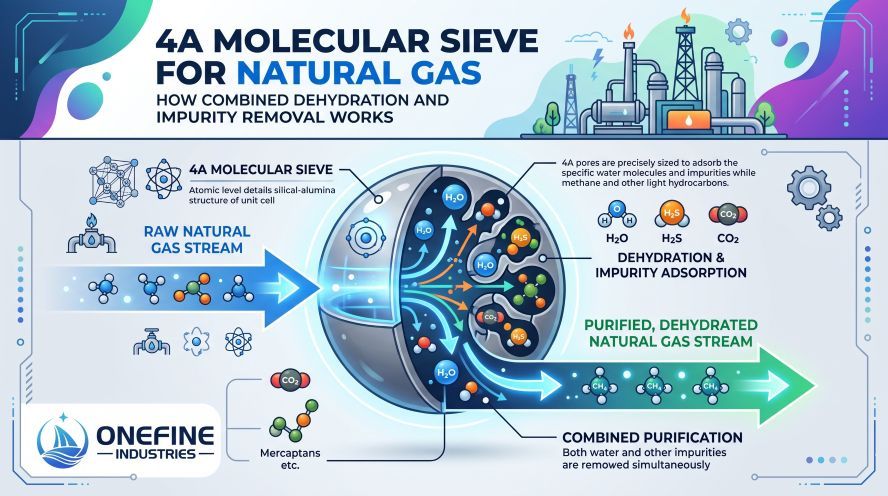
- The ~4Å pore diameter of 4A molecular sieve allows it to simultaneously co-adsorb water, CO₂, and H₂S from natural gas streams.
- It reliably pushes moisture content down to the extremely low dew points required to prevent freezing in downstream cryogenic and LNG equipment.
- While 3A is used to strictly exclude hydrocarbons during dehydration, 4A serves as a practical single-stage solution when simultaneous dehydration and moderate acid-gas polishing are needed.
Natural gas straight from the wellhead rarely meets pipeline or LNG feed specs on its own. Beyond free water and water vapor, raw gas streams commonly carry CO₂ and H₂S that must be brought down to strict limits before the gas can be transported, liquefied, or processed downstream. Operators increasingly turn to 4A molecular sieve because it handles both jobs — drying and acid-gas polishing — in a single adsorption bed, instead of running separate units for each contaminant. This article explains how 4A's pore structure enables that dual function, where it fits in a natural gas treatment train, and when it makes more sense than the narrower selectivity of 3A. For the fuller picture of molecular sieve across the whole natural gas treatment train, see Sorbsieve's Molecular Sieve in Natural Gas Applications: Case Analysis for Dehydration, CO2 Removal, and LNG Pre-Treatment guide.
Why 4A Handles More Than Water
3A and 4A molecular sieve are both sodium-based Type A zeolites, but their pore diameters set very different limits on what they can adsorb. 3A's ~3Å pore excludes almost everything except water molecules, which is exactly why it is the standard choice ahead of ethylene or propylene cracking furnaces — it dries the gas without touching the hydrocarbon molecules around it.
4A's larger ~4Å pore opens the door to more than water. Alongside H₂O, it can also adsorb CO₂, H₂S, and other small polar or gas molecules such as ammonia and short-chain alcohols, depending on stream composition and operating conditions. For a natural gas stream where dehydration and acid-gas trimming are both required — and where excluding hydrocarbons molecule-by-molecule is not the priority — 4A's broader capture window lets one bed do work that would otherwise take two adsorption stages. For the full breakdown of 4A's structure and specifications, see Sorbsieve's companion guide, What is 4A Molecular Sieve? Uses, Specifications & How It Works.
Dehydration: The Baseline Function
Removing water is still 4A's primary and most consistent job in gas processing. Downstream cryogenic units and LNG trains are unforgiving of residual moisture — even trace water content can form hydrates or ice at the very low temperatures involved, which can plug valves, foul heat exchangers, and force unplanned shutdowns. Molecular sieve dehydration is what allows gas processors to push moisture content down to the extremely low dew points cryogenic and liquefaction equipment demands, a level of dryness that glycol systems alone cannot reliably reach.
4A is widely used as the general-purpose workhorse for this dehydration step in standard natural gas processing. It offers strong water capacity, efficient mass transfer, and solid hydrothermal stability across repeated adsorption-regeneration cycles, and it typically regenerates at temperatures that support shorter cycle times than some alternative desiccants — a practical advantage for high-throughput gas plants where equipment footprint and cycle economics matter.
Impurity Removal: CO₂ and H₂S Alongside Water
Where 4A distinguishes itself from 3A is in what happens alongside dehydration. Because its pore size does not screen out CO₂ and H₂S the way 3A's tighter pore does, a 4A bed sized and operated for this purpose can pull measurable levels of these acid gases out of the stream at the same time it dries it.
This matters most in gas streams where CO₂ and H₂S are present but not so concentrated that they need a dedicated amine or scrubbing unit upstream. In those cases, a combined 4A dehydration/polishing bed can serve as a practical single-stage solution rather than adding a second treatment system purely to trim residual acid gas. It is a polishing role, not a substitute for primary sweetening on genuinely sour gas — but for moderate contaminant loads, it meaningfully simplifies the treatment train.
Where This Fits in the Gas Treatment Train
A typical placement is downstream of bulk liquid knockout and any primary sweetening step (where the gas is genuinely sour), and upstream of cryogenic NGL recovery or LNG liquefaction, where both moisture and residual acid gas specs are tightest. In gathering and pipeline-quality gas applications where acid gas levels are already moderate, a 4A bed can be the sole polishing step before the gas moves on.
Regeneration follows the same thermal-swing principle used across molecular sieve systems: hot regeneration gas drives off the adsorbed water, CO₂, and H₂S, restoring the bed's capacity for the next cycle. Because 4A is handling more than one adsorbate, operators typically monitor breakthrough on whichever contaminant is tightest to spec for that stream, since it will usually set the practical cycle length.
4A vs 3A: Making the Right Call for Your Gas Stream
The choice between 3A and 4A for a given natural gas application comes down to what else is in the stream and what happens to it downstream. See Sorbsieve's 3A vs 4A Molecular Sieve: Key Differences & How to Choose for a fuller side-by-side comparison.
- Choose 3A when the gas feeds directly into an ethylene, propylene, or other olefin cracking process, or any application where even minor co-adsorption of hydrocarbons would cause yield loss or side reactions — 3A's tight pore protects those hydrocarbons by simply excluding them. (already linked above)
- Choose 4A when the priority is dehydration plus moderate CO₂/H₂S polishing in one bed, and hydrocarbon exclusion is not the deciding factor — typical of general gathering, pipeline, and LNG pre-treatment applications where cost-effective, high-throughput processing matters more than single-molecule selectivity.
Some plants run both grades in different parts of the same facility, matching each sieve to the specific stream it treats rather than standardizing on one grade across the board.
Recommended Products from Sorbsieve
For natural gas dehydration and impurity removal applications, Sorbsieve supplies:
- 4A Molecular Sieve — general-purpose drying with CO₂/H₂S co-adsorption capability (already linked above)
- 3A Molecular Sieve — for applications requiring strict hydrocarbon exclusion alongside dehydration (already linked above)
FAQ
Does 4A molecular sieve remove all the H₂S and CO₂ from natural gas? No. 4A works well as a polishing step for moderate acid-gas loads alongside dehydration, but it is not a substitute for primary amine sweetening on genuinely sour gas with high H₂S/CO₂ concentrations. Stream composition should be assessed to determine whether 4A alone is sufficient or whether upstream sweetening is required first.
Can I use 4A instead of 3A for gas going into a cryogenic ethylene plant? Generally not recommended. 3A's tighter pore excludes hydrocarbons that 4A's larger pore can co-adsorb, which risks hydrocarbon loss and side reactions in olefin-sensitive applications. 3A remains the standard choice for that specific use case.
How often does a 4A bed need regeneration in natural gas service? Cycle length depends on the specific contaminant loads, gas flow rate, and which adsorbate (water, CO₂, or H₂S) reaches its breakthrough point first for that stream — it varies by installation rather than following a single fixed number.
Is 4A molecular sieve suitable for LNG pre-treatment? Yes, 4A is commonly used ahead of LNG liquefaction for combined dehydration and light acid-gas polishing, helping the gas meet the strict moisture specs cryogenic equipment requires before it reaches deeper CO₂ removal and liquefaction stages.
Looking for Bulk Supply of 4A Molecular Sieve?
Sorbsieve is a trusted bulk supplier of 4A Molecular Sieve and complete industrial adsorbents, serving industrial buyers across the Middle East.
We provide:
- ✅ Container-level supply (20'GP / 40'GP / 40'HQ)
- ✅ Full documentation (COA / TDS / SDS / COO)
- ✅ Multiple packaging options
- ✅ Technical support for 4A molecular sieve selection and system optimization
- ✅ Fast quote response for industrial inquiries
Contact our team for bulk pricing, product samples, and technical consultation.
Related Products
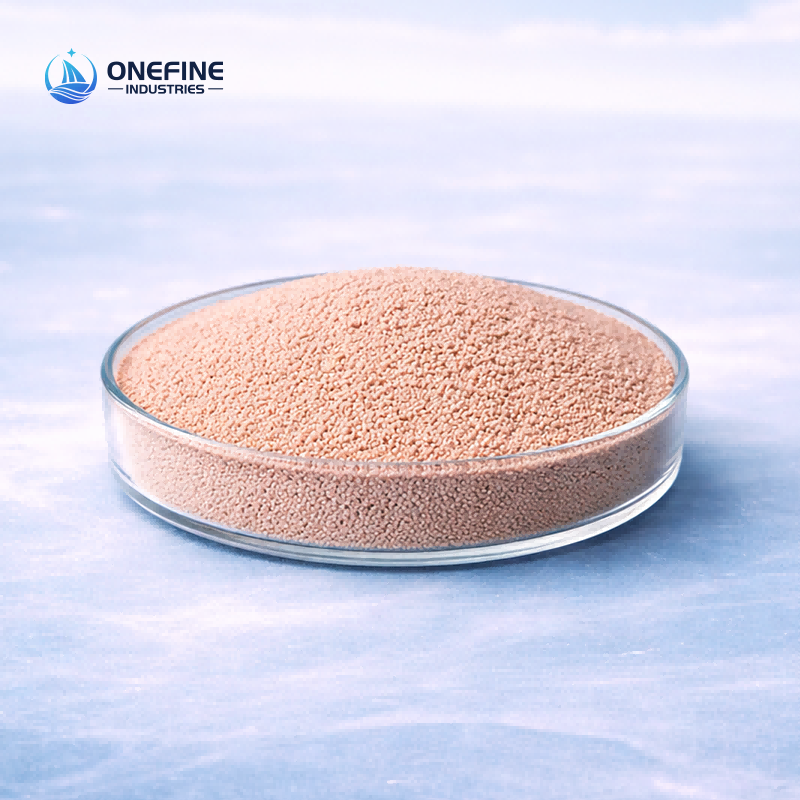
3A Molecular Sieve
High-efficiency 3A molecular sieve desiccant for ultra-deep industrial dehydration. Available in beads and pellets, 2-3 year service life with proper regeneration.
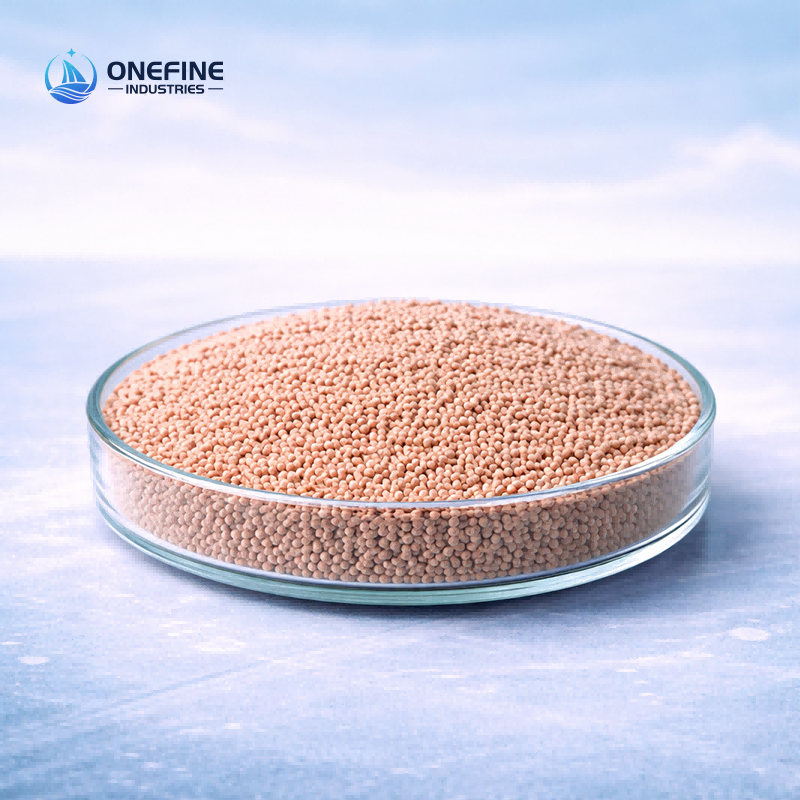
4A Molecular Sieve
General-purpose 4A molecular sieve desiccant for industrial air drying, solvent dehydration, CO2 removal, and static packaging applications. High capacity, long service life.
Related Reading
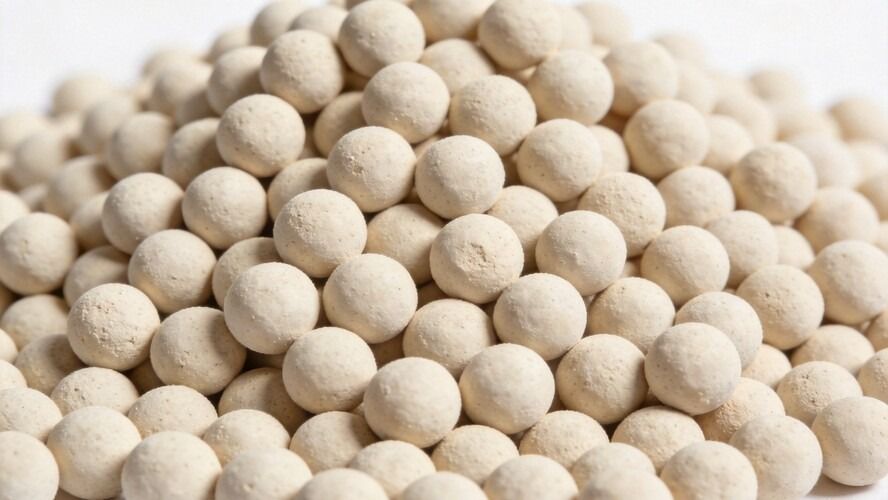
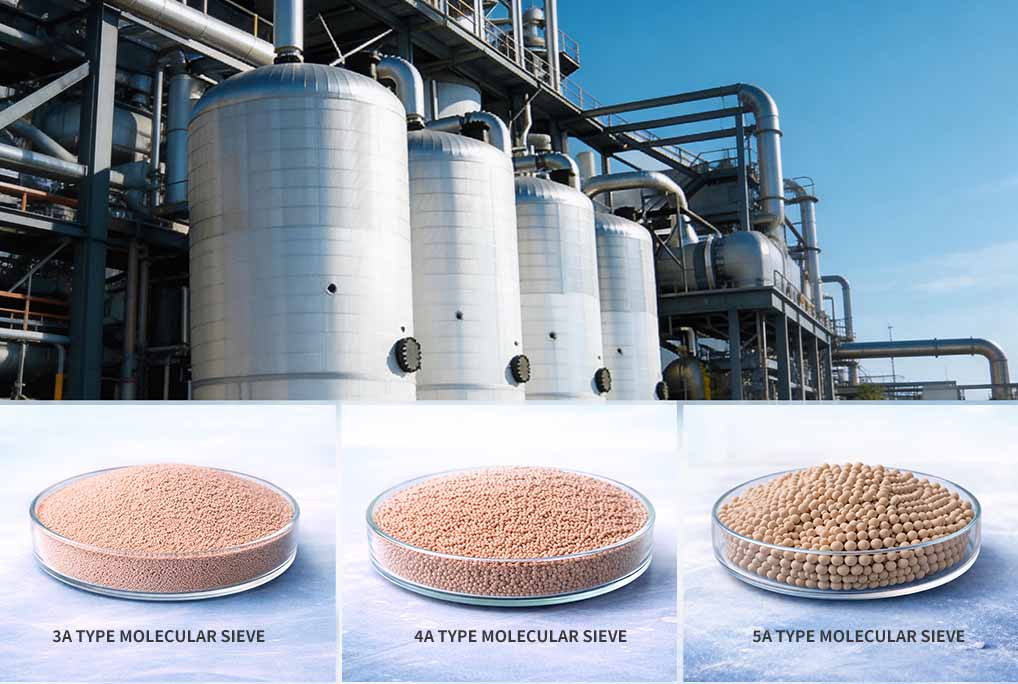
What is 4A Molecular Sieve? Uses, Specifications & How It Works
Everything you need to know about 4A molecular sieve: how it works, its 4Å pore size, physical adsorption process, and main industrial applications like air drying and CO2 removal.
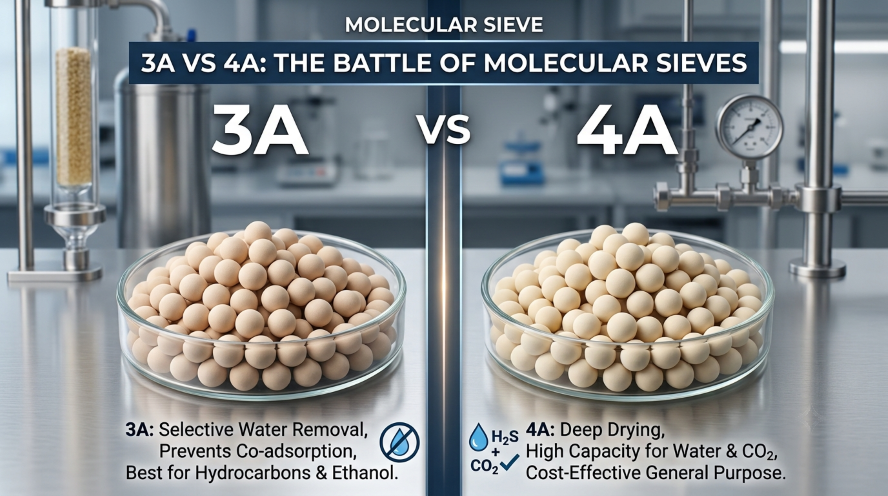
3A vs 4A Molecular Sieve: Key Differences & How to Choose
In-depth guide comparing 3A and 4A molecular sieves. Covers pore size differences, adsorption selectivity, capacity comparison, application scenarios for each type, and practical guidance on selecting the right molecular sieve for your industrial drying or gas separation needs.
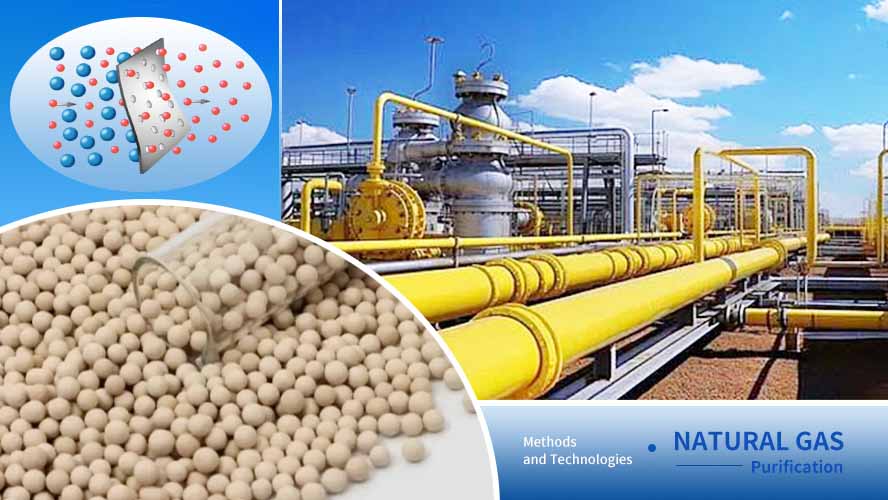
Molecular Sieve in Natural Gas Applications: Case Analysis for Dehydration, CO2 Removal, and LNG Pre-Treatment
Molecular sieve is a critical adsorbent in natural gas processing — removing water, CO2, and H2S to meet pipeline and LNG specifications. This case analysis walks through a layered 4A/13X system for a midstream gas processing facility.