Do You Need Both High and Low Temperature Shift Catalysts, or Just One?
Key Takeaways
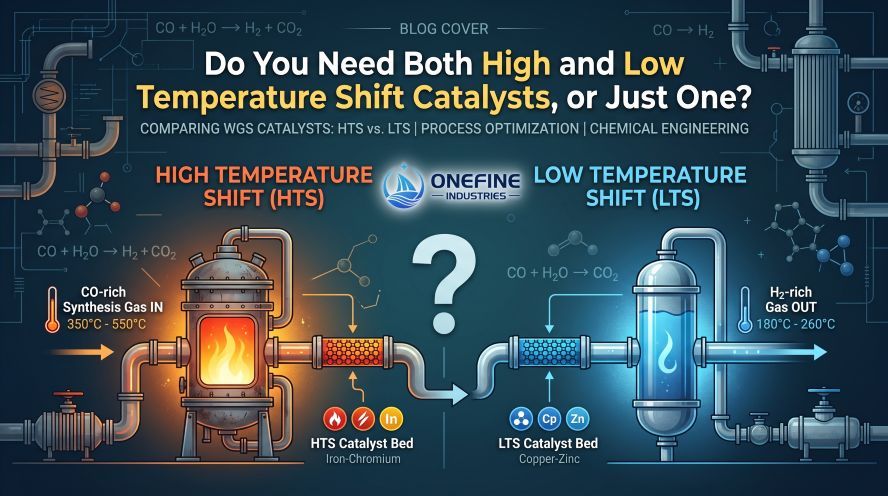
- High-Temperature Shift (HTS) does the bulk of CO conversion but is limited by reaction equilibrium at higher operating temperatures.
- Low-Temperature Shift (LTS) polishes residual CO down further, but is highly sensitive to feed poisons like sulfur and chloride.
- Downstream processes with tight CO specifications, such as ammonia and methanol synthesis loops, typically require a two-stage HTS and LTS configuration.
- PSA-based hydrogen production plants often run HTS only, as the PSA unit rejects unconverted CO directly into the purge gas stream.
If you're specifying a water-gas shift section for a syngas, hydrogen, ammonia, or methanol plant, this is usually the first configuration question: does the process need a High-Temperature Shift (HTS) stage, a Low-Temperature Shift (LTS) stage, or both in series? The short answer is that it depends entirely on how much CO your downstream process can tolerate — not on which catalyst performs "better."
What Each Stage Actually Does
HTS and LTS are not competing options. They are two steps in the same reaction, run at different temperatures because the water-gas shift reaction (CO + H₂O → CO₂ + H₂) is thermodynamically favored at lower temperatures but kinetically faster at higher ones.
- HTS Fe-Cr Series runs at higher inlet temperatures and does the bulk of the conversion work. It brings CO down quickly and tolerates a wider range of feed impurities, but the higher operating temperature means the reaction equilibrium limits how far conversion can go.
- LTS Cu-Zn-Al Series runs at lower temperatures and picks up where HTS leaves off, driving residual CO down further than HTS can reach on its own. It is more sensitive to feed conditions (sulfur, chloride) and typically sits downstream of a protective bed.
Neither stage is designed to do the other's job efficiently — that's the whole reason two-stage systems exist. For a deeper look at how each stage works, see our guides to HTS chemistry explained and LTS chemistry explained.
When You Need Both Stages
A two-stage HTS + LTS configuration is the standard choice whenever the downstream process has a low tolerance for residual CO:
- Ammonia synthesis — the ammonia synthesis catalyst is sensitive to CO poisoning, so feed gas typically needs shift conversion carried as far as practical before methanation and final purification.
- Methanol synthesis — CO is actually a reactant here, but the shift section still needs to hit a specific H₂:CO ratio, which usually calls for both stages to fine-tune the gas composition precisely.
- Any process with a tight CO specification downstream — if the next unit (whether a catalyst bed, a membrane, or a cryogenic separation step) is CO-sensitive, running only HTS will typically leave too much CO in the gas.
In these cases, HTS and LTS work as a matched pair: HTS handles the bulk reduction, LTS polishes the gas to the level the rest of the plant actually needs.
When a Single Stage May Be Enough
Some configurations only need HTS:
- Hydrogen production ahead of a PSA (Pressure Swing Adsorption) unit — PSA systems reject the unconverted CO (along with CO₂, CH₄, and N₂) into the purge/tail gas stream rather than passing it through to the product hydrogen. Because the PSA is doing the final purification work, many hydrogen plants run HTS only and let the PSA handle the rest, skipping the extra capital and pressure drop of an LTS bed.
- Processes where CO removal happens by another route — if methanation, a wash system, or another downstream unit is already designed to take out residual CO, adding LTS ahead of it can be redundant.
The decision comes down to whether the value of driving CO lower with LTS is worth the added catalyst volume, pressure drop, and capital cost for your specific flowsheet.
Questions to Ask Before You Decide
Before finalizing a shift configuration, it's worth confirming:
- What CO level does your downstream unit actually require? A PSA-based hydrogen train has very different tolerances than an ammonia synthesis loop.
- What's your feed gas composition and steam-to-gas ratio? These affect how much conversion HTS alone can achieve before hitting equilibrium limits.
- Is there sulfur or chloride in the feed that could affect LTS catalyst life? LTS catalysts are generally more sensitive to poisons than HTS, which affects protective bed design either way.
- What's the cost trade-off between an extra reactor stage and the CO reduction it buys you? Sometimes the answer is genuinely "just HTS" — it isn't always the two-stage default.
If you're not sure which configuration fits your process, sharing your feed gas composition and downstream requirements with a technical team is usually the fastest way to get a straight answer rather than guessing from general rules of thumb.
Recommended Products from Sorbsieve
- Shift Catalyst (Fe-Cr Series) — High-Temperature Shift catalyst for bulk CO conversion (already linked above)
- Low Temperature Shift Catalyst (Cu-Zn-Al Series) — CO polishing catalyst for deep conversion (already linked above)
FAQ
Can you run LTS without HTS first? It's uncommon. LTS catalysts operate at lower temperatures and are generally not designed to handle high inlet CO concentrations efficiently or safely — running LTS alone against a high-CO feed can shorten catalyst life and reduce conversion efficiency. HTS is normally the first stage precisely because it's built to handle the bulk conversion load.
Does skipping LTS save meaningful cost? It removes one reactor's worth of catalyst, vessel, and pressure drop, which is a real saving on capital and operating cost. Whether that saving makes sense depends entirely on whether your downstream process needs the extra CO reduction LTS provides.
Do HTS and LTS need the same upstream protection? Both benefit from upstream desulfurization, but LTS catalysts are typically more sensitive to sulfur and chloride poisoning, so protective guard beds are especially important ahead of an LTS stage.
Can an existing single-stage HTS system be upgraded to two-stage later? This depends on the reactor design and available space/pressure drop margin in the existing system — it's a plant-specific engineering question rather than a general yes/no.
Looking for Bulk Supply of Shift Catalysts?
Sorbsieve is a trusted bulk supplier of High and Low Temperature Shift Catalysts and complete industrial adsorbents, serving industrial buyers across the Middle East.
We provide:
- ✅ Container-level supply (20'GP / 40'GP / 40'HQ)
- ✅ Full documentation (COA / TDS / SDS / COO)
- ✅ Multiple packaging options
- ✅ Technical support for shift catalyst configuration and system optimization
- ✅ Fast quote response for industrial inquiries
Contact our team for bulk pricing, product samples, and technical consultation.
Related Products
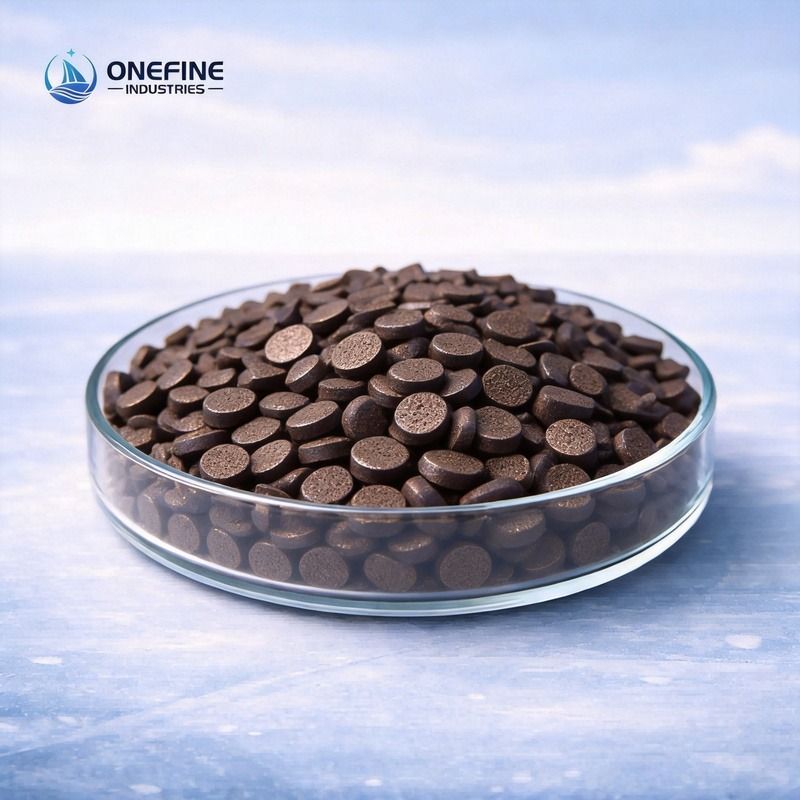
Shift Catalyst (Fe-Cr Series)
Fifth-generation iron-chromium water-gas shift catalyst manufactured via co-precipitation from nitrate precursors, delivering high CO conversion activity, low sulfur content, excellent mechanical strength, and extended service life for hydrogen production, syngas, ammonia synthesis, and methanol synthesis processes.
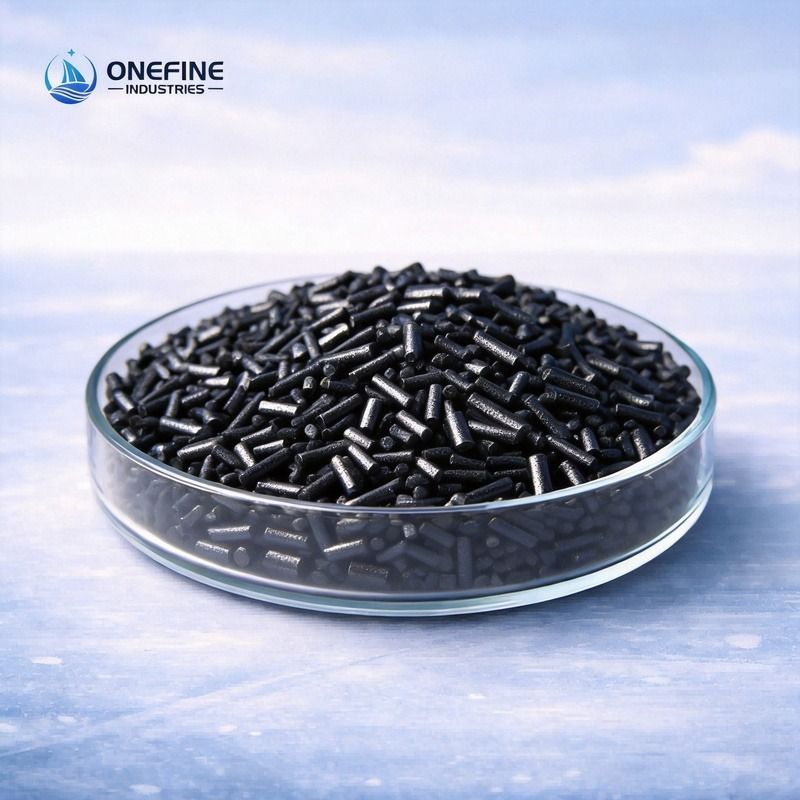
Low Temperature Shift Catalyst (Cu-Zn-Al Series)
Co-precipitation copper-zinc-aluminum low temperature shift (LTS) catalyst delivering exceptional CO conversion at 180–250 °C, with superior low-temperature activity, high mechanical strength, and excellent sulfur tolerance for hydrogen production, syngas, ammonia synthesis, and methanol synthesis processes.
Related Reading
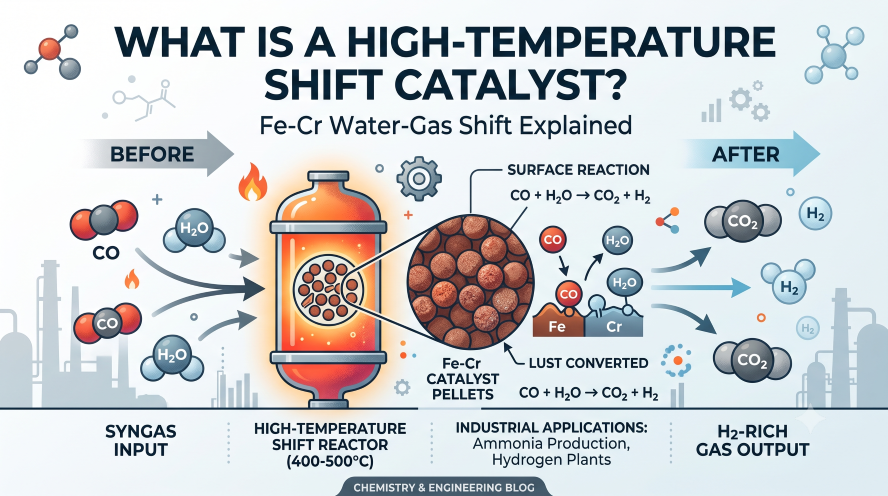
What Is a High-Temperature Shift Catalyst? Fe-Cr Water-Gas Shift Explained
A practical guide to how Fe-Cr high-temperature shift catalysts work, why they're built the way they are, and how HTS fits alongside LTS in a complete shift train.
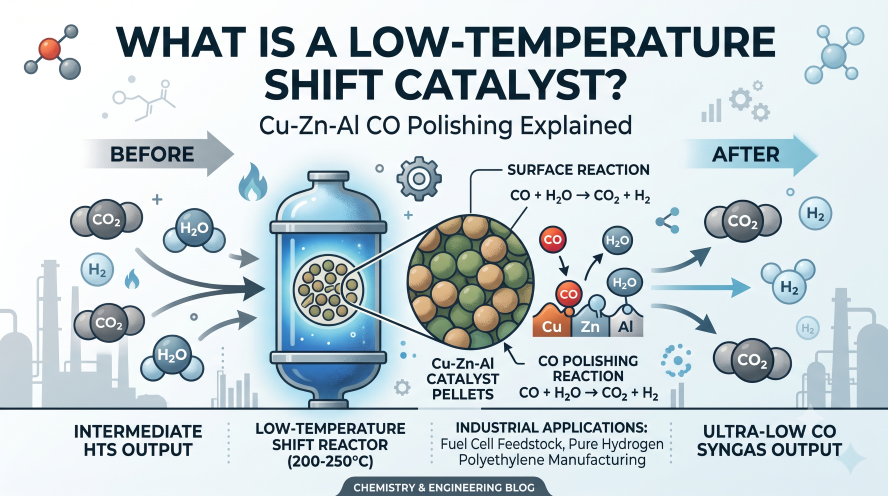
What Is a Low Temperature Shift Catalyst? Cu-Zn-Al CO Polishing Explained
A practical guide to how Cu-Zn-Al low temperature shift catalysts work, why sulfur protection is critical, and how LTS completes a two-stage shift train.