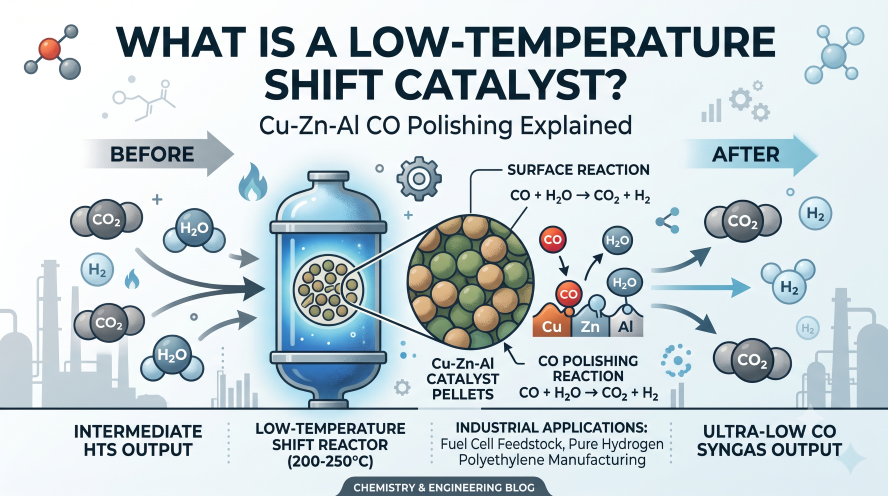
What Is a High-Temperature Shift Catalyst? Fe-Cr Water-Gas Shift Explained
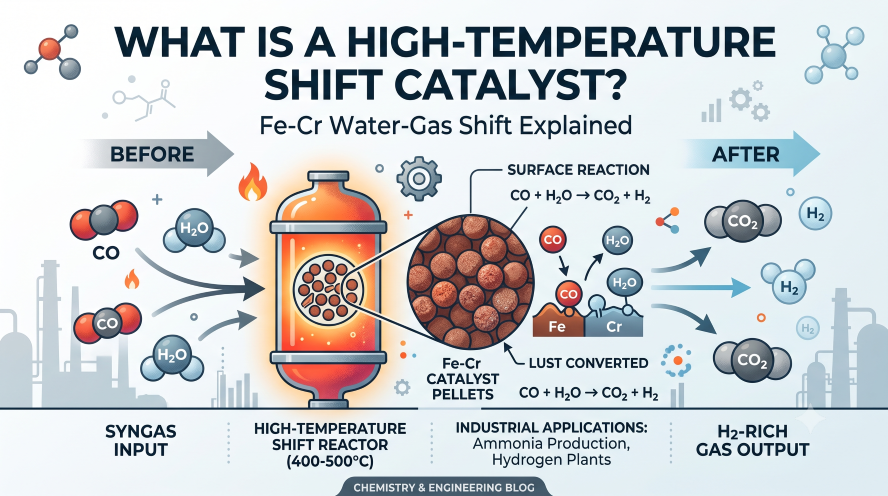
Buyers sourcing catalysts for hydrogen, ammonia, or methanol plants often run into the term "shift catalyst" without a clear picture of what it actually does or why the iron-chromium (Fe-Cr) type is still the industry default for the high-temperature stage. This guide breaks down how Fe-Cr shift catalysts work, why the chemistry is built the way it is, and how this stage fits into a complete CO conversion train. For full specifications, see our Shift Catalyst (Fe-Cr Series) product page.
What Is a High-Temperature Shift Catalyst?
Key Takeaways:
- A high-temperature shift (HTS) catalyst promotes the water-gas shift reaction (CO + H₂O ⇌ CO₂ + H₂) at 300–520 °C, converting the bulk of feed-gas CO — typically 60–75% of the total load — before a low-temperature stage polishes the remainder.
- Fe-Cr chemistry is chosen for this stage because it tolerates the heat and moderate sulfur levels that would degrade a copper-based catalyst.
A high-temperature shift (HTS) catalyst is the first-stage catalyst in a water-gas shift conversion train, positioned immediately after reforming or gasification. Its job is to convert carbon monoxide and steam into carbon dioxide and additional hydrogen — a reaction that is both exothermic and equilibrium-limited, which is exactly why plants split the conversion into two temperature stages rather than trying to do it in one pass.
At the high end of the temperature range, reaction kinetics are fast, so the HTS stage can process a large gas volume quickly and remove most of the CO in a relatively compact reactor. The trade-off is that equilibrium at high temperature doesn't favor complete conversion, which is why a second, lower-temperature stage is needed downstream to finish the job.
How Fe-Cr Catalysts Drive the Water-Gas Shift Reaction
Iron-chromium shift catalysts are built around an Fe₃O₄ (magnetite) active phase, with Fe₂O₃ typically making up 75% or more of the formulation by weight. Chromium oxide (Cr₂O₃) doesn't participate directly in the shift chemistry — its role is structural. It anchors the Fe₃O₄ crystallite boundaries and slows grain growth at high temperature, which is what keeps the catalyst's active surface area from collapsing over years of continuous operation.
Modern fifth-generation formulations, manufactured by co-precipitation from nitrate precursors, add structural, electronic, and activity promoters on top of the base Fe-Cr system. These promoters do two things worth understanding if you're comparing suppliers: they open up the pore structure so gas molecules can reach active sites more easily, and they suppress Fischer-Tropsch side reactions that would otherwise consume CO and hydrogen to form unwanted hydrocarbons at low steam-to-gas ratios. A catalyst that manages this well lets a plant run with less steam injection — which translates directly into lower energy costs.
Why Iron-Chromium Chemistry Works for High-Temperature Service
Copper-based catalysts, which dominate the low-temperature shift stage, simply can't survive at 300–520 °C — copper sinters and loses surface area rapidly above roughly 300 °C. Iron-chromium chemistry, by contrast, is thermally robust and also tolerates moderate sulfur exposure in the feed gas, which matters because feed gas desulfurization is never perfectly complete in real plant operation.
This sulfur tolerance is one of the most practical reasons Fe-Cr remains the standard choice for HTS duty rather than trying to push a more sulfur-sensitive chemistry into that position. That said, tolerance isn't immunity — feed gas is still typically desulfurized upstream using a hydrodesulfurization catalyst and a zinc oxide guard bed, both to protect the shift train generally and to keep sulfur breakthrough from reaching the more sensitive low-temperature stage downstream.
HTS vs LTS: Where Each Stage Fits in a Shift Train
A complete water-gas shift system almost always runs two catalyst beds in series, not because it's more complex than necessary, but because no single catalyst chemistry performs well across the whole temperature and conversion range required.
The HTS bed handles the bulk conversion — bringing CO from roughly 10–15% down to 3–5% — operating where kinetics are fast even though equilibrium conversion is incomplete. The gas then cools before entering the low-temperature shift (LTS) bed, typically Cu-Zn-Al based, which operates at 180–250 °C where equilibrium strongly favors near-complete conversion, polishing residual CO down to 0.2–0.5% or lower depending on the downstream requirement.
Understanding this division matters when you're specifying catalyst for a new build or a reactor revamp: ordering only an HTS catalyst without accounting for the LTS stage — or vice versa — leaves the shift train unable to hit target CO specifications.
Choosing the Right HTS Catalyst for Your Plant
For buyers evaluating suppliers, the practical checkpoints are: confirmed Fe₂O₃/Cr₂O₃ content within spec, mechanical crush strength adequate for your bed depth and reactor design, documented sulfur tolerance appropriate to your feed gas quality, and a manufacturing process (co-precipitation vs. impregnation) that supports consistent batch-to-batch performance. Pellet size and shape should also match your existing reactor internals unless you're designing a new unit, in which case there's more flexibility to optimize for pressure drop.
Recommended Products from Sorbsieve
For a complete shift conversion train, pair this catalyst with our Low Temperature Shift Catalyst (Cu-Zn-Al Series), the second-stage catalyst that polishes residual CO after HTS conversion. For technical background on that stage, see our companion guide, What Is a Low Temperature Shift Catalyst?
FAQ
Why can't a single catalyst handle the entire water-gas shift conversion?
No single catalyst chemistry performs well across the full temperature and equilibrium range needed. High temperature gives fast kinetics but incomplete equilibrium conversion; low temperature gives near-complete equilibrium conversion but is only practical with copper-based catalysts that can't survive high-temperature conditions. Splitting the reaction into two stages lets each catalyst operate in its optimal window.
How much does feed gas composition affect HTS catalyst performance?
Feed gas steam-to-gas ratio, CO concentration, and residual sulfur level all affect HTS performance and lifetime. Higher steam ratios push conversion further but cost more energy; lower ratios save energy but risk Fischer-Tropsch side reactions unless the catalyst formulation specifically suppresses them. Sulfur breakthrough, even within the catalyst's tolerance range, gradually affects activity over time.
Is HTS catalyst reusable or regenerable after deactivation?
Fe-Cr shift catalysts are not typically regenerated once deactivated by sintering or sulfur poisoning beyond tolerance — they are replaced at the end of their service life, generally every 2–3 years under standard operation. Some activity recovery is possible from mild, reversible poisoning, but replacement is the standard industry approach for end-of-life catalyst.
What happens if HTS and LTS catalysts are sourced from different suppliers?
This is common practice and generally not a problem, provided both catalysts are sized and specified correctly for your reactor conditions and gas composition. What matters most is that the two stages are engineered together as a system — matching conversion targets, pressure drop, and temperature profile — rather than the catalysts sharing a single supplier.
Looking for Bulk Supply of Fe-Cr Shift Catalyst?
Sorbsieve is a trusted bulk supplier of Fe-Cr Shift Catalyst and complete industrial catalysts, serving industrial buyers across the Middle East.
We provide:
- ✅ Container-level supply (20'GP / 40'GP / 40'HQ)
- ✅ Full documentation (COA / TDS / SDS / COO)
- ✅ Multiple packaging options
- ✅ Technical support for shift catalyst selection and system optimization
- ✅ Fast quote response for industrial inquiries
Contact our team for bulk pricing, product samples, and technical consultation.
Related Products
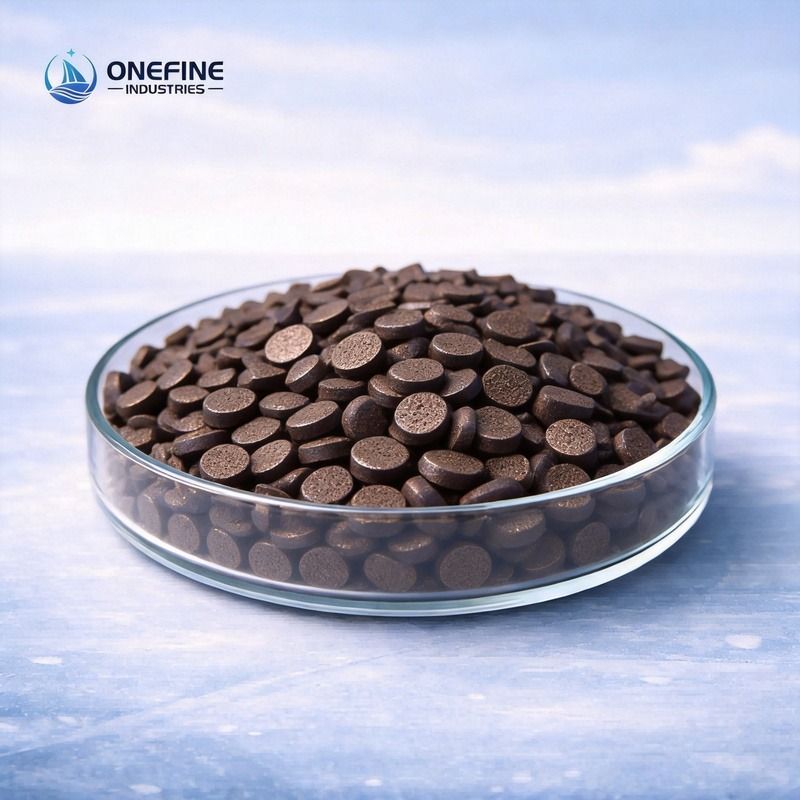
Shift Catalyst (Fe-Cr Series)
Fifth-generation iron-chromium water-gas shift catalyst manufactured via co-precipitation from nitrate precursors, delivering high CO conversion activity, low sulfur content, excellent mechanical strength, and extended service life for hydrogen production, syngas, ammonia synthesis, and methanol synthesis processes.
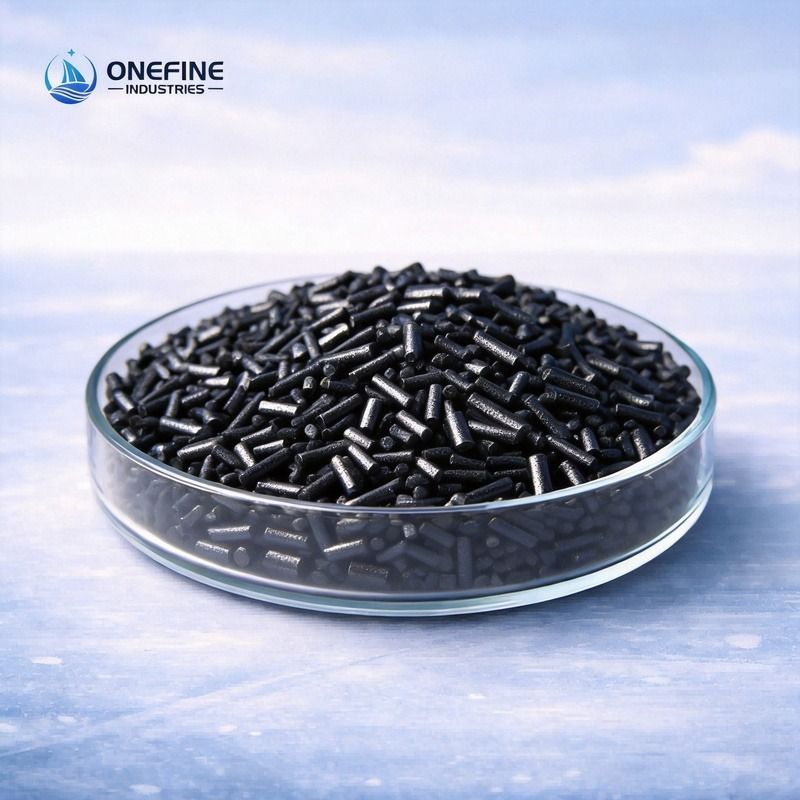
Low Temperature Shift Catalyst (Cu-Zn-Al Series)
Co-precipitation copper-zinc-aluminum low temperature shift (LTS) catalyst delivering exceptional CO conversion at 180–250 °C, with superior low-temperature activity, high mechanical strength, and excellent sulfur tolerance for hydrogen production, syngas, ammonia synthesis, and methanol synthesis processes.