How Do You Know When to Replace an Ultra-Precision Desulfurization Catalyst?

Key Takeaways
- A falling COS conversion rate is the primary warning sign for bifunctional beds, often occurring before total H₂S breaks through.
- A gradual, sustained upward trend in total outlet sulfur indicates the overall adsorption capacity of the bed is nearing exhaustion.
- Increasing pressure drop signals physical degradation like particle attrition or channeling, requiring mechanical bed inspection.
- Unexplained activity loss in downstream sulfur-sensitive catalysts is a lagging indicator that the guard bed has already failed.
An Ultra-Precision Desulfurization Catalyst is built to do two jobs in one bed: hydrolyze carbonyl sulfide (COS) into H₂S, then adsorb that H₂S in the same pass. That bifunctional design is exactly why replacement timing catches people off guard — a bed can still look fine on a simple outlet-H₂S check while the hydrolysis side is already losing ground. This guide walks through the warning signs that actually matter, in the order most plants can check them, so you're not guessing between a routine regeneration and a full reload.
Why Replacement Timing Is Trickier for a Bifunctional Bed
A single-function adsorbent (plain ZnO, for example) gives you one number to watch: outlet H₂S. Once it climbs, you're near the end of the bed's life, full stop.
An Ultra-Precision catalyst has two mechanisms aging at different rates. The hydrolysis catalyst component can lose activity from moisture swings, chloride exposure, or thermal excursions well before the adsorption capacity is exhausted — and when that happens, unconverted COS starts slipping through even though total H₂S at the outlet still looks acceptable. Relying on a single sulfur reading can mean you catch the problem later than you think you will.
Warning Sign 1: Rising Total Sulfur at the Outlet
This is the baseline check, and it should never be skipped even though it's not the whole picture. Track outlet total sulfur (H₂S + any residual COS) against your process's tolerance threshold — for most feed-gas purification applications ahead of a sensitive downstream catalyst, that threshold sits at a sub-ppm level. A gradual, sustained upward trend — not a single spike — is the signal that the bed's remaining capacity is narrowing. Log it on a rolling basis rather than spot-checking occasionally; slow creep is easy to miss if you're only sampling once a month.
Warning Sign 2: COS Conversion Falls Before H₂S Ever Breaks Through
This is the sign that's specific to bifunctional systems and the one plants most often miss. If you have the analytical capability to separate COS from H₂S in your outlet gas (rather than reading "total sulfur" as one number), watch the COS conversion rate on its own. A falling conversion rate — even while total outlet sulfur is still within spec — tells you the hydrolysis function is degrading faster than the adsorption function. Left unaddressed, this gap widens until COS slip becomes the dominant contributor to total sulfur, and by then you're much closer to a full breakthrough than the H₂S number alone would suggest.
Warning Sign 3: Increasing Pressure Drop Across the Bed
Pressure drop climbing above your normal operating baseline points to a physical issue rather than a chemical exhaustion issue: catalyst fines migrating and packing more tightly, condensation or liquid carryover wetting the bed, or particle attrition from repeated thermal or flow-rate cycling. A rising pressure drop doesn't necessarily mean the catalyst has lost desulfurization capacity, but it does mean the bed's mechanical condition needs inspection — and if the cause turns out to be attrition or channeling, replacement is often the only real fix, since it changes how the gas actually contacts the catalyst.
Warning Sign 4: Downstream Catalyst Starts Showing Sulfur Poisoning
If the ultra-precision bed is protecting a sulfur-sensitive downstream catalyst (a methanation, ammonia synthesis, or hydrogenation catalyst, for example), unexplained activity loss on that downstream catalyst is itself a lagging indicator that your guard bed is no longer holding the line. By the time this shows up, the guard bed has typically already been under-protecting for some time — which is why this sign works best as a cross-check against Signs 1 and 2, not as your primary monitoring method.
Building a Practical Monitoring Routine
None of these four signs should be read in isolation. A workable routine looks like:
- Continuous or frequent outlet total-sulfur monitoring as the first line of defense
- Periodic (not just reactive) COS-specific analysis, especially once the bed has passed the midpoint of its expected service life
- Regular pressure-drop logging against a documented clean-bed baseline
- Scheduled bed sampling at multiple depths to check for a moving sulfidation front, rather than waiting for an outlet excursion to prompt a look
When two or more of these signs move in the same direction at the same time, that's a stronger case for replacement than any single reading — and it's a more reliable basis for a shutdown decision than relying on a fixed calendar interval alone.
If your plant runs a traditional two-stage system instead of a bifunctional bed, the monitoring principle is the same but the signals are cleaner to separate — see our How Long Does a Zinc Oxide Desulfurization Catalyst Bed Last Before Breakthrough? guide for how to read breakthrough timing on that setup.
Recommended Products from Sorbsieve
If you're weighing a bifunctional one-step bed against a traditional two-stage setup, our Ultra-Precision Desulfurization Catalyst product page covers full specifications, and our companion guide, What Is an Ultra-Precision Desulfurization Catalyst? Bifunctional COS Hydrolysis Explained, explains how the hydrolysis-plus-adsorption mechanism works in more depth.
For plants running — or considering — a conventional two-stage approach instead, our Zinc Oxide Desulfurization Catalyst product page lays out how that separate hydrolysis-then-adsorption configuration compares on selection and lifecycle grounds.
FAQ
Can regeneration extend the life of an Ultra-Precision Desulfurization Catalyst, or is replacement the only option once signs appear? Regenerability depends on the specific formulation and the cause of the performance decline. Capacity exhaustion from normal sulfur loading is a different situation from activity loss due to poisoning or physical degradation, and the two don't always respond the same way to regeneration. Confirm with your supplier's technical team based on your actual operating history before assuming either path.
Is a rising pressure drop always a sign the catalyst needs replacing? Not necessarily — it's a sign the bed's mechanical condition needs inspection first. Sometimes the cause is upstream (liquid carryover, fines from a preceding vessel) rather than the catalyst itself. But if inspection confirms attrition or channeling within the bed, replacement is usually the practical fix.
How does replacement timing differ between a one-step bifunctional catalyst and a two-stage ZnO system? The monitoring logic differs more than the underlying chemistry does. A two-stage system gives you a cleaner, single-mechanism signal at each stage, while a one-step bifunctional bed requires watching both the hydrolysis and adsorption sides together, as covered above. Neither approach is inherently "better" — the right choice depends on your feed gas composition, available analytical capability, and footprint constraints.
What happens if I keep running past the point where I first notice a warning sign? The risk compounds rather than staying flat. Once COS slip or H₂S breakthrough begins, the concentration reaching downstream equipment tends to increase at an accelerating rate as the remaining active sites near exhaustion — which is why catching the gradual-rise stage matters more than catching the sudden-spike stage.
Looking for Bulk Supply of Ultra-Precision Desulfurization Catalyst?
Sorbsieve is a trusted bulk supplier of Ultra-Precision Desulfurization Catalyst and complete industrial adsorbents, serving industrial buyers across the Middle East.
We provide:
- ✅ Container-level supply (20'GP / 40'GP / 40'HQ)
- ✅ Full documentation (COA / TDS / SDS / COO)
- ✅ Multiple packaging options
- ✅ Technical support for catalyst selection and system optimization
- ✅ Fast quote response for industrial inquiries
Contact our team for bulk pricing, product samples, and technical consultation.
Related Products
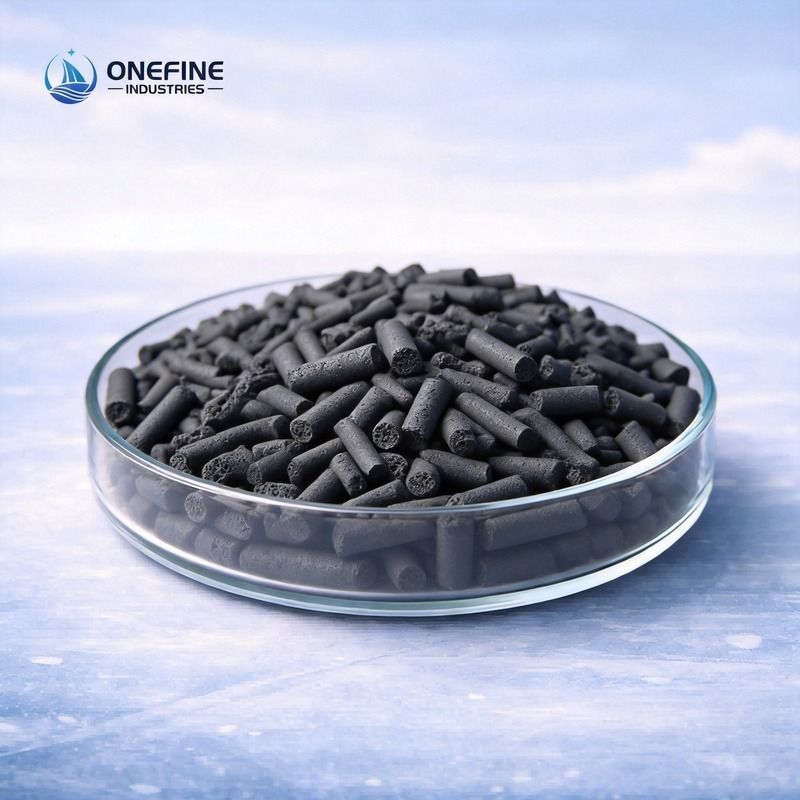
Ultra-precision Desulfurization Catalyst
A bifunctional desulfurization catalyst that couples COS hydrolysis and H₂S adsorption in a single reactor, achieving ultra-deep sulfur removal in one step. Effectively removes H₂S, COS, and trace RSH from process gases. Features high surface area, fast reaction kinetics, and broad operating range. Ideal for final purification of synthesis gas, natural gas, and light hydrocarbons.
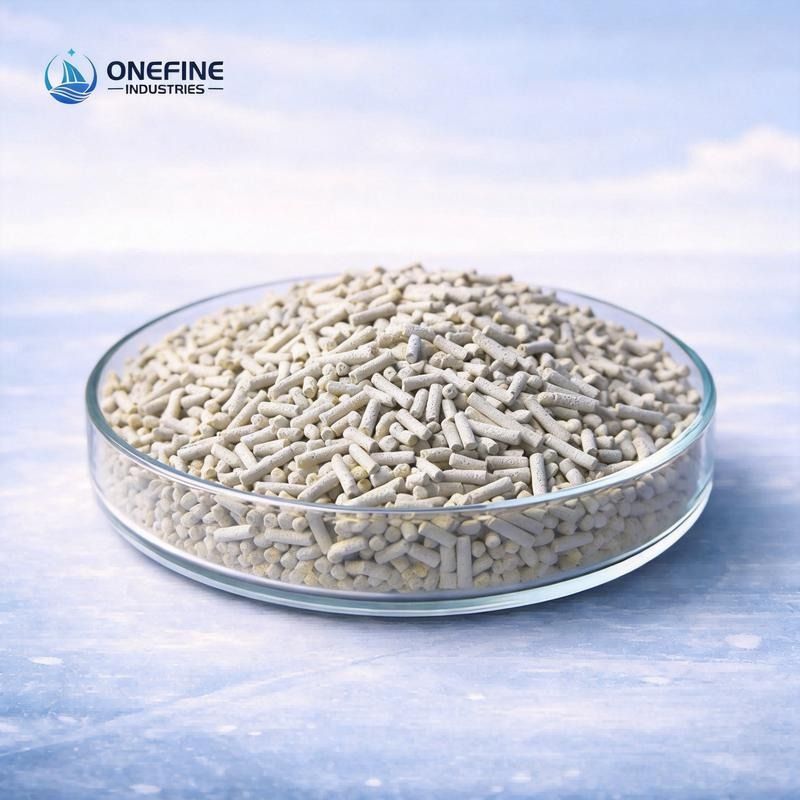
Zinc oxide desulfurization catalyst
High-purity zinc oxide (ZnO) desulfurization catalyst for fine removal of H₂S from natural gas, synthesis gas, hydrogen, and hydrocarbon feeds. Achieves outlet sulfur levels below 0.1 ppm through irreversible chemisorption. High sulfur capacity, long service life, and strong resistance to steam.
Related Reading

What Is an Ultra-Precision Desulfurization Catalyst? Bifunctional COS Hydrolysis Explained
A plain-language guide to how bifunctional ultra-precision desulfurization catalysts combine COS hydrolysis and H₂S adsorption in one reactor bed — and when this one-step approach makes more sense than conventional two-stage ZnO desulfurization.
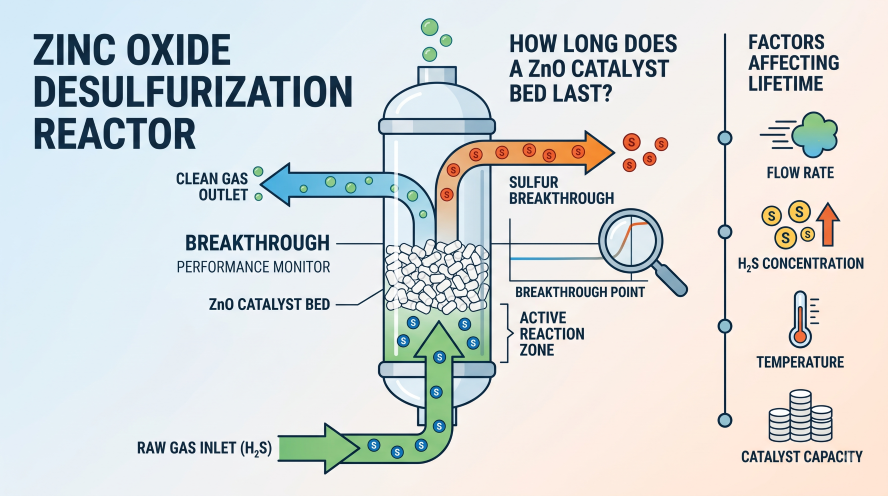
How Long Does a Zinc Oxide Desulfurization Catalyst Bed Last Before Breakthrough?
Discover the thermodynamic and kinetic principles dictating the lifespan of Zinc Oxide (ZnO) desulfurization guard beds. Learn how to calculate theoretical sulfur capacity, understand the Mass Transfer Zone (MTZ), and identify the variables that trigger premature hydrogen sulfide (H₂S) breakthrough.