How Long Does a Zinc Oxide Desulfurization Catalyst Bed Last Before Breakthrough?
The Industrial Imperative of Deep Desulfurization
In modern chemical processing — including coal gasification, steam methane reforming (SMR), and refinery hydroprocessing — achieving ultra-low sulfur concentration in synthesis gas (syngas) or natural gas feed is an absolute operational necessity. Trace sulfur compounds, particularly hydrogen sulfide (H₂S), act as severe and permanent poisons to sensitive downstream catalysts. These downstream units often rely on noble metals, copper-based methanol synthesis loops, or iron-based ammonia synthesis catalysts, which suffer catastrophic and irreversible deactivation when exposed to even fractional ppm levels of sulfur.
To achieve the mandatory sub-0.1 ppmwt sulfur threshold, process engineers universally specify Zinc Oxide (ZnO) guard beds as the final polishing stage in the desulfurization train. Unlike physical adsorbents such as activated carbon or un-functionalized molecular sieves, Zinc Oxide operates via an irreversible chemical reaction — chemisorption. The ZnO bed is therefore a sacrificial consumable, and the fundamental predictive-maintenance question plant operators face is: exactly how long will this catalyst bed operate before hydrogen sulfide breaches the effluent tolerance limit?
While theoretical calculations derived from strict stoichiometry often promise 18 to 24 months of continuous operation, actual field lifespans exhibit real variance — beds can fail prematurely within 6 months, or exceed expectations with a 36-month run. This guide deconstructs the chemical thermodynamics of ZnO chemisorption, details the role of the Mass Transfer Zone (MTZ) and space velocity, and outlines the operational parameters that dictate your catalyst replacement interval.
Key Takeaways
- Zinc oxide operates via irreversible chemisorption (forming ZnS); the bed is a sacrificial consumable and cannot be thermally regenerated.
- Maximum practical sulfur capacity (20–30 wt%) is achieved within a 200°C to 450°C operating window.
- Excessive Gas Hourly Space Velocity (GHSV) or low temperatures stretch the Mass Transfer Zone (MTZ), triggering premature H₂S breakthrough.
The Chemical Stoichiometry and Theoretical Capacity
To predict the operational lifespan of a ZnO desulfurization bed, one must first analyze the underlying reaction stoichiometry. The removal of hydrogen sulfide by zinc oxide is a favorable, mildly exothermic gas-solid chemisorption reaction:
ZnO (s) + H₂S (g) → ZnS (s) + H₂O (g) ΔH = -76.6 kJ/mol
The zinc oxide solid matrix undergoes a permanent phase transformation into solid zinc sulfide (ZnS). Because this covalent bonding is thermodynamically stable across standard industrial operating temperatures, the reaction is completely irreversible in situ under normal conditions — spent ZnS cannot be thermally regenerated and must be safely discharged and replaced.
Calculating Theoretical Bed Life
Because the reaction follows absolute stoichiometry, one mole of ZnO reacts with exactly one mole of H₂S. Pure ZnO has a molecular weight of 81.38 g/mol; sulfur (S) has an atomic weight of 32.06 g/mol. By simple division (32.06 ÷ 81.38), 100% pure ZnO has a theoretical sulfur capacity of approximately 39.4% by weight.
Industrial-grade ZnO catalysts, however, are typically formulated with a ZnO content of 90–95%, with the remainder consisting of structural binders (such as alumina or specialized cementitious agents) that provide mechanical crush strength. Physical pore-diffusion limitations also prevent 100% conversion of the pellet's internal core. Consequently, premium industrial ZnO catalysts are practically rated for a breakthrough sulfur capacity of 20–30% by weight, depending on operating temperature and flow dynamics.
Theoretical Lifespan Equation:
Lifespan (Days) = [ Bed Mass (kg) × Breakthrough Capacity (%) ] ÷ [ Daily Sulfur Mass Flow (kg/day) ]
Worked example: A guard bed loaded with 10,000 kg of ZnO catalyst, rated at 25% breakthrough capacity, can theoretically absorb 2,500 kg of sulfur. If the inlet gas stream introduces 3.5 kg of sulfur per day, the theoretical lifespan is 714 days (≈1.95 years). This is only the baseline — fluid dynamics determine the rest.
Fluid Dynamics, MTZ, and Space Velocity
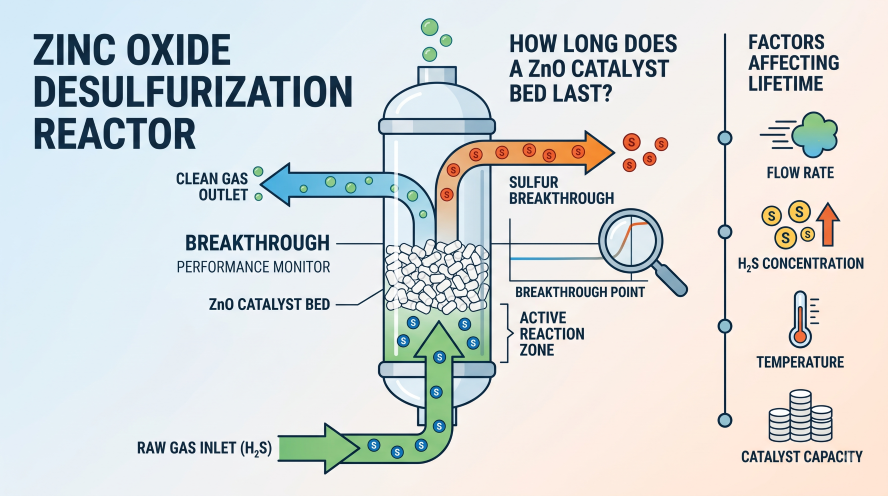
In continuous plant operation, the entire ZnO bed does not saturate simultaneously. The reaction between incoming H₂S and solid ZnO occurs within a localized, vertical cross-section of the reactor known as the Mass Transfer Zone (MTZ).
Above the MTZ, the catalyst is 100% saturated (fully converted to ZnS) and offers no further resistance to H₂S. Below the MTZ, the catalyst remains fresh and unreacted. The MTZ is the active boundary layer where H₂S concentration drops from the bulk inlet level (e.g., 5 ppm) to the strict outlet specification (e.g., ≤0.1 ppm). As the catalyst is consumed, the MTZ continuously migrates downward through the vessel.
Empty Bed Contact Time (EBCT) and GHSV
The vertical length of the MTZ is governed by internal diffusion kinetics and the superficial velocity of the process gas, typically quantified via EBCT or Gas Hourly Space Velocity (GHSV). If plant production scales up abruptly and pushes GHSV beyond the engineered design range, gas transits the reactor too quickly for H₂S to diffuse deep into the ZnO extrudates' macropores. This kinetic bottleneck stretches the MTZ vertically — meaning the leading edge of the reaction zone reaches the bottom of the reactor sooner than anticipated, triggering premature breakthrough while a significant share of the bed's stoichiometric capacity remains unused.
To compress the MTZ and maximize lifespan, engineers specify custom extruded shapes — such as trilobes or quadralobes — that maximize external geometric surface area and reduce internal diffusion distance.
Thermodynamic Boundaries and Temperature Limits
Beyond space velocity, temperature is the most critical variable governing ZnO capacity.
The Practical 200–450°C Operating Window
ZnO chemisorption is strongly temperature-dependent. Industrial practice and thermodynamic studies confirm ZnO achieves its highest practical sulfur capacity and fastest kinetics within a 200°C to 450°C operating range, where H₂S molecules retain enough kinetic energy to overcome internal pore-diffusion resistance and react through to the pellet core.
Low-Temperature Penalty
Below roughly 150°C, physical diffusion slows sharply even though the reaction remains thermodynamically favorable. Running a ZnO guard bed near 100°C stretches the MTZ enormously — effective sulfur capacity can fall from a theoretical 25 wt% to under 10 wt%, triggering rapid, unexpected breakthrough as the outer shell of each pellet converts to ZnS and forms a barrier that chokes access to the unreacted core.
High-Temperature Reversibility
At the upper end, thermodynamic reversibility of ZnO + H₂S ⇌ ZnS + H₂O begins to appear once bed temperature moves past roughly 450°C, and becomes significantly more pronounced above 500–600°C — particularly in gas streams heavily saturated with water vapor. Under these conditions the equilibrium shifts back toward H₂S formation, making it physically impossible to hold sub-0.1 ppm effluent purity. In practice, this is why standard ZnO guard beds are specified to stay within the 200–450°C window rather than pushed toward the upper thermodynamic limit.
Operational Best Practices and Lead-Lag Implementation
Because replacing a ZnO bed requires isolating the vessel, depressurizing, and performing manual extraction of spent ZnS under hazardous-entry protocols, detecting the exact moment of breakthrough is critical to avoiding unplanned plant shutdowns.
Modern facilities universally employ a Lead-Lag (Series) Vessel Configuration to guarantee continuous uptime. The Lead Vessel receives the raw, concentrated inlet gas and operates until its MTZ pushes fully through the bottom support grid (100% saturation). The Lag Vessel, containing fresh ZnO, sits immediately downstream as a fail-safe, capturing any H₂S slip from the Lead vessel and guaranteeing the final effluent stays ≤0.1 ppm.
Once breakthrough is confirmed via gas chromatography at the intermediate sampling point, the Lead vessel is bypassed and taken offline for replacement while the Lag vessel is promoted to primary duty. Once reloaded, the offline vessel returns online as the new Lag vessel. This rotation guarantees zero downtime and pushes total ZnO inventory to its maximum practical capacity before disposal.
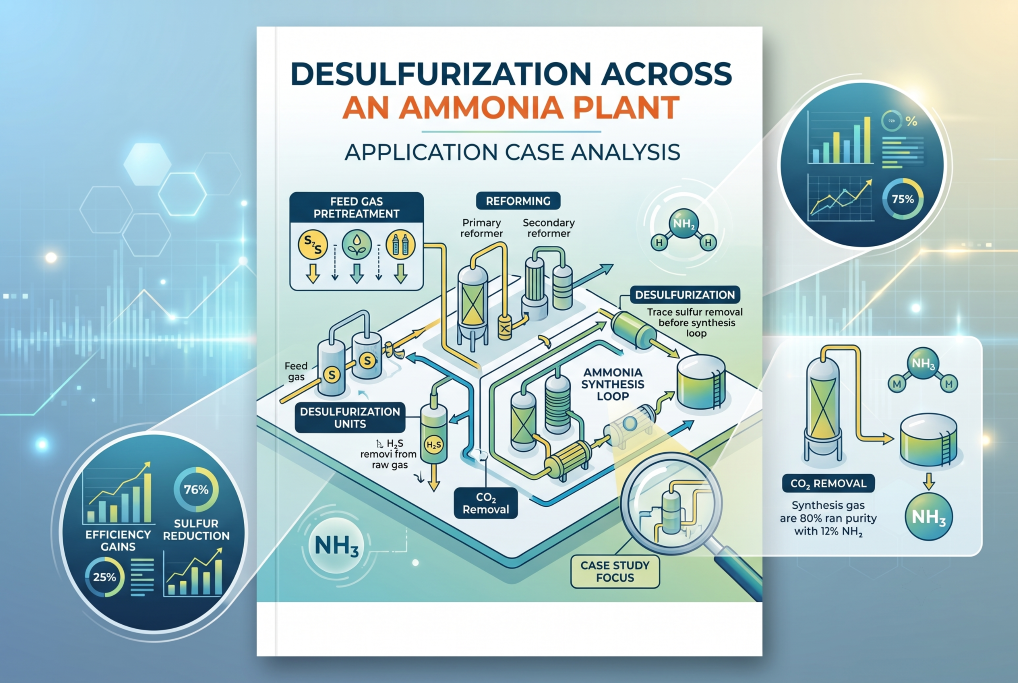
For a real-world example of Lead-Lag ZnO integration within a full desulfurization train, see our application case: Desulfurization Across an Ammonia Plant
Mitigation of Trace Contaminants and Carbonyl Sulfide (COS)
A frequent complication in syngas purification trains is trace Carbonyl Sulfide (COS). Unlike the highly polar H₂S molecule, COS is stable, non-polar, and linear — standard ZnO catalysts are kinetically "blind" to COS below roughly 250°C. If upstream COS Hydrolysis Catalyst units fail or are omitted from the process design, stable COS molecules slip completely through the ZnO guard bed unreacted — falsely simulating premature breakthrough on total-sulfur monitors and poisoning downstream noble metal catalysts. A dedicated COS hydrolysis stage must precede the ZnO bed, chemically unlocking the sulfur via COS + H₂O ⇌ H₂S + CO₂ so it can be captured downstream.
For plants running a two-stage desulfurization configuration, Iron Oxide Desulfurization Catalyst is commonly deployed as a bulk, ambient-temperature pre-treatment stage ahead of the ZnO polishing bed — Iron Oxide handles the bulk of the sulfur load at low cost, extending the practical lifespan of the more precise (and more expensive) ZnO stage downstream.
Recommended Products from Sorbsieve
Zinc Oxide Desulfurization Catalyst
Sorbsieve's industrial Zinc Oxide catalyst is formulated for sub-0.1 ppmwt deep desulfurization, with breakthrough capacity and crush strength backed by technical documentation for guard-bed sizing.
Frequently Asked Questions (FAQ)
Q1: Why did my ZnO bed fail in 6 months when calculations predicted 2 years?
A1: Premature breakthrough is almost always driven by fluid dynamic or thermodynamic upsets rather than a failure of the catalyst's inherent capacity. Operating below 200°C restricts internal pore diffusion, excessive GHSV stretches the MTZ, and flow channeling from poor initial bed loading lets gas bypass the active material entirely.
Q2: Can I regenerate a spent ZnO catalyst to save operational costs?
A2: No. The conversion of Zinc Oxide to Zinc Sulfide forms stable, permanent mineral bonds. Attempting to thermally oxidize ZnS back to ZnO in-situ would require extreme temperatures that cause severe structural sintering. Industrial ZnO desulfurization catalysts are one-time, sacrificial barriers.
Q3: How does moisture (H₂O) impact the ZnO desulfurization reaction?
A3: Per Le Chatelier's Principle, because water vapor is a stoichiometric byproduct of the chemisorption reaction, high moisture concentration in the inlet feed acts as a thermodynamic inhibitor. In steam reforming units heavily saturated with steam, high H₂O partial pressure reduces the driving force, slowing kinetics and expanding the MTZ.
Q4: How do I know when to replace the catalyst in a single-bed system?
A4: Continuously monitor H₂S concentration at the reactor outlet using online analyzers or colorimetric tubes. Once the outlet concentration breaches the downstream catalyst's tolerance threshold (e.g., rising from 0.05 ppm to >0.1 ppm), the MTZ has exited the bed and the catalyst must be replaced immediately.
Looking for Bulk Supply of Zinc Oxide Desulfurization Catalyst?
Sorbsieve is a trusted bulk supplier of Zinc Oxide Desulfurization Catalyst and complete industrial catalysts, serving industrial buyers across the Middle East.
We provide:
- ✅ Container-level supply (20'GP / 40'GP / 40'HQ)
- ✅ Full documentation (COA / TDS / SDS / COO)
- ✅ Multiple packaging options
- ✅ Technical support for guard-bed sizing and lead-lag configuration
- ✅ Fast quote response for industrial inquiries
Contact our team for bulk pricing, product samples, and technical consultation.
Related Products
Zinc oxide desulfurization catalyst
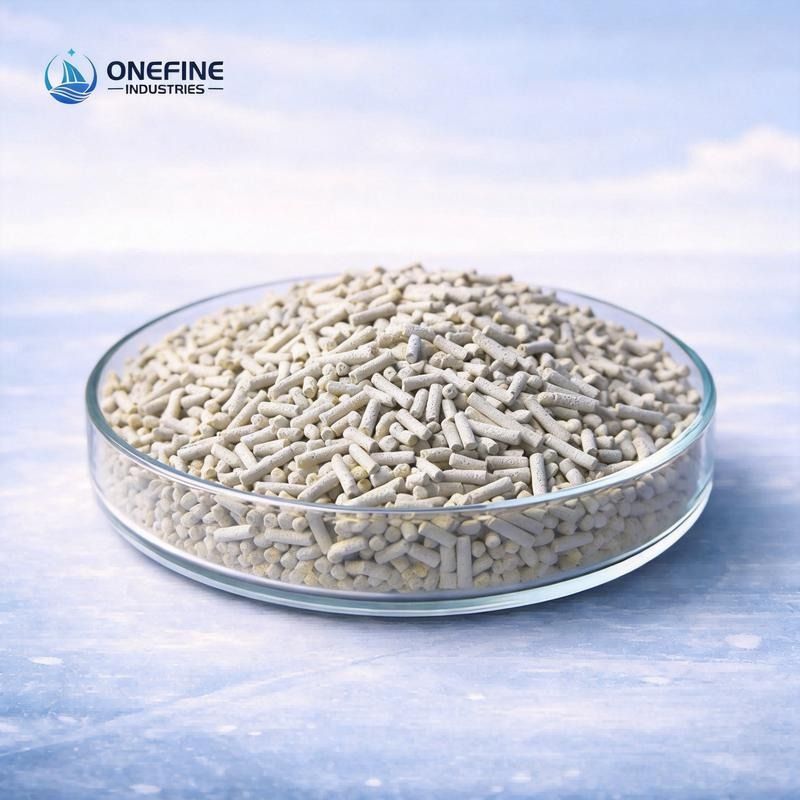
High-purity zinc oxide (ZnO) desulfurization catalyst for fine removal of H₂S from natural gas, synthesis gas, hydrogen, and hydrocarbon feeds. Achieves outlet sulfur levels below 0.1 ppm through irreversible chemisorption. High sulfur capacity, long service life, and strong resistance to steam.
COS Hydrolysis Catalyst
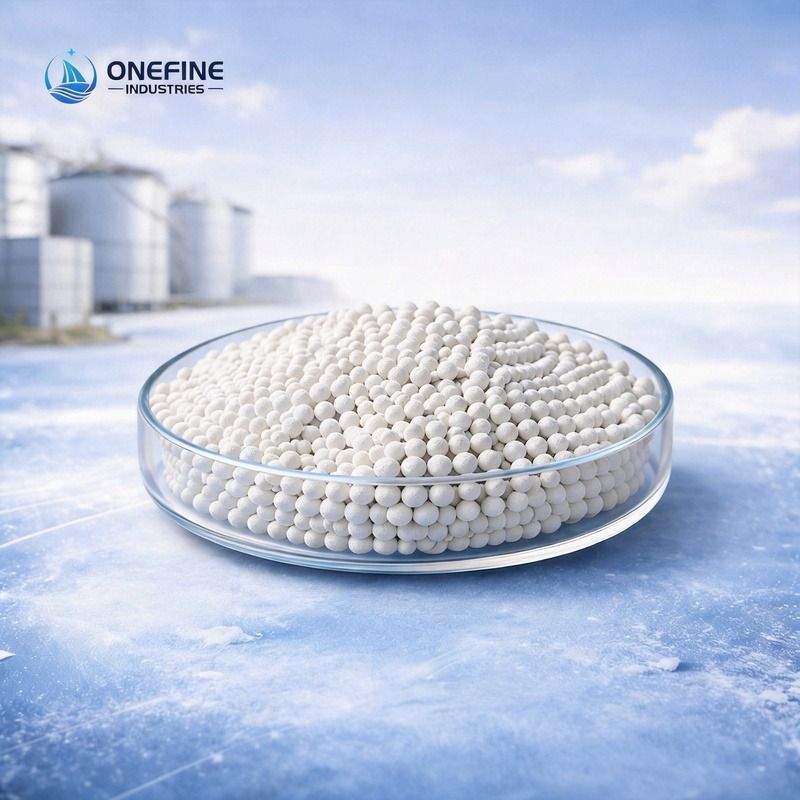
High-efficiency γ-Al2O3 supported COS hydrolysis catalyst designed to convert carbonyl sulfide into easily removable H2S with ≥95% conversion efficiency across diverse hydrocarbon streams.
Iron Oxide Desulfurization Catalyst
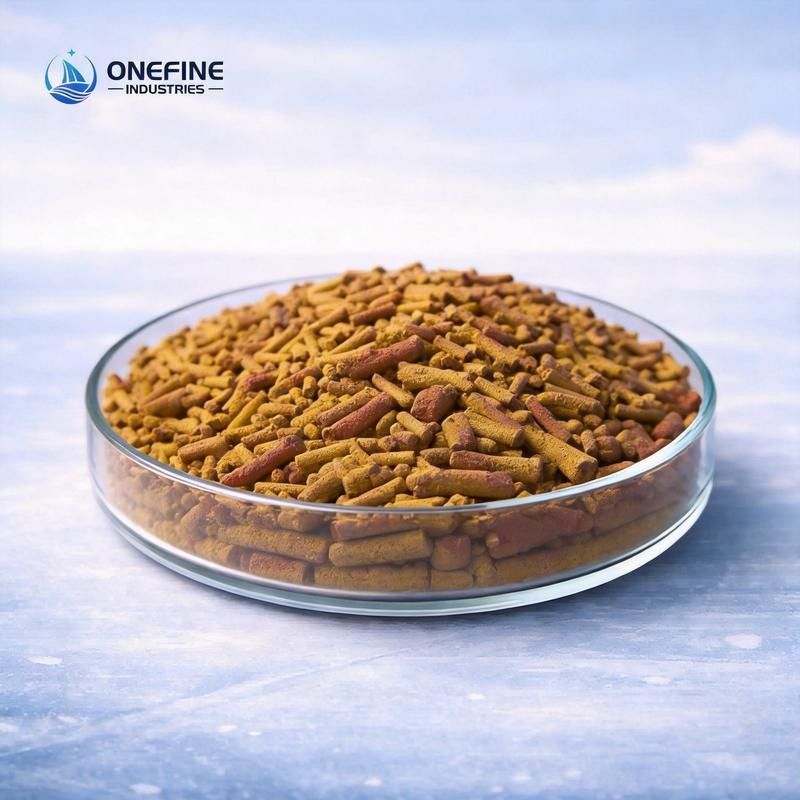
High-efficiency iron oxide-based desulfurization catalyst for deep removal of H₂S from natural gas, biogas, syngas, coke oven gas, and various industrial gas streams. Features high sulfur capacity, excellent water resistance, and room-temperature operation — a cost-effective solution for both bulk and precision desulfurization applications.
Related Reading
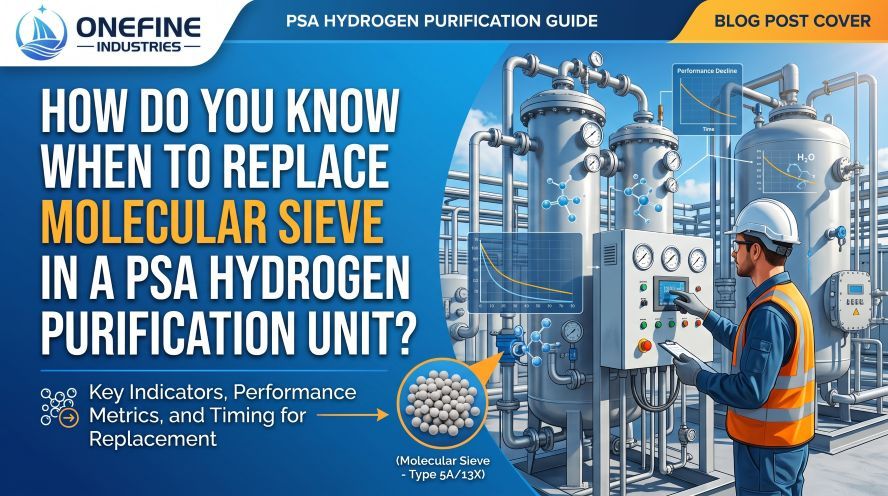
How Do You Know When to Replace Molecular Sieve in a PSA Hydrogen Purification Unit?
5A molecular sieve in a PSA hydrogen purification unit gradually loses capacity from moisture, CO2 slip, mechanical attrition, and thermal aging. Learn the early warning signs — purity drift, shorter cycle times, rising pressure drop — so you can plan a changeout before an off-spec hydrogen stream forces one.
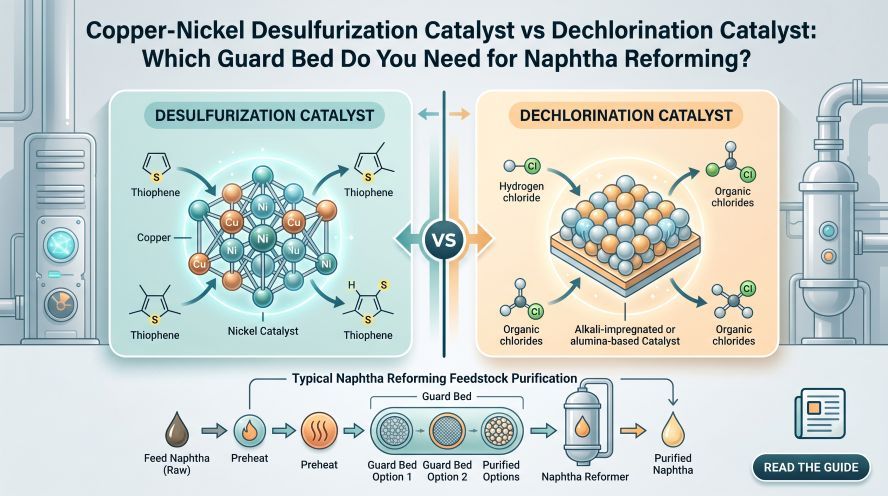
Copper-Nickel Desulfurization Catalyst vs Dechlorination Catalyst: Which Guard Bed Do You Need for Naphtha Reforming?
Sulfur and chloride threaten a naphtha reformer in different ways and from different directions. This guide explains what a copper-nickel desulfurization guard bed and a dechlorination guard bed each protect, where each one belongs, and when your unit needs both.
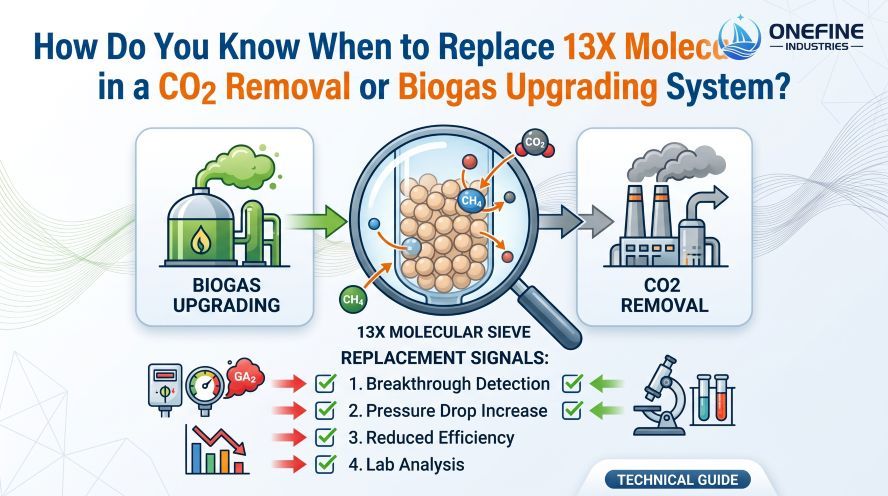
How Do You Know When to Replace 13X Molecular Sieve in a CO2 Removal or Biogas Upgrading System?
Learn the key breakthrough, capacity, and regeneration signals that tell you it's time to replace 13X molecular sieve in a CO2 removal or biogas upgrading system — before product quality or system efficiency suffers.