Copper-Nickel Desulfurization Catalyst vs Dechlorination Catalyst: Which Guard Bed Do You Need for Naphtha Reforming?
Key Takeaways
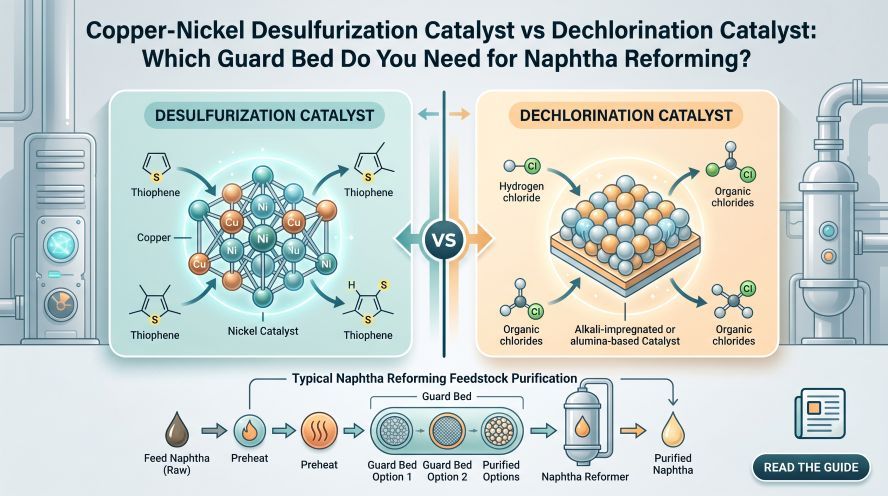
- The Cu-Ni bed sits ahead of the reforming reactors to chemically absorb residual sulfur and directly protect the sensitive Pt/Re catalyst.
- A dechlorination catalyst acts as a dedicated chloride trap that prevents hydrogen chloride from corroding equipment and fouling downstream units.
- While sulfur is primarily a feed-side problem aimed at the catalyst, chloride appears on both the feed and product sides of the reforming unit.
- When both beds are used on the same feed stream, the dechlorination bed must be placed first to prevent chloride from consuming the sulfur guard's capacity.
A naphtha reformer runs on a Pt/Re catalyst that is expensive, slow to replace, and unforgiving of contaminants. Two contaminants cause most of the trouble: sulfur, which poisons the metal sites, and chloride, which corrodes equipment, forms salt deposits, and upsets the unit's chloride balance. A Copper-Nickel Desulfurization Catalyst and a Dechlorination Catalyst are both called guard beds, and both are used around reforming units, so buyers often ask which one they actually need. The honest answer depends on which contaminant dominates, where it enters the unit, and whether you are protecting the reforming catalyst itself or the equipment and product streams around it. This guide walks through that decision.
What Each Guard Bed Is Built to Stop
The two products solve different problems, even though both sit in the same unit.
A copper-nickel desulfurization catalyst is a sulfur polishing bed. Hydrotreating removes most of the sulfur from reformer feed, but trace sulfur always remains, and Pt/Re catalysts are highly sensitive to it. Rhenium in particular loses activity quickly when sulfur reaches it. The Cu-Ni bed chemisorbs that residual sulfur, fixing it as stable metal sulfides so it never reaches the reactor. Because the copper and nickel are supplied in a pre-reduced state, the bed does not need a separate in-situ reduction step at start-up. Its multi-function formulation also gives it a secondary capacity for trace chloride and arsenic, which is why it is often described as a combined S/Cl/As protection layer. For the full working principle, see our explanation of dual-metal Cu-Ni guard beds.
A dechlorination catalyst is a dedicated chloride trap. Its job is to capture hydrogen chloride and hold it as a stable chloride inside the pellet, so the chloride does not travel on to compressors, exchangers, stabilizer columns, or downstream catalysts. It does not target sulfur. What it offers instead is a much deeper chloride capacity than a multi-function bed can spare, because its entire formulation is devoted to one contaminant. Our guide to HCl removal chemistry covers how that reaction works.
In short: the Cu-Ni bed protects the catalyst from sulfur, with some chloride tolerance on the side. The dechlorination bed protects the unit from chloride, with no sulfur function at all.
Where Sulfur and Chloride Enter a Reforming Unit
To choose correctly, you need to know where each contaminant comes from. In a reforming complex there are two distinct chloride sources and one main sulfur source.
Sulfur on the feed side. Straight-run naphtha carries organic sulfur. The naphtha hydrotreater converts most of it to hydrogen sulfide, which is stripped out, but a small residual always passes through. That residual is exactly what the Cu-Ni bed is placed to catch, directly ahead of the reforming reactors.
Chloride on the feed side. Organic chlorides are not naturally present in crude oil, but they can enter through contaminated crude cargoes, disposed solvents, or upstream process streams. In the hydrotreater these organic chlorides convert to HCl. That HCl can combine with ammonia to form ammonium chloride deposits in exchangers, and it can attack metal-based sulfur sorbents, consuming capacity that should be reserved for sulfur. This is why feed-side chloride guard beds — a well-established guard bed category in its own right — are commonly placed ahead of the sulfur guard in reformer feed treatment trains.
Chloride on the product side. Reforming catalysts are continuously dosed with organic chloride to maintain their acid function. That chloride is not permanently held on the catalyst, so it leaves the reactors in the net hydrogen gas, the LPG, and the reformate. Net hydrogen is often sent to hydrotreaters elsewhere in the refinery, which spreads the chloride problem across other units. This is the most common reason refiners install dedicated chloride guard beds on reformer product streams.
The pattern is clear: sulfur is a feed-side problem aimed at the catalyst, while chloride appears on both sides and threatens equipment and downstream units as much as the catalyst.
How the Two Guard Beds Compare
- Primary target: Copper-nickel bed targets trace sulfur; dechlorination bed targets HCl.
- Secondary capability: Copper-nickel bed has limited chloride and arsenic tolerance; dechlorination bed has no sulfur function.
- What it protects: Copper-nickel bed protects the Pt/Re reforming catalyst directly; dechlorination bed protects equipment, product quality, downstream catalysts, and, on the feed side, the sulfur guard itself.
- Typical position: Copper-nickel bed sits on hydrotreated naphtha just ahead of the reformer; dechlorination beds sit on net hydrogen, LPG, or reformate streams, and ahead of the sulfur guard where feed chloride is a concern.
- Start-up: Copper-nickel bed is pre-reduced and does not need in-situ reduction; dechlorination bed is loaded and put on stream without a reduction step.
- What happens if it is missing: Without the copper-nickel bed, sulfur shortens reforming cycles and reduces yield; without the dechlorination bed, chloride drives corrosion, salt fouling, and contamination of downstream hydrogen consumers.
For full specifications, operating windows, and packaging options, refer to each product page. This comparison focuses on selection logic, not grade data.
Decision Guide: Which One Does Your Unit Need?
Most buyers fall into one of four situations.
Your concern is residual sulfur after hydrotreating, and chloride is low. Choose the copper-nickel desulfurization catalyst. Its sulfur polishing protects the Pt/Re catalyst directly, and its secondary chloride tolerance can handle occasional traces without a separate bed.
Your concern is chloride in net hydrogen, LPG, or reformate. Choose the dechlorination catalyst. These are product-side streams, and the goal is to stop chloride from reaching compressors, stabilizers, fuel gas, or hydrogen consumers. A sulfur guard offers no benefit here.
Your feed has a known organic chloride history and residual sulfur. Plan for both. A multi-function Cu-Ni bed can tolerate some chloride, but a sustained chloride load will consume capacity intended for sulfur and shorten its service life. A dedicated dechlorination bed upstream takes the chloride load and lets the Cu-Ni bed do its main job.
You are unsure what your chloride species are. Get an analysis first. Chloride in reformer streams can be HCl, organic chloride, or a mix, and guard bed formulations differ in how well they handle each. Share your stream analysis with our technical team so we can confirm whether our dechlorination grade suits your chloride profile before you order.
Why Sequence Matters When You Install Both
When both beds are used on the same feed stream, the dechlorination bed goes first. The reasoning is capacity protection. A Cu-Ni bed that has to absorb chloride as well as sulfur reaches its limit sooner, and an unplanned sulfur breakthrough into a Pt/Re reactor is far more costly than an early change-out of a chloride trap. Putting the chloride trap upstream keeps the Cu-Ni bed's capacity focused on sulfur and makes its replacement interval more predictable.
On the product side, the question of sequence does not arise, because only the dechlorination bed is needed there.
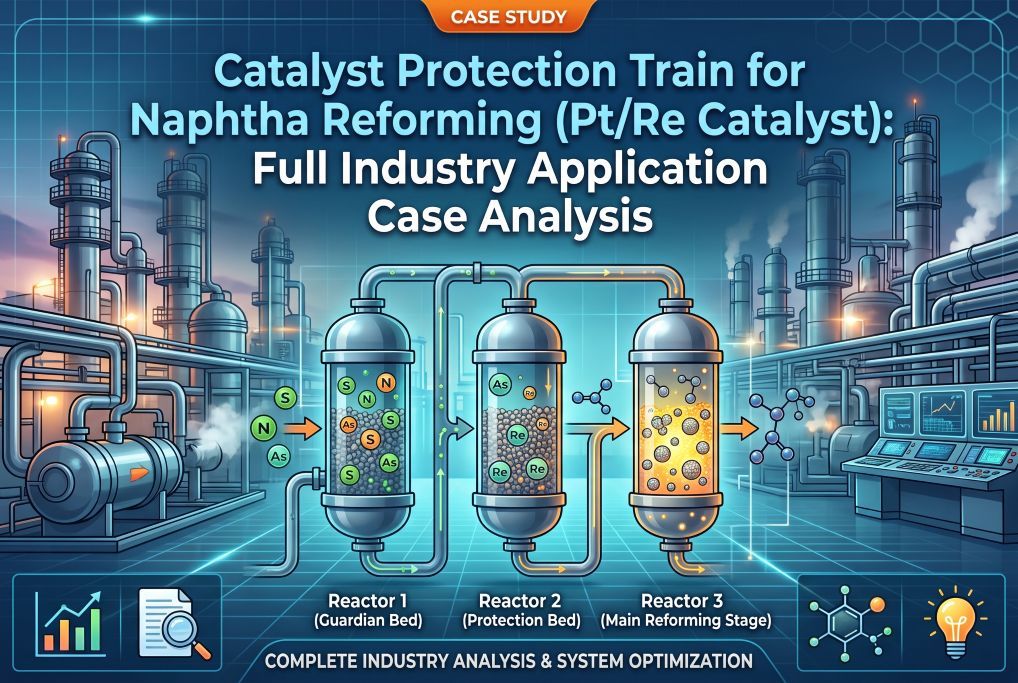
Seen as a whole, the two products are not competitors so much as two layers of the same protection strategy. Our naphtha reforming protection train case shows how both guard beds work together in a complete reformer layout.
Recommended Products from Sorbsieve
- Copper-Nickel Desulfurization Catalyst — Pre-reduced dual-metal guard bed for trace sulfur polishing ahead of Pt/Re reforming catalysts, with secondary chloride and arsenic tolerance.
- Dechlorination Catalyst — Dedicated HCl trap for reformer net hydrogen, LPG, and reformate streams, and for feed-side chloride protection ahead of sulfur guard beds.
FAQ
Can a copper-nickel desulfurization catalyst replace a dedicated dechlorination bed?
Only where chloride levels are low and occasional. The Cu-Ni bed's chloride tolerance is a secondary function. Under a steady chloride load, it will lose the sulfur capacity it was installed to provide.
Do I need a dechlorination bed if my reformer feed is already hydrotreated?
Possibly. Hydrotreating does not remove chloride; it converts organic chloride into HCl. And even with a chloride-free feed, the chloride dosed onto the reforming catalyst will still leave in the product streams.
Which bed should be replaced first if both are on the same stream?
Replacement should follow each bed's own breakthrough monitoring, not a fixed pairing. In practice, the upstream chloride trap is usually watched more closely, because its failure pushes chloride onto the Cu-Ni bed.
Can one supplier provide both guard beds for the same project?
Yes. Sorbsieve supplies both products and can coordinate grades, quantities, and delivery for a complete reforming protection package.
Looking for Bulk Supply of Copper-Nickel Desulfurization and Dechlorination Catalysts?
Sorbsieve is a trusted bulk supplier of Copper-Nickel Desulfurization and Dechlorination Catalysts and complete industrial adsorbents, serving industrial buyers across the Middle East.
We provide:
- ✅ Container-level supply (20'GP / 40'GP / 40'HQ)
- ✅ Full documentation (COA / TDS / SDS / COO)
- ✅ Multiple packaging options
- ✅ Technical support for guard bed catalyst selection and system optimization
- ✅ Fast quote response for industrial inquiries
Contact our team for bulk pricing, product samples, and technical consultation.
Related Products
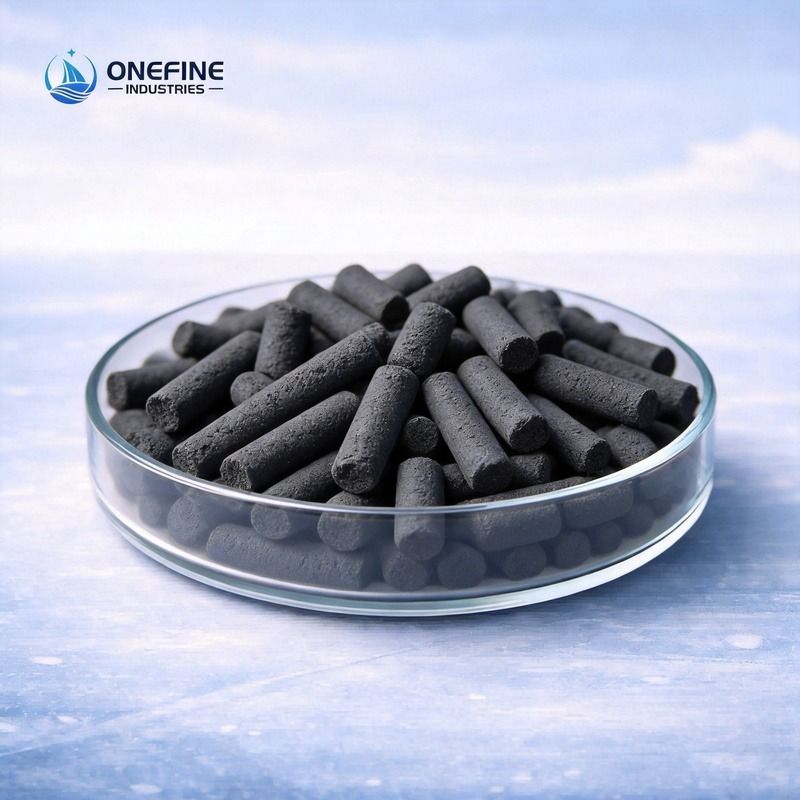
Copper-Nickel Desulfurization Catalyst
A Cu-Ni dual-system desulfurization catalyst for oil refining guard-bed applications. Removes inorganic and organic sulfur, trace chlorine, and arsenic impurities in a single step. Supplied in pre-reduced form for immediate use. Ideal as a protection agent for precious metal catalysts in reforming, hydrocracking, and isomerization units.
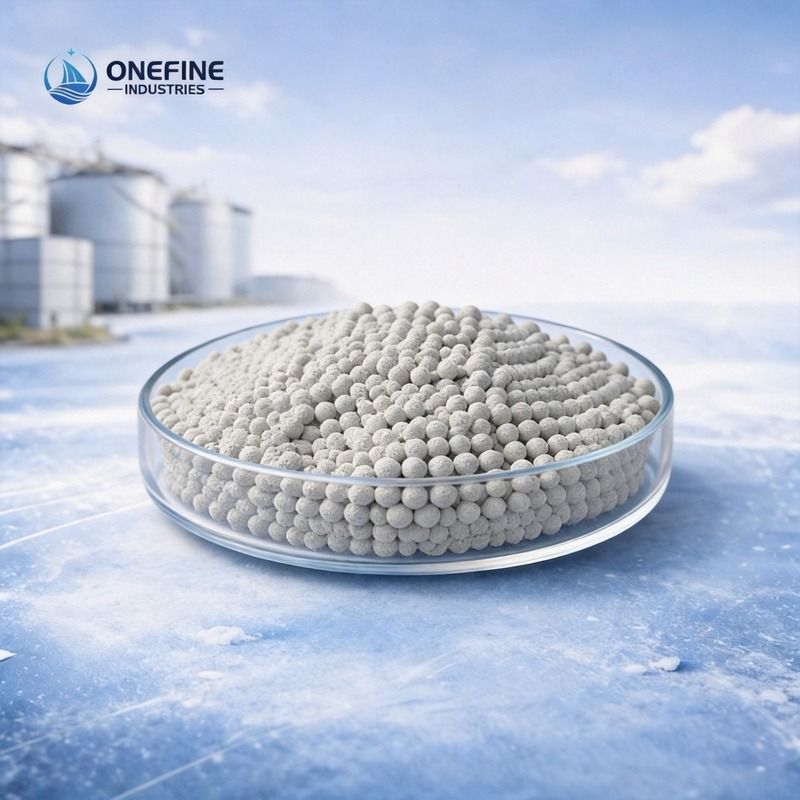
Dechlorination Catalyst
High-performance Na₂CO₃/Al₂O₃-based dechlorination catalyst designed for ultra-deep hydrogen chloride (HCl) removal from hydrocarbon streams with high chlorine capacity and minimal green oil formation.
Related Reading
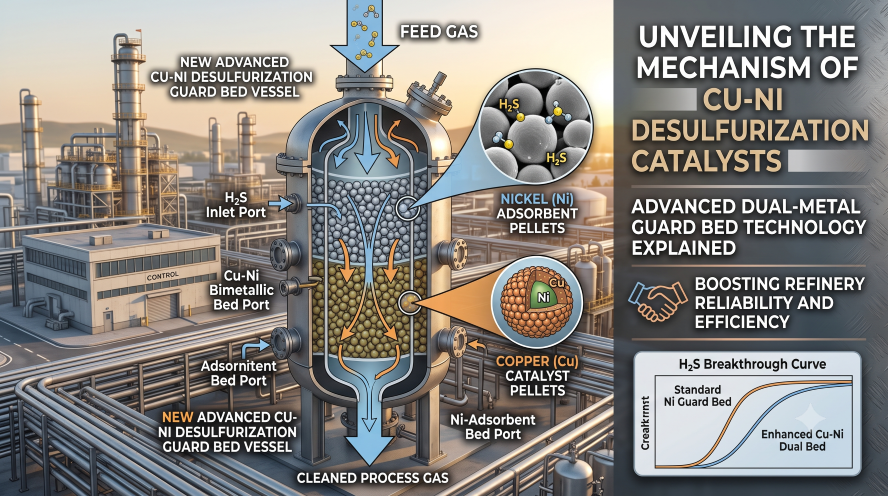
What Is a Cu-Ni Desulfurization Catalyst? Dual-Metal Guard Bed Technology Explained
A plain-language guide to copper-nickel (Cu-Ni) desulfurization catalysts: how the dual-metal mechanism works, why pre-reduced supply matters for commissioning time, and how to choose between a Cu-Ni system and a single-metal guard bed.
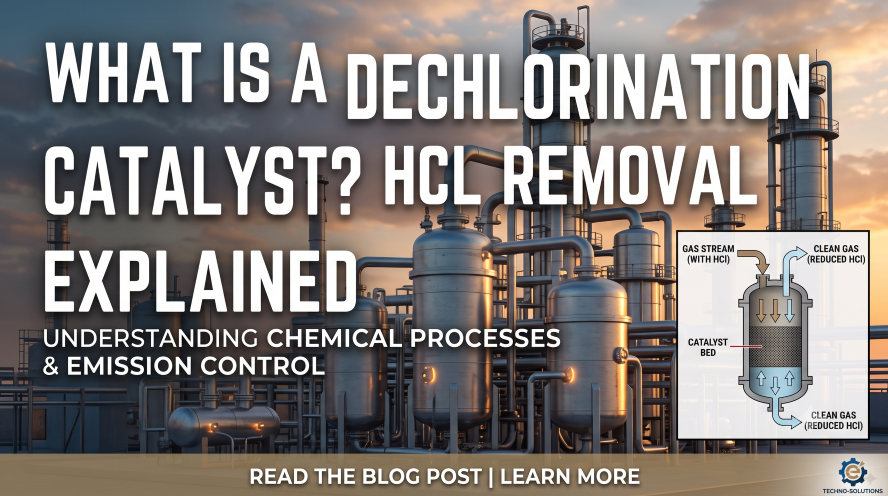
What Is a Dechlorination Catalyst? HCl Removal Explained
Trace hydrogen chloride (HCl) and organochlorides threaten Continuous Catalytic Reforming, Isomerization, PDH, and Syngas purification units. This guide explains dechlorination catalyst chemistry, green oil control, and guard bed operation practices.
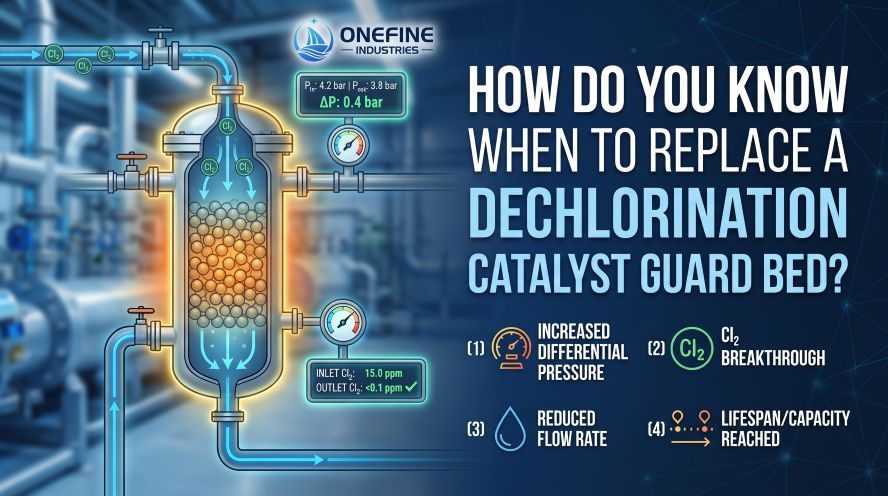
How Do You Know When to Replace a Dechlorination Catalyst Guard Bed?
There's no fixed calendar date for replacing a dechlorination catalyst guard bed. This guide covers the three signals that actually matter — outlet chlorine breakthrough, organic chloride slip even when HCl looks clean, and rising pressure drop from green oil fouling — and why watching HCl alone isn't enough.