What Is a Cu-Ni Desulfurization Catalyst? Dual-Metal Guard Bed Technology Explained
Introduction
If you run a catalytic reforming unit, a hydrocracker, or an isomerization line, you already know that trace sulfur, chlorine, and arsenic are the enemy of your most expensive catalysts. Precious-metal reforming catalysts in particular — Pt/Re, Pt-Sn, Pt-Ir — can lose activity permanently after exposure to even single-digit ppm levels of these poisons. A copper-nickel (Cu-Ni) desulfurization catalyst is one of the most widely used guard-bed solutions for stopping these impurities before they ever reach your primary catalyst bed. This guide walks through how the dual-metal chemistry works, what makes the pre-reduced supply form worth paying attention to, and how it compares to other guard-bed options on the market.
Key Takeaways:
- Dual-Metal Synergy: Copper drives the hydrogenolysis of organic sulfur, while nickel extends total sulfur breakthrough capacity.
- Turnaround Efficiency: Pre-reduced supply forms bypass the hazardous and time-consuming on-site hydrogen reduction sequence.
- Irreversible Chemisorption: Contaminants form stable metal sulfides and arsenides, rendering the catalyst a highly secure, non-regenerable sacrificial guard.
How a Cu-Ni Desulfurization Catalyst Works
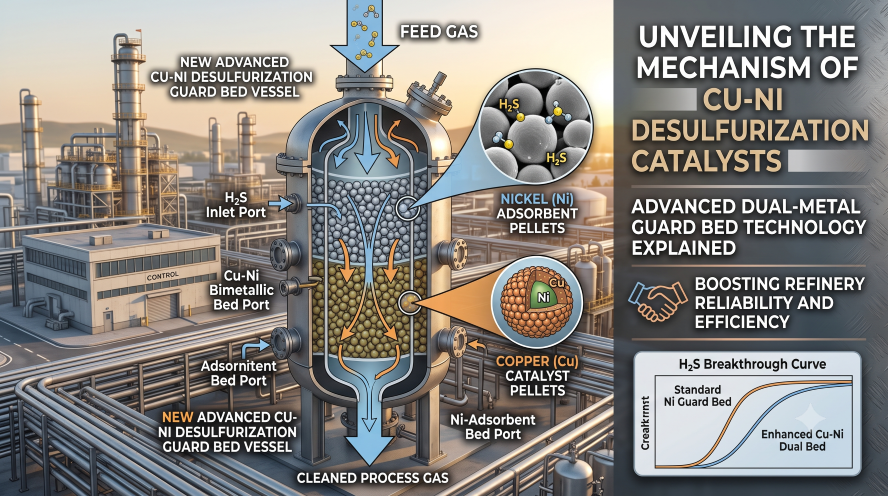
At its core, a Cu-Ni desulfurization catalyst is a guard-bed material built around two active metal oxides — copper oxide (CuO) and nickel oxide (NiO) — dispersed on a high-surface-area alumina support. Each metal contributes a different strength to the purification process.
Copper is highly reactive toward both inorganic sulfur (H₂S) and organic sulfur compounds such as mercaptans, sulfides, and thiophenes. It chemisorbs H₂S directly onto its surface, forming stable copper sulfide, and it also drives the hydrogenolysis of organic sulfur species — breaking the carbon-sulfur bond so the sulfur can be captured as H₂S and then chemisorbed in turn.
Nickel plays a complementary role. It boosts overall hydrogenation activity, which improves how efficiently organic sulfur compounds are converted, and it extends the total sulfur breakthrough capacity of the bed. In practice, this means a Cu-Ni system can handle more total sulfur loading over its service life than a single-metal alternative of the same size, because the two metals are working through slightly different reaction pathways rather than competing for the same active sites.
Beyond sulfur, the alumina support itself plays an active role: chloride compounds are physically adsorbed onto the support surface, while arsenic compounds react with the active metal phase to form stable arsenides. This is why a single guard bed can address three separate poisons — sulfur, chlorine, and arsenic — in one pass, rather than requiring three separate treatment stages.
Why the Pre-Reduced Supply Form Matters
One detail that often gets overlooked when comparing guard-bed catalysts is supply form. Most conventional desulfurization catalysts are shipped in oxidized form (CuO, NiO) and require an on-site reduction step — typically heating the bed under a controlled hydrogen flow — before the catalyst becomes active. This reduction step adds time, requires dedicated equipment and a trained operator, and introduces a point where startup performance can vary from one commissioning to the next.
A pre-reduced Cu-Ni catalyst skips this step entirely. The active metals have already been converted to their metallic form (Cu⁰, Ni⁰) during manufacturing, so the catalyst is ready to work as soon as it's loaded. For a refinery managing a turnaround schedule where every day of downtime has a real cost, this difference is not cosmetic — it can shave meaningful time off a guard-bed changeout. The tradeoff is that pre-reduced catalyst is pyrophoric when exposed to air, so it needs to stay sealed until loading and should be handled under an inert atmosphere during installation. An oxidized form remains available for sites that prefer to avoid pyrophoric handling altogether.
Cu-Ni Dual-Metal vs. Single-Metal Guard Beds: How to Choose
A question we hear often from refinery buyers is whether a dual-metal Cu-Ni system is worth it compared to a simpler single-metal CuO/Al₂O₃ guard bed, such as our Desulfurization and Arsenic Removal Catalyst. Both products target the same core problem — protecting downstream catalysts from sulfur, chlorine, and arsenic — but they arrive at it differently.
The single-metal CuO/Al₂O₃ system is a proven, straightforward chemistry that many refineries already run today. It typically requires on-site reduction before use, which some operators prefer because it gives direct control over the reduction profile and timing.
The Cu-Ni dual-metal system trades that control for convenience and higher total sulfur capacity: the nickel promoter extends breakthrough capacity beyond what copper alone can achieve, and the pre-reduced supply form removes the reduction step from your commissioning timeline entirely. If your priority is minimizing changeout downtime and you're comfortable with pyrophoric-material handling procedures, the dual-metal pre-reduced option is usually the better fit. If your site's procedures are built around on-site reduction and you'd rather not introduce pyrophoric handling, the single-metal system remains a solid choice.
Either way, the underlying goal is the same: protecting the catalysts downstream that actually cost the most to replace. In catalytic reforming, that's almost always the precious-metal catalyst itself — see our Palladium Catalyst for Hydrogenation for an example of the kind of high-value catalyst these guard beds exist to protect.
Where Cu-Ni Guard Beds Are Used
Cu-Ni desulfurization catalysts show up most often upstream of catalytic reforming units, where even trace sulfur, chlorine, or arsenic can permanently deactivate a Pt-based reforming catalyst. They're also common ahead of hydrocracking reactors, where clean feedstock is essential for maintaining conversion rates and product selectivity, and in isomerization and alkylation units, which use acid or metal catalysts sensitive to the same impurities. Some refineries also use a Cu-Ni bed as a polishing step after a primary hydrotreater, catching whatever residual sulfur escapes the main desulfurization stage before it reaches more sensitive downstream equipment.
Service Life and What Happens at Breakthrough
Because the catalyst works through chemisorption — sulfur, chlorine, and arsenic are captured on the metal and support surfaces, not chemically reversed — the process is irreversible under normal operating conditions. Typical service life runs from one to three years, depending on inlet impurity concentrations, operating temperature and pressure, space velocity, and how strict your outlet purity target is. Once outlet sulfur exceeds specification (breakthrough), the bed has reached the end of its useful life and needs to be replaced. Spent catalyst isn't regenerated on-site; because it contains recoverable copper and nickel sulfides, it's typically sent to a specialized metal-recovery facility rather than disposed of as waste.
Recommended Products from Sorbsieve
If you're evaluating guard-bed options for your refinery, these related products may also be relevant:
- Copper-Nickel Desulfurization Catalyst — full specifications, packaging, and technical documentation for the dual-metal system covered in this guide
- Dechlorination Catalyst — for buyers whose primary contaminant is chlorine specifically, or who need a higher-capacity replacement for an existing dechlorination bed
- Desulfurization and Arsenic Removal Catalyst — a single-metal CuO/Al₂O₃ alternative for sites that prefer on-site reduction
- Palladium Catalyst for Hydrogenation — a common downstream catalyst that Cu-Ni guard beds are used to protect
FAQ
Q1: How is a Cu-Ni desulfurization catalyst different from a standard single-metal desulfurizer? A: The nickel promoter extends total sulfur breakthrough capacity beyond what copper alone can achieve, and the catalyst is typically supplied pre-reduced, removing the on-site reduction step required by most single-metal systems.
Q2: Is the pre-reduced form dangerous to handle? A: It's pyrophoric when exposed to air, so it needs to stay sealed until loading and should be installed under inert-atmosphere procedures. This is a standard handling requirement, not a sign of instability during normal storage.
Q3: Can I switch from a single-metal system to a Cu-Ni system without changing my reactor? A: In most cases yes — guard beds of this type are designed as drop-in replacements within standard reactor vessel dimensions, but always confirm bed volume and pressure drop with your process engineer before switching.
Q4: How do I know when the catalyst needs replacing? A: Monitor outlet sulfur levels. Once they exceed your target specification (breakthrough), the active capacity has been consumed and the bed should be changed out.
Looking for Bulk Supply of Copper-Nickel Desulfurization Catalyst?
Sorbsieve is a trusted bulk supplier of Copper-Nickel Desulfurization Catalyst and complete industrial adsorbents, serving industrial buyers across the Middle East.
We provide:
- ✅ Container-level supply (20'GP / 40'GP / 40'HQ)
- ✅ Full documentation (COA / TDS / SDS / COO)
- ✅ Multiple packaging options
- ✅ Technical support for catalyst selection and system optimization
- ✅ Fast quote response for industrial inquiries
Contact our team for bulk pricing, product samples, and technical consultation.
Related Products
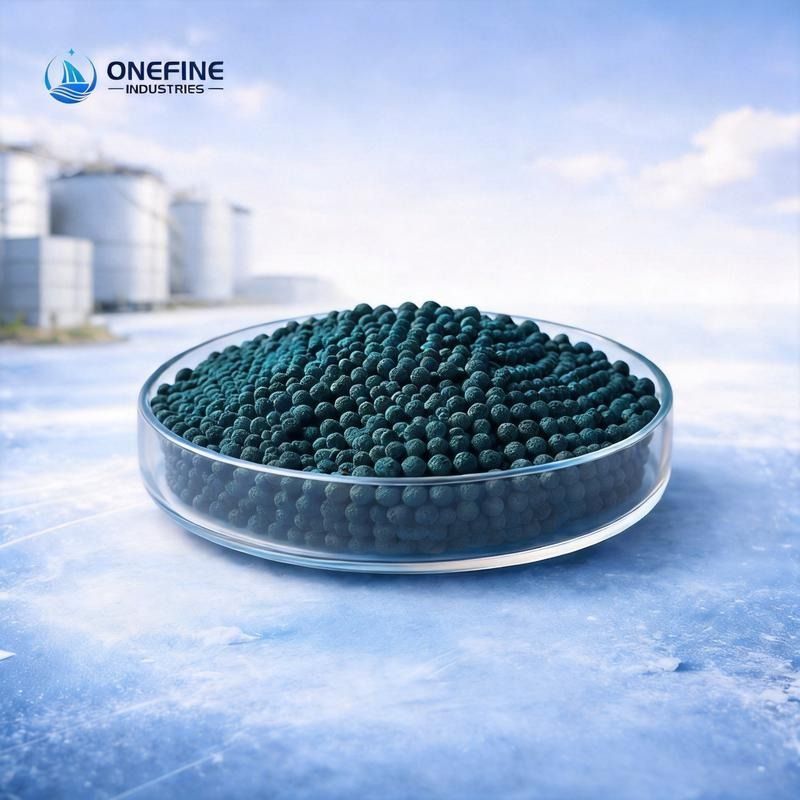
Desulfurization and arsenic removal catalyst
High-performance CuO/Al₂O₃-based desulfurization and arsenic removal catalyst, engineered for the ultra-deep removal of sulfur compounds and volatile arsenides to protect downstream noble metal catalysts. Available in bulk from 1 ton MOQ for Middle East industrial buyers.
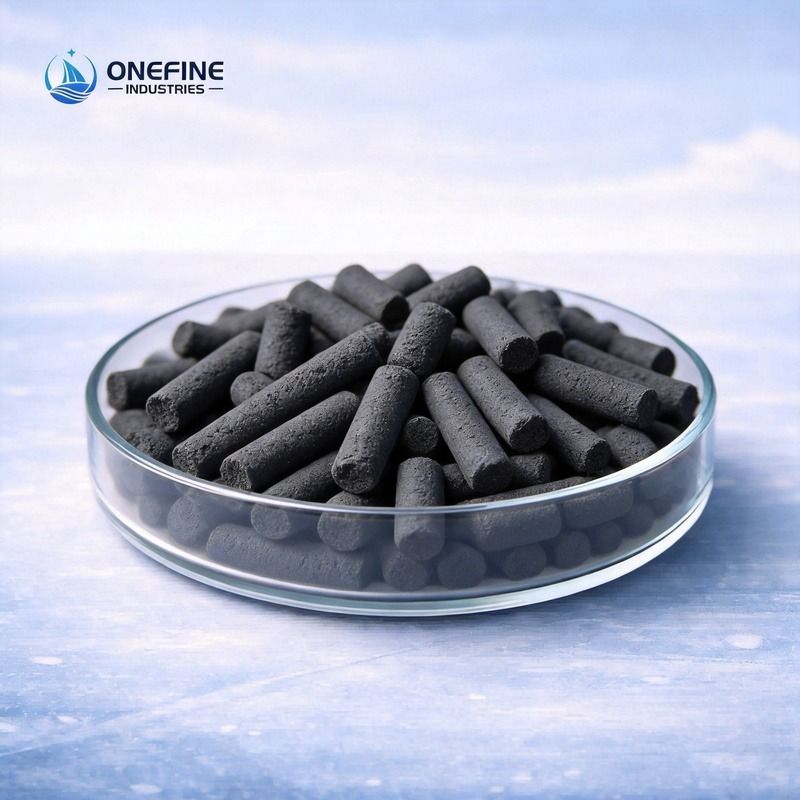
Copper-Nickel Desulfurization Catalyst
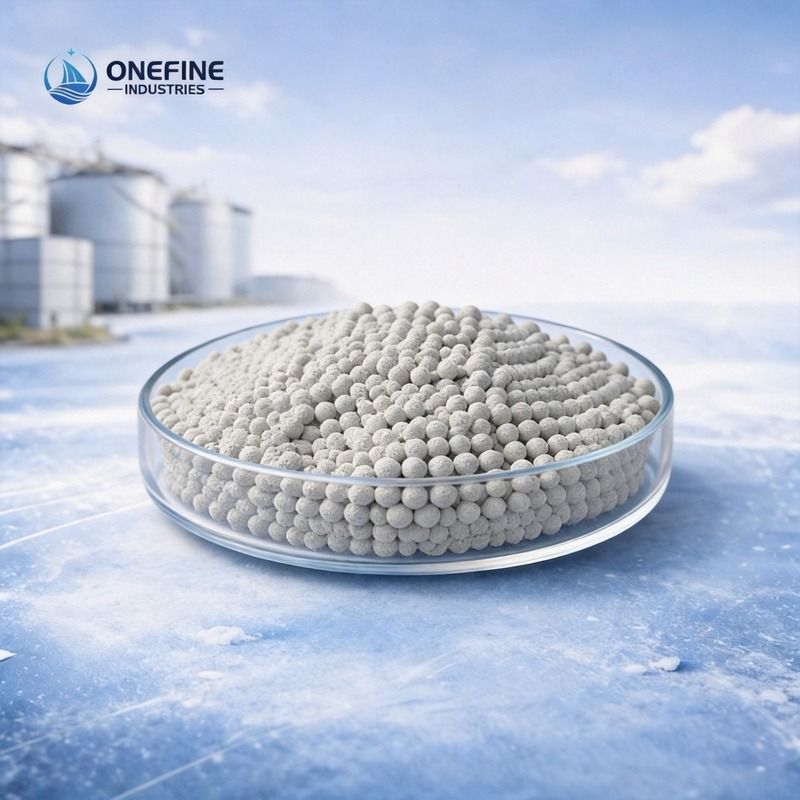
A Cu-Ni dual-system desulfurization catalyst for oil refining guard-bed applications. Removes inorganic and organic sulfur, trace chlorine, and arsenic impurities in a single step. Supplied in pre-reduced form for immediate use. Ideal as a protection agent for precious metal catalysts in reforming, hydrocracking, and isomerization units.
Dechlorination Catalyst
High-performance Na₂CO₃/Al₂O₃-based dechlorination catalyst designed for ultra-deep hydrogen chloride (HCl) removal from hydrocarbon streams with high chlorine capacity and minimal green oil formation.