How to Choose a Desulfurization Catalyst: A Buyer's Selection Guide
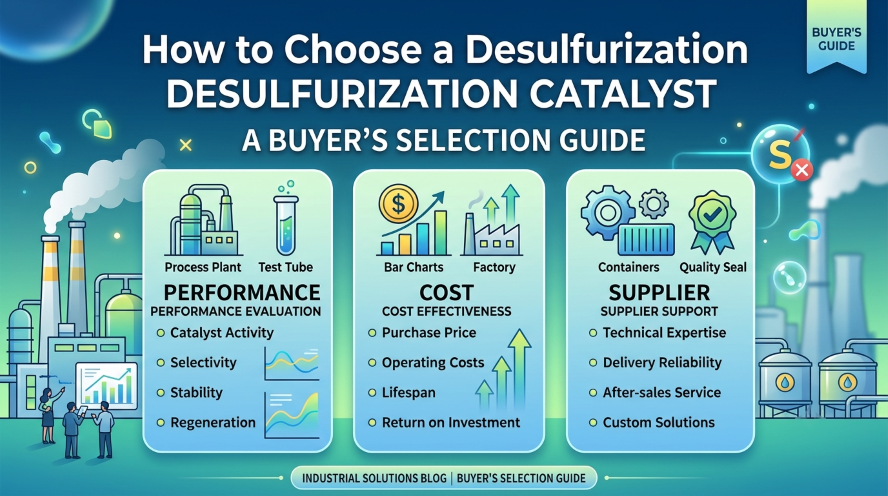
"Desulfurization catalyst" isn't a single technology — it's a category that covers everything from a simple high-temperature ZnO bed to a bifunctional catalyst that hydrolyzes COS and adsorbs H₂S in one pass. The right choice depends on specifics: how wet your gas is, what other contaminants ride along with the sulfur, how deep your outlet spec needs to go, and what you're ultimately protecting downstream. This guide walks through the questions that actually decide which catalyst fits your process, rather than starting from a product list and working backward.
Key Takeaways
- Moisture Filter: Standard Zinc Oxide fits dry to moderate feeds, while Ammonia Refining catalysts handle saturated/wet gas.
- COS Removal: Feeds with Carbonyl Sulfide (COS) require bifunctional Ultra-Precision catalysts to achieve sub-10 ppb limits.
- Multi-Impurity: Deeply Refined Catalysts handle mixed S, As, P, and O, while Cu-Ni catalysts protect reforming units from S, Cl, and As.
Question 1: Is Your Gas Stream Dry or Saturated with Moisture?
Moisture tolerance is often the first filter. A conventional zinc oxide bed performs best under dry to moderately wet conditions — sustained exposure to saturated, condensing moisture can cause the material to soften or "mudify," losing its structural integrity as a fixed bed.
- Dry to moderate-moisture feed, deep H₂S polishing: Zinc Oxide Desulfurization Catalyst — the standard choice, high-temperature chemisorption drives outlet H₂S very low.
- Saturated, wet gas — such as sour water stripper off-gas: Ammonia Refining Desulfurization Catalyst — a composite metal oxide formulation specifically engineered for water resistance, withstanding sustained boiling-water exposure without breaking down.
Question 2: Does Your Feed Carry COS, Not Just H₂S?
H₂S reacts readily with zinc oxide. Carbonyl sulfide (COS) doesn't — it's chemically stable and largely inert toward plain ZnO at normal conditions, which is why it often slips through single-function desulfurizers to poison downstream synthesis catalysts.
- Feed is essentially H₂S-only: a standard Zinc Oxide Desulfurization Catalyst handles it without added complexity.
- Feed carries meaningful COS, and you need total sulfur below 10 ppb: Ultra-Precision Desulfurization Catalyst — a bifunctional catalyst that hydrolyzes COS to H₂S and adsorbs it in the same bed, avoiding the extra reactor a conventional two-stage COS-hydrolysis-plus-ZnO setup would need.
Question 3: Do You Need to Remove More Than Sulfur — Arsenic, Phosphorus, or Oxygen Too?
Some feeds carry a genuinely mixed impurity profile, and how broad that profile is changes which guard bed makes sense.
- Sulfur plus arsenic only — the classic case ahead of palladium-based hydrogenation catalysts: Desulfurization and Arsenic Removal Catalyst, a focused CuO/Al₂O₃ guard bed.
- Sulfur, arsenic, phosphorus, and oxygen compounds together — common in liquid hydrocarbon and synthesis gas streams with a wider contamination profile: Deeply Refined Catalyst, a CuO-ZnO four-in-one guard bed that consolidates what would otherwise take two or three separate beds.
Paying for four-impurity capacity you don't need adds cost without adding protection — if your feed genuinely only carries sulfur and arsenic, the narrower catalyst is usually the more economical call.
Question 4: Are You Protecting a Reforming Unit — and Does Your Feed Carry Chlorine Too?
Catalytic reforming introduces a specific wrinkle: precious-metal catalysts (Pt/Re, Pt-Sn, Pt-Ir) are sensitive not just to sulfur and arsenic but to trace chlorine as well, and reforming feed commissioning schedules often put a premium on fast guard-bed startup.
- Reforming, hydrocracking, or isomerization feed with S, Cl, and As all present: Copper-Nickel Desulfurization Catalyst — a dual-metal system supplied pre-reduced, removing the on-site reduction step that most single-metal systems require and shortening turnaround changeout time.
Question 5: Would a Two-Stage Bulk-Plus-Polishing Setup Serve You Better Than One Bed?
Not every application calls for a single do-everything catalyst. When feed sulfur load is high, splitting bulk removal from precision polishing can be the more cost-effective design.
- Bulk H₂S removal at ambient temperature, tolerant of wet feed gas: Iron Oxide Desulfurization Catalyst — low-cost first stage.
- Precision polishing to protect the most sulfur-sensitive downstream catalysts: Zinc Oxide Desulfurization Catalyst as the second stage.
This iron-oxide-plus-zinc-oxide pairing is common enough in gas treatment trains that it's worth considering even when a single-bed option would technically work — the two-stage design can reduce overall bed size and cost for high sulfur loads.
Putting It Together
- Dry-to-moderate feed, H₂S only → Zinc Oxide Desulfurization Catalyst
- Saturated/wet gas (e.g., sour water stripper) → Ammonia Refining Desulfurization Catalyst
- COS present, need sub-10 ppb total sulfur → Ultra-Precision Desulfurization Catalyst
- Sulfur + arsenic, protecting Pd catalysts → Desulfurization and Arsenic Removal Catalyst
- Sulfur + arsenic + phosphorus + oxygen → Deeply Refined Catalyst
- Reforming feed with S, Cl, and As → Copper-Nickel Desulfurization Catalyst
- High sulfur load, bulk-plus-polishing design → Iron Oxide + Zinc Oxide (two-stage)
None of these are mutually exclusive — many plants run more than one of these catalysts across different units or process stages. The right starting point is always your actual feed assay and outlet specification, not a general impurity label.
Recommended Products from Sorbsieve
- Zinc Oxide Desulfurization Catalyst — high-temperature, deep H₂S removal for dry-to-moderate feeds
- Ammonia Refining Desulfurization Catalyst — water-resistant composite formulation for saturated gas streams
- Ultra-Precision Desulfurization Catalyst — bifunctional COS hydrolysis + H₂S adsorption in one bed
- Desulfurization and Arsenic Removal Catalyst — focused sulfur + arsenic guard bed for precious-metal protection
- Deeply Refined Catalyst — four-in-one CuO-ZnO guard bed for sulfur, arsenic, phosphorus, and oxygen
- Copper-Nickel Desulfurization Catalyst — pre-reduced dual-metal guard bed for reforming, hydrocracking, and isomerization
- Iron Oxide Desulfurization Catalyst — low-cost, ambient-temperature bulk H₂S removal
FAQ
Q1: Can I use more than one of these catalysts in the same plant? A: Yes — it's common. Many plants run different desulfurization catalysts at different process stages (for example, iron oxide for bulk feed treatment and zinc oxide for final polishing ahead of synthesis catalysts). The question isn't "which one catalyst" but "which catalyst fits which duty."
Q2: What's the single most important factor in choosing between these options? A: Feed moisture content and the specific impurity mix (COS, arsenic, phosphorus, chlorine) narrow the field faster than anything else. Outlet purity requirements and commissioning timeline are the next-level tiebreakers.
Q3: I'm not sure which impurities are actually in my feed — what should I do first? A: Start with a feed gas analysis. Our technical team can review your composition data and recommend a configuration rather than guessing from a general process description.
Q4: Is the more expensive, broader-scope catalyst always the safer choice? A: Not necessarily. Paying for impurity removal capacity your feed doesn't actually need adds cost without adding protection. Matching catalyst scope to your real feed profile is usually more cost-effective than defaulting to the broadest option.
Looking for Bulk Supply of Desulfurization Catalysts?
Sorbsieve is a trusted bulk supplier of the full desulfurization catalyst range — Zinc Oxide, Iron Oxide, Ammonia Refining, Ultra-Precision, Desulfurization and Arsenic Removal, Deeply Refined, and Copper-Nickel — serving industrial buyers across the Middle East.
We provide:
- ✅ Container-level supply (20'GP / 40'GP / 40'HQ)
- ✅ Full documentation (COA / TDS / SDS / COO)
- ✅ Multiple packaging options
- ✅ Technical support for catalyst selection based on your feed assay
- ✅ Fast quote response for industrial inquiries
Contact our team for bulk pricing, grade recommendation, and technical consultation.
Related Products
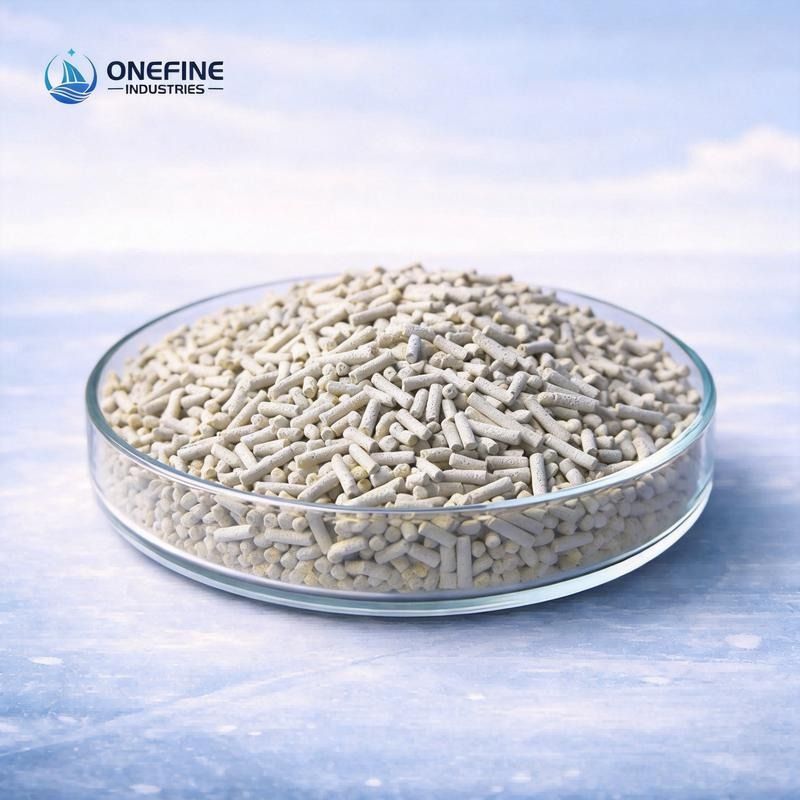
Zinc oxide desulfurization catalyst
High-purity zinc oxide (ZnO) desulfurization catalyst for fine removal of H₂S from natural gas, synthesis gas, hydrogen, and hydrocarbon feeds. Achieves outlet sulfur levels below 0.1 ppm through irreversible chemisorption. High sulfur capacity, long service life, and strong resistance to steam.
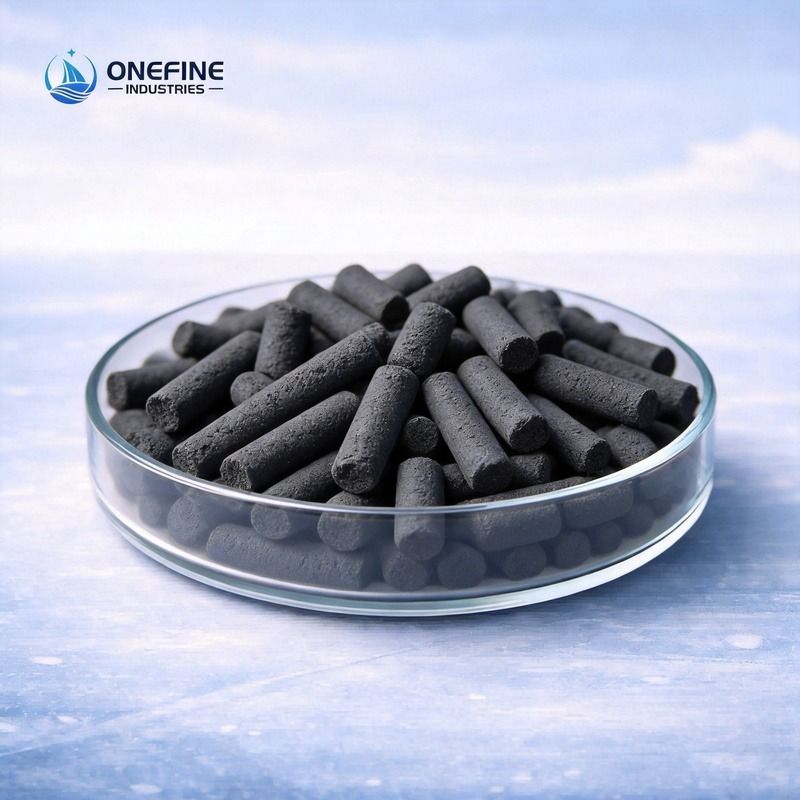
Copper-Nickel Desulfurization Catalyst
A Cu-Ni dual-system desulfurization catalyst for oil refining guard-bed applications. Removes inorganic and organic sulfur, trace chlorine, and arsenic impurities in a single step. Supplied in pre-reduced form for immediate use. Ideal as a protection agent for precious metal catalysts in reforming, hydrocracking, and isomerization units.
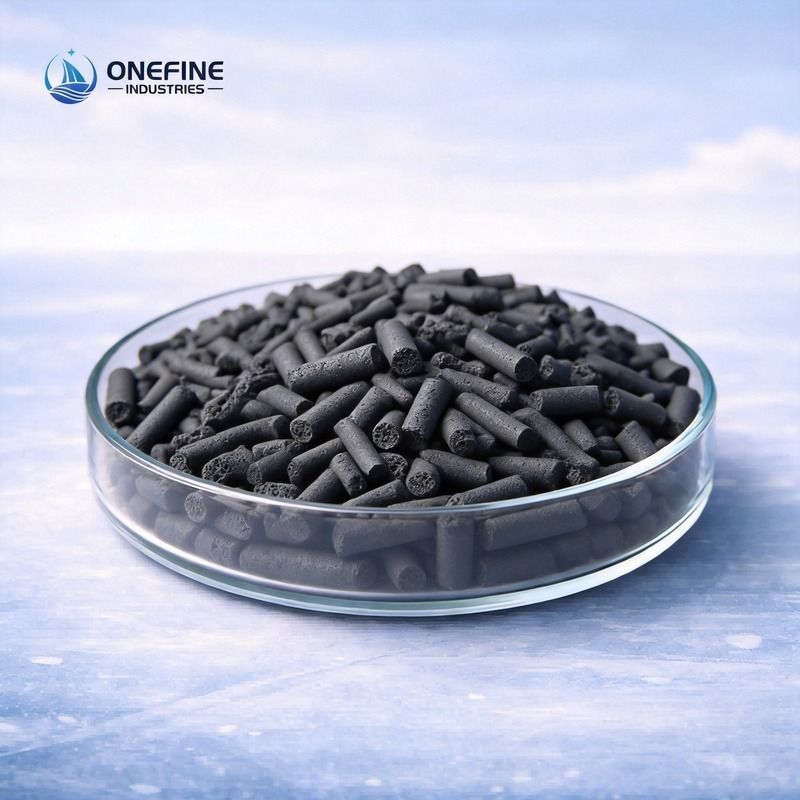
Ultra-precision Desulfurization Catalyst
A bifunctional desulfurization catalyst that couples COS hydrolysis and H₂S adsorption in a single reactor, achieving ultra-deep sulfur removal in one step. Effectively removes H₂S, COS, and trace RSH from process gases. Features high surface area, fast reaction kinetics, and broad operating range. Ideal for final purification of synthesis gas, natural gas, and light hydrocarbons.
Related Reading
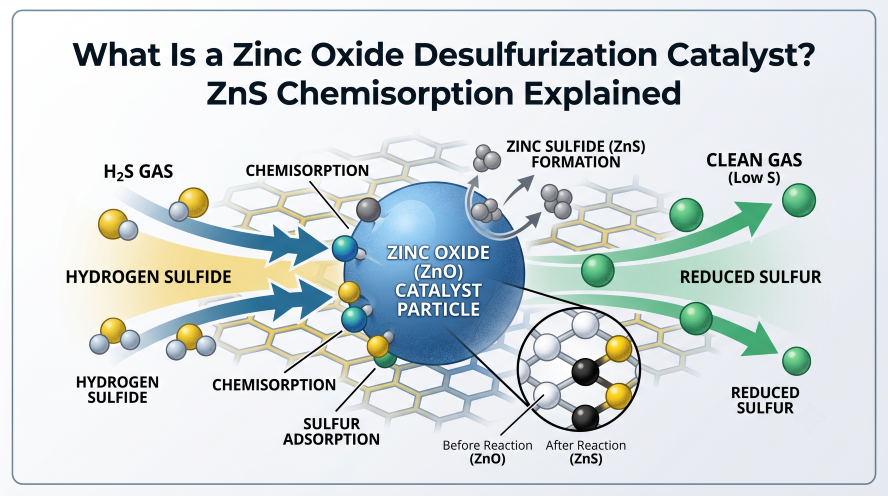
What Is a Zinc Oxide Desulfurization Catalyst? ZnS Chemisorption Explained
A plain-language guide to zinc oxide (ZnO) desulfurization catalyst: how it removes H₂S down to sub-ppm levels, where it fits in a desulfurization train, and how to decide if you need it.
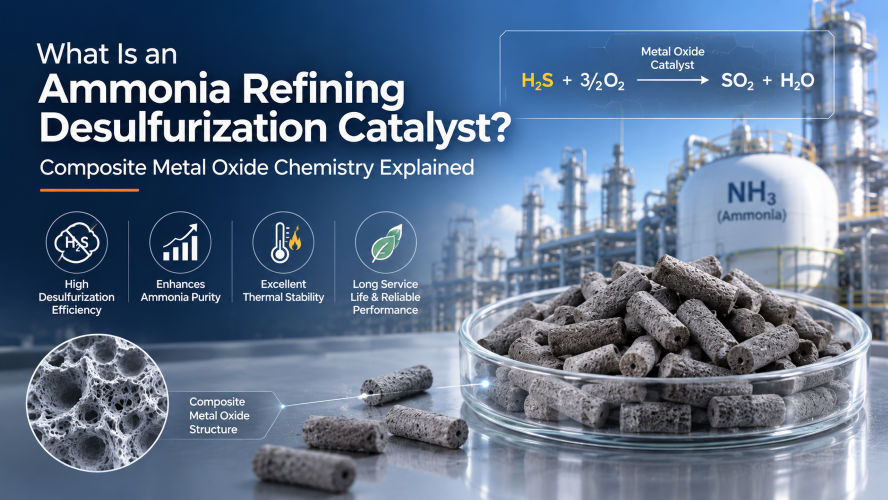
What Is an Ammonia Refining Desulfurization Catalyst? Composite Metal Oxide Chemistry Explained
Ammonia refining desulfurization catalysts use composite metal oxides to remove H₂S from wet, sour gas streams where conventional ZnO desulfurizers struggle. Learn how the chemistry works and when to choose this catalyst over standard alternatives.