Why Improper Catalyst Loading Causes Premature Channeling and Hot Spots in Hydrotreating Catalyst Beds

Key Takeaways
- Improper loading creates bridging and void spaces, leading to channeling where feed bypasses the catalyst by taking the path of least resistance.
- Because hydrotreating reactions are exothermic, areas starved of flow lose their mechanism for shedding heat, resulting in localized hot spots and accelerated coking.
- A radial temperature spread exceeding ~6°C at the same bed depth, combined with unexpected pressure drop shifts, is a primary warning sign of flow maldistribution.
- Mechanical errors during execution—such as an unlevel distributor, incorrect dense-loader settings, or leftover debris—can cripple a bed regardless of the catalyst's chemistry.
A hydrotreating reactor can be charged with premium-grade catalyst and still underperform from day one — not because the catalyst itself is deficient, but because of how it went into the vessel. Catalyst loading is often treated as a mechanical formality squeezed into a turnaround schedule. In reality, the way particles settle into the bed determines whether feed flows evenly through the catalyst or finds a path of least resistance around it. When loading leaves uneven density or voids behind, the result is channeling — and because hydrotreating reactions release heat, channeling concentrates that heat into localized hot spots instead of spreading it across the bed. This piece looks at why loading method matters and what the early warning signs look like.
What Channeling Looks Like Before It Shows Up in Yield
Channeling is the formation of a preferred flow path through the catalyst bed. Feed takes the route of least resistance, so a portion of the loaded catalyst sees far less flow than the rest — and does far less work than it was sized to do.
The clearest operating signal is radial temperature spread across the bed. In a densely loaded bed, a spread beyond roughly 6°C between thermocouples at the same bed depth is generally read as an indicator that flow is not reaching the catalyst evenly; sock-loaded beds tend to run a naturally wider spread, so the same number means less there. Pressure drop can move in either direction depending on the cause — voids from uneven loading let feed bypass with less resistance and pressure drop falls, while coking in the active flow paths narrows them and pressure drop climbs. Watching both together, alongside the temperature profile, is how operators usually catch channeling before it shows up as off-spec product or a shortened run.
Sock Loading vs. Dense Loading: Where the Problem Starts
Most loading problems trace back to how the catalyst was introduced to the vessel in the first place. Sock loading feeds catalyst through a canvas tube and lets the particles fall and settle in random orientations. That randomness creates bridging — particles stacking at angles with void spaces underneath — which lowers bulk density and leaves the bed more prone to uneven packing. Dense loading controls the fall so particles settle horizontally and pack more tightly, reducing bridging and voidage, though it typically raises initial pressure drop and requires loading equipment rather than gravity feed alone.
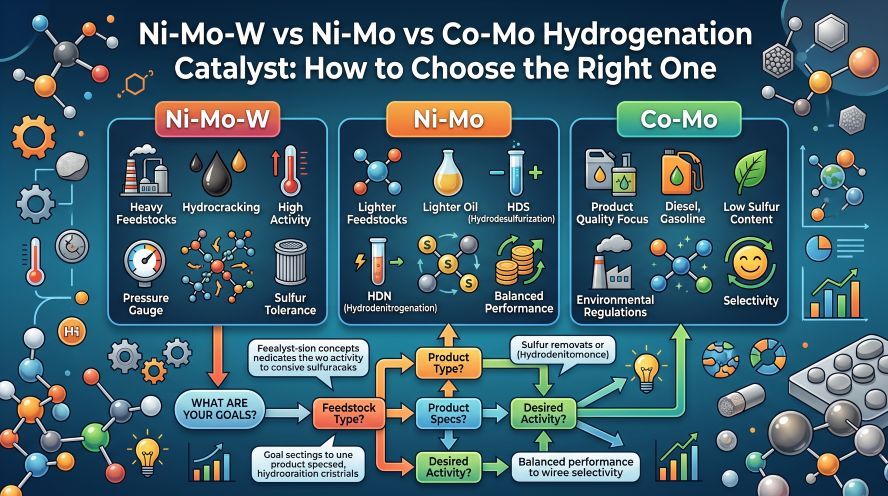
Neither method is inherently wrong — sock loading is simpler, cheaper, and more tolerant of particulates in the feed, while dense loading trades a higher upfront pressure drop for a more uniform bed over the run. The risk comes from applying either method without controlling it. This is a bed-structure issue, not a chemistry issue, so it applies the same way whether the vessel is loaded with Co-Mo Hydrogenation Catalyst, Ni-Mo Hydrogenation Catalyst, or Ni-Mo-W Hydrogenation Catalyst — all three see the same risk from the same loading error, which is part of why loading practice matters across diesel and VGO HDS service regardless of which of the three is specified.
Loading Errors That Go Beyond the Method Itself
A few specific mistakes show up repeatedly once a bed is in service:
- Unlevel distributor: If the catalyst distributor isn't level, the bed settles at a slope. Feed follows that slope rather than moving uniformly downward, producing uneven conversion and temperature across the cross-section.
- Wrong dense-loader settings: Incorrect feed rate, air pressure, or rotation speed on a dense-loading device can pile catalyst into a central mound or a "doughnut" ring instead of a flat bed, leaving parts of the cross-section under-filled.
- Debris in the bed: Packaging material, tape, or other foreign objects left in the vessel can block the distributor or deflect catalyst flow, creating localized gaps.
- Bed shrinkage over time: Sock-loaded beds settle and compact during early operation. Where that shrinkage is uneven, it can damage internals or — in radial-flow reactors in particular — open a bypass path around the catalyst.
None of these are chemistry problems, and none of them are things a catalyst specification sheet can fix. They're mechanical execution issues at the loading stage.
Why Channeling Becomes a Hot Spot in an Exothermic Bed
Hydrotreating reactions are exothermic. Where flow through the bed is even, fresh feed continuously moves through and carries reaction heat along with it, keeping the temperature profile under control. Where channeling has starved a section of the bed of flow, that section loses its main mechanism for shedding heat — and the reaction occurring there, even at reduced rate, has nowhere for the heat to go. The result is a localized hot spot rather than a bed-wide temperature rise.
Hot spots are also where coking accelerates fastest, since high local temperature combined with low flow is close to ideal coke-forming territory. Coking in that zone narrows the flow path further, pushing even more feed toward the channel and reinforcing the same imbalance. Over a run, this shows up as uneven catalyst deactivation, a shorter effective run length than the catalyst's chemistry would otherwise support, and a reactor that needs attention earlier than planned. It's a structural problem, not a selection problem — for buyers working through the three-way comparison guide, loading practice at startup matters as much as which of the three is chosen.
Recommended Products from Sorbsieve
- Co-Mo Hydrogenation Catalyst — cobalt-molybdenum catalyst for hydrodesulfurization service.
- Ni-Mo Hydrogenation Catalyst — nickel-molybdenum catalyst suited to hydrodenitrogenation-heavy feeds.
- Ni-Mo-W Hydrogenation Catalyst — nickel-molybdenum-tungsten catalyst for harder-to-treat, higher-severity service.
FAQ
Is sock loading always a mistake? No. It's widely used, costs less, and handles particulates in the feed better than dense loading. The risk isn't the method itself — it's bridging and voidage going unmanaged during loading.
How can an operator tell channeling is happening without opening the reactor? Radial temperature spread across thermocouples at the same bed depth is the main signal, read alongside pressure drop trends. Neither one alone is conclusive, but a widening temperature spread combined with an unexpected pressure drop shift is a strong indicator.
Does this loading risk apply equally to Co-Mo, Ni-Mo, and Ni-Mo-W catalysts? Yes. Channeling comes from how the bed is physically packed, not from the active metal on the catalyst, so the same loading errors create the same risk regardless of which of the three is in the vessel.
Can channeling be corrected without a full catalyst change-out? Generally no. Once bridging, voids, or bed shrinkage have set the bed's structure, correcting it means re-loading — which in practice means waiting for the next scheduled turnaround rather than a mid-run fix.
Looking for Bulk Supply of Hydrogenation Catalysts?
Sorbsieve is a trusted bulk supplier of Co-Mo, Ni-Mo, and Ni-Mo-W Hydrogenation Catalysts and complete industrial adsorbents, serving industrial buyers across the Middle East.
We provide:
- ✅ Container-level supply (20'GP / 40'GP / 40'HQ)
- ✅ Full documentation (COA / TDS / SDS / COO)
- ✅ Multiple packaging options
- ✅ Technical support for hydrogenation catalyst selection and system optimization
- ✅ Fast quote response for industrial inquiries
Contact our team for bulk pricing, product samples, and technical consultation.
Related Products
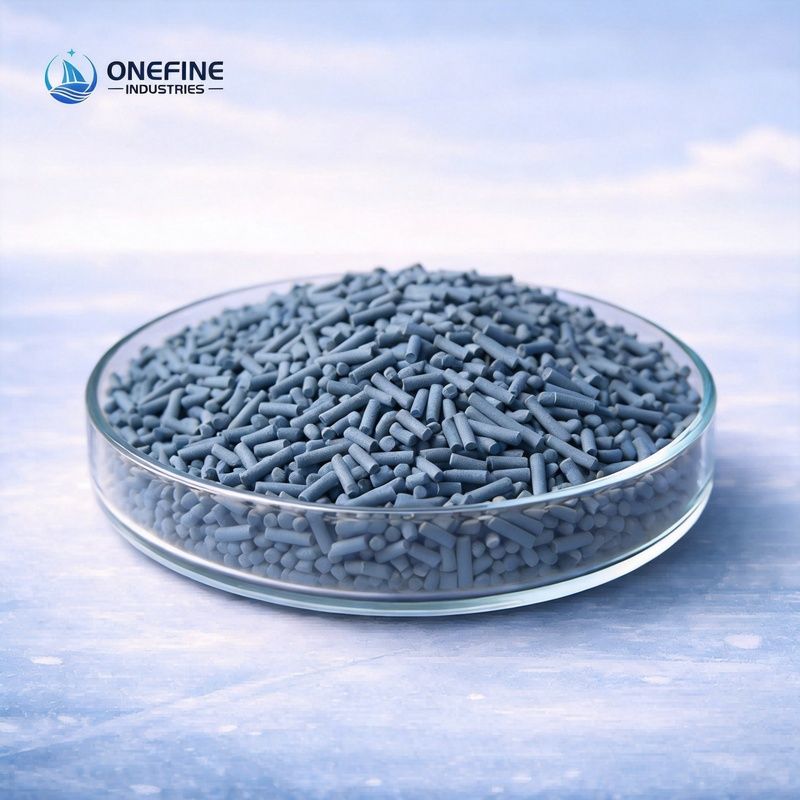
Co-Mo Hydrogenation Catalyst
A high-performance cobalt-molybdenum (Co-Mo) hydrogenation catalyst designed for hydrodesulfurization (HDS) and hydrotreating of petroleum fractions and synthesis gas. Features low light-off temperature, high mechanical strength, and excellent stability. Widely used in ammonia plant feed purification, naphtha pretreatment, refinery reforming feed desulfurization, and natural gas sweetening. Available with MOQ from 1 ton, customizable appearance, particle size, and active component loading.
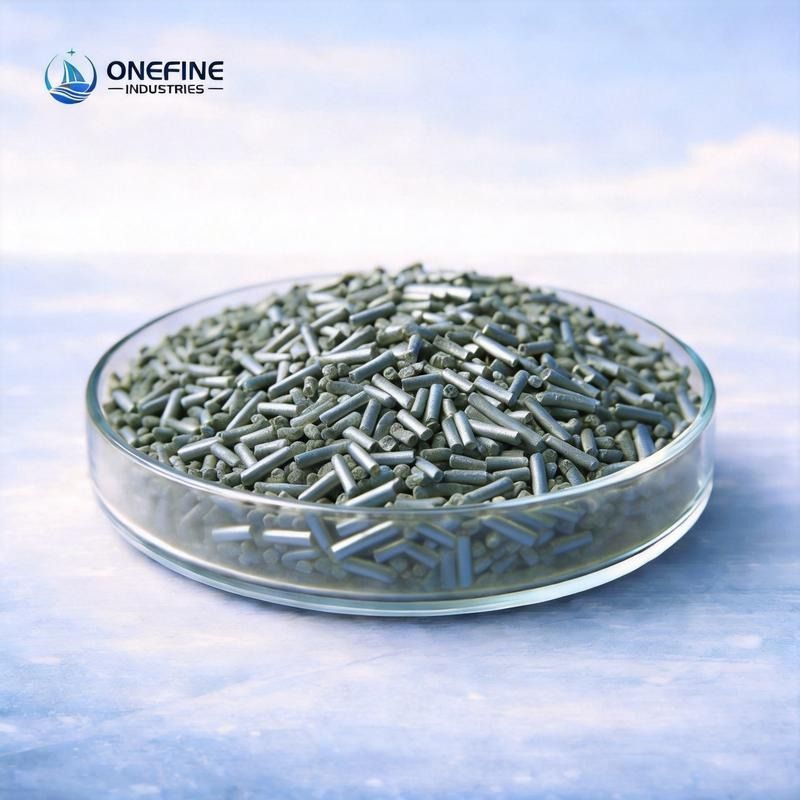
Ni-Mo Hydrogenation Catalyst
A high-performance nickel-molybdenum (Ni-Mo) hydrogenation catalyst designed for hydrodesulfurization (HDS) and hydrodenitrogenation (HDN) of medium to heavy petroleum fractions. Features superior hydrogenation activity, excellent stability, and long service life. Widely used in diesel hydrotreating, gas oil upgrading, and refractory sulfur removal. MOQ from 1 ton. Customizable appearance, particle size, and active component loading.
Ni-Mo-W hydrogenation catalyst
A trimetallic nickel-molybdenum-tungsten (Ni-Mo-W) hydrogenation catalyst engineered for ultra-deep hydrodesulfurization of challenging petroleum feeds. Combines the synergistic HDS activity of Mo-W mixed sulfide phases with Ni promoter for superior refractory sulfur removal. Widely used in diesel ULSD production, heavy gas oil upgrading, and severe hydrotreating service. Customizable appearance, particle size, and component loading.