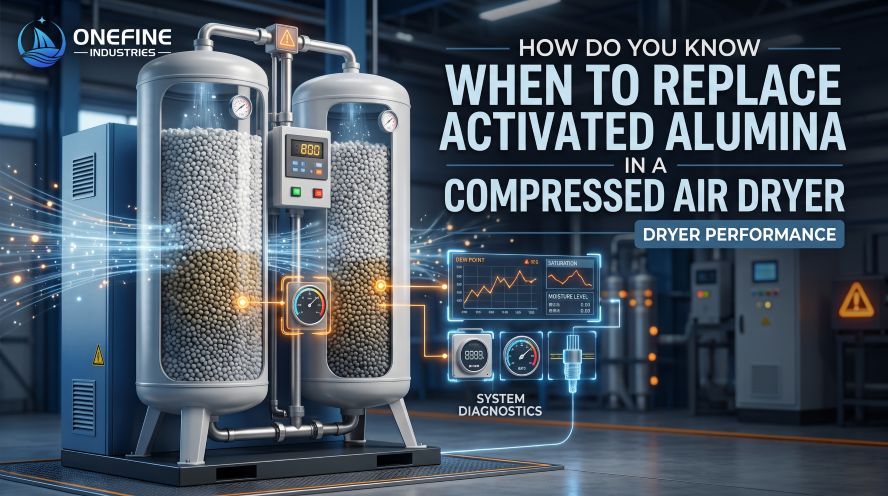
How Do You Know When to Replace Activated Alumina in a Compressed Air Dryer?
Key Takeaways
- A rising pressure dew point — not a fixed calendar date — is the most reliable signal that activated alumina has reached the end of its service life.
- Dust or fines at the bottom of the bed point to attrition, which cuts adsorption capacity and can carry through to downstream filters and instruments.
- Oil fouling and liquid water carryover are the two most common causes of early, premature replacement — not normal aging.
In a desiccant compressed air dryer, activated alumina works as the main moisture-adsorbing media, cycling through repeated adsorption and thermal regeneration as the dryer switches between towers. Like any desiccant, it doesn't fail all at once — it loses capacity gradually, and the warning signs show up well before the bed stops working completely. Catching them early avoids the real cost of a worn-out bed: corrosion in downstream piping, moisture reaching pneumatic instruments, or contamination reaching the product itself. This guide covers the three signs worth tracking and what typically drives early failure.
Sign #1: Rising Pressure Dew Point
The pressure dew point downstream of the dryer is the single most direct measurement of desiccant performance, and a steady upward drift — even while still technically within spec — is the earliest reliable warning. Activated alumina typically holds a standard pressure dew point around -40°C when the bed is in good condition; as the desiccant ages, its usable capacity per cycle shrinks, so the dew point creeps upward even though regeneration is still running on schedule. A dew point monitor or periodic spot-check catches this trend long before a visual inspection would show anything obviously wrong with the beads.
Sign #2: Dust, Fines, and Channeling in the Bed
Activated alumina is more prone to physical breakdown than some other desiccant media, and dust or fines collecting at the bottom of the vessel — or showing up in downstream particulate filters — is a direct sign of attrition. This breakdown is typically driven by repeated mechanical stress: high flow velocities, pressure surges during tower switching, and moisture overload all accelerate it. Beyond reducing the bed's total adsorption surface area, fines can also channel airflow through the bed unevenly, letting humid air bypass sections of desiccant that still have capacity left — which shows up as a dew point problem even though part of the bed is still fresh.
Sign #3: Oil Fouling and Contamination
Unlike normal thermal aging, oil fouling is a failure mode that typically points to a problem upstream — most often a compressor carrying over oil mist into the air stream, or a pre-filter that isn't doing its job. Oil and hydrocarbon residue coat the alumina's pore surfaces, blocking water molecules from reaching the adsorption sites, so capacity drops sharply rather than gradually. Liquid water carryover (from an undersized or malfunctioning pre-filter/separator) and improper regeneration cycles are the other common causes of early failure. Both call for checking the upstream equipment, not just replacing the desiccant — otherwise the new charge fouls the same way.
How Long Does Activated Alumina Actually Last?
There's no fixed replacement interval that applies across every system — service life depends heavily on air quality, flow conditions, and how well the dryer is maintained — but under normal operating conditions, activated alumina in a compressed air dryer typically lasts in the range of 3 to 5 years before replacement becomes the more economical option than continuing to regenerate a degraded bed. This is a different service-life profile from use as a molecular sieve guard bed, where the desiccant sees different loading conditions — see our guard bed replacement guide if that's the role your system uses it for. For a broader look at how activated alumina performs as the primary drying media, see compressed air dryer basics.
Recommended Products from Sorbsieve
- Activated Alumina — Sorbsieve's bulk-supply activated alumina for compressed air drying and general moisture removal applications (already linked above).
FAQ
Can activated alumina be regenerated instead of replaced? Yes — that's the normal operating mode. Thermal regeneration (typically in the 150-200°C range) restores most of the adsorption capacity for the next cycle. Replacement only becomes necessary once repeated regeneration cycles no longer restore enough capacity to hold the target dew point, or once physical damage (fines, contamination) has degraded the bed beyond what regeneration can fix.
Does a rising dew point always mean the desiccant needs replacing? Not necessarily. A rising dew point can also point to a regeneration system problem (heater, blower, or valve issue) rather than desiccant exhaustion. It's worth ruling out mechanical causes before assuming the bed itself is spent.
How do I know if dust in the system is coming from the desiccant? Fines collecting in downstream filters or at the bottom of the vessel during a bed inspection are the clearest indicator. If filter change-out frequency increases without any other change to the air system, desiccant attrition is a common cause worth checking.
What's the difference between activated alumina and molecular sieve in a compressed air dryer? They're often used together in a layered bed, with activated alumina handling the bulk moisture load and molecular sieve polishing the air to a deeper dew point. For a full side-by-side comparison, see activated alumina vs molecular sieve.
Looking for Bulk Supply of Activated Alumina?
Sorbsieve is a trusted bulk supplier of activated alumina and complete industrial adsorbents, serving industrial buyers across the Middle East.
We provide:
- ✅ Container-level supply (20'GP / 40'GP / 40'HQ)
- ✅ Full documentation (COA / TDS / SDS / COO)
- ✅ Multiple packaging options
- ✅ Technical support for activated alumina selection and system optimization
- ✅ Fast quote response for industrial inquiries
Contact our team for bulk pricing, product samples, and technical consultation.
Related Reading
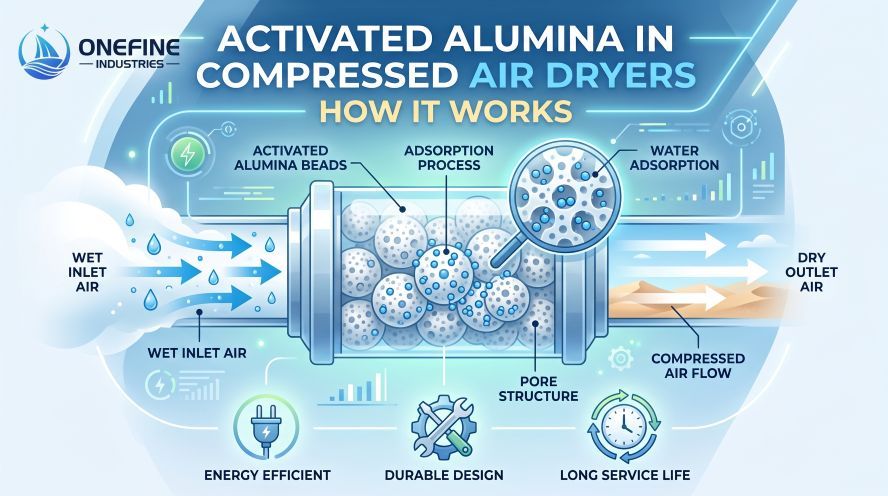
Activated Alumina in Compressed Air Dryers: How It Works
How activated alumina serves as the primary desiccant in heat-reactivated and heatless compressed air dryers, and when it's layered with molecular sieve for deeper dehydration.
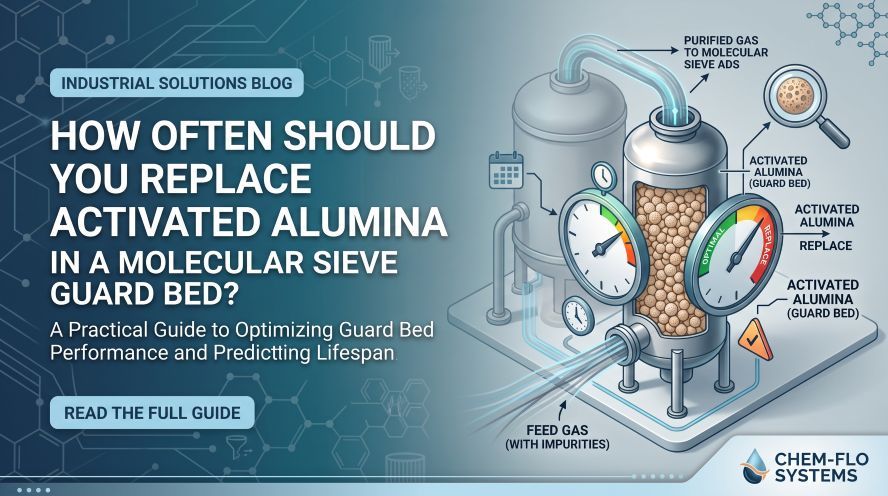
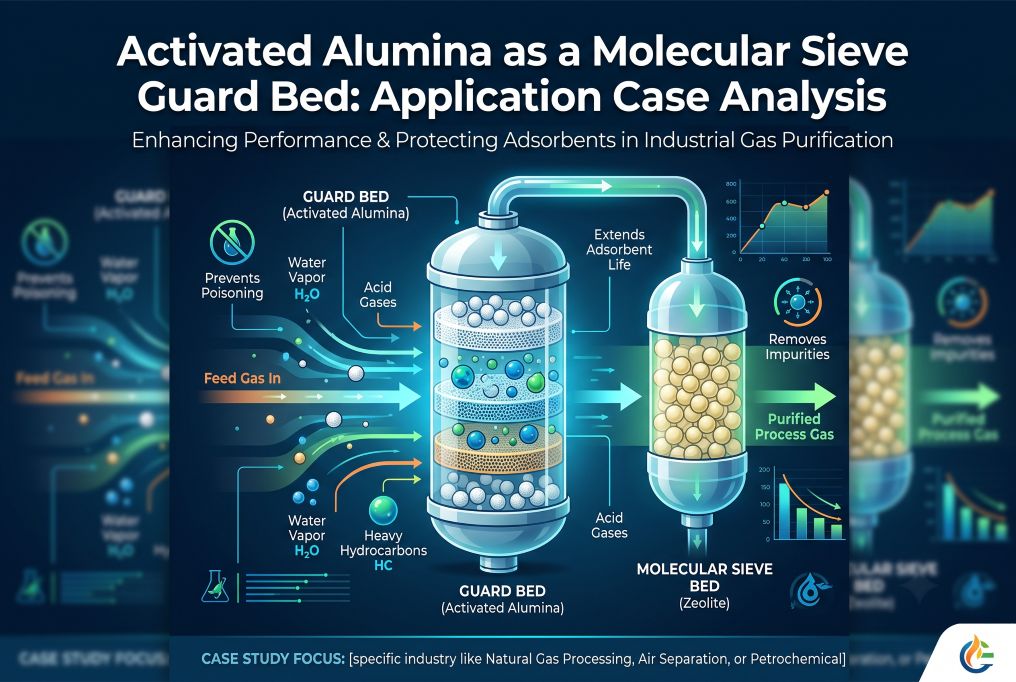
How Often Should You Replace Activated Alumina in a Molecular Sieve Guard Bed?
Activated alumina guard beds protect your molecular sieve system, but they don't last forever. Here's how to tell the difference between a bed that needs regeneration and one that needs full replacement — before a saturated guard bed lets moisture or oil straight through to your CMS or PSA oxygen system.
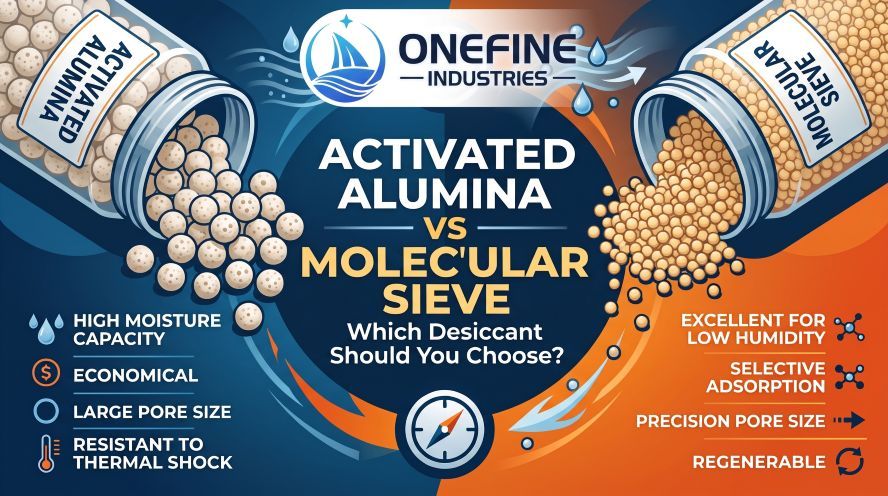
Activated Alumina vs Molecular Sieve: Which Desiccant Should You Choose?
Activated alumina and molecular sieve are both used to dry gas and liquid streams, but they work on different principles. Learn how each one performs, when to choose which, and when your process needs both.