Syngas Purification Train for Ammonia Production: Application Case Analysis
Overview
Introduction
In coal gasification and steam methane reforming (SMR) complexes, raw synthesis gas (syngas) is a crude mixture of hydrogen, carbon monoxide, carbon dioxide, and a range of catalyst poisons — trace heavy metals and sulfur compounds among them. Before this gas can feed downstream methanol synthesis, ammonia production, or Fischer-Tropsch conversion, it must pass through a rigorous multi-stage purification train.
These contaminants aren't just an operational nuisance — a single failure point in the sequence can permanently poison noble metal catalysts or trigger liquid metal embrittlement in cryogenic cold boxes. As plants scale toward thousands of metric tons of ammonia per day, the margin for error shrinks close to zero. This case walks through a five-stage purification train engineered to systematically eliminate these threats.
Key Takeaways
- Multi-Stage Protection: A five-stage train (HTS → LTS → Methanation → Mercury Removal → COS Hydrolysis) systematically protects downstream ammonia synthesis loops.
- Trace Carbon Oxide Elimination: Methanation converts residual CO and CO₂ into inert methane to prevent irreversible oxidation of iron-based synthesis catalysts.
- Heavy Metal Containment: Irreversible chemisorption captures elemental mercury, completely eliminating the risk of Liquid Metal Embrittlement (LME) in cryogenic cold boxes.
The Challenge
The core difficulty in syngas conditioning is contaminant diversity — each type requires a distinct removal mechanism. Bulk carbon monoxide must be converted, but trace carbon oxides that slip through primary separation stages will irreversibly oxidize and destroy the iron-based ammonia synthesis catalyst downstream.
Sulfur compounds present a dual threat. Standard desulfurization and amine washing handle polar hydrogen sulfide (H₂S) effectively, but carbonyl sulfide (COS) is non-polar and weakly reactive, easily slipping past these primary defenses. Trace oxygen ingress compounds the problem, oxidizing H₂S into elemental sulfur or SO₂ that reacts with alumina carriers to form stable sulfates, permanently blocking active sites.
Elemental mercury vapor poses a separate, severe threat to cryogenic infrastructure — if it reaches downstream plate-fin heat exchangers, it causes liquid metal embrittlement. Because mercury can't be captured by physical molecular sieves at standard syngas temperatures (roughly 40–80°C), specialized irreversible chemisorption is required. Managing this interlocking set of contaminants demands a precisely sequenced train where each bed protects the next.
The Solution
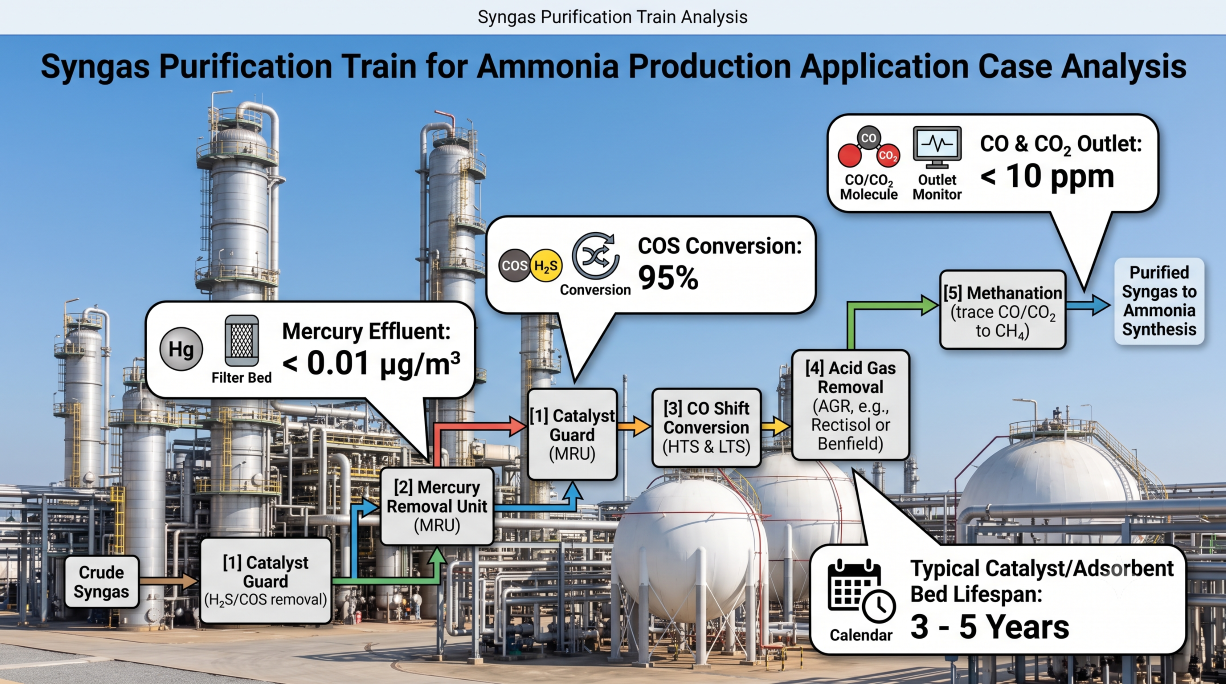
A five-stage catalytic and chemisorption purification train was deployed: High-Temperature Shift (HTS) → Low-Temperature Shift (LTS) → Methanation → Mercury Removal → COS Hydrolysis.
The first objective is adjusting the hydrogen-to-carbon-monoxide ratio via the Water-Gas Shift reaction, split into two stages to balance thermodynamics and kinetics: HTS handles bulk conversion, while LTS pushes the equilibrium further.
After the shift reactors and bulk acid gas removal, a methanation guard bed eliminates trace carbon oxides, keeping downstream iron catalysts unoxidized and active. For sulfur management, syngas routes through a COS hydrolysis catalyst — instead of adsorbing sulfur directly, it uses surface hydroxyl chemistry to unlock the COS molecule, and the resulting H₂S is captured by a downstream zinc oxide guard bed.
Finally, a mercury removal catalyst prevents liquid metal embrittlement through irreversible chemisorption, locking mercury into a stable solid before the gas reaches cryogenic units. Each contaminant is addressed by its most kinetically favorable mechanism, ensuring complete system protection.
Technical Approach
Execution relies on precise temperature, pressure, and space velocity control across all five stages.
Stage 1 & 2 — Bulk CO Conversion (HTS & LTS): Raw syngas enters the HTS reactor around 300–350°C. An iron-chromium oxide catalyst drops CO concentration from over 10% to roughly 2–3%. The cooled effluent then enters the LTS reactor at 190–230°C, where a copper-zinc-alumina catalyst pushes residual CO down to 0.1–0.3%.
Stage 3 — Trace Carbon Oxide Elimination (Methanation): Operating at 200–450°C and 0.8–4.0 MPa, a nickel-on-alumina catalyst forces residual carbon oxides to react with hydrogen, converting them to inert methane and water. Because this reaction is highly exothermic, uncontrolled CO/CO₂ spikes risk thermal runaway and sintering of nickel crystallites above roughly 500°C.
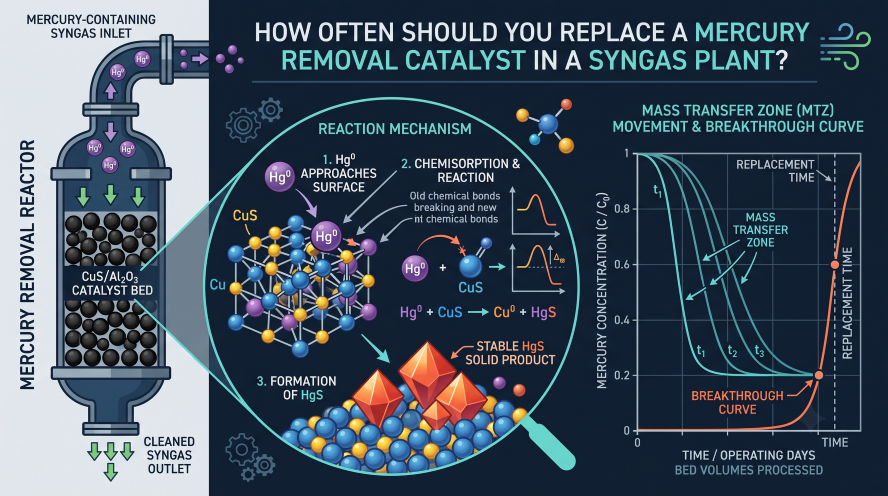
Stage 4 & 5 — COS Hydrolysis & Mercury Removal: Running at space velocities of roughly 1000–3500 h⁻¹, the COS hydrolysis stage uses surface hydroxyl groups to create a localized reaction layer that lowers the activation energy of the carbon-sulfur bond. For mercury removal, elemental mercury undergoes a solid-gas reaction at active copper sulfide sites; because this consumption is stoichiometric and irreversible, operators typically use a Lead-Lag multi-bed configuration to maintain continuous protection while saturated beds are safely swapped out. For more detail on how replacement timing is determined, see our guide on mercury removal catalyst replacement frequency.
Results & Benefits
This sequential train delivers measurable operational benefits. The methanation stage processes inlet streams with up to roughly 0.7% carbon oxides while reliably holding outlet purity to ≤10 ppm CO+CO₂ — sustaining ammonia synthesis loop efficiency and preventing costly iron catalyst deactivation.
The COS hydrolysis stage consistently converts ≥95% of stable COS into reactive H₂S, which is then neutralized downstream, eliminating a major sulfur poisoning pathway. For heavy metal management, the CuS guard bed holds mercury effluent to ≤0.01 µg/m³. Because the mercury removal stage runs on a Lead-Lag rotation, operators typically only need to swap saturated beds every 3 to 5 years. Together, this interlocking system protects the purity of the synthesis gas and the working life of every downstream catalytic asset.
Why Sorbsieve
Sorbsieve is a trusted bulk supplier of molecular sieves, activated alumina, and industrial catalysts, serving industrial buyers across the Middle East.
We provide:
- ✅ Container-level supply (20'GP / 40'GP / 40'HQ)
- ✅ Full documentation (COA / TDS / SDS / COO)
- ✅ Technical support for guard bed sizing across multi-stage purification trains
- ✅ Fast quote response for industrial inquiries
Contact our team for bulk pricing, product samples, and technical consultation.
Related Products
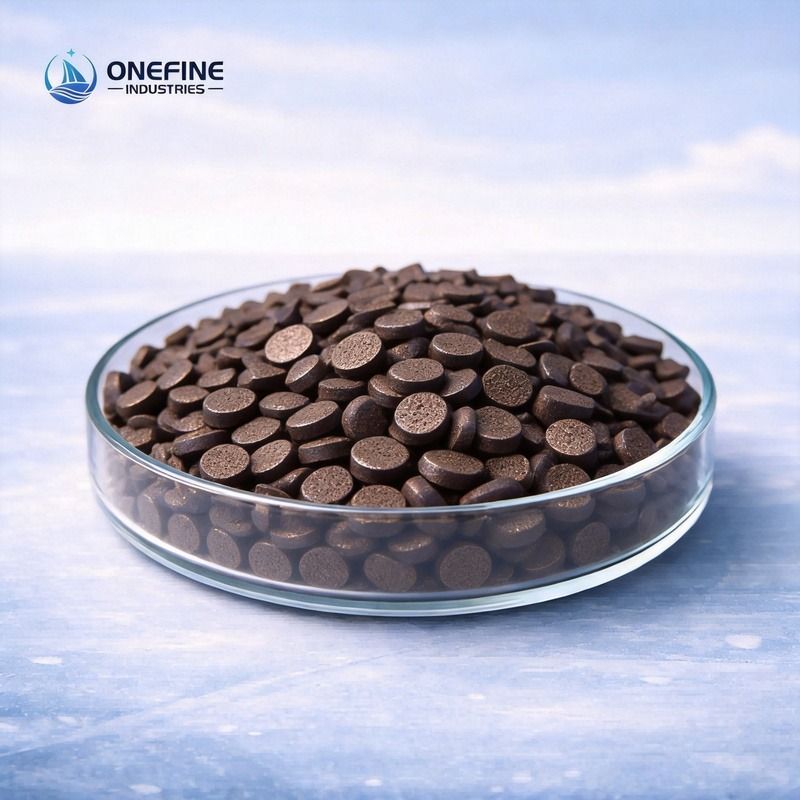
Shift Catalyst (Fe-Cr Series)
Fifth-generation iron-chromium water-gas shift catalyst manufactured via co-precipitation from nitrate precursors, delivering high CO conversion activity, low sulfur content, excellent mechanical strength, and extended service life for hydrogen production, syngas, ammonia synthesis, and methanol synthesis processes.
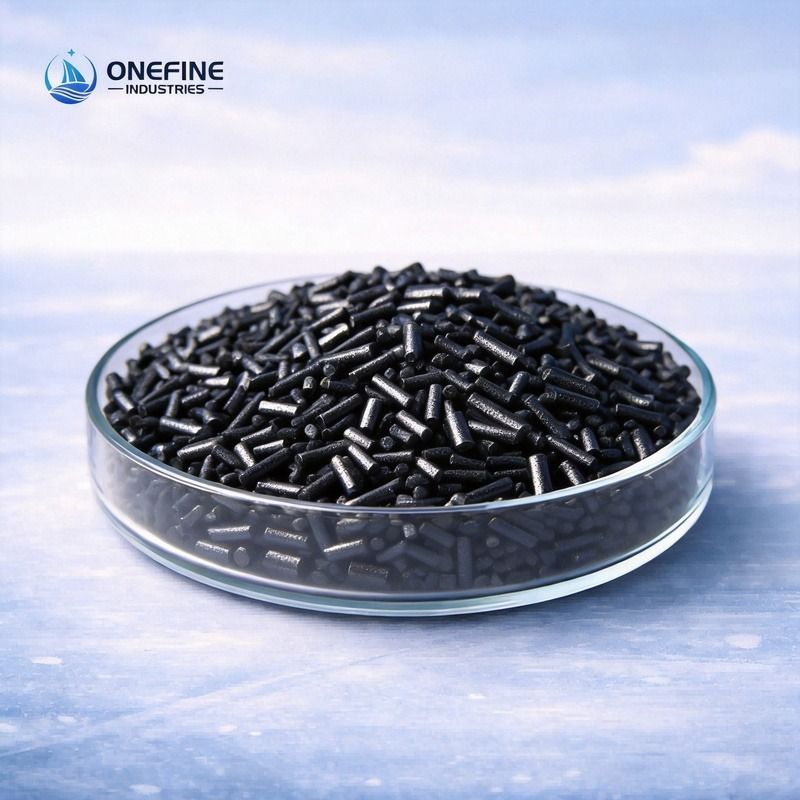
Low Temperature Shift Catalyst (Cu-Zn-Al Series)
Co-precipitation copper-zinc-aluminum low temperature shift (LTS) catalyst delivering exceptional CO conversion at 180–250 °C, with superior low-temperature activity, high mechanical strength, and excellent sulfur tolerance for hydrogen production, syngas, ammonia synthesis, and methanol synthesis processes.
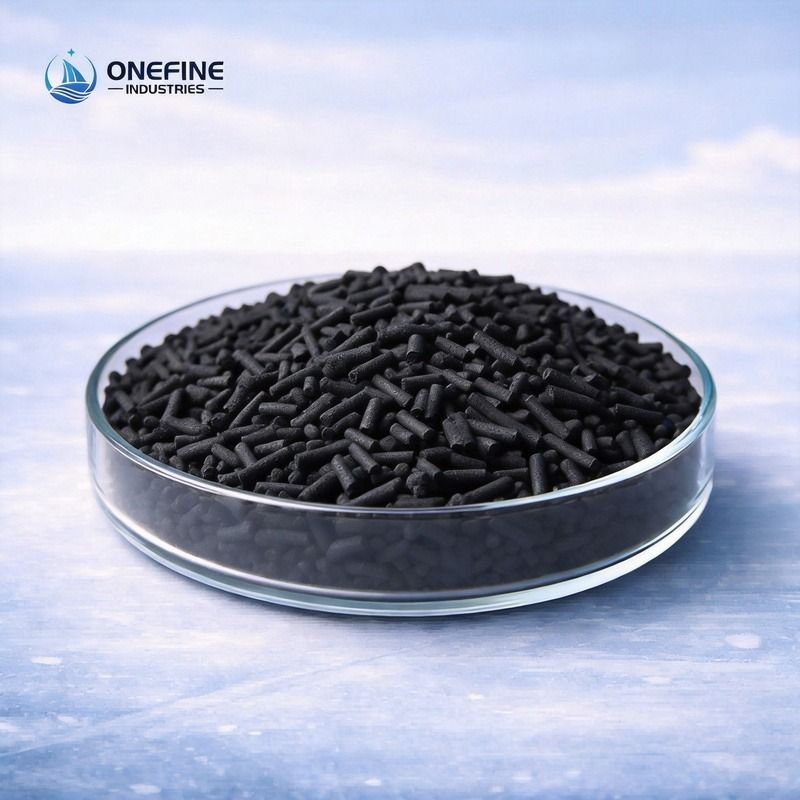
Mercury Removal Catalyst
High-capacity CuS/Al₂O₃ mercury removal catalyst engineered for the ultra-deep purification of natural gas, synthesis gas, and liquid hydrocarbons, permanently reducing elemental mercury to ≤ 0.01 µg/m³.