Comprehensive Guide to Activated Carbon Fine Desulfurization: H2S Oxidation and COS Hydrolysis Mechanisms
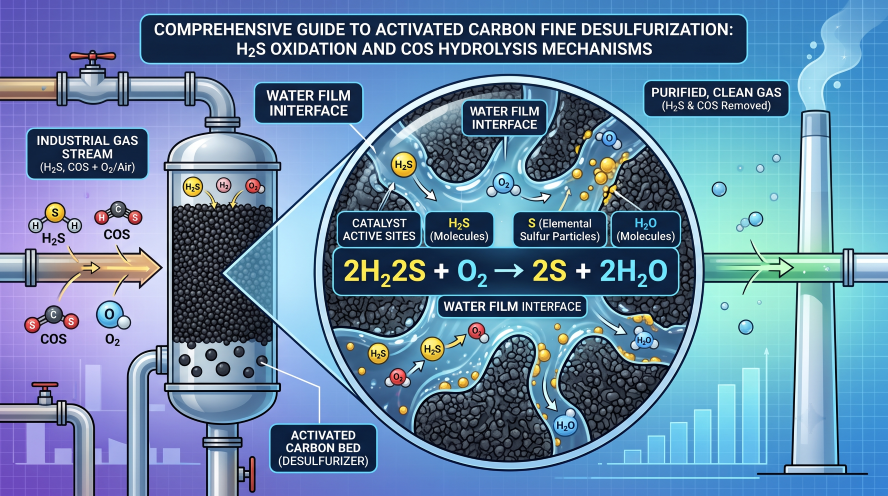
In the demanding landscape of modern petroleum refining, coal gasification, and natural gas processing, achieving ultra-deep desulfurization is no longer optional — it is a strict operational mandate. Even trace levels of hydrogen sulfide (H2S) and carbonyl sulfide (COS) can trigger catastrophic corrosion in pipeline networks, fail standard copper strip corrosion tests for LPG, and irreversibly poison highly sensitive downstream noble metal and copper-based synthesis catalysts. While conventional bulk acid gas removal units (like amine scrubbing) handle high concentrations of sulfur, they often struggle to achieve the sub-ppm purity levels required for final product specifications. Furthermore, stable, non-polar molecules like COS routinely slip through standard physical adsorption beds unreacted.
To bridge this purification gap, plant engineers increasingly rely on Activated Carbon Fine Desulfurization Catalysts as the ultimate polishing stage. Unlike simple physical filters, these carbon-based scavengers deploy a dual-action chemical mechanism. This guide explores the reaction kinetics of H2S catalytic oxidation and water-film-promoted COS hydrolysis, and diagnoses the engineering pitfalls that most often trip up an otherwise well-designed guard bed.
Key Takeaways
- This catalyst utilizes a dual mechanism: it hydrolyzes inert COS into H2S using a condensed micro-water film, then immediately oxidizes H2S into solid elemental sulfur via catalytic basic sites.
- Trace oxygen is absolutely required to drive the exothermic oxidation reaction (2H2S + O2 → 2S + 2H2O), permanently trapping solid sulfur inside the micropores.
- Engineered specifically for low-temperature thermodynamics (ambient to 50°C); running the bed too hot risks vaporizing the critical water film needed for COS conversion.
- Oxygen starvation causes premature breakthrough, while excess oxygen combined with high inlet sulfur can trigger dangerous thermal runaway and bed fires.
The Dual Mechanism: Catalytic Oxidation and Hydrolysis
The defining characteristic of a premium activated carbon fine desulfurization catalyst is its ability to simultaneously address two distinct chemical challenges: reactive H2S and stubbornly inert COS.
Catalytic oxidation of hydrogen sulfide. The highly porous structure of activated carbon is enriched with basic surface functional groups that act as active catalytic sites. When the sulfur-laden gas stream passes through the bed, the catalyst facilitates a direct, irreversible oxidation reaction between H2S and trace oxygen present in the feed:
2H2S + O2 → 2S + 2H2O
This reaction is highly exothermic. The resulting elemental sulfur is not simply adsorbed; it precipitates as a solid phase and permanently deposits deep within the carbon's microporous network. This permanent chemical trapping is what gives the catalyst its high breakthrough sulfur capacity — the exact figure is listed on the product page.
The micro-water film interface for COS hydrolysis. COS lacks the molecular polarity to be efficiently captured by basic active sites. To overcome this, the activated carbon leverages trace ambient moisture in the feed gas — capillary action in the micropores condenses this vapor into a localized "water film interface" across the internal catalytic surfaces. As gas-phase COS diffuses into this aqueous layer, it hydrolyzes into reactive intermediates:
COS + H2O ⇌ H2S + CO2
The newly synthesized H2S is immediately consumed by the primary oxidation reaction, driving the hydrolysis equilibrium continuously forward and ensuring near-total elimination of trace sulfur species.
Why Low-Temperature Operation Changes the Engineering
Unlike Zinc Oxide (ZnO) scavengers that require substantial energy expenditure to maintain elevated operating temperatures, this catalyst is engineered for low-temperature thermodynamics — full parameters are on the product page, and our Zinc Oxide desulfurization guide covers the high-temperature alternative in more depth. Two things matter more here than temperature by itself:
Don't let the bed run too hot. Pushing well past the catalyst's design temperature risks vaporizing the trace moisture needed to sustain the micro-water film, which quietly kills COS hydrolysis performance even while H2S oxidation keeps working — a failure mode that's easy to miss because outlet H2S can still look fine for a while.
Space velocity is a phase question, not just a number. For gas-phase streams, mass-transfer resistance is low and the bed tolerates a wide range of throughput. For liquid-phase applications (liquid naphtha or LPG), fluid viscosity is much higher, so engineers need to size for lower liquid hourly space velocity to give heavier hydrocarbon molecules enough residence time to reach the active sites. Exact GHSV/LHSV ranges are on the product page.
For buyers comparing this catalyst against Sorbsieve's other desulfurization options, the COS Hydrolysis Catalyst handles COS conversion alone and pairs with a separate H2S scavenger, while the Ultra-Precision Desulfurization Catalyst is also bifunctional but captures H2S by adsorption instead of oxidation — worth a look if your process can't tolerate an exothermic in-bed reaction.
The Real Operating Variable: Trace Oxygen Management
The Achilles' heel of any activated carbon desulfurization unit is oxygen starvation, not temperature. The oxidation reaction (2H2S + O2 → 2S + 2H2O) proves that stoichiometric oxygen is an absolute requirement for permanently fixing the sulfur.
Oxygen dosing. In many industrial processes — off-gas purification or specific syngas fractions — the inherent trace oxygen slipping from upstream units already satisfies the required O2:H2S ratio. In heavily anaerobic environments, such as pure cryogenic hydrogen streams or deeply fractionated liquid hydrocarbons, the catalyst rapidly saturates physically and fails chemically. In these scenarios, operators install precision micro-dosing skids to inject controlled volumes of instrument air or pure oxygen upstream of the guard bed.
Avoiding excessive oxygen. The opposite failure mode is just as real: because H2S oxidation is intensely exothermic, an oversupply of O2 combined with a high inlet sulfur concentration can trigger a localized thermal runaway inside the carbon bed. If internal temperature climbs too high, the combustible activated carbon carrier can auto-ignite — a bed fire that also releases toxic sulfur dioxide (SO2). Continuous, automated monitoring of both inlet H2S and O2 concentrations is a mandatory safety protocol, not an optional refinement.
Diagnosing Premature Breakthrough
If trace H2S is detected at the reactor outlet long before the theoretical sulfur loading limit is reached, two culprits should be investigated first:
Loss of the micro-water film. If the feed gas undergoes aggressive upstream dehydration — for example, passing through a severe molecular sieve desiccant bed — the gas can become entirely bone-dry. Without trace moisture, the activated carbon loses its localized aqueous film, instantly halting COS hydrolysis and severely retarding H2S mass transfer.
Liquid condensation and pore blinding. While the catalyst needs trace vapor moisture, the presence of free liquid water or heavy hydrocarbon condensates is lethal. Liquid flooding physically suffocates the carbon pellets, blocking the micropores and blinding the active sites from the target sulfur compounds.
Safe catalyst unloading. Because elemental sulfur is permanently bonded within the carbon matrix, the catalyst is non-regenerable and must be treated as a sacrificial chemical reactant. Spent activated carbon can be pyrophoric — when opening the reactor for a change-out, the saturated bed must be cooled and purged with inert nitrogen (N2) to prevent spontaneous combustion upon exposure to atmospheric oxygen.
Recommended Products from Sorbsieve
Zinc Oxide Desulfurization Catalyst — A high-density ZnO scavenger engineered for elevated temperature operations. It permanently captures H2S through irreversible chemisorption, forming solid ZnS, and remains the standard choice for hot process streams where this catalyst's low-temperature design isn't the right fit.
Activated Alumina for Purification — Premium γ-Al2O3 adsorbents featuring large surface areas and strong crush strength. Used for deep dehydration and trace heavy metal scavenging, and as a stable, inert catalyst carrier in severe petrochemical environments.
FAQ
Q1: Can we use this activated carbon catalyst to remove bulk H2S (e.g., concentrations > 1%)?
No. While the catalyst possesses a large sulfur capacity, it is strictly designed as a final-stage "fine desulfurization" or polishing guard bed. If inlet H2S concentrations exceed several hundred parts-per-million, the intense exothermic heat generated by the rapid catalytic oxidation will cause localized thermal runaway, potentially igniting the carbon bed. Bulk sulfur must first be removed by upstream amine scrubbing or liquid redox units.
Q2: How does the catalyst perform in liquid LPG sweetening compared to caustic wash?
The activated carbon catalyst offers a distinct environmental and operational advantage over traditional liquid caustic (NaOH) wash systems. Caustic washes generate large volumes of hazardous, foul-smelling spent caustic waste that requires expensive treatment. The dry-bed activated carbon system permanently converts and traps sulfur as solid elemental sulfur within the pellet, producing zero liquid effluent while reliably ensuring the LPG passes the ASTM copper strip corrosion test.
Q3: How is this different from running a separate COS Hydrolysis Catalyst and ZnO bed in series?
Functionally, the two approaches accomplish the same overall job — converting COS and capturing H2S — but this catalyst does both in a single vessel rather than two. A two-stage train (hydrolysis catalyst followed by ZnO) generally gives you higher total sulfur capacity and lets you replace each bed independently, which some operators prefer for maintenance planning. The single-bed activated carbon approach reduces footprint, piping, and instrumentation, but ties both functions to one changeout schedule. Which is better depends on available vessel space and how your plant likes to manage bed replacements.
Q4: What actually causes a thermal runaway in this type of bed, and how is it prevented?
Thermal runaway happens when oxygen dosing outpaces what the H2S oxidation reaction needs, combined with a high inlet sulfur concentration — the excess exothermic heat has nowhere to go and the bed temperature climbs uncontrolled. It's prevented through continuous monitoring of both inlet H2S and O2 concentrations, keeping oxygen dosing close to stoichiometric rather than in excess, and staging bulk sulfur removal upstream so this catalyst never sees concentrations above its polishing-stage design range.
Looking for Bulk Supply of Activated Carbon Fine Desulfurization Catalyst?
Sorbsieve is a trusted bulk supplier of industrial catalysts and complete adsorbents, serving industrial buyers across the Middle East and worldwide. We provide:
- ✅ Container-level supply (20'GP / 40'GP / 40'HQ)
- ✅ Full documentation (COA / TDS / SDS / COO)
- ✅ Multiple packaging options
- ✅ Technical support for catalyst selection and system optimization
- ✅ Fast quote response for industrial inquiries
Contact our team for bulk pricing, product samples, and technical consultation.
Related Products
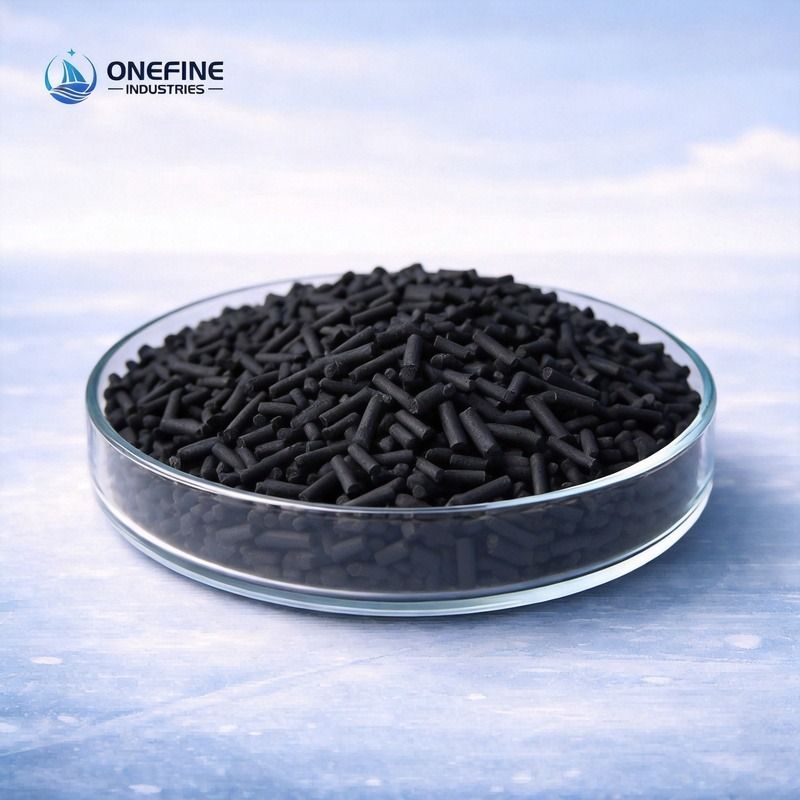
Activated Carbon Fine Desulfurization Catalyst
High-capacity activated carbon supported fine desulfurization catalyst designed for simultaneous H2S oxidation and COS hydrolysis in syngas, LPG, and CO2 streams, achieving ≥12 wt% breakthrough sulfur capacity.
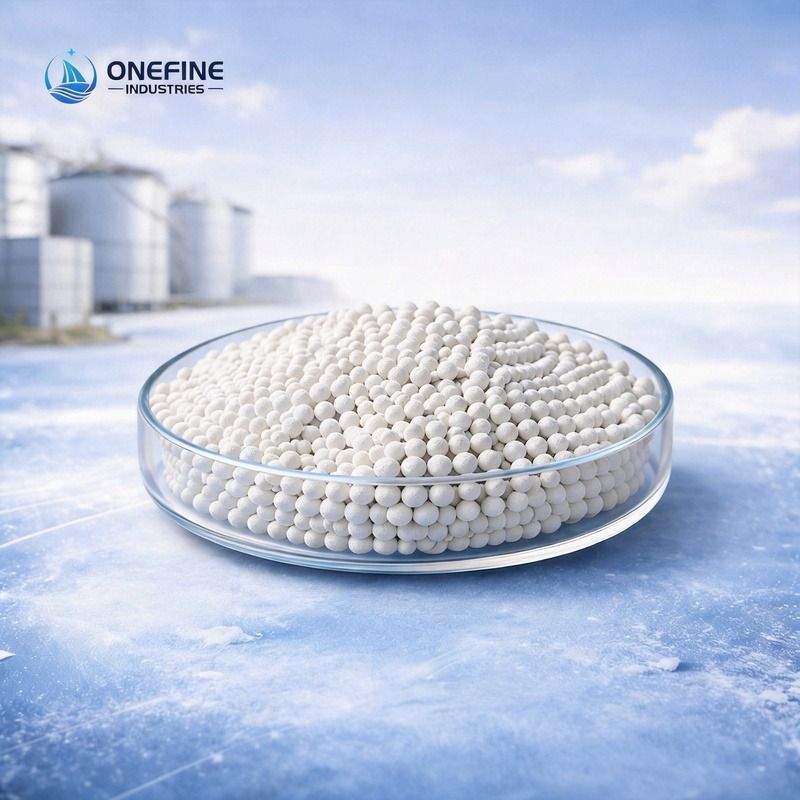
COS Hydrolysis Catalyst
High-efficiency γ-Al2O3 supported COS hydrolysis catalyst designed to convert carbonyl sulfide into easily removable H2S with ≥95% conversion efficiency across diverse hydrocarbon streams.
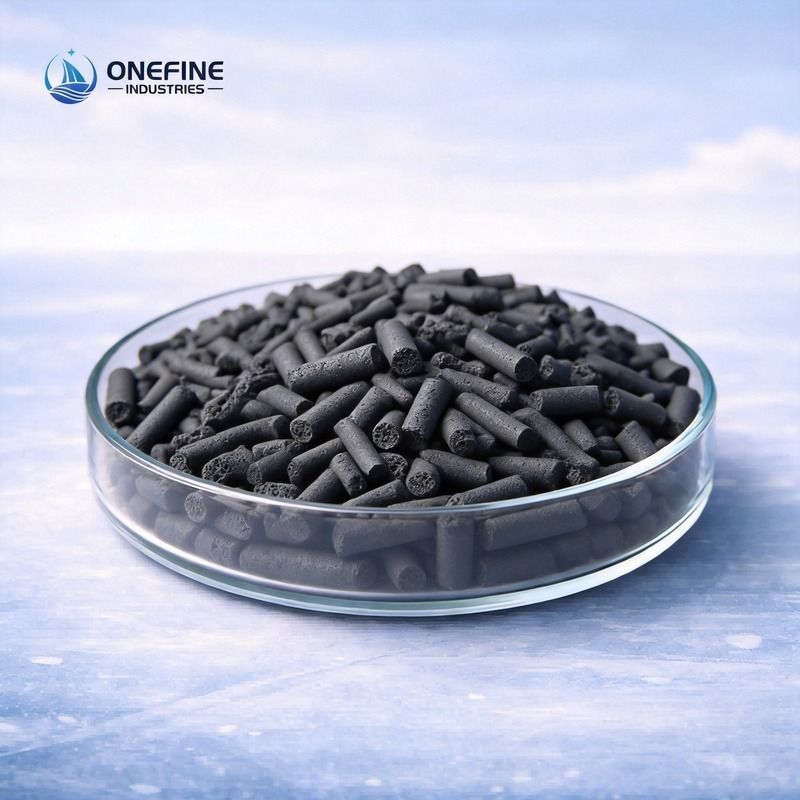
Ultra-precision Desulfurization Catalyst
A bifunctional desulfurization catalyst that couples COS hydrolysis and H₂S adsorption in a single reactor, achieving ultra-deep sulfur removal in one step. Effectively removes H₂S, COS, and trace RSH from process gases. Features high surface area, fast reaction kinetics, and broad operating range. Ideal for final purification of synthesis gas, natural gas, and light hydrocarbons.
Related Reading
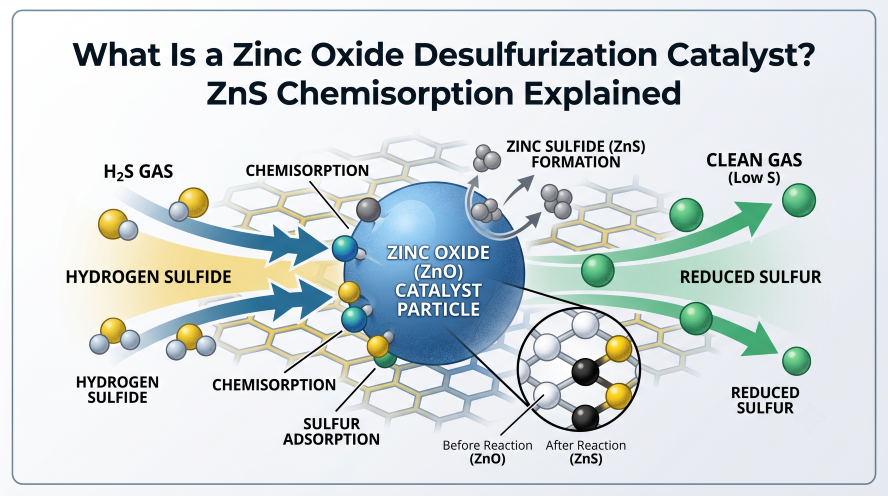
What Is a Zinc Oxide Desulfurization Catalyst? ZnS Chemisorption Explained
A plain-language guide to zinc oxide (ZnO) desulfurization catalyst: how it removes H₂S down to sub-ppm levels, where it fits in a desulfurization train, and how to decide if you need it.
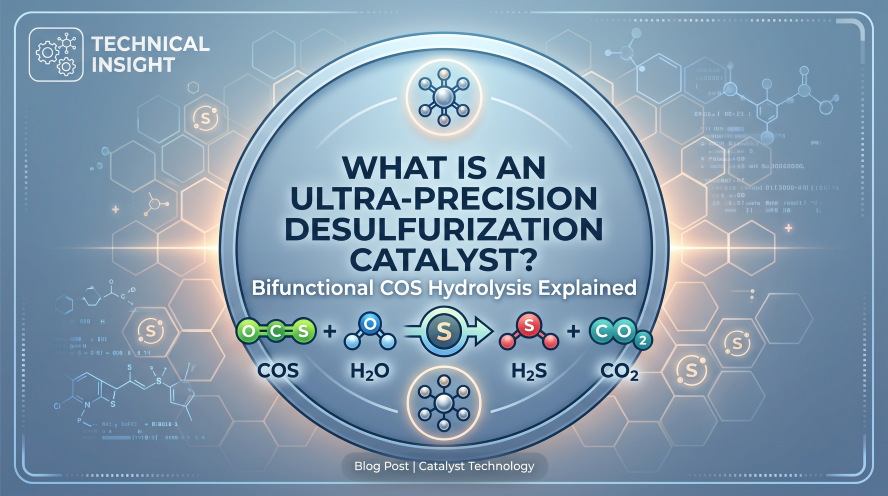
What Is an Ultra-Precision Desulfurization Catalyst? Bifunctional COS Hydrolysis Explained
A plain-language guide to how bifunctional ultra-precision desulfurization catalysts combine COS hydrolysis and H₂S adsorption in one reactor bed — and when this one-step approach makes more sense than conventional two-stage ZnO desulfurization.