Comprehensive Guide to COS Hydrolysis Catalysts: Chemical Mechanisms, Water Film Interface, and Deep Desulfurization
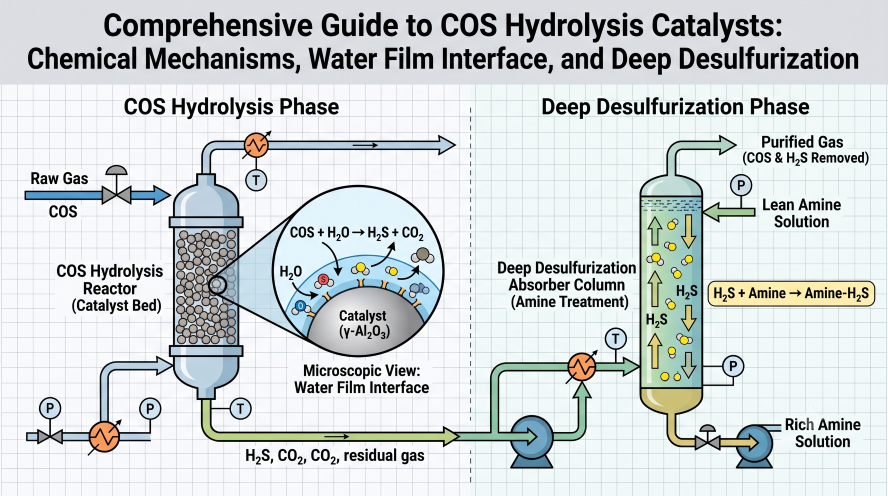
In modern petroleum refining, coal gasification, and petrochemical processing, removing trace sulfur is a mandatory prerequisite for protecting downstream catalytic units. While hydrogen sulfide (H2S) is readily captured by standard scavengers, carbonyl sulfide (COS) is a weakly reactive, non-polar molecule with negligible chemical affinity for conventional adsorbents. Left untreated, trace COS slips through primary desulfurization stages and poisons sensitive noble-metal reforming catalysts, copper-based methanol synthesis catalysts, and Ziegler-Natta polymerization systems.
To bridge this gap, engineers deploy specialized COS Hydrolysis Catalysts as an upstream conversion stage. Rather than trapping sulfur permanently, they chemically unlock the COS molecule into reactive H2S, which can then be captured by downstream guard beds. This guide walks through the reaction mechanism, how it fits into a real desulfurization train, and the failure modes plant operators should watch for.
Key Takeaways
- Carbonyl sulfide (COS) is non-polar and slips past traditional ZnO beds; a hydrolysis guard bed is mandatory to convert it into reactive H2S.
- The reaction relies on a microscopic water-film interface on the γ-Al2O3 surface, which uses trace feed moisture to chemically cleave the carbon-sulfur bond.
- Hydrolysis is a conversion step, not a capture step. It must be paired with a downstream scavenger like ZnO or a caustic wash to permanently remove the generated H2S.
- Trace oxygen in the feed gas is lethal to the catalyst, causing H2S to oxidize into sulfates that permanently blind the active basic sites.
The Chemistry: Why COS Needs a Different Approach
The core reaction is an endothermic, equimolar hydrolysis:
COS (g) + H2O (g/l) ⇌ H2S (g) + CO2 (g)
The catalyst carrier is a pseudo-boehmite-derived gamma-alumina engineered with a large specific surface area and a widely distributed macroporous matrix. Surface area alone, however, isn't what makes the reaction work. The defining feature of a functioning COS hydrolysis catalyst is its "micro-water film interface": basic hydroxyl groups on the alumina surface trap trace moisture already present in the feed gas, forming a nanometer-thick aqueous boundary layer inside the pores. As non-polar COS diffuses into this film, it dissolves and undergoes nucleophilic attack by the polarized water molecule, cleaving the carbon-sulfur bond and releasing H2S and CO2. Exact operating parameters — temperature window, pressure range, crush strength, and space velocity — are detailed on the COS Hydrolysis Catalyst product page.
How It Fits Into a Real Desulfurization Train
Because a hydrolysis catalyst only converts COS rather than capturing sulfur, it is almost never deployed as a standalone unit — it's the unlocking stage in a multi-bed sequential train. Two common configurations:
Syngas & dry gas purification (hydrolysis + ZnO): In coal gasification and steam methane reforming loops, raw syngas is routed through the COS hydrolysis bed first, converting the bulk of the COS into H2S. The gas then enters a Zinc Oxide Desulfurization Catalyst guard bed, which chemisorbs the H2S irreversibly, driving total sulfur down to trace levels before the gas reaches the copper or iron synthesis catalysts.
Liquid LPG & naphtha sweetening (hydrolysis + caustic wash): Because COS is non-acidic, it passes straight through a standard caustic (NaOH) wash unreacted. Installing a COS hydrolysis reactor upstream converts the inert COS into acidic H2S, which the caustic wash unit can then neutralize easily — helping the liquid product meet copper strip corrosion specifications.
When a single vessel is preferred: Some buyers would rather not run two separate beds. For that use case, Sorbsieve's Ultra-Precision Desulfurization Catalyst combines COS hydrolysis and H2S capture in a single bifunctional bed. It's covered in more detail in our guide to that catalyst. The trade-off between the two-step and one-step approach usually comes down to vessel footprint versus sulfur capacity and ease of individual bed replacement — worth discussing with your process engineer against your specific feed profile.
Deactivation: The Oxygen Problem
Unlike a sacrificial scavenger, the alumina active sites here aren't stoichiometrically consumed by sulfur — the reaction is catalytic, not adsorptive. The catalyst instead fails through a specific poisoning pathway called sulfation: if trace oxygen enters the feed, the freshly formed H2S oxidizes into elemental sulfur or SO2, which reacts with the alumina's basic sites to form stable aluminum sulfates. This permanently blocks the hydroxyl sites responsible for the water-film mechanism and is not reversible through standard thermal regeneration. Keeping feed-gas oxygen strictly controlled is the single most important operating discipline for protecting the investment. Typical service-life expectations and the exact conditions that shorten it are covered on the product page.
Recommended Products from Sorbsieve
Zinc Oxide Desulfurization Catalyst — A high-density ZnO scavenger designed to be installed directly downstream of the COS hydrolysis unit. It permanently captures H2S through irreversible chemisorption, providing ultimate protection for noble-metal synthesis catalysts.
Ultra-Precision Desulfurization Catalyst — A bifunctional catalyst that combines COS hydrolysis and H2S adsorption in a single vessel, for buyers who prefer a smaller-footprint, one-step guard bed over a two-stage configuration.
FAQ
Q1: Can COS hydrolysis and H2S capture be combined into a single guard bed, or are two separate catalysts always required?
Both configurations exist. The traditional approach uses two sequential beds — a hydrolysis catalyst followed by a dedicated H2S scavenger such as ZnO — which generally offers higher total sulfur capacity and lets you replace each bed independently as it saturates. A bifunctional catalyst can also perform both steps in one vessel, which reduces footprint and piping complexity at the cost of a more specialized replacement cycle. The right choice depends on available vessel space, sulfur loading, and how your maintenance team prefers to manage bed changeouts.
Q2: Are there differences between operating this catalyst in gas-phase versus liquid-phase hydrocarbons?
Yes. The chemical mechanism is identical, but the fluid dynamics differ. Gas-phase streams (like SMR syngas) exhibit much faster molecular diffusion, allowing efficient operation at high space velocities. Liquid-phase streams (like LPG or liquid propylene) have higher viscosity and mass-transfer resistance, so liquid-phase reactors need to run at lower space velocities to give the COS enough residence time to reach the water film. Exact recommended space-velocity ranges for each phase are listed on the product page.
Q3: What happens if COS breaks through the hydrolysis bed unconverted?
If the hydrolysis catalyst is exhausted, poisoned, or undersized for the feed rate, unconverted COS will pass straight through a downstream ZnO or caustic wash stage — both of which are essentially blind to it — and continue into the process. Depending on the application, that means COS reaching methanol/ammonia synthesis catalysts, Ziegler-Natta polymerization catalysts, or failing a copper strip corrosion spec on finished LPG. Because COS breakthrough is often invisible to standard H2S-focused sulfur analyzers, plants running tight sulfur specs should monitor total sulfur (not just H2S) at the outlet of the hydrolysis stage.
Looking for Bulk Supply of COS Hydrolysis Catalyst?
Sorbsieve is a trusted bulk supplier of COS Hydrolysis Catalyst and complete industrial adsorbents, serving industrial buyers across the Middle East.
We provide:
- ✅ Container-level supply (20'GP / 40'GP / 40'HQ)
- ✅ Full documentation (COA / TDS / SDS / COO)
- ✅ Multiple packaging options
- ✅ Technical support for COS Hydrolysis Catalyst selection and system optimization
- ✅ Fast quote response for industrial inquiries
Contact our team for bulk pricing, product samples, and technical consultation.
Related Products
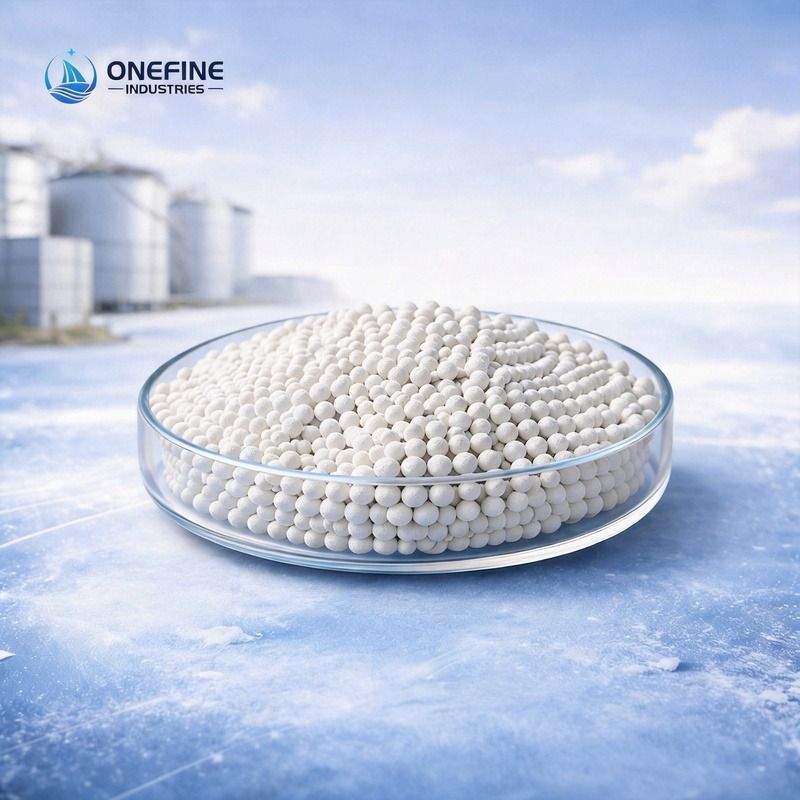
COS Hydrolysis Catalyst
High-efficiency γ-Al2O3 supported COS hydrolysis catalyst designed to convert carbonyl sulfide into easily removable H2S with ≥95% conversion efficiency across diverse hydrocarbon streams.
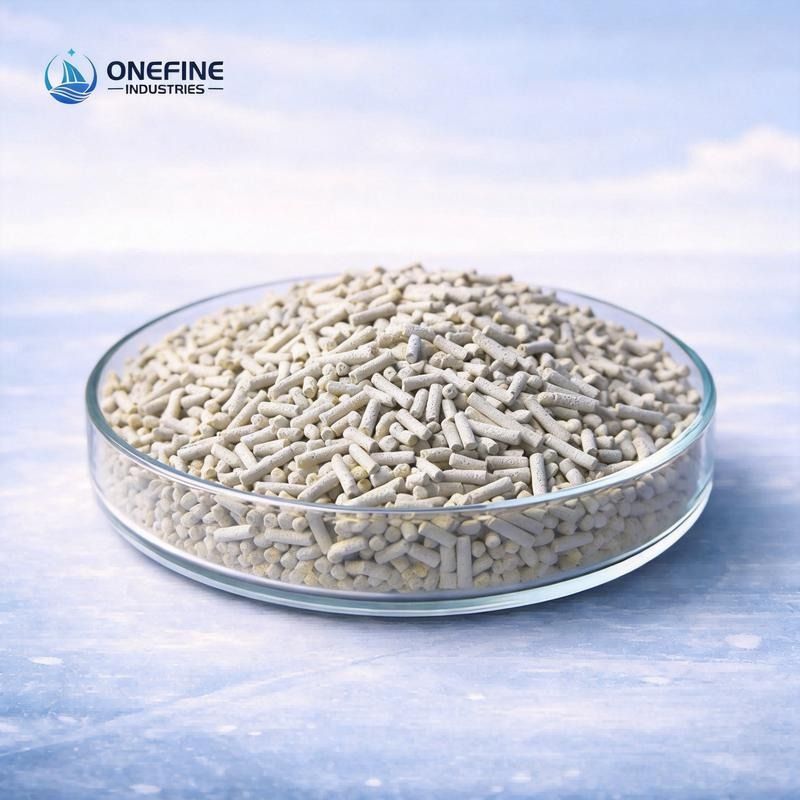
Zinc oxide desulfurization catalyst
High-purity zinc oxide (ZnO) desulfurization catalyst for fine removal of H₂S from natural gas, synthesis gas, hydrogen, and hydrocarbon feeds. Achieves outlet sulfur levels below 0.1 ppm through irreversible chemisorption. High sulfur capacity, long service life, and strong resistance to steam.
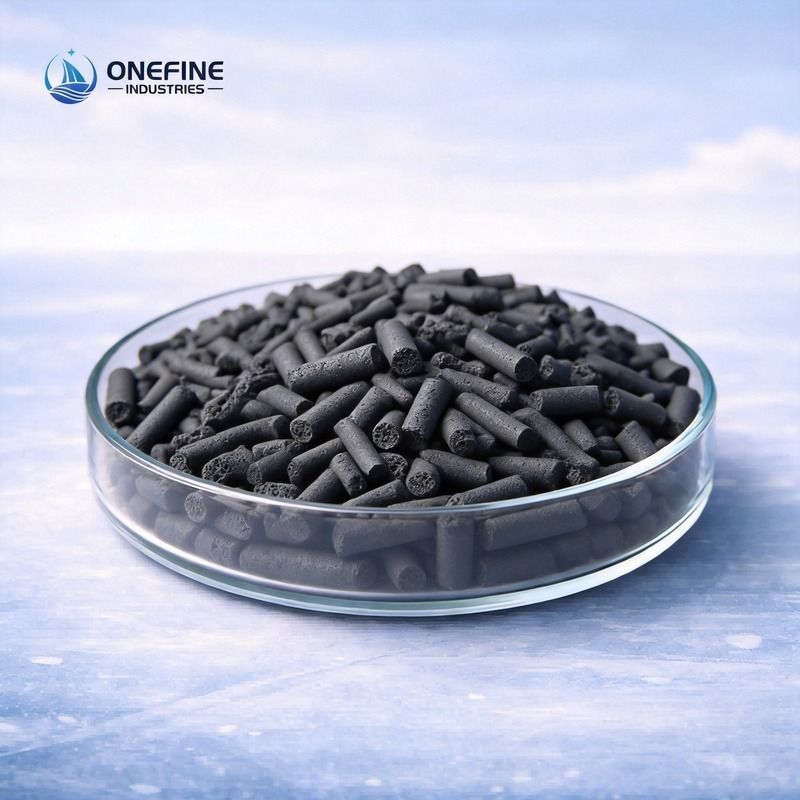
Ultra-precision Desulfurization Catalyst
A bifunctional desulfurization catalyst that couples COS hydrolysis and H₂S adsorption in a single reactor, achieving ultra-deep sulfur removal in one step. Effectively removes H₂S, COS, and trace RSH from process gases. Features high surface area, fast reaction kinetics, and broad operating range. Ideal for final purification of synthesis gas, natural gas, and light hydrocarbons.
Related Reading
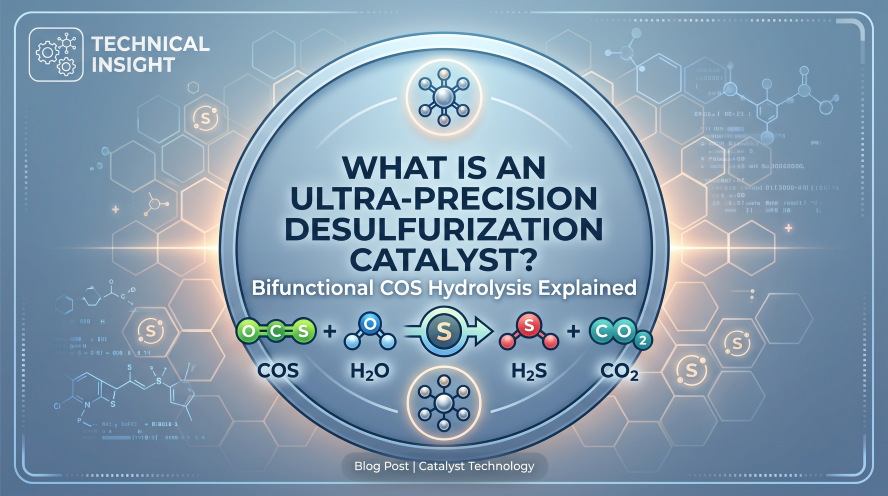
What Is an Ultra-Precision Desulfurization Catalyst? Bifunctional COS Hydrolysis Explained
A plain-language guide to how bifunctional ultra-precision desulfurization catalysts combine COS hydrolysis and H₂S adsorption in one reactor bed — and when this one-step approach makes more sense than conventional two-stage ZnO desulfurization.
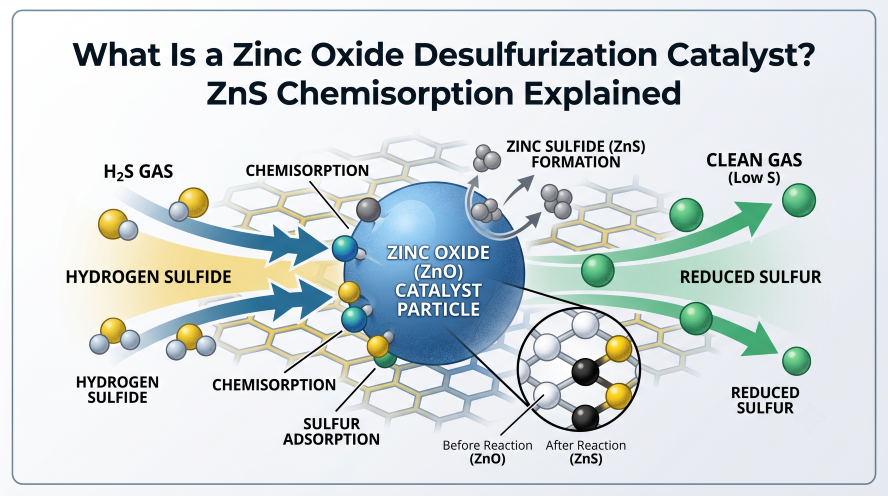
What Is a Zinc Oxide Desulfurization Catalyst? ZnS Chemisorption Explained
A plain-language guide to zinc oxide (ZnO) desulfurization catalyst: how it removes H₂S down to sub-ppm levels, where it fits in a desulfurization train, and how to decide if you need it.