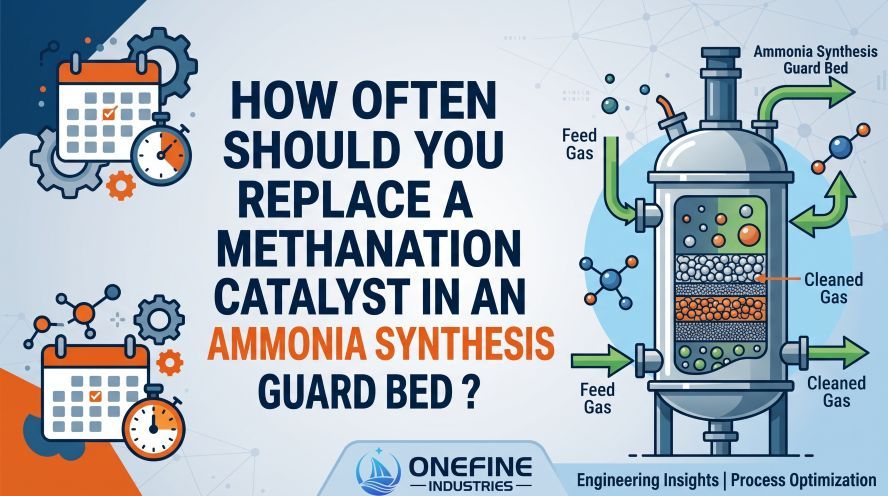
How Often Should You Replace a Methanation Catalyst in an Ammonia Synthesis Guard Bed?
Key Takeaways
- Methanation catalyst life is primarily dictated by irreversible sulfur poisoning from upstream desulfurization slip rather than a fixed calendar interval.
- A gradually shrinking temperature rise (ΔT) across the bed is the earliest indicator of declining carbon monoxide and carbon dioxide conversion.
- Rising CO and CO₂ slip downstream directly signals that active nickel surface area has been lost to sintering or carbon deposition.
- Even sub-ppm concentrations of H₂S in the feed gas can chemisorb onto nickel sites, causing permanent, orders-of-magnitude drops in activity.
Introduction
A methanation catalyst is the final guard bed before synthesis gas enters the ammonia converter, converting residual CO and CO₂ into methane so they don't poison the downstream iron-based ammonia synthesis catalyst. Unlike a simple time-based maintenance item, its replacement interval isn't fixed — it depends heavily on how well the upstream purification train protects it from sulfur, and how the bed has aged through sintering and carbon deposition. This guide walks through the deactivation mechanisms that actually determine methanation catalyst life, and the operating signals that tell you replacement is approaching rather than years away.
Why Methanation Catalyst Life Doesn't Follow a Fixed Schedule
Nickel-based methanation catalysts can run for years under clean, well-protected feed gas — or lose meaningful activity within months if the upstream guard beds let sulfur compounds slip through. That's the core reason a calendar-based replacement schedule doesn't work well for this catalyst: two plants running the same catalyst under different upstream protection can see very different service lives. The three mechanisms below — sulfur poisoning, carbon deposition, and sintering — combine at different rates depending on feed quality, so tracking the catalyst's actual condition matters more than tracking the calendar.
Sulfur Poisoning: The Dominant and Irreversible Threat
Nickel methanation catalysts are exceptionally sensitive to sulfur compounds such as H₂S. Published catalyst poisoning studies have shown that even trace, sub-ppm concentrations of H₂S in the feed can drive several orders-of-magnitude drops in nickel activity, because sulfur chemisorbs strongly onto active nickel sites. At the low temperatures typical of methanation guard beds, this sulfur poisoning is effectively irreversible — the catalyst doesn't recover once contaminated, unlike some regenerable poisoning mechanisms seen elsewhere in the purification train. This is why the condition of the upstream desulfurization stages matters as much to methanation catalyst life as anything happening in the methanation reactor itself.
Carbon Deposition and Sintering: The Slow Wear-Out Path
Even with clean feed, methanation catalysts age through two additional mechanisms. Carbon deposition can occur as encapsulating carbon that gradually covers active sites, or as filamentous carbon whiskers that physically dislodge nickel particles from the support — both reduce accessible active surface area over time, and are more likely to develop when CO concentration is high relative to hydrogen or when local hot spots form in the bed. Sintering is the separate, temperature-driven process by which small nickel crystallites migrate and coalesce into larger particles, permanently shrinking the active surface area; it accelerates with prolonged high-temperature operation or exposure to steam. Neither mechanism is reversible in a bulk sense, which is why catalyst that has aged through carbon deposition or sintering needs replacement rather than regeneration.
Signs Your Methanation Catalyst Needs Replacement
Because sulfur poisoning, carbon buildup, and sintering all reduce active nickel surface area, they show up through the same operational symptoms — just at different points in the catalyst's life:
- Falling temperature rise across the bed. The methanation reaction is strongly exothermic, so the temperature increase from inlet to outlet is a direct proxy for how much CO/CO₂ conversion is actually happening. A gradually shrinking ΔT for the same feed composition and flow rate is one of the clearest signs of declining catalyst activity.
- Widening gap to equilibrium temperature. As activity declines, the outlet temperature drifts further from the temperature equilibrium would predict for that feed composition — a widening approach-to-equilibrium gap is a classic guard-bed aging signal.
- Rising CO and CO₂ slip downstream. If residual CO/CO₂ starts showing up beyond normal levels after the methanation stage, it signals the catalyst is no longer converting to the extent it should — this is the symptom operators care about most, since CO and CO₂ are direct poisons for the ammonia synthesis catalyst further downstream.
- Higher pressure drop across the bed. Physical changes from carbon whisker growth or catalyst attrition can raise bed pressure drop over time, independent of the chemical poisoning signals above.
- Visual condition at turnaround. Discoloration, soot-like carbon deposits, or visibly sintered/fused pellets found during a shutdown inspection confirm what the process data has been suggesting.
None of these signs on its own always means immediate replacement — but a combination of falling ΔT, rising slip, and confirmed sulfur excursions upstream is a strong case for planning a catalyst change rather than waiting it out.
Protecting Methanation Catalyst Life Starts Upstream
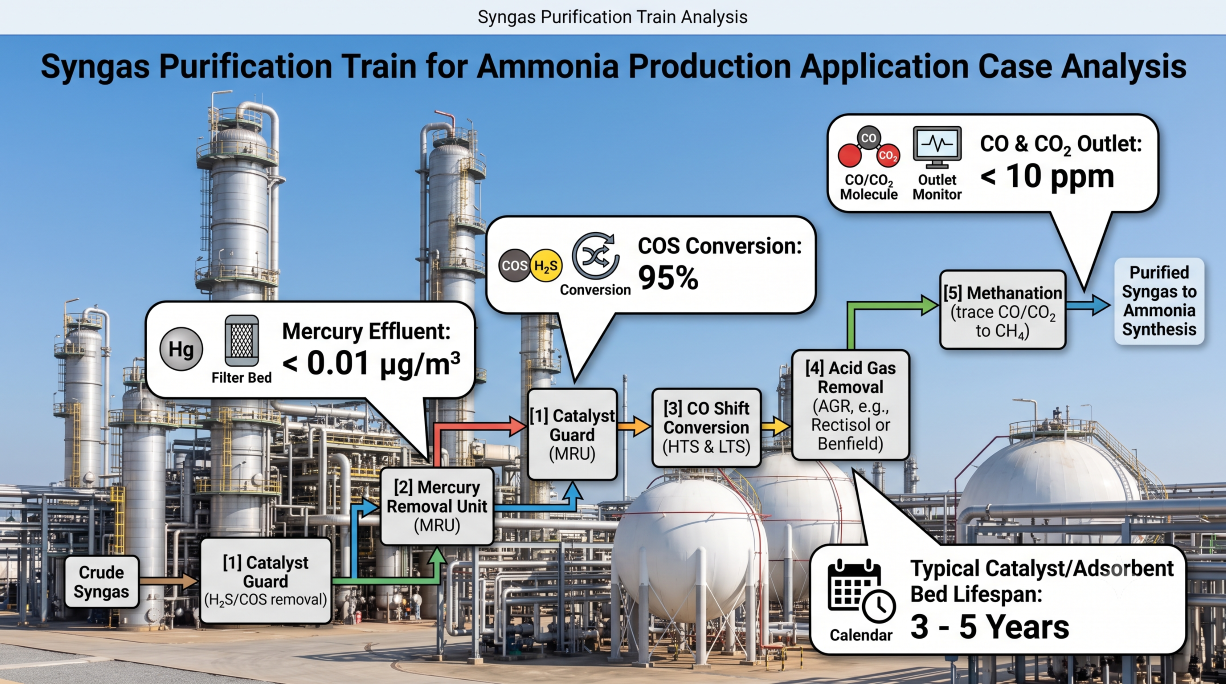
Given how irreversible sulfur poisoning is, the single biggest lever plant operators have over methanation catalyst life isn't anything done at the methanation stage itself — it's how tightly the upstream desulfurization guard beds are performing. A zinc oxide desulfurization catalyst positioned upstream is the standard line of defense that keeps residual sulfur compounds from ever reaching the nickel methanation bed. When that guard bed is sized correctly and monitored for breakthrough, methanation catalyst life is protected; when it isn't, sulfur slip becomes the dominant cause of early methanation catalyst replacement. This is also why methanation sits inside a broader multi-stage purification train rather than functioning as a standalone unit — its performance is only as good as the stages ahead of it.
Recommended Products from Sorbsieve
- Methanation Catalyst — nickel-based catalyst for final CO/CO₂ removal ahead of the ammonia synthesis loop
- Zinc Oxide Desulfurization Catalyst — high-capacity sulfur guard bed protecting downstream nickel and copper-based catalysts (already linked above)
FAQ
Does methanation catalyst deactivation ever reverse on its own? No. Sulfur poisoning at typical guard-bed temperatures is essentially irreversible, and carbon deposition and sintering are physical/structural changes rather than reversible chemical states. Once activity has declined from these mechanisms, replacement — not regeneration — is the realistic path forward.
What's the earliest warning sign operators should watch for? A gradually narrowing temperature rise across the bed for unchanged feed conditions is typically the earliest, most direct indicator, since it reflects declining conversion before CO/CO₂ slip becomes measurable downstream.
Can a sulfur upset event damage the catalyst permanently even if it's brief? Yes. Because nickel's sensitivity to sulfur is so high, even a short-duration upstream desulfurization upset can chemisorb enough sulfur onto the catalyst surface to cause a lasting activity loss, well before any visible process upset would otherwise be noticed.
Is there a standard replacement interval we should plan around? Not a fixed one. Because sulfur exposure history, feed composition, and thermal history vary plant to plant, methanation catalyst life is better tracked through the operating signals above than through a calendar-based interval. See our comprehensive guide to methanation catalysts for the full reaction mechanism and thermal runaway background behind these deactivation pathways.
Looking for Bulk Supply of Methanation Catalyst?
Sorbsieve is a trusted bulk supplier of Methanation Catalyst and complete industrial adsorbents, serving industrial buyers across the Middle East.
We provide:
- ✅ Container-level supply (20'GP / 40'GP / 40'HQ)
- ✅ Full documentation (COA / TDS / SDS / COO)
- ✅ Technical support for methanation catalyst selection and system optimization
- ✅ Fast quote response for industrial inquiries
Contact our team for bulk pricing, product samples, and technical consultation.
Related Products
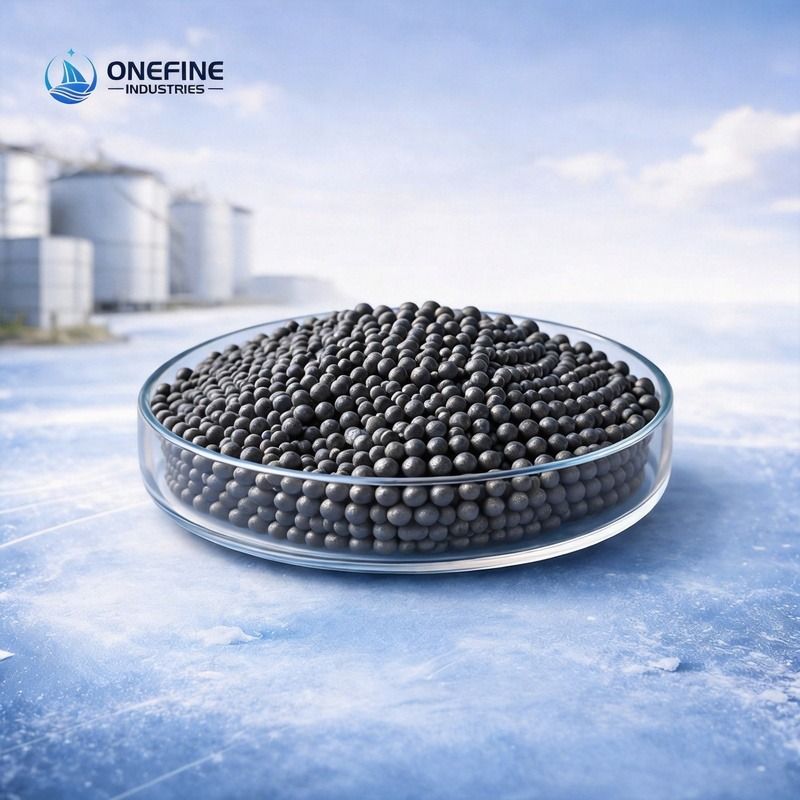
Methanation Catalyst
High-performance Ni/Al₂O₃-based methanation catalyst designed for ultra-deep removal of trace CO and CO₂ in ammonia synthesis and hydrogen purification units, reducing carbon oxides to ≤ 10 ppm.
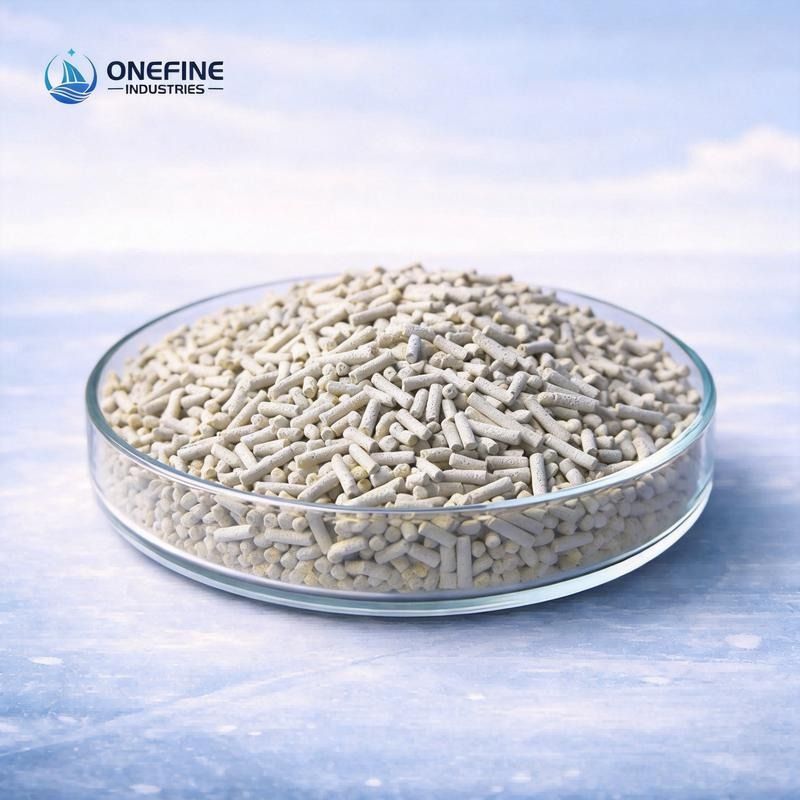
Zinc oxide desulfurization catalyst
High-purity zinc oxide (ZnO) desulfurization catalyst for fine removal of H₂S from natural gas, synthesis gas, hydrogen, and hydrocarbon feeds. Achieves outlet sulfur levels below 0.1 ppm through irreversible chemisorption. High sulfur capacity, long service life, and strong resistance to steam.
Related Reading
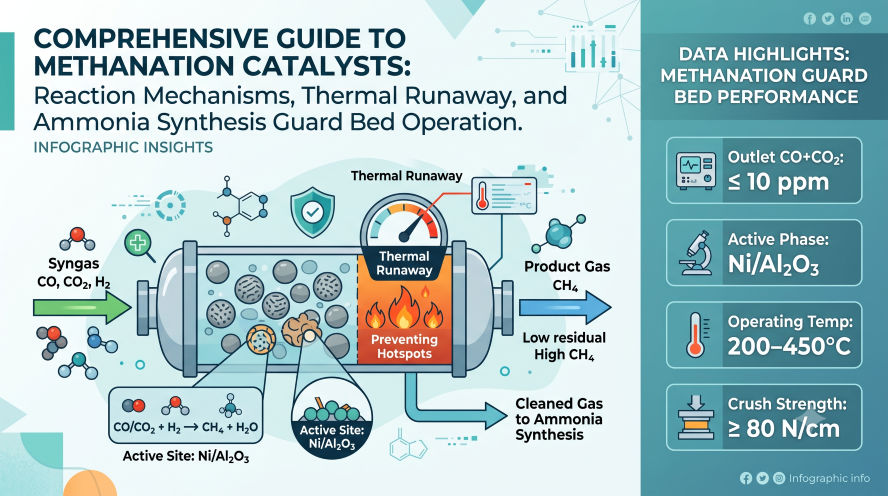
A Comprehensive Guide to Methanation Catalysts: Reaction Mechanisms, Thermal Runaway, and Ammonia Synthesis Guard Bed Operation
Trace carbon monoxide (CO) and carbon dioxide (CO2) in synthesis gas act as lethal poisons to downstream ammonia and hydrogen catalysts. This technical guide explores the fundamental chemistry of nickel-based methanation catalysts, sulfur poisoning mechanisms, thermal runaway prevention, and guard bed engineering strategies to achieve sub-10 ppm carbon oxide purity.
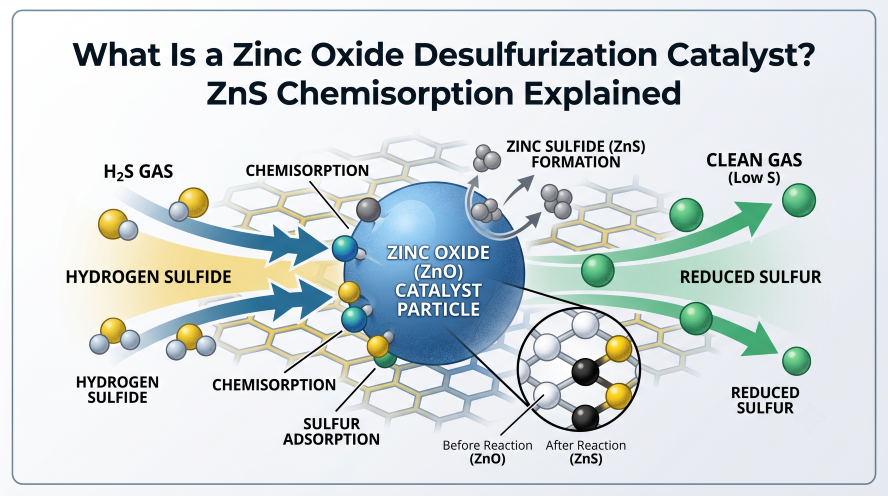
What Is a Zinc Oxide Desulfurization Catalyst? ZnS Chemisorption Explained
A plain-language guide to zinc oxide (ZnO) desulfurization catalyst: how it removes H₂S down to sub-ppm levels, where it fits in a desulfurization train, and how to decide if you need it.