How Do You Know When to Replace Carbon Molecular Sieve in a PSA Nitrogen Generator?
Key Takeaways
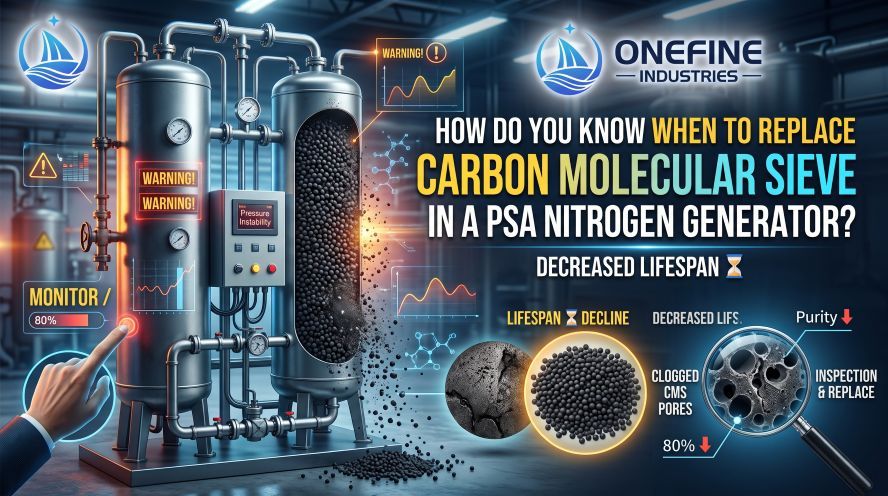
- CMS separates N₂ from O₂ by diffusion rate; a drop in nitrogen purity or the need for longer cycles often indicates a loss of active internal surface.
- A steady upward drift in differential pressure across the CMS beds is a mechanical early warning sign that the carbon is breaking down or packing more densely.
- While minor dust is normal, rapid powder accumulation or visible carbon dust exhausting during blow-down indicates severe physical deterioration of the beads.
- Oil or liquid moisture carryover from the compressor into the pre-filters is a primary cause of premature, and often irreversible, CMS bed failure.
Carbon molecular sieve (CMS) is the adsorbent that makes on-site PSA nitrogen generation possible, separating nitrogen from oxygen by exploiting diffusion rate differences in the carbon's pore structure rather than by equilibrium adsorption. That kinetic mechanism is precise, but it also means CMS degrades differently than other adsorbents — there's no single countdown clock, and a well-maintained bed can run for many years before it needs replacing. The real question operators face isn't "how old is the CMS," but "what is the bed telling me right now." This guide covers the four signals worth watching, and what each one actually indicates about the condition of your carbon.
Nitrogen Purity Drops — or You Need a Longer Cycle to Hit the Same Spec
The clearest operational sign is a generator that can no longer deliver its rated nitrogen purity at the flow rate it used to handle. Because CMS separates N₂ from O₂ by diffusion rate rather than pore-size exclusion, any loss of active internal surface — from contamination or physical breakdown — shows up first as oxygen breakthrough creeping upward at the same production rate, or as needing to stretch the pressure-swing cycle or cut throughput just to hold the same purity you had before.
Before blaming the carbon, rule out the usual operational causes first: running the generator above its rated output capacity, or supplying it with inlet pressure below spec, will both push purity down even with perfectly healthy CMS. If purity is slipping while flow rate and inlet pressure are both within the unit's normal operating window, that points toward the adsorbent itself rather than a process upset.
Differential Pressure Across the Adsorption Vessels Starts Climbing
A steady rise in differential pressure across the CMS beds — tracked through the generator's own pressure gauges or transmitters — is a mechanical sign that something inside the vessel has changed. It can mean the carbon is breaking down and packing more densely, or that fines generated by the rapid pressure-swing cycling are partially blocking flow through the bed.
Most PSA generator OEMs define a specific differential pressure threshold in their own operation and maintenance manual that calls for an immediate shutdown — the exact number is equipment-specific, so it's worth checking your unit's documentation rather than assuming a generic figure applies. What matters operationally is the trend: an upward drift in DP readings over weeks or months is a legitimate early warning, even before purity itself is affected.
Fine Carbon Dust Shows Up in the Final Filter or During Blow-Down
Some CMS fines are normal — pressure-swing cycling puts real mechanical stress on the beads, and a small, stable amount of dust in the final filter is an expected part of operating a PSA system. What's not normal is powder accumulating on the filter faster than before, or visible carbon dust exhausting from the silencer during the blow-down step. That pattern indicates the carbon itself is physically deteriorating, not just shedding a normal amount of fines, and it's typically treated as a reason to shut the unit down and have the bed inspected rather than running it until purity fails outright.
Oil or Moisture Turns Up in the Pre-Filters
CMS performance depends on clean, dry feed air, and oil or moisture carryover from the compressor is one of the most common — and most damaging — causes of premature bed failure. Liquid collecting in the pre-filtration stage, especially oil, is a strong indicator that contamination has already reached the carbon upstream. Oil contamination in particular tends to cause a sharper performance loss than moisture does, and depending on severity it can mean partial or full bed replacement rather than something that clears up on its own once the air supply is fixed.
This is also why upstream protection matters: pairing CMS with a properly sized guard bed — an activated alumina guard bed placed ahead of the molecular sieve is a common approach — is one effective way to catch moisture before it ever reaches the carbon and protect the working life of the CMS bed.
What Actually Determines CMS Service Life
Under clean, well-filtered feed air and normal duty cycling, a well-protected CMS bed can realistically run for many years. What shortens that life isn't the passage of time on its own — it's contamination events (an oil carryover incident, a failed coalescing filter, a period of poor air drying) and accumulated mechanical wear from the pressure-swing cycle itself. That's the practical reason to watch the signals above rather than plan replacement around a fixed calendar interval: two generators of the same age, on the same duty, can be in very different condition depending on how well the feed air was managed.
If you're specifying carbon for a new PSA nitrogen system or sizing a replacement charge, see our CMS sizing guide — bed sizing and replacement signals are closely related questions.
Recommended Products from Sorbsieve
- Carbon Molecular Sieve for Nitrogen Generation (CMS) — high-performance CMS engineered for PSA nitrogen generators, available in bulk with full documentation (already linked above)
- Activated Alumina for Purification — a guard-bed adsorbent for protecting CMS from moisture carryover upstream (already linked above)
FAQ
How long does carbon molecular sieve typically last in a PSA nitrogen generator? There's no fixed universal number — service life depends heavily on feed air quality and duty cycle. Under clean, well-filtered conditions, industrial CMS beds commonly run for many years; a single contamination event can shorten that dramatically.
Is CMS contamination from oil or moisture reversible? Oil carryover is generally treated as irreversible contamination of the carbon, and bulk liquid water reaching the bed can also cause permanent damage. Brief, minor exposure to humid air is a different matter and may not leave lasting harm — severity is what decides it, which is why catching problems early through pre-filter inspection and a properly maintained guard bed matters more than trying to recover a contaminated bed afterward.
Is some carbon dust in the filters normal, or always a warning sign? A small, stable amount of fine dust in the final filter is a normal byproduct of pressure-swing cycling. The warning sign is a change in that pattern — accumulating powder faster than before, or visible dust exhausting during blow-down — which points to physical breakdown of the carbon rather than routine wear.
If nitrogen purity drops, does that always mean the CMS needs replacing? Not necessarily. Operating above the generator's rated flow capacity or with inlet pressure below spec can both cause purity to drop even with healthy CMS. Rule out those operational factors first; if purity is still slipping within normal operating parameters, that points to the adsorbent itself.
Looking for Bulk Supply of Carbon Molecular Sieve?
Sorbsieve is a trusted bulk supplier of Carbon Molecular Sieve and complete industrial adsorbents, serving industrial buyers across the Middle East.
We provide:
- ✅ Container-level supply (20'GP / 40'GP / 40'HQ)
- ✅ Full documentation (COA / TDS / SDS / COO)
- ✅ Multiple packaging options
- ✅ Technical support for Carbon Molecular Sieve selection and system optimization
- ✅ Fast quote response for industrial inquiries
Contact our team for bulk pricing, product samples, and technical consultation.
Related Products
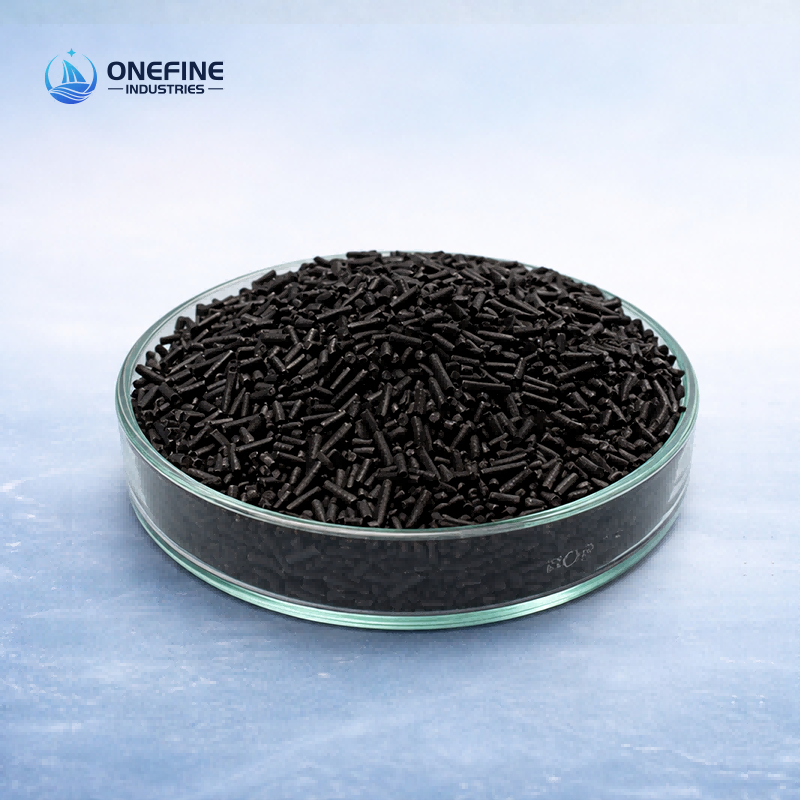
Carbon Molecular Sieve for Nitrogen Generation (CMS)
High-performance carbon molecular sieve (CMS) for PSA nitrogen generators. Uniform micropore distribution (0.3-0.5nm) ensures efficient oxygen-nitrogen separation. Delivers 95-99.999% nitrogen purity with 3-5 year service life. Bulk supply for industrial buyers worldwide.
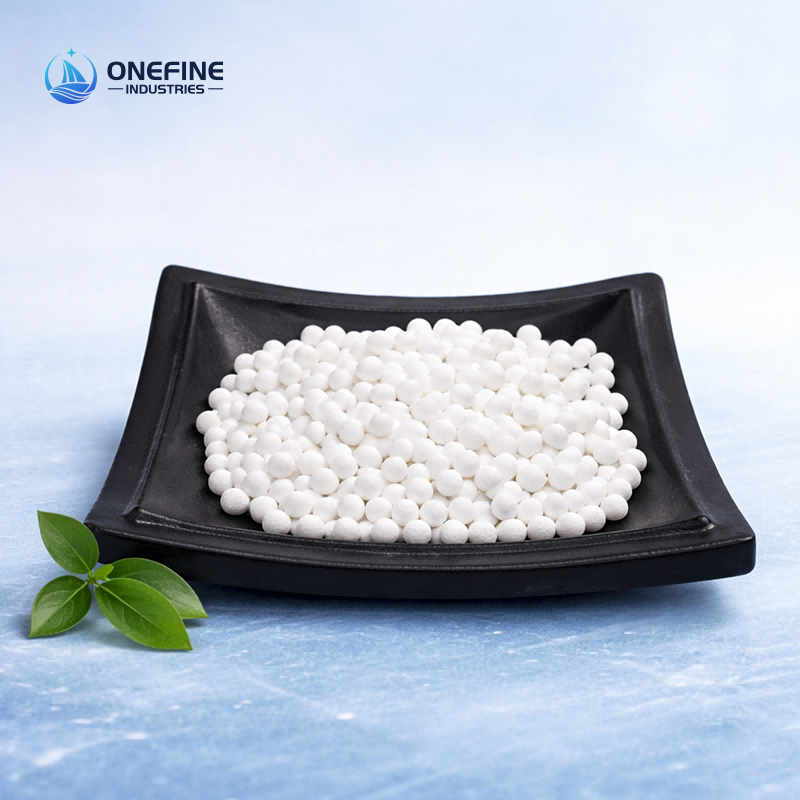
Activated Alumina for Purification
High-performance activated alumina (γ-Al₂O₃) adsorbent and desiccant for industrial gas/liquid drying, water defluoridation, and purification. White spherical beads with high surface area (≥300 m²/g), excellent crush strength, and full thermal regenerability. Available in multiple particle sizes for compressed air dryers, water treatment, and catalyst carrier applications.
Related Applications
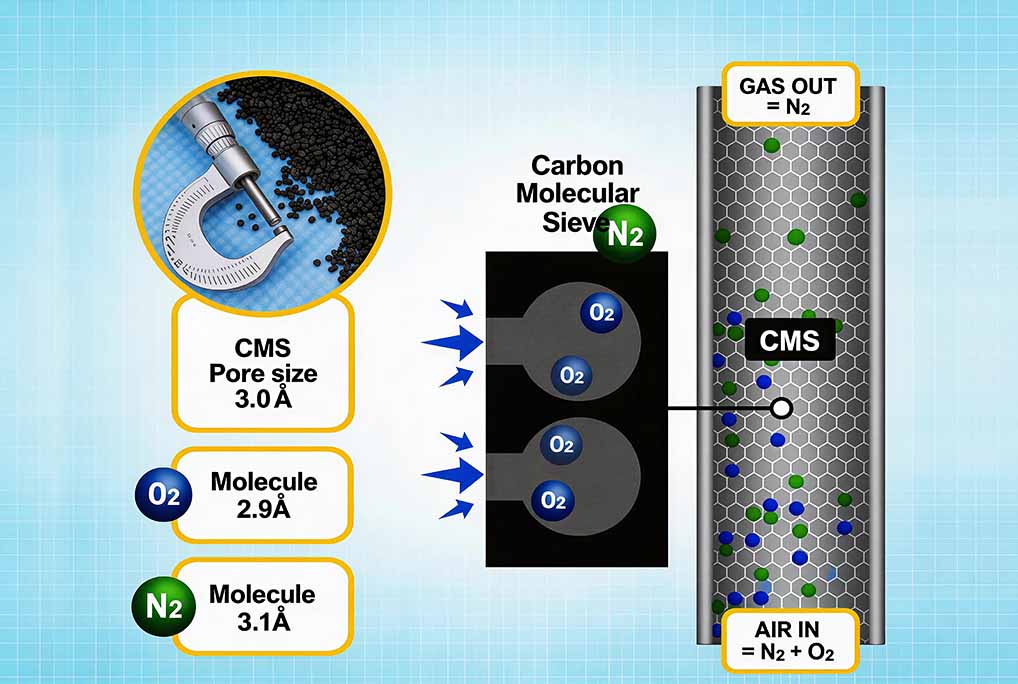
Carbon Molecular Sieve for Nitrogen Generation: Applications in PSA Nitrogen Generators, Food Packaging, and Industrial Gas Systems
Carbon molecular sieve is the core adsorbent behind on-site PSA nitrogen generation. This case covers three applications — nitrogen generators, food packaging, and industrial gas systems — with sieve specifications and supply details for each.
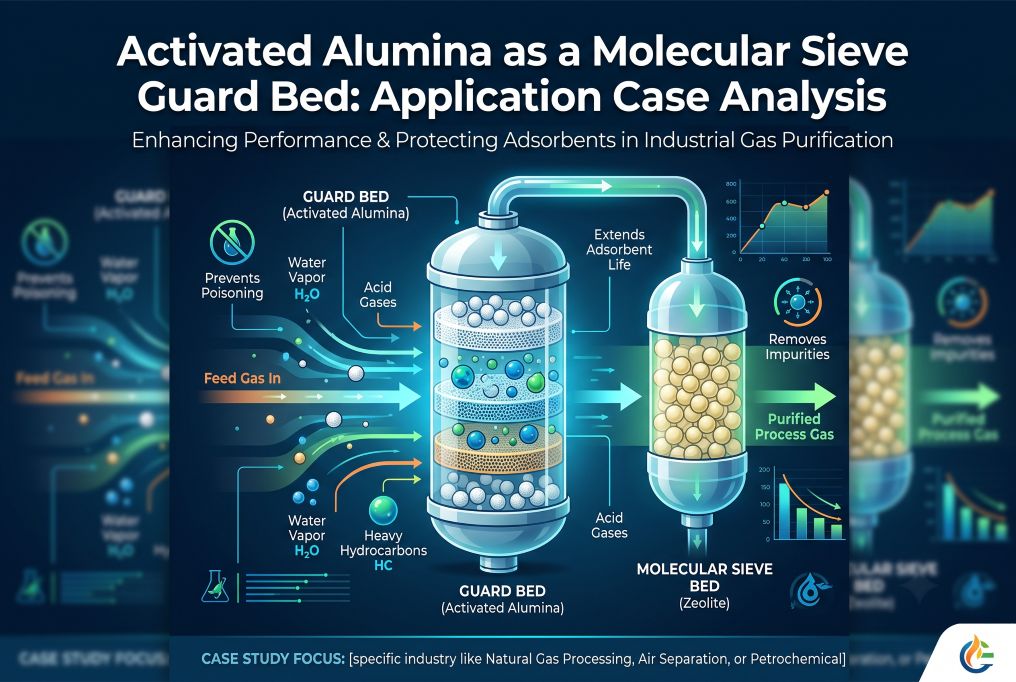
Activated Alumina as a Molecular Sieve Guard Bed: Application Case Analysis
How activated alumina protects downstream molecular sieve beds — CMS, Oxygen Generator Molecular Sieve, and 4A — across PSA nitrogen, PSA oxygen, and general drying systems.
Related Reading

Carbon Molecular Sieve: The Ultimate Guide to PSA Nitrogen Generation
A complete guide to carbon molecular sieve technology for on-site PSA nitrogen generation. Learn how CMS works based on kinetic diffusion separation, its key benefits including 50-90% cost savings vs cylinder/liquid nitrogen, industrial applications across food & beverage, chemical, electronics, pharmaceutical and mining industries, how to select the right CMS grade, maintenance tips, and comparisons with membrane and cryogenic nitrogen generation methods.
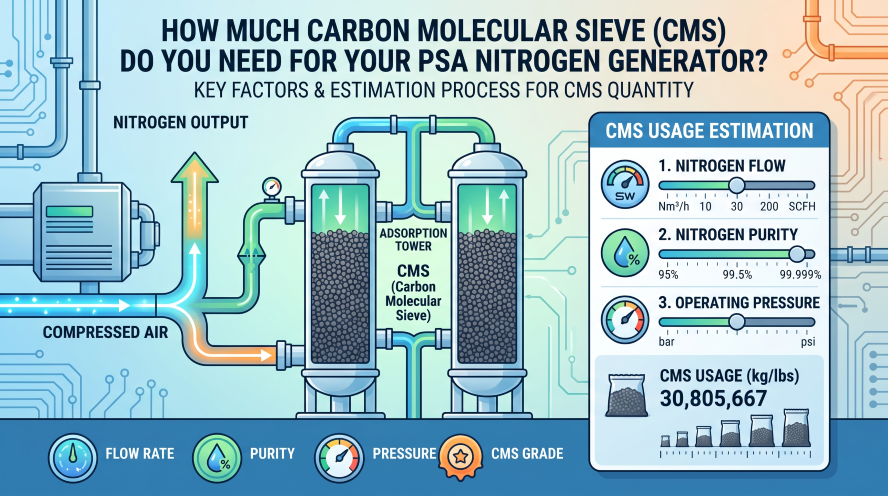
How Much Carbon Molecular Sieve Do You Need for a PSA Nitrogen Generator?
Discover the engineering calculations behind sizing a Pressure Swing Adsorption (PSA) nitrogen generator. Learn how Carbon Molecular Sieve (CMS) kinetic diffusion works, how target nitrogen purity dictates the Air-to-Nitrogen (A/N) ratio, and how to convert your CMS mass requirement into vessel geometry.
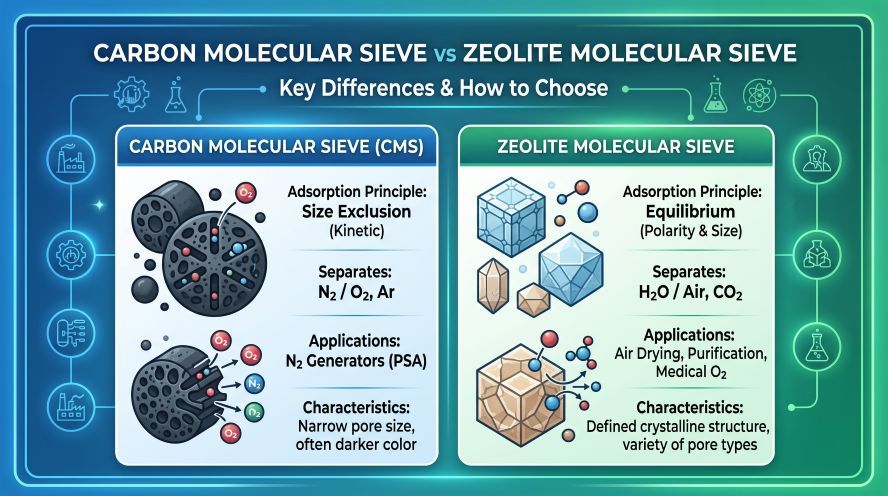
Carbon Molecular Sieve vs Zeolite Molecular Sieve: Key Differences & How to Choose
Carbon molecular sieve and zeolite molecular sieve are both called "molecular sieves" but separate gases through opposite mechanisms — kinetic diffusion vs equilibrium adsorption. This guide explains why CMS is the standard for PSA nitrogen while zeolite covers PSA oxygen, drying, and CO2 removal, and how to match the right material to your system.