Product Description
Premium Co-Mo Hydrogenation Catalyst
CDS-Optimized Hydrofining Solution for Light Hydrocarbon Feedstocks
1. Product Introduction
Our Premium Co-Mo Hydrogenation Catalyst represents the latest generation of hydrotreating catalyst technology, engineered to deliver exceptional performance in the hydrofining of light hydrocarbon streams. Featuring cobalt-molybdenum (Co-Mo) as the primary active phase supported on modified activated alumina, this catalyst incorporates our proprietary CDS-optimized geometric design that sets new benchmarks in mass transfer efficiency and catalytic activity.
This next-generation catalyst is specifically formulated for the hydrogenation purification of natural gas, oil field gas, liquefied petroleum gas (LPG), refinery gas, and light naphtha. It simultaneously performs hydrodesulfurization (HDS), hydrodenitrogenation (HDN), hydrodechlorination (HDCl), and olefin saturation in a single reactor pass, enabling operators to meet stringent product specifications with minimal process complexity.
Backed by rigorous quality control systems and extensive field validation across diverse operating environments, our Co-Mo hydrogenation catalyst delivers consistent, reliable performance with an impressively long service life, making it the preferred choice for refineries, gas processing plants, and petrochemical facilities worldwide.
2. Core Technology & Design Advantages
2.1 Co-Mo Active Phase Formulation
At the heart of our catalyst lies a precisely engineered cobalt-molybdenum active phase. The Co-Mo bimetallic system is widely recognized in hydroprocessing for its exceptional activity toward sulfur, nitrogen, and chlorine removal, as well as olefin saturation. Our proprietary preparation method ensures optimal interaction between cobalt and molybdenum sulfide phases, creating a high density of catalytically active Co-Mo-S sites (Type II) that deliver superior hydrogenation activity compared to conventional Co-Mo catalysts.
The cobalt promoter modifies the electronic structure of molybdenum sulfide, enhancing its ability to activate hydrogen and cleave carbon-heteroatom bonds. This synergistic bimetallic effect translates directly to higher conversion rates and lower operating temperatures, reducing energy consumption while improving product quality.
2.2 Modified Activated Alumina Support
The catalyst is supported on a specially modified activated alumina substrate engineered for hydrofining applications. The modification process—incorporating carefully selected additives and controlled thermal treatment—tailors the support's surface acidity, pore structure, and mechanical properties to maximize catalytic performance and durability.
Key benefits of the modified alumina support include:
- Optimized pore size distribution that balances diffusion accessibility and active phase anchoring
- Controlled surface acidity that promotes desired hydrogenation reactions while minimizing coking and cracking side reactions
- High thermal stability that maintains structural integrity under prolonged high-temperature operation
- Strong metal-support interaction that prevents active phase sintering and leaching
This carefully engineered support matrix ensures that the Co-Mo active sites remain highly accessible and stable throughout the catalyst's service life.
2.3 CDS-Optimized Geometric Design
A defining feature of this catalyst is its proprietary CDS-optimized geometric design—a breakthrough in catalyst particle engineering that delivers substantial performance advantages. CDS (Catalytic Design System) optimization involves computational fluid dynamics (CFD) modeling combined with experimental validation to determine the optimal particle shape, size, and surface configuration for maximum mass transfer efficiency.
The CDS design delivers several critical benefits:
- Low bulk density: Reduced particle weight per volume lowers catalyst loading costs and reduces reactor bed weight stress
- High specific surface area: Maximizes available active sites per unit volume, boosting volumetric activity
- Low pressure drop: Optimized particle geometry reduces flow resistance, lowering compression energy costs and allowing higher throughput
- Superior active component dispersion: The engineered surface morphology ensures uniform distribution of Co-Mo active sites, eliminating dead zones and maximizing catalytic efficiency
This design innovation means that operators can achieve higher conversion rates with less catalyst, at lower pressure drops, delivering both capital and operating cost savings.
3. Performance Characteristics
3.1 Hydrodesulfurization (HDS) Activity
The catalyst exhibits exceptional hydrodesulfurization activity across a wide range of sulfur compounds. From easily removed mercaptans and sulfides to more refractory species such as thiophenes and benzothiophenes, the Co-Mo active sites effectively cleave carbon-sulfur bonds, converting organic sulfur to hydrogen sulfide (H₂S) that can be readily removed in downstream processing. Typical HDS conversion exceeds 98% under recommended operating conditions.
3.2 Hydrodenitrogenation (HDN) Activity
Organic nitrogen compounds—including amines, pyrroles, and pyridines—are effectively converted to ammonia (NH₃) through catalytic hydrodenitrogenation. The catalyst's optimized acid-base properties promote both C-N bond cleavage and hydrogenation of aromatic nitrogen compounds, ensuring deep nitrogen removal to protect downstream sensitive catalysts and meet product specifications.
3.3 Hydrodechlorination (HDCl) Activity
Organic chloride compounds present in many hydrocarbon feedstocks can cause severe corrosion and catalyst poisoning in downstream processes. Our Co-Mo catalyst provides excellent hydrodechlorination activity, converting organic chlorides to hydrogen chloride (HCl) that can be easily scrubbed. This capability is particularly valuable for processing contaminated natural gas and refinery streams.
3.4 Olefin Saturation
The catalyst efficiently saturates olefins (alkenes) to corresponding paraffins (alkanes), improving product stability and reducing the potential for gum formation and polymerization in downstream processing. The hydrogenation activity is carefully balanced to achieve high olefin conversion without excessive aromatic saturation, preserving product value and minimizing hydrogen consumption.
3.5 Long-Term Stability & Durability
Field data consistently demonstrates that the catalyst maintains over 92% of its initial activity after 36 months of continuous operation under typical hydrofining conditions. This exceptional longevity stems from the combined effects of:
- High metal dispersion that resists sintering
- Modified support with excellent coking resistance
- CDS design that minimizes local hot spots
- Robust mechanical strength that prevents particle attrition and bed crushing
4. Technical Specifications
4.1 Physical & Chemical Properties
- Catalyst Type: Cobalt-Molybdenum Hydrofining Catalyst
- Active Components: CoO, MoO₃ (sulfided form in operation)
- Support: Modified activated γ-Al₂O₃
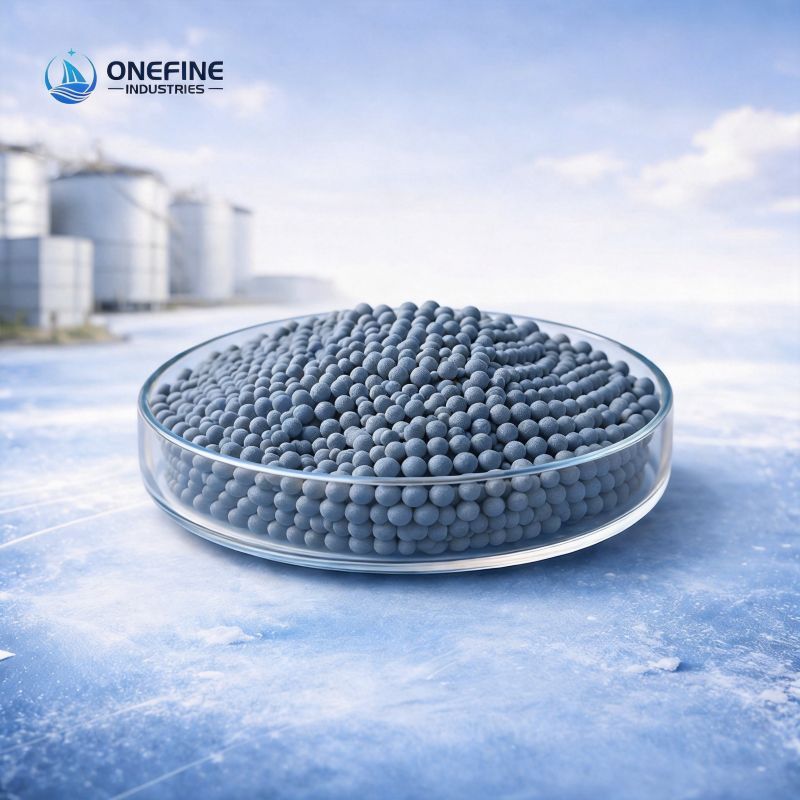
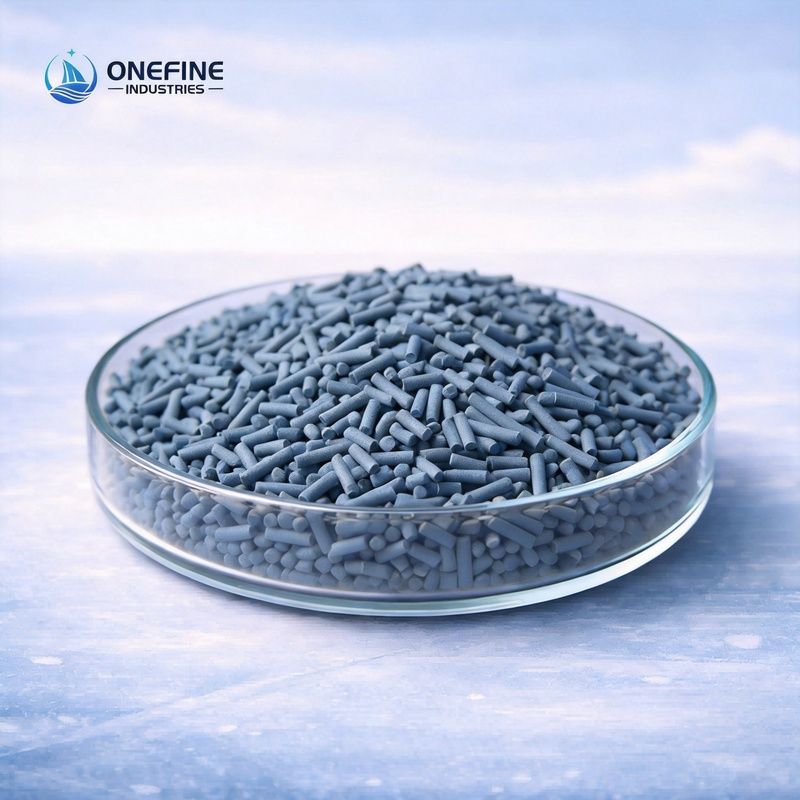
- Shape: CDS-optimized extrudates
- Nominal Diameter: Φ 1.5 – 3.0 mm
- Length: 2 – 8 mm
- Bulk Density: 0.50 – 0.65 kg/L
- Crushing Strength: ≥ 120 N/cm
- Specific Surface Area: ≥ 220 m²/g
- Pore Volume: ≥ 0.40 mL/g
- MoO₃ Content: 10 – 15 wt%
- CoO Content: 3 – 5 wt%
4.2 Typical Operating Conditions & Performance
Operating Parameters:
- Operating Temperature: 200 – 400°C
- Operating Pressure: 1.0 – 5.0 MPa
- Liquid Hourly Space Velocity (LHSV): 1 – 8 h⁻¹
- Gas Hourly Space Velocity (GHSV): 500 – 4000 h⁻¹
- H₂/Feed Ratio: 50 – 300 v/v
Performance Metrics:
- HDS Conversion: ≥ 98%
- HDN Conversion: ≥ 95%
- HDCl Conversion: ≥ 97%
- Olefin Saturation: ≥ 90%
- Expected Service Life: 36+ months
Note: Actual performance depends on feedstock composition, specific operating conditions, and process configuration. We offer customized performance evaluation and process simulation services to match our catalyst to your specific requirements.
5. Application Fields
5.1 Natural Gas Purification
Natural gas from various production sources often contains organic sulfur compounds, nitrogen compounds, chlorides, and olefins that must be removed to meet pipeline specifications and protect downstream processing equipment. Our Co-Mo hydrogenation catalyst provides comprehensive hydrofining, converting all these contaminants into easily removable forms in a single processing step.
5.2 Oil Field Gas Treatment
Oil field associated gas typically contains heavier hydrocarbons, variable sulfur content, and other impurities. The catalyst's robust performance across varying feed compositions makes it ideal for oil field gas upgrading, enabling reliable operation even with fluctuating feed quality from different production zones.
5.3 Liquefied Petroleum Gas (LPG) Hydrofining
LPG streams from refinery or gas plant operations frequently contain unsaturated compounds and sulfur impurities that limit their value and usability. Our catalyst effectively saturates olefins and removes sulfur from LPG, producing high-quality LPG suitable for fuel applications, petrochemical feedstock, or export.
5.4 Refinery Gas Processing
Refinery off-gases—including FCC dry gas, coker gas, and hydrotreater off-gas—contain valuable hydrocarbons but also sulfur, nitrogen, and olefin contaminants. Our catalyst enables efficient purification of these streams, allowing them to be used as fuel gas or further processed for chemical production.
5.5 Light Naphtha Hydrotreatment
Light naphtha streams from catalytic reforming, cracking, or straight-run distillation require pretreatment before use in isomerization units or as gasoline blend components. The CDS-optimized catalyst provides deep HDS, HDN, and olefin saturation while maintaining high throughput, making it an excellent choice for light naphtha hydrofining applications.
6. Quality Assurance & Technical Support
6.1 Rigorous Quality Control
Our Co-Mo hydrogenation catalyst is manufactured under strict ISO 9001 quality management systems. Every production batch undergoes comprehensive testing including:
- Chemical composition analysis (XRF, ICP)
- Physical property measurement (surface area, pore volume, density)
- Mechanical strength testing
- Activity evaluation in pilot-scale reactors
- Full quality documentation and traceability
This rigorous quality assurance ensures that customers receive consistently high-performance catalyst from batch to batch.
6.2 Comprehensive Technical Services
We provide end-to-end technical support throughout the catalyst lifecycle:
Pre-Sale Consulting: Our technical specialists analyze your process conditions, feed composition, and performance targets to recommend the optimal catalyst solution and loading scheme.
Process Simulation: Using advanced process simulation software, we model reactor performance under various operating scenarios to help optimize your process design and operating parameters.
Loading Supervision: Experienced field engineers provide on-site supervision during catalyst loading to ensure proper bed configuration and uniform packing.
Commissioning Support: We provide detailed sulfidation procedures and on-site technical support during catalyst activation and commissioning to ensure optimal catalyst performance from day one.
Performance Monitoring: Regular performance audits and analytical services help track catalyst health and identify optimization opportunities.
Regeneration Guidance: At the end of the catalyst cycle, we provide regeneration assessment and technical guidance to maximize catalyst value recovery.
7. Why Choose Our Co-Mo Hydrogenation Catalyst?
Superior Activity: Proprietary Co-Mo-S active phase formulation delivers industry-leading HDS, HDN, HDCl, and olefin saturation performance.
CDS Design Advantage: Optimized particle geometry means lower pressure drop, higher surface area, and better mass transfer—translating to lower operating costs and higher throughput.
Extended Service Life: 36+ months of reliable operation reduces catalyst replacement frequency and associated downtime costs.
Proven Reliability: Extensive field validation across diverse applications and operating conditions confirms consistent, dependable performance.
Expert Support: A dedicated team of catalyst specialists provides technical support from initial evaluation through end-of-life management.
Cost-Effective Performance: The combination of high activity, long life, and low pressure drop delivers exceptional total cost of ownership value.
Contact our technical sales team today to learn how our Premium Co-Mo Hydrogenation Catalyst can improve your hydrofining operation's performance, reliability, and profitability. We offer complimentary process evaluations and can tailor catalyst specifications to meet your unique operational requirements.