How to Choose the Right Molecular Sieve: 3A vs 4A vs 5A vs 13X Selection Guide
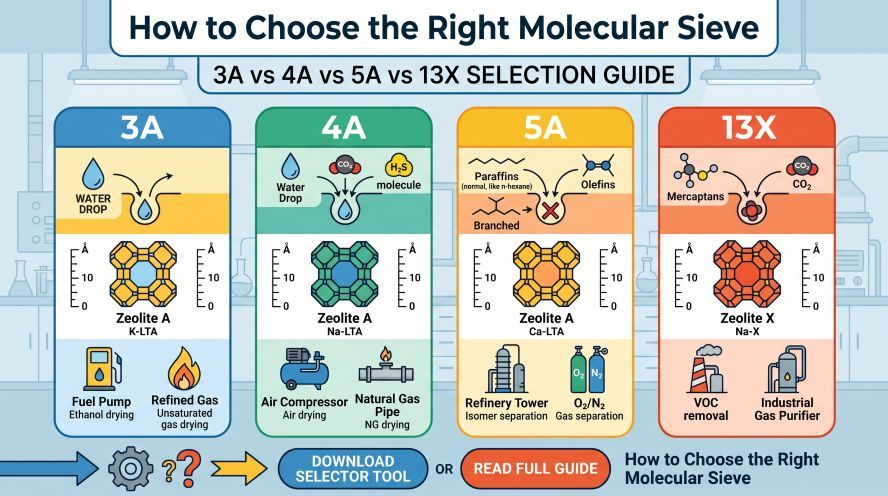
Choosing between 3A, 4A, 5A, and 13X molecular sieve isn't about which one is "better" — it's about which pore size matches what you actually need to remove from your gas or liquid stream. Buyers new to industrial adsorbents often assume these four types are interchangeable variants of the same product, then discover mid-project that the wrong pore size either wastes capacity or lets contaminants slip through. This guide walks through the selection logic buyers actually use, so you can narrow down the right grade before you request a quote.
Key Takeaways
- Molecular sieve selection depends entirely on matching the physical pore size to the specific molecules you need to capture and exclude.
- The 3A grade exclusively removes water to prevent product co-adsorption, while 4A acts as the general-purpose workhorse for standard drying duties.
- The 5A sieve enables n-paraffin and iso-paraffin separation, whereas 13X handles larger polar molecules like CO₂ and H₂S in deep purification systems.
Start With What You're Trying to Remove
The single most important question isn't "which molecular sieve is strongest" — it's "what molecule needs to come out, and what needs to stay in." Pore size determines which molecules a sieve can physically capture:
- Only water needs removing, and the gas stream contains no other polar or larger molecules → 3A is typically the safer default, since its smaller pore excludes larger co-adsorbing molecules like unsaturated hydrocarbons.
- Water removal in general gas or air drying applications, including cracked gas streams → 4A is the most widely used general-purpose grade, balancing capacity and cost for standard drying duty.
- Water plus normal paraffins need to be separated from branched/cyclic hydrocarbons → 5A's pore size is what enables this separation, making it the standard choice for n-paraffin/iso-paraffin separation processes.
- Water plus larger polar molecules (CO2, H2S, mercaptans) need removing together → 13X's larger pore size lets it capture these bigger molecules in the same bed, which is why it's the default for CO2 removal duty and PSA oxygen generation.
Pore Size Is the Mechanism, Not the Marketing
Each of these designations corresponds to a real, physical pore diameter, and that diameter is the entire reason the selection matters:
- 3A: smallest effective pore among the four, excludes most molecules except water
- 4A: next size up, the general-purpose workhorse for standard drying
- 5A: sized to admit straight-chain hydrocarbons while excluding branched/cyclic ones
- 13X: largest pore among the four, admits CO2, H2S, and other bulkier polar molecules alongside water
If you already know which pore size your application calls for, our dedicated pages on 3A Molecular Sieve , 4A Molecular Sieve , 5A Molecular Sieve , and 13X Molecular Sieve cover full specifications, packaging, and regeneration data for each grade.
Selecting by Application
Buyers usually arrive at this decision from one of a few common starting points:
- Refrigerant and AC system drying → typically 3A or 4A, depending on the specific refrigerant chemistry and whether co-adsorption of refrigerant molecules needs to be avoided
- Compressed air and industrial gas drying → 4A is the standard default unless a specific downstream process calls for a different pore size
- PSA oxygen generation → 13X (or 5A in some system designs) is standard, since these systems rely on selective adsorption of nitrogen and CO2
- Natural gas dehydration, LNG pre-treatment, CO2 removal → 4A for straightforward drying duty, 13X when CO2 or H2S must be removed in the same step
- Ethanol dehydration (fuel-grade ethanol) → 3A is the standard grade, precisely because its small pore excludes the ethanol molecule while admitting water
Common Selection Mistakes We See From Buyers
A few patterns show up repeatedly in buyer inquiries:
- Assuming "bigger pore is always better" — a larger pore size that co-adsorbs your target product (not just water) reduces effective capacity and shortens bed life. Bigger isn't safer; it's a different tool for a different job.
- Choosing based on price alone — 3A, 4A, 5A, and 13X are not simply cheaper-to-more-expensive tiers of the same material; using the wrong pore size to save cost usually costs more in reduced service life or product loss.
- Not accounting for co-adsorbed target molecules — this is the most common costly mistake, particularly in ethanol dehydration and refrigerant drying, where the sieve must exclude the product itself, not just capture water.
When You Need More Than One Type
Not every system uses a single molecular sieve grade. In multi-layer or multi-vessel designs, different pore sizes are sometimes combined — for example, a coarser pre-treatment layer ahead of a finer polishing layer, or different grades in parallel trains handling different feed conditions. Some natural gas and CO2 removal systems use a 4A drying layer followed by a 13X layer for acid gas polish removal, since splitting the two duties across two grades can be more efficient than asking a single bed to do both jobs at once.
If your process involves multiple contaminants or a multi-stage purification train, it's worth discussing your full stream composition with a technical contact before finalizing a single grade — the right combination is a system-level decision, not a single-product one. Sending us your target dew point, gas composition, and flow rate up front is usually the fastest way to get a grade recommendation that avoids costly trial-and-error at the pilot stage.
Recommended Products from Sorbsieve
- 3A Molecular Sieve — for applications requiring water removal only, with co-adsorption exclusion
- 4A Molecular Sieve — general-purpose drying grade for gas and liquid streams
- 5A Molecular Sieve — for n-paraffin/iso-paraffin separation and PSA applications
- 13X Molecular Sieve — for combined water and CO2/H2S removal, and PSA oxygen generation
FAQ
Can I use 4A molecular sieve in place of 3A if I don't have 3A in stock?
Not for applications where the sieve needs to exclude the target product itself — such as ethanol dehydration — since 4A's larger pore will co-adsorb ethanol along with water, reducing yield and capacity. For general air/gas drying with no co-adsorption concern, 4A is often the more versatile default anyway.
Is 13X always the best choice since it has the largest pore size?
No. A larger pore only helps if you need to capture larger molecules like CO2 or H2S. If your stream is simple water removal, 13X offers no advantage and typically costs more than 4A for the same drying duty.
Do 3A, 4A, 5A, and 13X all use the same regeneration process?
All four are thermally regenerable, but exact regeneration temperature and cycle time vary by grade and by system design. Our technical team can confirm the appropriate regeneration parameters for your specific bed configuration.
Can these four types be mixed in the same vessel?
Generally no — mixed beds of different pore sizes in a single vessel are uncommon because it complicates regeneration and capacity calculations. Multi-stage systems typically use separate vessels or layers rather than a physical mix.
Looking for Bulk Supply of Molecular Sieve?
Sorbsieve is a trusted bulk supplier of 3A, 4A, 5A, and 13X molecular sieve and complete industrial adsorbents, serving industrial buyers across the Middle East.
We provide:
- ✅ Container-level supply (20'GP / 40'GP / 40'HQ)
- ✅ Full documentation (COA / TDS / SDS / COO)
- ✅ Multiple packaging options
- ✅ Technical support for molecular sieve grade selection and system optimization
- ✅ Fast quote response for industrial inquiries
Contact our team for bulk pricing, product samples, and technical consultation.
Related Products
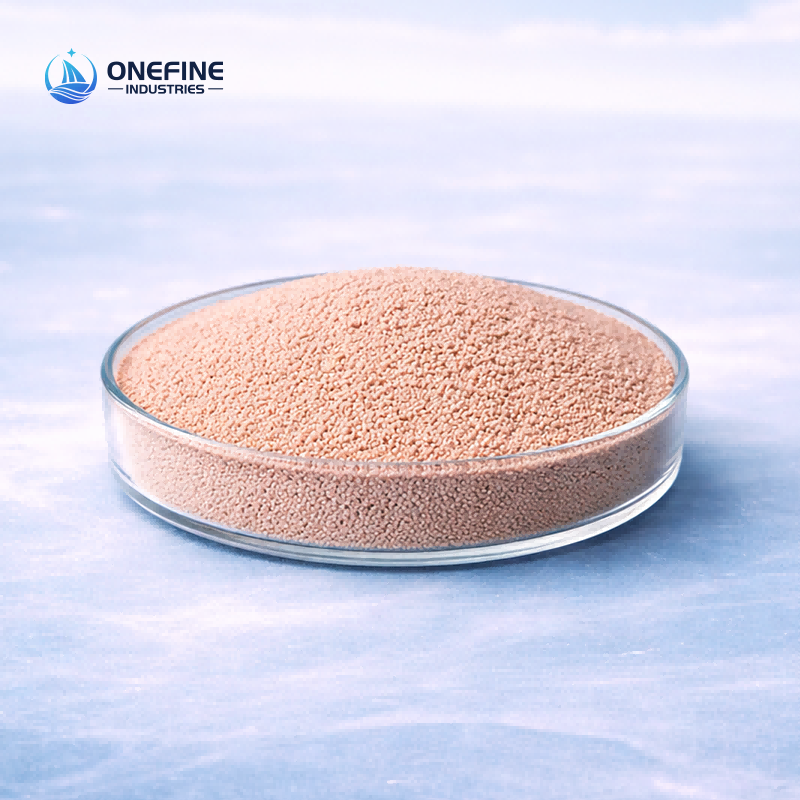
3A Molecular Sieve
High-efficiency 3A molecular sieve desiccant for ultra-deep industrial dehydration. Available in beads and pellets, 2-3 year service life with proper regeneration.
3A Molecular Sieve
High-efficiency 3A molecular sieve desiccant for ultra-deep industrial dehydration. Available in beads and pellets, 2-3 year service life with proper regeneration.
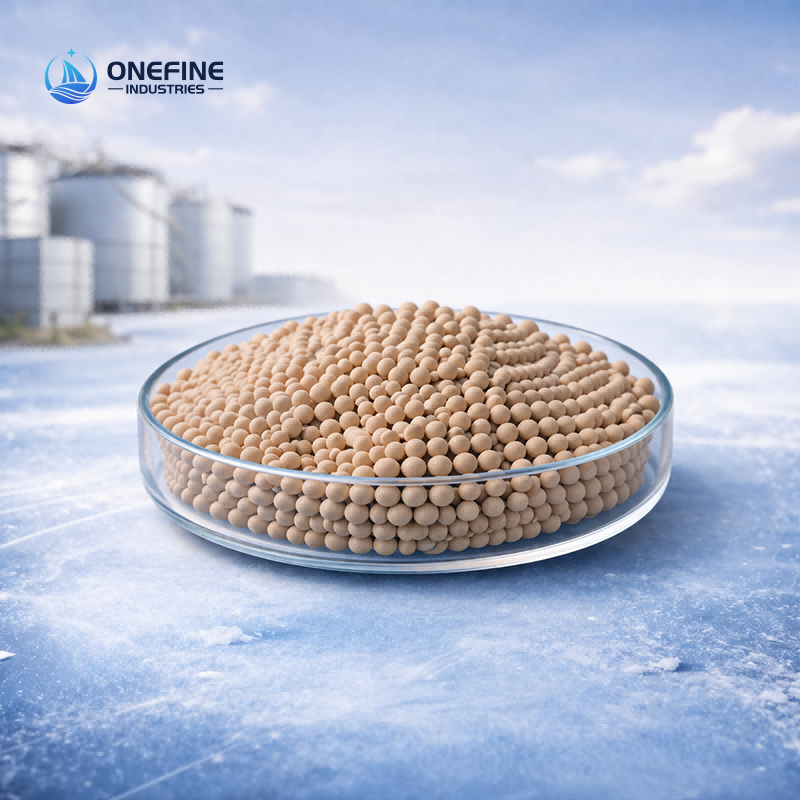
5A Molecular Sieve (Calcium Type)
Calcium-exchanged 5A molecular sieve for PSA oxygen enrichment, natural gas sweetening, n-isoparaffin separation, and simultaneous desulfurization & decarbonization. Bulk supply with MOQ from 1 ton, serving industrial buyers across the Middle East.
Related Applications
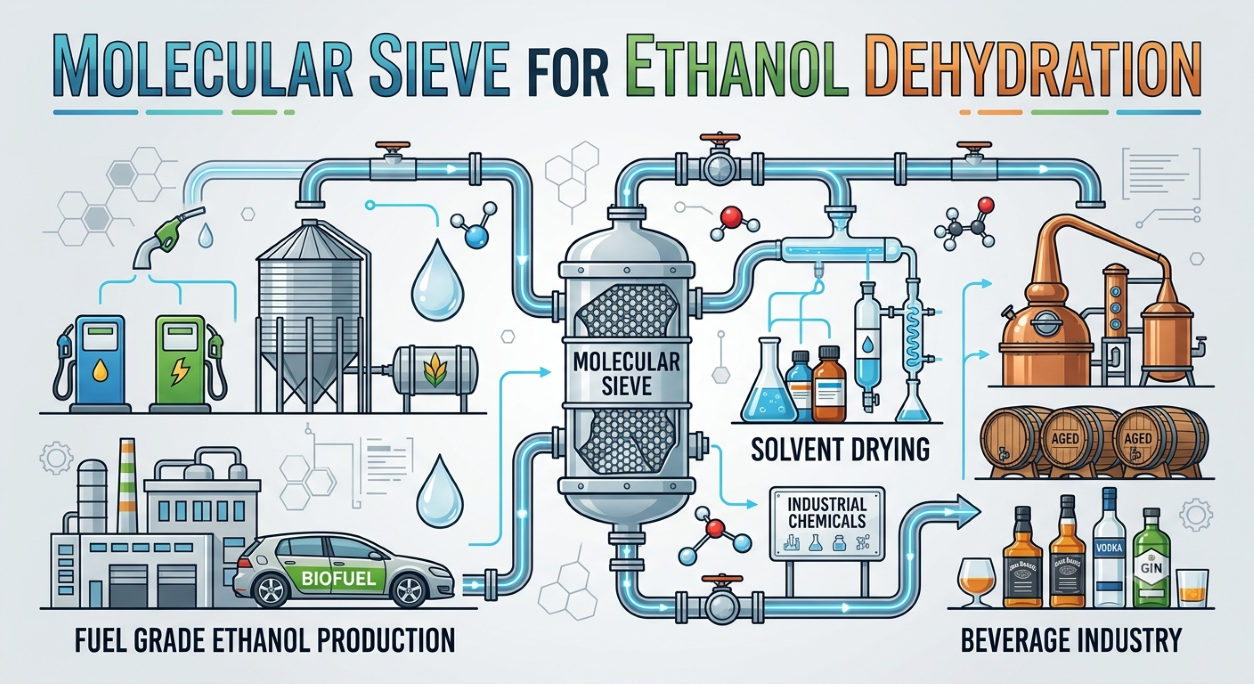
Molecular Sieve for Ethanol Dehydration: Applications in Fuel Grade Ethanol Production, Solvent Drying, and Beverage Industry
Ethanol dehydration relies on 3A molecular sieve to break the water-ethanol azeotrope and reach anhydrous purity that distillation alone can't achieve. This case covers four core applications — fuel-grade ethanol (TSA dual-bed systems), pharmaceutical solvent drying, beverage industry moisture control, and bioethanol upgrading — along with the specifications, documentation, and supply details needed for each.
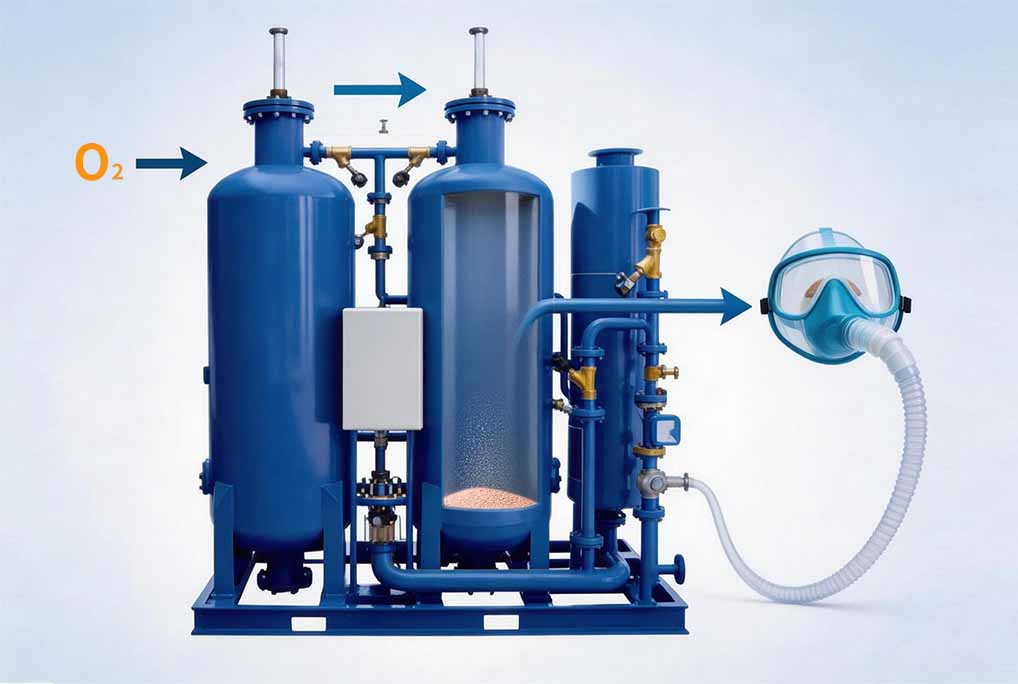
Molecular Sieve for Oxygen Generation: Applications in PSA Oxygen Plants, Oxygen Concentrators, and Industrial Air Separation
Molecular sieve enables oxygen production across industrial PSA plants, compact concentrators, and cryogenic air separation pre-purification. This case covers three distinct application roles and the sieve types suited to each.
Related Reading
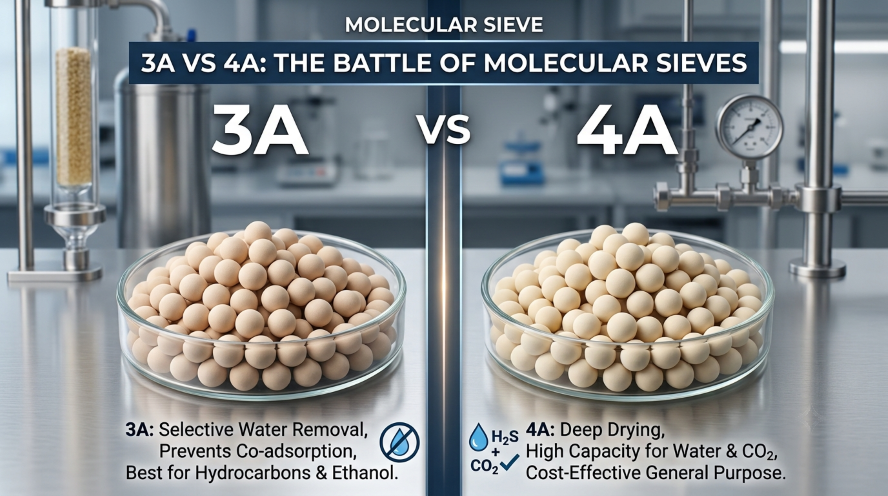
3A vs 4A Molecular Sieve: Key Differences & How to Choose
In-depth guide comparing 3A and 4A molecular sieves. Covers pore size differences, adsorption selectivity, capacity comparison, application scenarios for each type, and practical guidance on selecting the right molecular sieve for your industrial drying or gas separation needs.
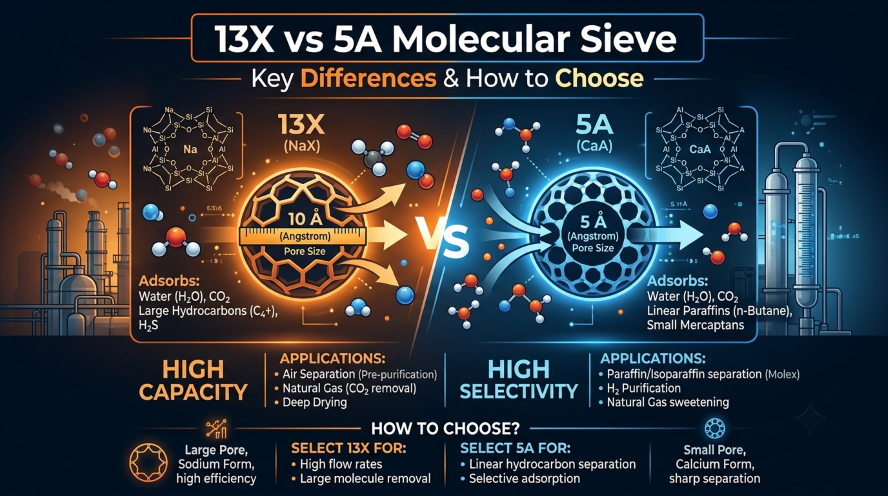
13X vs 5A Molecular Sieve: Key Differences & How to Choose
13X and 5A molecular sieve look similar on paper, but they're built for very different jobs. This guide breaks down the real differences — pore size, selectivity, and application — so you can pick the right one for your system.
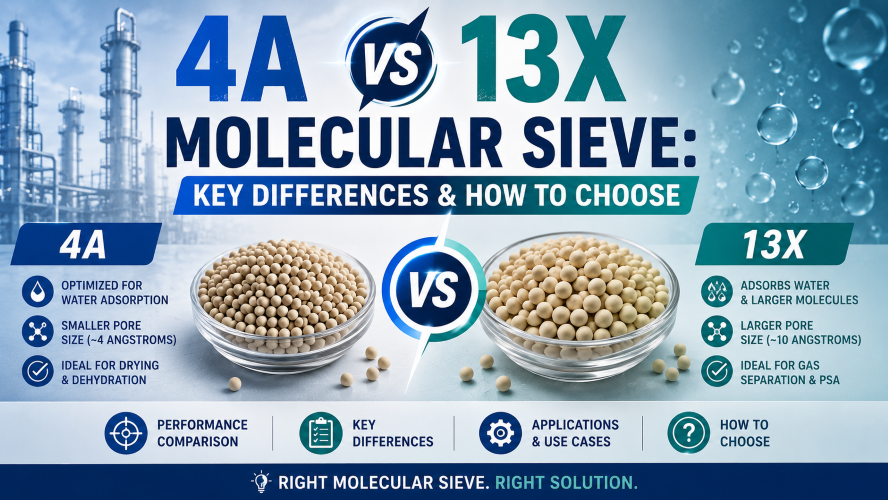
4A vs 13X Molecular Sieve: Key Differences & How to Choose
4A and 13X are two of the most widely used molecular sieve types, but they're built for different jobs. This guide breaks down the pore size, capacity, and application differences to help you choose correctly.