How Do You Know When to Replace a Ni-Mo or Ni-Mo-W Hydrogenation Catalyst?
Key Takeaways
- Hitting the reactor's metallurgical temperature ceiling without restoring product specifications indicates the catalyst has exhausted its reserve hydrogenation activity.
- Sulfur or nitrogen levels creeping above target despite thermal compensation signals that active site loss has fundamentally outpaced temperature adjustments.
- A steadily climbing pressure drop caused by heavy feed polymerization and coking often forces a premature shutdown before temperature limits are even reached.
- Successive cycles ending with shrinking run lengths confirm a permanent decline in baseline stability rather than just temporary operational variation.
Ni-Mo and Ni-Mo-W hydrogenation catalysts rarely fail all at once. Activity declines gradually as the active phase loses hydrogenating power cycle after cycle, and the hard part for most plant engineers is not spotting decline — it's knowing when ordinary decline has crossed into "this bed needs to come out." Because Ni-Mo and Ni-Mo-W share the same core deactivation pathways (the tungsten in Ni-Mo-W mainly buys extra reserve activity for harder feeds, not a different failure mode), the warning signs worth tracking are largely the same across both. Here's what actually tells you it's time.
Temperature Creep Has Hit Its Practical Ceiling
Early in a run, a modest bump in reactor inlet temperature restores lost conversion with little penalty. As the bed ages, you need larger and larger temperature increases to hold the same hydrodesulfurization or hydrodenitrogenation performance — and every reactor has a practical ceiling set by metallurgy, hydrogen partial pressure, and safe operating margins. Once you're pushing close to that ceiling just to maintain spec, you've burned through the catalyst's reserve activity and you're operating on borrowed time, not stable performance.
Product Spec Starts Slipping Even With Temperature Adjusted
If sulfur or nitrogen in the treated product begins creeping above target even after you've already raised bed temperature to compensate, that's a stronger signal than temperature creep alone. It usually means active site loss has outpaced what thermal compensation can offset — a sign the catalyst is approaching the end of its useful hydrogenation capacity rather than simply needing a routine temperature adjustment.
Pressure Drop Across the Bed Keeps Climbing
Heavy and olefinic feed components can polymerize and deposit as coke on the catalyst surface over a run, gradually fouling the bed and restricting flow. A steadily rising pressure drop — beyond what feed rate changes explain — points to physical fouling building up alongside chemical deactivation, and is often the limiting factor that forces a shutdown even before temperature or spec limits are reached.
Run Length Between Turnarounds Keeps Shrinking
Comparing cycle length run over run is one of the clearest trend indicators available. If each successive cycle is ending sooner than the last — even with similar feed quality and operating conditions — it usually reflects a real decline in the catalyst's baseline activity or stability, not just operational variation, and is worth tracking alongside temperature and spec data rather than in isolation.
What You See When the Bed Is Unloaded
Physical inspection at turnaround tells its own story: visible carbon/coke deposits, color changes in the catalyst extrudates, loss of mechanical strength or excessive attrition/fines, and — particularly with feeds carrying trace metals — a hardened metal-contaminant shell forming on the outer surface of the pellets. These are permanent, irreversible changes that confirm a replacement decision rather than a regeneration decision.
Ni-Mo and Ni-Mo-W tend to show these same signs on a similar timeline, since the underlying chemistry is closely related — see our guides on Ni-Mo catalyst chemistry and Ni-Mo-W catalyst chemistry for the active-phase background. Where the two can diverge is in how much margin you have before hitting the ceiling in the first place — Ni-Mo-W's added hydrogenation activity is typically applied to harder feeds or deeper HDS/HDN targets, which changes the operating envelope more than it changes the failure pattern itself.
Recommended Products from Sorbsieve
Sorbsieve supplies both Ni-Mo Hydrogenation Catalyst and Ni-Mo-W Hydrogenation Catalyst in bulk for Middle East refiners and petrochemical processors. If you're weighing which one fits your feedstock and target spec, our hydrogenation catalyst selection guide breaks down the logic in more depth.
FAQ
Can a Ni-Mo or Ni-Mo-W catalyst be regenerated instead of replaced?
In many cases, moderate deactivation from coking can be addressed with an off-site or in-situ regeneration cycle, restoring a meaningful portion of activity. But regeneration has diminishing returns over multiple cycles, and once deactivation includes permanent metal poisoning or sintering, regeneration no longer recovers the lost performance — replacement becomes the only option.
How long does a Ni-Mo or Ni-Mo-W hydrogenation catalyst typically run before replacement?
Run length depends heavily on feedstock severity, metals content, operating pressure, and target product spec, so there's no single number that applies across applications. Tracking the trends above over your specific operating history is a more reliable guide than a generic benchmark.
Does Ni-Mo-W last longer than Ni-Mo?
Not necessarily in absolute terms — it depends on what each is being asked to do. Ni-Mo-W is typically selected for harder feeds or deeper desulfurization/denitrogenation targets precisely because it has more reserve activity to spend on those duties, so a direct run-length comparison only makes sense when both are treating the same feed to the same spec.
What happens if a deactivated catalyst isn't replaced in time?
Beyond off-spec product, pushing a severely deactivated bed can mean operating close to or past the reactor's safe temperature ceiling, increased hydrogen consumption for the conversion achieved, and a higher risk of a harder, more disruptive shutdown later instead of a planned turnaround now.
Looking for Bulk Supply of Ni-Mo and Ni-Mo-W Hydrogenation Catalysts?
Sorbsieve is a trusted bulk supplier of Ni-Mo and Ni-Mo-W hydrogenation catalysts and complete industrial adsorbents, serving industrial buyers across the Middle East.
We provide:
- ✅ Container-level supply (20'GP / 40'GP / 40'HQ)
- ✅ Full documentation (COA / TDS / SDS / COO)
- ✅ Multiple packaging options
- ✅ Technical support for hydrogenation catalyst selection and system optimization
- ✅ Fast quote response for industrial inquiries
Contact our team for bulk pricing, product samples, and technical consultation.
Related Products
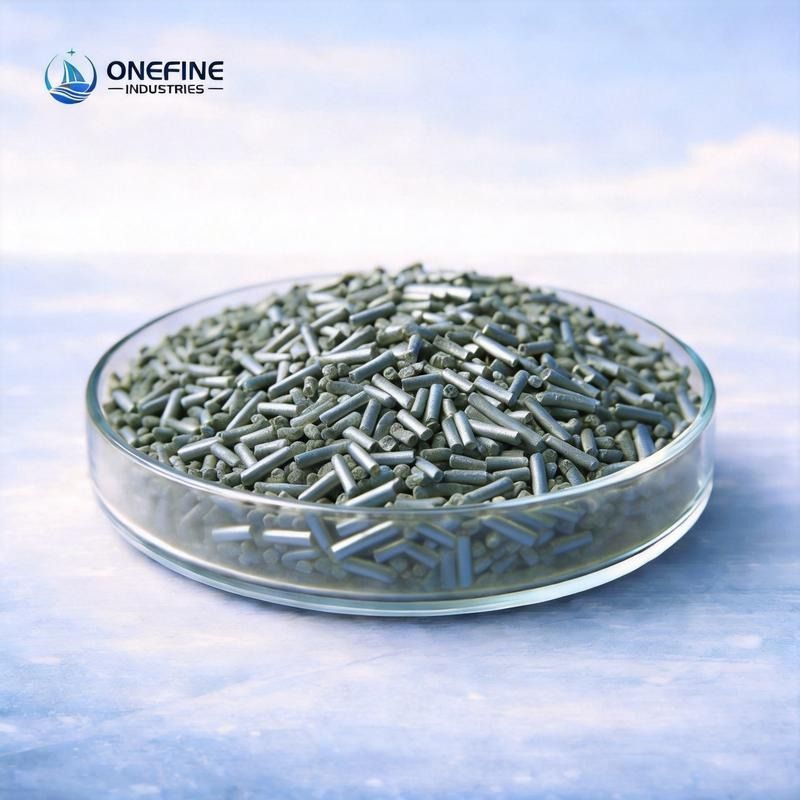
Ni-Mo Hydrogenation Catalyst
A high-performance nickel-molybdenum (Ni-Mo) hydrogenation catalyst designed for hydrodesulfurization (HDS) and hydrodenitrogenation (HDN) of medium to heavy petroleum fractions. Features superior hydrogenation activity, excellent stability, and long service life. Widely used in diesel hydrotreating, gas oil upgrading, and refractory sulfur removal. MOQ from 1 ton. Customizable appearance, particle size, and active component loading.
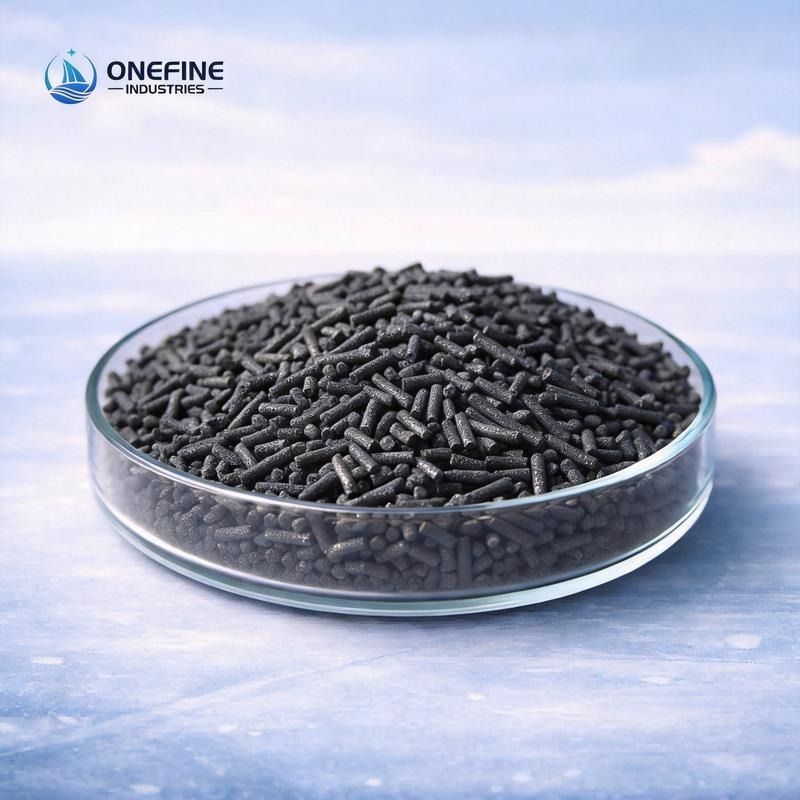
Ni-Mo-W hydrogenation catalyst
A trimetallic nickel-molybdenum-tungsten (Ni-Mo-W) hydrogenation catalyst engineered for ultra-deep hydrodesulfurization of challenging petroleum feeds. Combines the synergistic HDS activity of Mo-W mixed sulfide phases with Ni promoter for superior refractory sulfur removal. Widely used in diesel ULSD production, heavy gas oil upgrading, and severe hydrotreating service. Customizable appearance, particle size, and component loading.
Related Reading
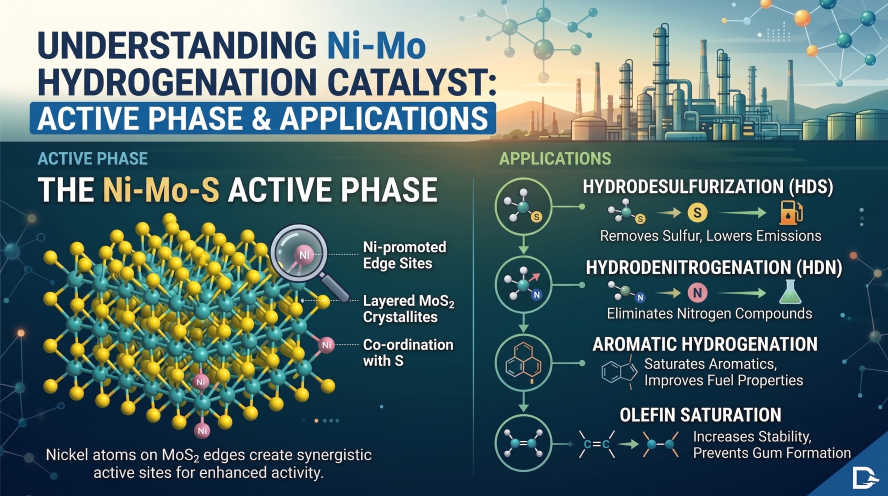
What is a Ni-Mo Hydrogenation Catalyst? Active Phase & Applications Explained
A plain-language guide to Ni-Mo hydrogenation catalysts — how the Ni-Mo-S active phase works, when to choose Ni-Mo over Co-Mo, and where it's used in refinery hydrotreating.
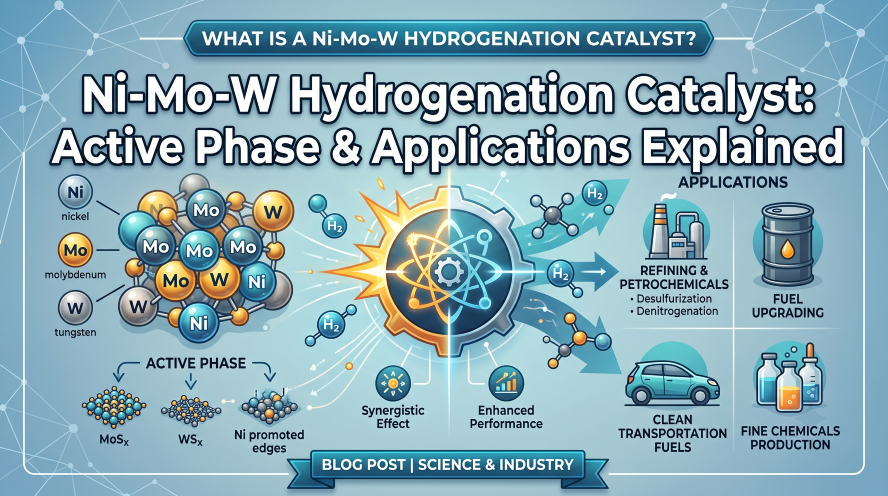
What is a Ni-Mo-W Hydrogenation Catalyst? Active Phase & Applications Explained
A guide to Ni-Mo-W trimetallic hydrogenation catalysts — how the active phase works, when to choose it over Ni-Mo or Co-Mo, and typical refinery applications.
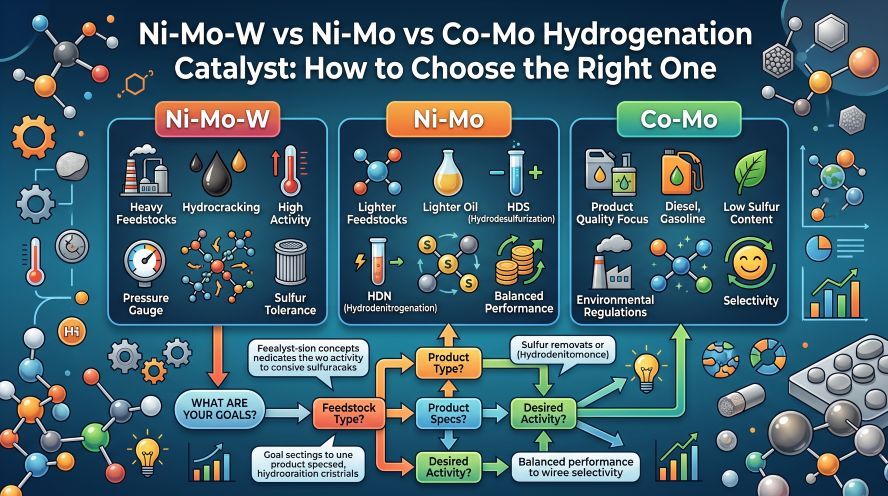
Ni-Mo-W vs Ni-Mo vs Co-Mo Hydrogenation Catalyst: How to Choose the Right One
A buyer's guide to choosing between Co-Mo, Ni-Mo, and Ni-Mo-W hydrogenation catalysts based on feedstock nitrogen content, hydrogen availability, and sulfur removal severity.