COS Hydrolysis Catalyst vs Activated Carbon Fine Desulfurization vs Ultra-Precision Desulfurization Catalyst: How to Choose the Right Deep Desulfurization Solution
Key Takeaways
- Standalone COS hydrolysis acts as a two-step system, requiring a small amount of moisture to convert COS into H₂S for downstream capture.
- Activated carbon fine desulfurization combines H₂S oxidation and COS hydrolysis on one surface, depositing elemental sulfur directly onto the carbon.
- Bifunctional ultra-precision catalysts perform both COS hydrolysis and H₂S adsorption in a single bed, minimizing skid footprint and vessel requirements.
- Activated carbon requires planned thermal regeneration for sulfur loading, whereas hydrolysis-based catalyst lifespans are governed by poisoning and physical degradation.
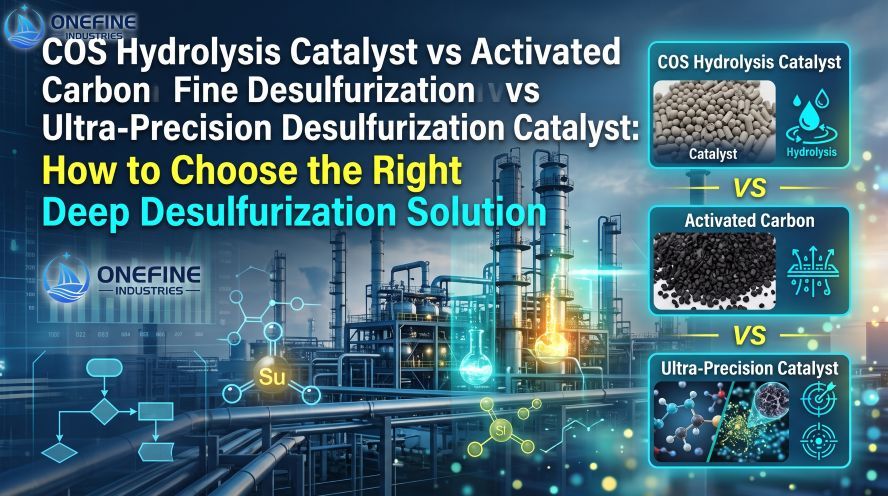
When a process gas still carries sulfur after the main H₂S removal stage, picking the right final-polishing catalyst determines whether downstream equipment — hydrogenation catalysts, molecular sieves, cryogenic units — stays protected for years instead of months. Three technologies compete for this role: a standalone COS hydrolysis catalyst, an activated carbon fine desulfurization catalyst, and a bifunctional ultra-precision desulfurization catalyst. They look similar on a spec sheet but solve the problem differently, and picking the wrong one usually shows up later as unplanned downtime rather than an obvious mistake on day one. This guide walks through the real decision points — reaction pathway, moisture tolerance, bed complexity, and regeneration — so you can match the technology to your gas stream instead of to whichever name sounds most "precise."
What Each Technology Actually Does
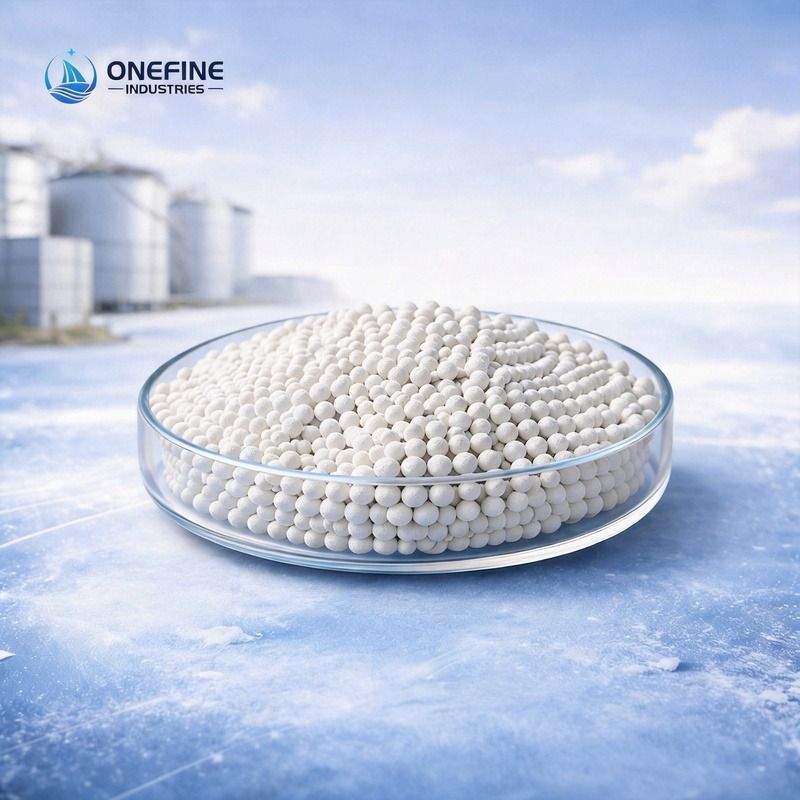
A standalone COS hydrolysis catalyst has one job: convert carbonyl sulfide (COS) into H₂S and CO₂ so the sulfur can then be captured by a separate adsorbent or absorbent downstream. It does not remove sulfur on its own — it converts an otherwise hard-to-remove species into one that conventional desulfurization can handle. For the full reaction chemistry and water-film mechanism, see our COS hydrolysis mechanism guide.
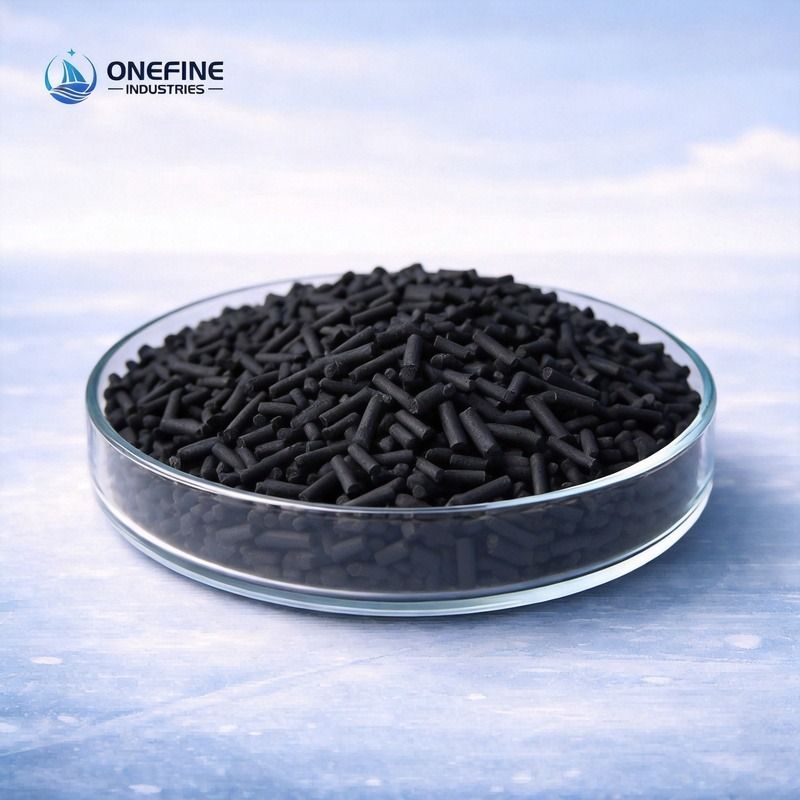
Activated carbon fine desulfurization works through a different route, combining H₂S oxidation with COS hydrolysis on the same carbon surface. Elemental sulfur deposits directly on the carbon, and COS is hydrolyzed in parallel rather than being handed off to a second bed. Our fine desulfurization mechanism guide covers the oxidation and hydrolysis pathways in detail.
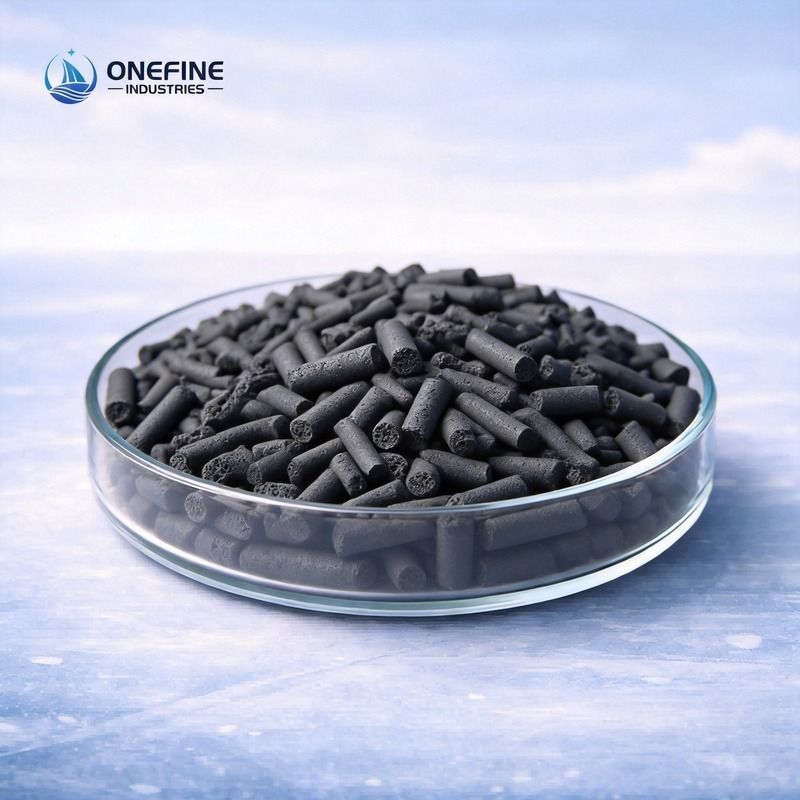
An ultra-precision desulfurization catalyst is bifunctional by design: it hydrolyzes COS and adsorbs the resulting H₂S within the same catalyst bed, collapsing what would otherwise be a two-stage system into one step. See our ultra-precision catalyst explainer for how the dual-function mechanism works.
One-Step vs Two-Step: Does Your System Need Bifunctional Capability?
This is the single biggest fork in the decision. A standalone COS hydrolysis catalyst is a two-step approach by nature — it needs a downstream guard bed (commonly zinc oxide or an amine unit) to actually capture the H₂S it produces. That adds a vessel, more pressure drop, and another component to monitor, but it also lets you size and replace each stage independently, which some plants prefer for maintenance planning.
The ultra-precision catalyst removes that second vessel by doing both jobs in one bed — a real advantage where skid space, capital cost, or piping complexity is the constraint. Activated carbon fine desulfurization sits in between: it handles both H₂S and COS within one material, but through oxidation and sulfur deposition rather than hydrolysis-plus-adsorption, so its capacity is governed by how much elemental sulfur the carbon surface can physically hold before it needs regenerating.
If your plant already has an existing H₂S polishing bed and only needs to add COS conversion ahead of it, a standalone COS hydrolysis catalyst is often the simpler retrofit. If you're designing a new guard-bed system from scratch and want to minimize footprint, the bifunctional ultra-precision option usually wins on simplicity.
Feed Composition and Operating Conditions
These three technologies are not equally forgiving of what's actually in your gas stream:
- Moisture: COS hydrolysis is a water-driven reaction, so a small, controlled amount of moisture is actually necessary for conversion — bone-dry feed can starve the reaction, while excess liquid water can damage the catalyst structure. Confirm your expected moisture range with our technical team before specifying.
- Oxygen availability: activated carbon fine desulfurization depends on oxidizing H₂S to elemental sulfur, so it generally needs a controlled oxygen source in the system — a factor that doesn't apply to the hydrolysis-based options.
- Sulfur species mix: if your gas carries COS alongside H₂S and little else, any of the three can work technically; the choice then comes down to footprint and maintenance philosophy rather than chemistry.
Because feed gas composition varies significantly by source (natural gas, syngas, ammonia synthesis loops, refinery off-gas), we recommend sharing your gas analysis so we can confirm which option fits — this is exactly the kind of judgment call worth a technical consultation rather than a generic answer.
Regeneration, Service Life, and Operating Cost
Activated carbon fine desulfurization accumulates elemental sulfur on the carbon surface as it works, which means the bed has a finite capacity before it needs thermal regeneration or replacement — a real recurring operating step to budget for. COS hydrolysis catalysts and the hydrolysis side of ultra-precision catalysts are not consumed in the same way, since the reaction converts COS rather than depositing solid sulfur on the catalyst itself; service life there is governed more by poisoning and physical degradation over time than by a sulfur-loading limit.
In practice, this means a two-step system (standalone COS hydrolysis plus a separate H₂S guard bed) often separates these cost centers cleanly — you budget for the guard bed's replacement cycle independently. A one-step ultra-precision bed simplifies logistics but ties both functions to a single replacement schedule.
Matching the Catalyst to Your Application
- Ammonia synthesis and syngas guard beds, where skid space is tight and operators want fewer vessels to monitor, typically favor the bifunctional ultra-precision catalyst.
- Natural gas and LPG sweetening trains that already run an oxidative sulfur-recovery step are a natural fit for activated carbon fine desulfurization, since the oxygen-driven chemistry is already part of the process.
- Retrofits adding COS conversion ahead of an existing H₂S removal stage are the classic use case for a standalone COS hydrolysis catalyst — you're adding one function, not redesigning the train.
None of these are hard rules — they're starting points. The right call depends on your specific feed gas, available footprint, and how your team prefers to plan maintenance, so treat this as a shortlist to bring into a conversation with our technical team rather than a final answer.
If your deep desulfurization question involves other catalyst types — zinc oxide, iron oxide, or a two-stage metal-oxide setup — our full desulfurization catalyst guide covers the broader seven-way decision tree these three technologies sit alongside.
Recommended Products from Sorbsieve
- COS Hydrolysis Catalyst — standalone catalyst for converting carbonyl sulfide ahead of a separate H₂S removal stage
- Activated Carbon Fine Desulfurization Catalyst — combined H₂S oxidation and COS hydrolysis on one carbon-based material
- Ultra-Precision Desulfurization Catalyst — bifunctional, one-step COS hydrolysis and H₂S adsorption in a single bed
FAQ
Can these three technologies be used together in the same train? Yes, in some configurations — for example, a standalone COS hydrolysis catalyst feeding into a separate downstream polishing bed is itself a two-product system. Whether combining them makes sense depends on your specific process layout, so it's worth confirming with our technical team rather than assuming.
Which option needs the least day-to-day monitoring? The bifunctional ultra-precision catalyst generally involves fewer vessels and a single replacement schedule, which simplifies monitoring compared to a two-stage setup. Activated carbon fine desulfurization requires tracking sulfur loading toward its regeneration point.
Does switching between these technologies require different vessel design? Often yes — a two-step approach needs two beds in series, while the bifunctional option fits in one. If you're retrofitting an existing system, vessel geometry is one of the first things to check before committing to a technology.
Is one of these three always the "best" choice? No. Each solves the deep desulfurization problem through a different mechanism, and the right fit depends on your feed composition, available footprint, and maintenance preferences — not on which technology sounds most advanced.
Looking for Bulk Supply of Deep Desulfurization Catalysts?
Sorbsieve is a trusted bulk supplier of COS hydrolysis, activated carbon, and ultra-precision desulfurization catalysts, serving industrial buyers across the Middle East.
We provide:
- ✅ Container-level supply (20'GP / 40'GP / 40'HQ)
- ✅ Full documentation (COA / TDS / SDS / COO)
- ✅ Multiple packaging options
- ✅ Technical support for deep desulfurization catalyst selection and system design
- ✅ Fast quote response for industrial inquiries
Contact our team for bulk pricing, product samples, and technical consultation.
Related Products
COS Hydrolysis Catalyst
High-efficiency γ-Al2O3 supported COS hydrolysis catalyst designed to convert carbonyl sulfide into easily removable H2S with ≥95% conversion efficiency across diverse hydrocarbon streams.
Activated Carbon Fine Desulfurization Catalyst
High-capacity activated carbon supported fine desulfurization catalyst designed for simultaneous H2S oxidation and COS hydrolysis in syngas, LPG, and CO2 streams, achieving ≥12 wt% breakthrough sulfur capacity.
Ultra-precision Desulfurization Catalyst
A bifunctional desulfurization catalyst that couples COS hydrolysis and H₂S adsorption in a single reactor, achieving ultra-deep sulfur removal in one step. Effectively removes H₂S, COS, and trace RSH from process gases. Features high surface area, fast reaction kinetics, and broad operating range. Ideal for final purification of synthesis gas, natural gas, and light hydrocarbons.
Related Reading
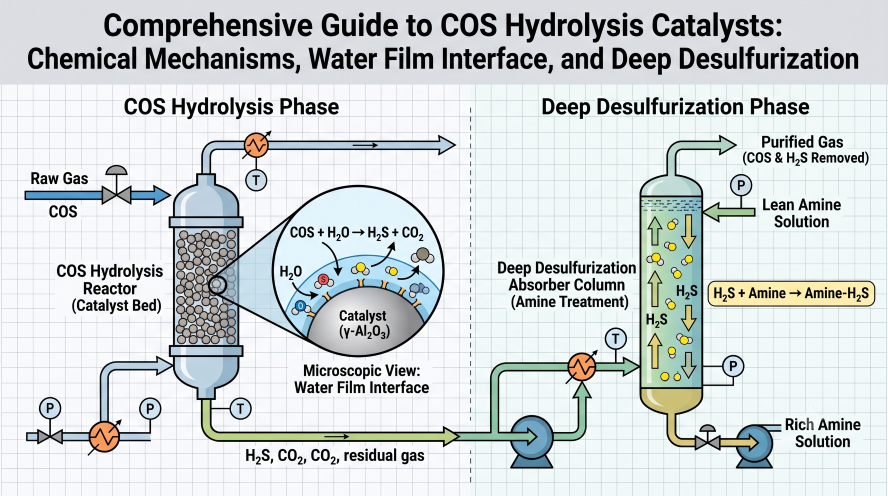
Comprehensive Guide to COS Hydrolysis Catalysts: Chemical Mechanisms, Water Film Interface, and Deep Desulfurization
Carbonyl sulfide (COS) is a highly stable, non-polar contaminant that easily slips past traditional zinc oxide desulfurization beds and amine scrubbing units. This technical guide explains why COS hydrolysis is needed, how the water-film reaction works, and how it fits into a real plant's desulfurization train.
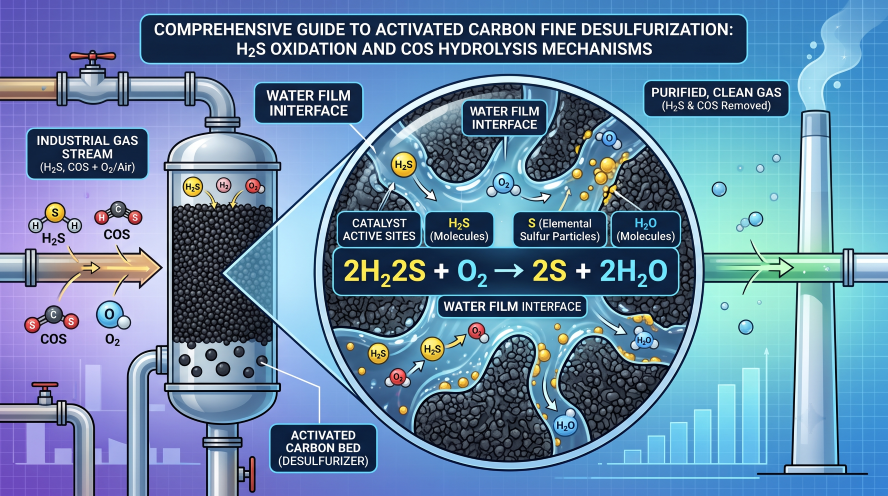
Comprehensive Guide to Activated Carbon Fine Desulfurization: H2S Oxidation and COS Hydrolysis Mechanisms
Explore the dual-mechanism of activated carbon fine desulfurization catalysts. Learn how the micro-water film promotes carbonyl sulfide (COS) hydrolysis and how trace oxygen facilitates catalytic hydrogen sulfide (H2S) oxidation for ultra-deep sulfur removal in syngas and LPG streams.
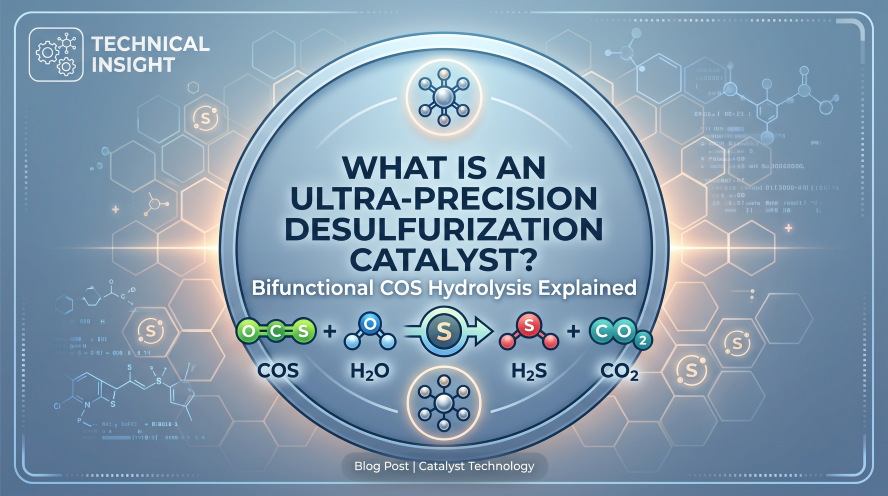
What Is an Ultra-Precision Desulfurization Catalyst? Bifunctional COS Hydrolysis Explained
A plain-language guide to how bifunctional ultra-precision desulfurization catalysts combine COS hydrolysis and H₂S adsorption in one reactor bed — and when this one-step approach makes more sense than conventional two-stage ZnO desulfurization.